Korean Clothing Size Guide 2026 is not just a chart; it is a complex navigation through a different anatomical philosophy. As a Korean man standing 180cm tall and weighing 100kg, I have personally experienced the “Sizing Wall” in my own country. For someone with a larger frame, shopping in Seoul often feels like a ritual of exclusion, forcing me to turn to global platforms like Amazon for direct purchases. However, even then, the fear of a “size mismatch” remains a constant anxiety. Understanding why a Korean 2XL is not a Western 2XL is the first step in mastering the digital and physical wardrobe ritual of 2026.
1. The Paradox of “Free Size”: The One-Size-Fits-Most Myth
The most ubiquitous and frustrating label you will encounter in Korea is Free Size (F). For many international visitors, this term implies a sense of “liberation” or “inclusivity,” as if the garment were designed to magically drape over any silhouette. However, in the pragmatic world of Korean Clothing Size Guide 2026, “Free” actually represents a very specific, narrow boundary.
The “Mass-Market” Identity of Free Size
It is crucial to understand that Free Size is predominantly found in budget-friendly, mass-produced womenswear, particularly in the bustling street markets of Dongdaemun or the “underground” shopping malls of Gangnam and Express Bus Terminal. Because these vendors aim for high-volume sales at low price points, they eliminate the cost of multi-size production. Instead of manufacturing five different sizes, they create one “universal” cut that captures the largest demographic of the local market.
Decoding the Hidden Measurement (The 55-66 Standard)
The “Free” label is not an absence of size, but a hidden commitment to a specific anatomical standard.
- The Reality Check: In 2026, a Free Size garment is almost always patterned after a Korean Size 55 or 66, which translates roughly to a US Size 2 to 6 or a UK Size 6 to 10.
- The Exclusionary Ritual: If your frame exceeds these parameters—whether due to height, shoulder width, or muscle mass—the “Free” ritual becomes a struggle. For those used to Western “One-Size” (which tends to be oversized and flowy), the Korean “Free” will often feel like a “Slim-Fit Small.”
Why It Matters for Your Wardrobe Ritual
Understanding this concept is the first step to avoiding “Buyer’s Regret.”
- Fabric Flexibility: Always check the fabric of a Free Size item. If it’s a non-stretch woven material like linen or stiff cotton, the “Free” claim is a myth. Only high-stretch knits or jersey fabrics truly offer any degree of “freedom.”
- Visual Literacy: If a garment looks “Oversized” on a local mannequin, it will likely fit as a “Standard” or “Regular” fit on a Western frame. If it looks “Regular” on the mannequin, expect a “Tight” fit or a complete mismatch.
By deconstructing the Free Size Mystery, you shift from a confused traveler to a savvy curator of your own style, knowing exactly when to embrace the local cut and when to walk away toward a brand that respects your unique proportions.
2. The Anatomical Gap: Why Your Sleeves and Inseams are Crying
Even when the numbers on the tag seem to align, the actual silhouette often tells a different story. This is where the physical ritual of “Asian Fit” vs. “Global Fit” becomes a literal barrier for larger frames. As someone who stands 180cm tall, I have learned the hard way that a Korean garment isn’t just smaller; it is proportioned for a completely different skeletal architecture.
The “Short-Limb” Bias: The Sleeve and Hemline Ritual
One of the most immediate frustrations for Western shoppers—or larger Koreans like myself—is the chronic lack of length in the limbs.
- The Sleeve Mystery: Statistically, East Asian clothing patterns are designed with a shorter arm-to-torso ratio. This leads Korean designers to cut sleeves 1 to 2 inches shorter than US or UK standards. When I put on a Korean “XL,” the cuff often ends awkwardly above my wrist bone, making it look like I’m wearing a younger sibling’s hand-me-down.
- The Torso Trap: Similarly, the vertical length of shirts is often “Cropped” by default. On a 180cm frame, a standard Korean tee that looks perfect on a mannequin will often sit right at or above the beltline, offering zero “tuck-in” security.
The Inseam Nightmare: The “One-Length-Fits-None” Policy
Perhaps the most significant difference between the Korean Clothing Size Guide 2026 and Western shopping rituals is how we handle denim and trousers.
- The Levi’s Ritual vs. The Korean Standard: In the US or UK, brands like Levi’s offer a “Dual-Axis” sizing system (Waist x Length). You can buy a 34×32 or a 34×34 to match your height. In Korea, this ritual is almost non-existent in local brands.
- The Uniform Inseam: Most Korean pants are produced with a uniform, standardized inseam length designed for the average Korean height (approx. 173-175cm for men). If you are 180cm or taller, you will find that almost every pair of pants becomes an accidental “ankle-grazer” or “cropped” style. While a shorter person can easily hem their pants (a very common ritual in Korea), there is no way to “add” fabric for those of us with longer legs.
The Shoulder and Thigh “Slimming” Filter
Beyond length, there is the issue of breadth.
- The Shoulder Squeeze: Korean patterns prioritize a narrow, “slim” shoulder line to maintain a sleek silhouette. For a 100kg frame with broad shoulders, this creates a restrictive “Tension Ritual” across the back, often leading to ripped seams if you move too suddenly.
- The Thigh Trap: Even if you find the correct waist size (measured in inches), you’ll find that the “thigh-to-waist” ratio is significantly tighter in Korea. What is labeled a “Straight Fit” in Seoul often fits like a “Skinny Fit” on a Western or larger athletic build.
This anatomical mismatch is why the “Amazon Ritual” becomes a necessity for me. When you shop locally in Korea, you aren’t just fighting the numbers; you are fighting a pattern that wasn’t drawn with your proportions in mind.
3. The Numeric Maze: Mastering the Global Conversion Ritual
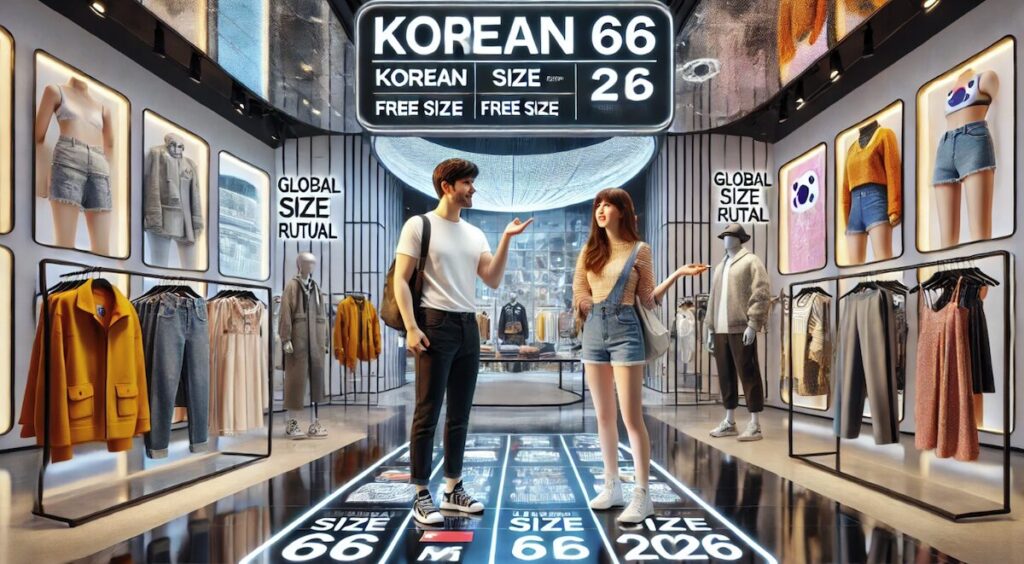
Navigating the Korean Clothing Size Guide 2026 is like decoding a secret language where numbers and units shift depending on who—or what—you are shopping for. For someone like me, who constantly balances between Korean physical stores and Amazon’s global catalog, mastering these specific numeric rituals is the only way to avoid the heartbreak of a “Too Small” delivery.
The Universal Conversion Ritual (Adults & Kids)
In Korea, adult women’s sizes are often expressed in a unique double-digit code (44, 55, 66), while men’s and children’s sizes rely more on centimeters—but even these cm-based labels can be misleading.
| International | US / UK | Korean (Women) | Korean (Men/Unisex) | Korean (Kids – Height) |
| XS | 0 – 2 | 44 (Slim) | 85 – 90 | 100cm (Age 3-4) |
| S | 4 | 55 (Standard) | 95 | 110cm – 120cm |
| M | 6 – 8 | 66 | 100 | 130cm (Age 7-8) |
| L | 10 – 12 | 77 | 105 | 140cm (Age 9-10) |
| XL | 14 – 16 | 88 | 110 | 150cm (Age 11-12) |
| 2XL+ | 18+ | 99+ | 115 – 120+ | 160cm (Junior) |
- The Kids’ Ritual: Unlike the US where sizes are labeled by age (e.g., 5T), Korean children’s clothing is almost always labeled by height in centimeters (110, 120, 130). If your child is taller or more robust than the average Korean child, always jump one full “Height Tier” up (e.g., if they are 120cm, buy 130).
The “Pants Mystery”: Decoding Inches vs. Centimeters
This is where the real confusion starts. In Korea, most pants and jeans are sold using Inches for the waist, mimicking the US system. However, the legal standard for all official labeling in Korea is Centimeters. This dual-unit ritual creates a massive “Translation Gap.”
- The Golden Ratio (1 Inch = 2.54cm): If you see a size labeled “82” on a Korean tag, don’t panic. Simply divide by 2.54.
- Formula: $82cm \div 2.54 \approx 32.2 inches$.
- The Trap: Even if the math says it’s a 32-inch waist, the Korean “32” is often cut much slimmer in the hip and rise compared to an American “32.” As a 100kg man, I’ve found that I must add at least 1-2 inches to my usual Western size to accommodate for the narrower Korean pattern.
The Global Bridge: Brand-Specific Rituals
When shopping at common global brands, the “Size Shift” is a mandatory adjustment. Here is how the 2026 market handles the crossover:
- Uniqlo & MUJI: These brands follow the “Asian Standard.” A US/EU Small is equivalent to a Korean Medium. If you usually wear an L in London, you will need an XL in Seoul.
- ZARA & H&M: These brands often carry “Global Fit” and “Asian Fit” simultaneously. “Asian Fit” items will have shorter sleeves and narrower shoulders. Always check the secondary tag to see if it lists the US/EU equivalent.
- The Amazon Direct Ritual: When I order from Amazon to Korea, I ignore the “L/XL” labels and go strictly by Chest and Waist measurements in inches, then compare them to the detailed “Size Chart” provided by the seller. This is the only way to bridge the 10,000km gap between a US 40-inch chest and a Korean 110.
By understanding this numeric maze, you can finally stop guessing in the dressing room. Whether you are buying a tiny 110cm dress for a child or hunting for a rare 115cm shirt for a 100kg frame, these numbers are your roadmap to a perfect fit.
🏮 Citygram Seoul: Related Rituals in Seoul
- Korean Clothing Size Guide 2026: Why Expats Should Buy Local Seoul Brands Once you master the numeric maze, unlock the secret of local aesthetics. This guide explains how to find the perfect balance between high-quality Korean fabrics and your unique Western frame.
- Korean Shoe Size Guide 2026: Finding 300mm+ Shoes & Big Size Socks The struggle doesn’t end with shirts and pants. Learn the specific rituals of hunting for 300mm+ footwear and durable socks that actually fit a larger foot in the heart of Seoul.
- Cheap SIM Cards in Korea 2026: 7 Rituals to Master the MVNO Life Complete your digital transition while you shop. Master the connectivity ritual that saves you 50% on your bills, ensuring you can always access your size conversion apps on the go.
4. The Safe Havens: Brands That Follow Western Proportions
If you are tired of the “Sleeve Struggle” or the “Thigh Trap,” there are specific brands in Korea that honor larger frames and Western proportions. In Seoul 2026, these are the go-to sanctuaries for anyone who finds the standard “Free Size” or “Asian Fit” too restrictive.
The “Western Size” Standard-Bearers
Some brands maintain a consistent global sizing policy, meaning a “Large” in New York is a “Large” in Seoul.
- Polo Ralph Lauren: This is the gold standard for many larger-framed Koreans and expats. Polo in Korea typically uses the Classic Fit or Custom Slim Fit that matches US measurements. If you wear an L in the US, the L at a Seoul department store will likely fit you perfectly.
- Brooks Brothers: Known for the “American Traditional” cut, their shirts and trousers in Korea are much more generous in the chest and waist than local brands. It is a reliable ritual for those with broader shoulders.
- Levi’s (Global Line): While some local Korean denim brands are tiny, the official Levi’s stores in major malls like IFC or Starfield often carry the Global 501 and 505 cuts. Unlike local brands, you can sometimes find the “Dual-Axis” (W x L) sizing here, especially in flagship locations.
The “True-to-Size” Global Giants
- Costco Korea: For many expats and larger locals (like my 100kg self), the clothing aisle at Costco is a hidden sanctuary. They carry brands like Kirkland Signature, Eddie Bauer, and Adidas in true US sizes. A “Medium” there often feels larger than a Korean “XL.”
- Decathlon: This French sports giant has taken over Seoul. Their sizing follows European standards, which are much more accommodating in limb length and shoulder width than Korean domestic athletic brands.
Korean “Big & Tall” Specialists
In 2026, the local market has finally begun to recognize the “Big & Tall” demographic.
- 4XR: This is the most famous local brand dedicated to larger frames. They don’t just “scale up” small clothes; they design patterns specifically for bigger chests and thicker thighs. They offer sizes up to 4XL (130cm+).
- O-Size (Musinsa): On the massive Korean fashion platform Musinsa, look for the “O-Size” or “Big Size” tags. These items are specifically curated to solve the “short sleeve/tight thigh” mystery we’ve discussed.
The Ritual of the “Global Flagship”
When shopping at ZARA, H&M, or Nike, always head to the Global Flagship Stores (usually in Myeongdong or Gangnam). These massive locations are more likely to stock the “Global Fit” inventory intended for international tourists, whereas smaller neighborhood branches might only stock the “Asian Fit” versions of the same items.
5. Conclusion: The Wisdom of the Dressing Room
Korean Clothing Size Guide 2026 is not an impossible puzzle; it is a ritual of understanding the local silhouette. As someone who has navigated the frustration of being a 180cm, 100kg man in a world of “Free Size,” my ultimate advice is to shift your mindset from “What is my size?” to “What is the pattern?”
Shopping in Seoul requires a blend of digital strategy—using formulas to convert centimeters to inches—and physical intuition. Don’t let a “Too Small” tag discourage your exploration of Korean style. Whether you are hunting for high-end labels in Apgujeong or browsing the hidden gems of Dongdaemun, remember that the most sophisticated fit comes from knowing where the local cut ends and where your unique proportions begin. Use the “Safe Haven” brands when you need reliability, but don’t be afraid to experiment with the local aesthetic now that you have the secret code.