Hongdae R2 busking zone is one of the most searched addresses in Seoul right now — and not for the reasons most travel guides think.
Travelers are not just looking for directions.
They are trying to figure out if the street still exists.
They saw something on Reddit. Or TikTok. Or a friend who visited three months ago said it looked completely different from what they expected. A wall where the performances used to be. Green protest banners instead of dance circles. Activists handing out flyers where K-pop cover groups used to draw crowds of hundreds.
So before you walk out of Hongdae Station Exit 8 expecting the scene from every travel video you’ve ever watched — you need to know what is actually on the ground in 2026.
This is that guide.
Quick Answer: What Is Happening to Hongdae R2 Right Now?
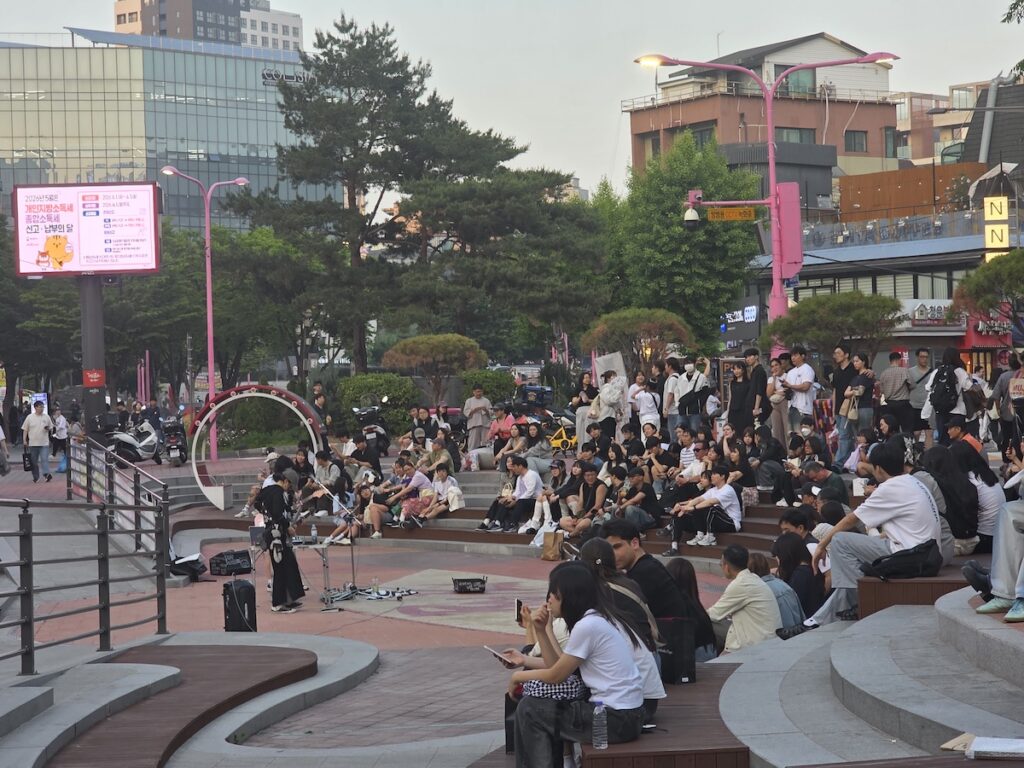
The Hongdae R2 busking zone — the historic heart of Seoul’s street performance culture along the Red Road — is caught in the middle of a major urban development conflict. A new subway line called the Daejang-Hongdae Line is scheduled to terminate directly underneath the R1 and R2 plazas, requiring a 7-meter-high construction barrier to occupy the space for approximately six years, with completion projected for 2031. Local buskers and merchants are actively protesting the station placement. The busking scene has not disappeared — but it has moved. Knowing where to go is the difference between a memorable night and a confusing one.
What Is the Hongdae Red Road — And What Is R2?
Most foreigners arrive in Hongdae with a vague sense of “the busking street near the subway” and no idea that the area has been officially reorganized, renamed, and zoned.
Here is what you need to know.
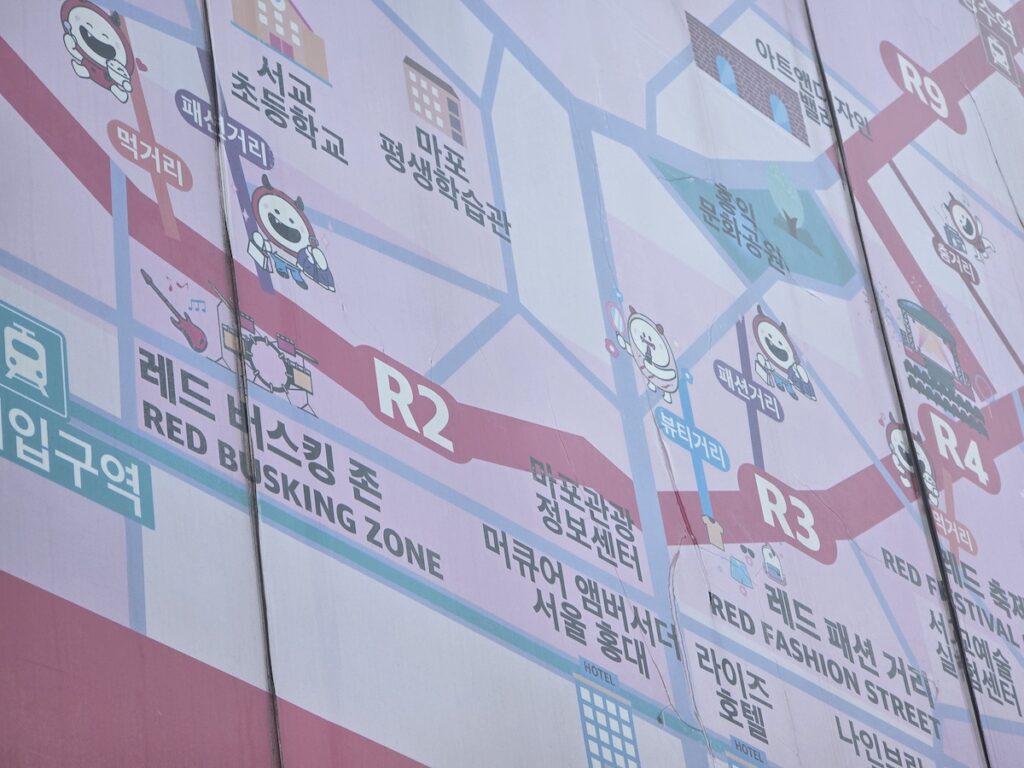
Mapo District Office — the local government authority for this part of Seoul — launched a rebranding and management initiative that unified the long pedestrian corridor stretching from Hongik University Station all the way toward the Han River under a single name: Red Road. The pavement was painted a distinctive red. The street was divided into zones labeled R1 through R6. Each zone was assigned a specific function.
The zones that matter most for travelers:
R1 Zone — Begins immediately at Exit 8 and Exit 9 of Hongik University Station. This is the welcoming entrance to the corridor, home to the main plaza stage and the traveler-facing commercial strip.
R2 Zone — Directly adjacent to R1, moving away from the station. This has historically been the true performance hub: the location of the Mapo Tourist Information Center, the semi-circular step seating built specifically for busking audiences, and the designated Busking Zone where performers rotate through official time slots managed by the city’s online reservation system.
R4 and R5 Zones — Further down the corridor, past the main intersection toward Sangsangmadang. Traditionally home to fashion markets and smaller indie acts. Currently the primary alternative performance destination.
When foreigners type “Hongdae R2 busking zone” into Google, they are searching for the address that Visit Seoul and Google Maps both display as the official location of the main busking area. The name comes directly from this administrative zoning system.
The Subway Construction Issue — What Is Actually Happening
This is the part that most guides are not covering honestly.
In late 2025, groundbreaking began on the Daejang-Hongdae Line — a 20-kilometer metro project connecting Bucheon’s Daejang-dong and Goyang’s Deogeun-dong in Gyeonggi Province with western Seoul. The line is a legitimate infrastructure project, backed by approximately 2.1 trillion won in combined government and private investment. Its completion in 2031 is expected to cut commute times for hundreds of thousands of daily travelers from 50 minutes to 27 minutes.
The problem is where the terminus is going.
The final station — provisionally called Station 111 — is blueprinted to surface directly between the R1 and R2 plazas. The station entrance, exit stairs, and ventilation infrastructure will sit in the open pedestrian space that has functioned as Hongdae’s primary performance area for over a decade.
To excavate safely, the construction consortium must erect a solid security barrier through the center of the street. That barrier is projected to stand 7 meters high and remain in place for roughly six years.
For a street culture built entirely on open sightlines, wide pedestrian flow, and acoustic visibility — a 7-meter wall running down the center of the neighborhood is an existential problem.
The Korea Times reported the situation in December 2025: the area had already been designated a high-density crowd management zone by Mapo District following the Itaewon crowd crush disaster, and the station placement was described as turning the busking zone into a construction site for the duration of the build.
The Protest Movement — What You Will See When You Arrive
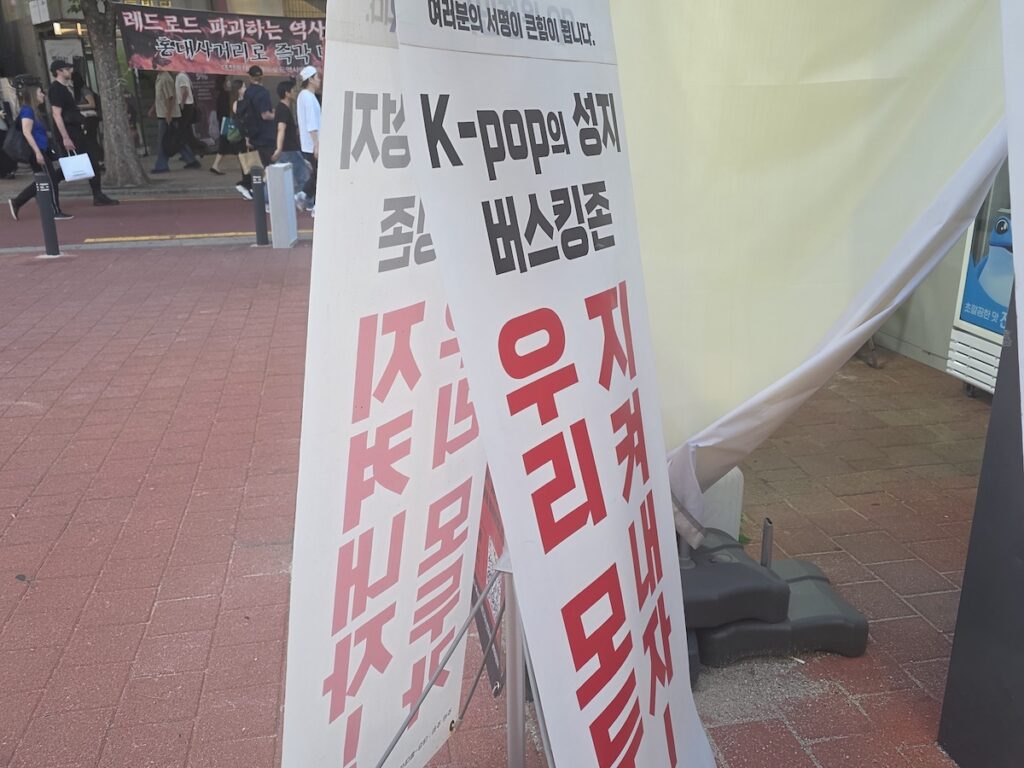
Walking into the R1 and R2 zones today is a different experience from what travel videos show.
The protest is visible and ongoing.
Local merchants — the clothing boutiques, cosmetic shops, independent restaurants, and bars that line both sides of the Red Road — have formed a coalition with the Hongdae Busker’s Union. Together, they are running an active campaign against the current station placement. The street is marked by:
- Green protest tape and banners covered in Korean calligraphy
- Temporary coordination tents set up by activist organizers
- Flyers being distributed to passersby explaining the construction timeline
- Signature-gathering for relocation petitions
The core demand from the protest coalition is not that the subway line be cancelled. It is that Station 111 be relocated — specifically, to the Hongik University Station intersection two blocks southwest, which they argue would preserve the cultural corridor without losing the transit benefit.
Mapo District has acknowledged the dispute and announced a review of technical route alternatives. As of 2026, the outcome remains unresolved.
For travelers, this means the R2 zone currently looks and feels like a neighborhood in active civic conflict — which is itself a more honest and interesting version of Hongdae than most tourists get to see.
Where the Busking Scene Is Actually Happening in 2026
The performers have not left. They have adapted.
Street artists are highly mobile, and the Hongdae scene has fractured into several distinct alternative pockets that are, in some ways, easier to enjoy than the crowded original zones.
R4 and R5 Zones — The New Main Stage
The most immediate migration has been down the Red Road corridor, past the main intersection toward Sangsangmadang — the major cultural complex that anchors the middle section of the street.
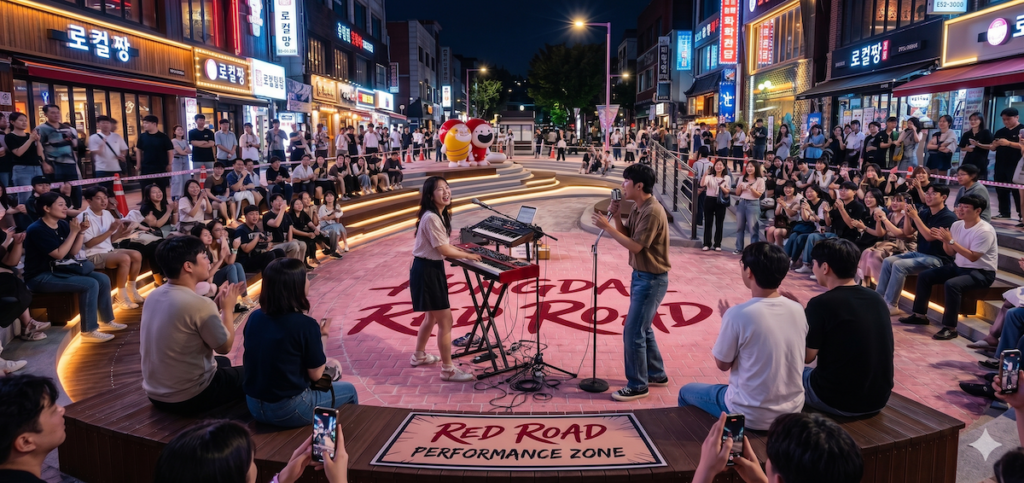
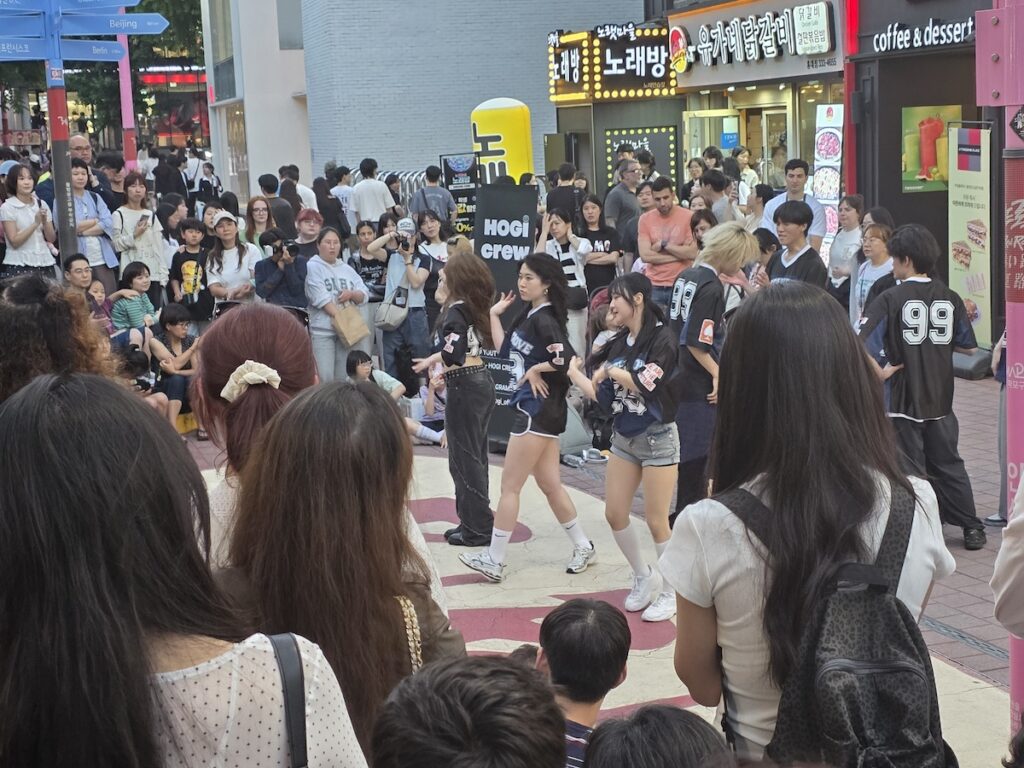
The R4 and R5 zones offer wider sidewalk space with no current construction disruption. High-energy K-pop dance cover crews — the groups that draw the largest tourist crowds — have shifted their primary performance locations here. On weekend evenings, these zones are genuinely packed, and the energy is comparable to what the R2 zone used to offer.
Practical note: amplified performances in these zones end at 10:00 PM under Seoul’s municipal noise regulations. Plan to arrive by 7:30 PM to catch the full evening rotation at peak energy.
Yeonnam-dong — Gyeongui Line Forest Park
For a completely different atmosphere, cross the main road toward Exit 3 of Hongik University Station and walk into the Gyeongui Line Forest Park — a long, narrow park built over old abandoned railroad tracks, known locally as “Yeontral Park.”
No amplifiers are permitted here. The park is surrounded by residential buildings and quiet cafes, and the city enforces this strictly.
What you find instead: acoustic musicians on wooden benches, singers with unplugged guitars playing to audiences sitting on picnic blankets, and the kind of unhurried, local-feeling street music experience that has almost disappeared from the main Red Road. If you came to Hongdae hoping to find something genuine rather than something spectacular, this is where it is.
Zone-by-Zone Breakdown: 2026 Status
| Zone | Location | Current Status | What to Expect |
|---|---|---|---|
| R1 (Exit 8/9) | Station entrance plaza | Protest activity, preliminary disruption | Visible banners and tents; reduced performance space |
| R2 (Adjacent to R1) | Historic busking heart | Most affected zone; construction preparation | Protest tents; fewer performance circles; worth seeing for context |
| R4/R5 (Near Sangsangmadang) | Mid-corridor | Fully open; no barriers | Main dance crews; high energy; crowded weekends |
| Yeonnam-dong Park (Exit 3) | Across the main road | Completely unaffected | Acoustic only; no amplifiers; relaxed local vibe |
Getting to Hongdae R2 in 2026: Exit by Exit
Hongik University Station is one of Seoul’s busiest transit hubs — three separate lines, ten exits, and a neighborhood layout that genuinely confuses first-time visitors even before the construction disruption is factored in.
Knowing which exit leads where saves you twenty minutes of wrong-direction walking.
Exit 8 — The Classic Approach to R1 and R2
This is the exit most travel videos show.
Turn left out of Exit 8 and you are immediately on Eoulmadang-ro, the main Red Road corridor. Within 30 seconds of walking you hit the R1 plaza. Another 60 seconds brings you to the R2 zone — the historic busking heart.
In 2026, this is also where the protest activity is concentrated.
You will see green banners, coordinator tents, and in some sections, preliminary construction barriers. The pedestrian flow is narrower than it used to be. Expect crowds on Friday and Saturday evenings regardless — this area still draws significant foot traffic even during the disruption period.
Best for: Travelers who want to see the current situation firsthand. Understanding the protest context before moving further down the road makes the rest of the evening make more sense.
Walking time to R2: 2 minutes from exit.
Exit 9 — Alternative Entry, Same Destination
Exit 9 brings you out on the opposite side of the station from Exit 8, but curves back around to meet the same Red Road corridor within a few minutes of walking.
Slightly less crowded at the exit point itself, which can matter on peak weekend nights when Exit 8 becomes a bottleneck of people flowing in both directions.
Best for: Travelers arriving during peak hours (8–10 PM Friday/Saturday) who want to enter the corridor with less initial congestion.
Walking time to R2: 4 minutes from exit.
Exit 3 — Direct Route to Yeonnam-dong Forest Park
This exit is on the completely opposite side of the station from the Red Road and takes you toward the Gyeongui Line Forest Park — the acoustic alternative that has become increasingly important in 2026 as the R2 zone loses performance space.
Turn right out of Exit 3. The park entrance appears within 2 minutes of walking. Follow the path into the long, narrow green corridor. Acoustic performers typically set up along the wooden bench sections between the cafe clusters.
In 2026, this exit is genuinely underrated.
Most tourists funnel toward Exit 8 by default. The Exit 3 crowd is noticeably more local — couples, small groups, people who know the neighborhood. The performers here are quieter, more intimate, and playing without amplification. A completely different energy from the main Red Road.
Best for: Travelers who prefer acoustic music, a less crowded atmosphere, or who want to combine busking with a walk through a quieter part of the neighborhood.
Walking time to forest park entrance: 2 minutes from exit.
Exit 1 — Yeonnam-dong Neighborhood (Cafes and Side Streets)
Exit 1 takes you into the residential and cafe-heavy streets of Yeonnam-dong proper — the neighborhood that runs alongside the forest park.
No dedicated busking zones here, but the streets are filled with independent cafes, small live music venues, and the kind of low-key nightlife that locals prefer. If the main Red Road feels too crowded or too disrupted on a given night, Yeonnam-dong through Exit 1 is a reliable alternative for a good evening.
Best for: Travelers who want to explore the neighborhood beyond the busking zones, or who are combining the evening with dinner and cafe time.
Walking time to Yeonnam-dong main street: 3 minutes from exit.
The 2026 Recommended Route — Based on What You Want
| Goal | Exit to Use | Walk to |
|---|---|---|
| See the protest situation + R2 context | Exit 8 | R1 → R2 → continue to R4/R5 |
| Main K-pop dance crews | Exit 8 or 9 | Walk past R2 directly to R4/R5 zone |
| Acoustic / local atmosphere | Exit 3 | Gyeongui Line Forest Park |
| Dinner + neighborhood exploration | Exit 1 | Yeonnam-dong side streets |
| Full evening — everything | Exit 3 first | Forest Park → back through Exit 8 → R4/R5 |
One Route Worth Considering: The Full Loop
If you have a full evening and want to see all of it:
Start at Exit 3. Walk the forest park while it is still daylight or early evening — the acoustic performers are typically out from around 6 PM. The light is better for photos and the crowd is thinner.
Then walk back through the station underpass and come out at Exit 8. Move through R1 and R2 — take in the protest context, understand what the disruption looks like on the ground — then continue down the corridor to R4 and R5 where the amplified performances are running.
By the time you reach R4/R5, it will be around 7:30–8:00 PM. That is exactly when the evening rotation hits its peak energy.
Performances end at 10:00 PM sharp under Seoul noise regulations. Plan accordingly.
Practical Information for 2026 Visitors
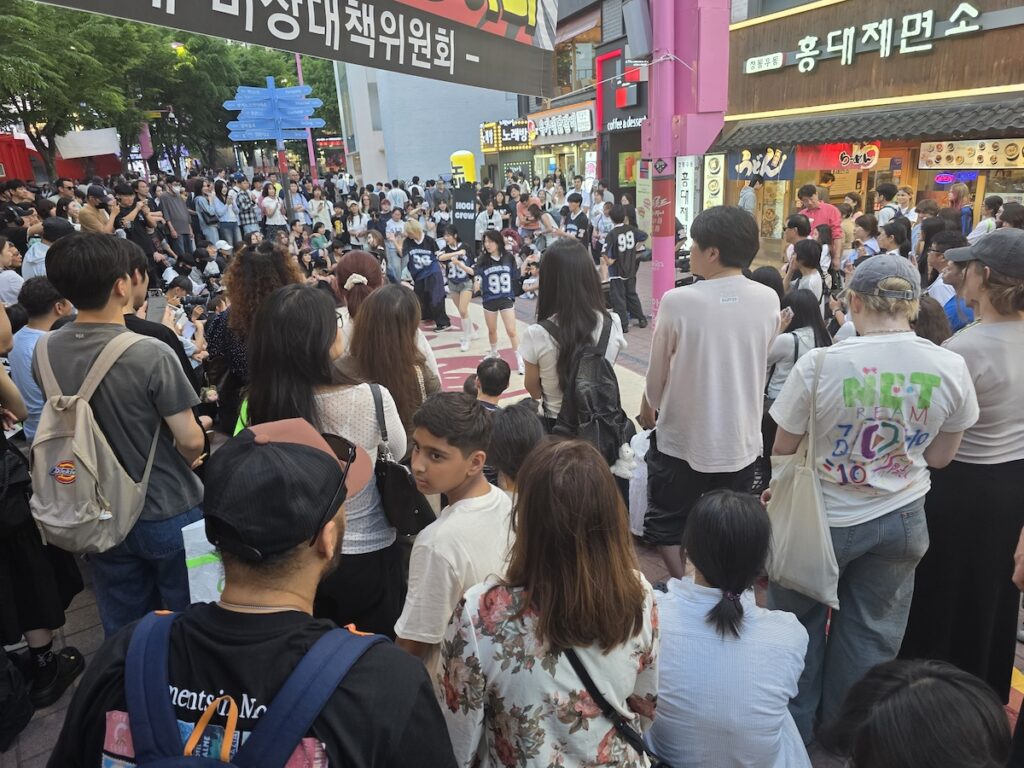
Getting there: Hongik University Station — Line 2, Gyeongui-Jungang Line, or Airport Railroad. Exit 8 or Exit 9 for R1/R2. Exit 3 for Yeonnam-dong Forest Park.
Best time to arrive: 7:30 PM on Friday or Saturday for peak energy in the R4/R5 zones. Performances end at 10:00 PM.
Navigating the protest area: The tents and banners in R2 represent real livelihoods and an ongoing civic dispute. Treat the space with the same awareness you would bring to any active community gathering. Do not use protest signage as a backdrop for social media photos without thinking about what it represents.
Crowd density: Mapo District monitors foot traffic in the Red Road area in real time following the 2022 Itaewon crowd crush. During peak weekend hours, safety wardens with reflective batons manage crowd flow. Follow their directions immediately if asked to step back or clear a path.
Where to eat nearby: The small restaurants and bars lining both sides of the Red Road corridor are owned by the same merchants participating in the protest. Eating and drinking at these establishments is a direct way to support the local community during a difficult period.
Why This Moment in Hongdae Is Worth Seeing
There is a version of this story that is just disappointing — you came for the busking street and found construction barriers instead.
But there is another version.
What is happening in Hongdae’s R2 zone right now is a rare thing: a neighborhood actively fighting to preserve its own identity against the pressure of urban development. The performers, the shop owners, the local government, and the transit planners are all in genuine conflict about what the street should become. That conflict is visible on the pavement, in the banners, in the protest tents.
Most tourists never see a city working through something real. They see the version that has already been resolved, packaged, and marked on a map.
In Hongdae in 2026, you can see the working version.
The music is still there. You just have to walk a little further down the road to find it.
The Bottom Line for 2026 Visitors
Hongdae R2 is not gone.
But it is not what it was two years ago either.
The construction is real. The protest is real. The six-year timeline is real. Travelers who arrive expecting the wide-open performance circles from older travel videos will find something different on the ground — and they deserve to know that before they get there.
What is also real: the music found another way through.
R4 and R5 are running. The forest park is alive. The buskers adapted before the construction barriers even went up — because that is what street artists do. The scene did not wait for permission to continue.
For travelers, the honest advice is simple.
Go. Just go informed.
Walk through R2 and understand what the protest is about. Then keep walking down the Red Road toward R4 and R5 where the performances are. End the night in Yeonnam-dong if you want something quieter.
The Hongdae that exists in 2026 is messier and more complicated than the one in the guidebooks. It is also, in some ways, more worth seeing — because you are watching a neighborhood decide what it wants to be, in real time, on the street.
That does not happen often.