The Korea Banking: NH Bank vs Local Nonghyup paradox is a ritual of identity that every expatriate and digital nomad must eventually decode to survive beyond the neon borders of Seoul. On my recent emergency dash to Mokpo—a 400km journey fueled by the “Refresh Ritual” of a KTX standing ticket—I stepped off the train and was immediately confronted by a financial maze that even the most advanced AI often misinterprets. Standing before a green signboard that read “Mokpo Nonghyup,” I realized that for a global citizen, this isn’t just a building; it is a separate legal dimension of the Korean economy.
As someone who bridges the gap between the analog era of local cooperatives and the hyper-digital 2026 AML (Anti-Money Laundering) protocols, I saw more than just a bank; I saw the “Shared Breath” of rural finance. In this guide, we perform a deep-tissue dissection of the Korea Banking: NH Bank vs Local Nonghyup divide. We will explore why your international card might fail at a “Chukhyup” terminal, the 300% complexity increase in the ARC Mandate, and the tactical secrets of the 1st-tier vs. 2nd-tier hierarchy that no travel wiki will tell you. This is not a travel tip; it is a financial survival protocol for those seeking the true pulse of the peninsula.

1. The Mokpo Emergency: Why I Decoded the Nonghyup Maze
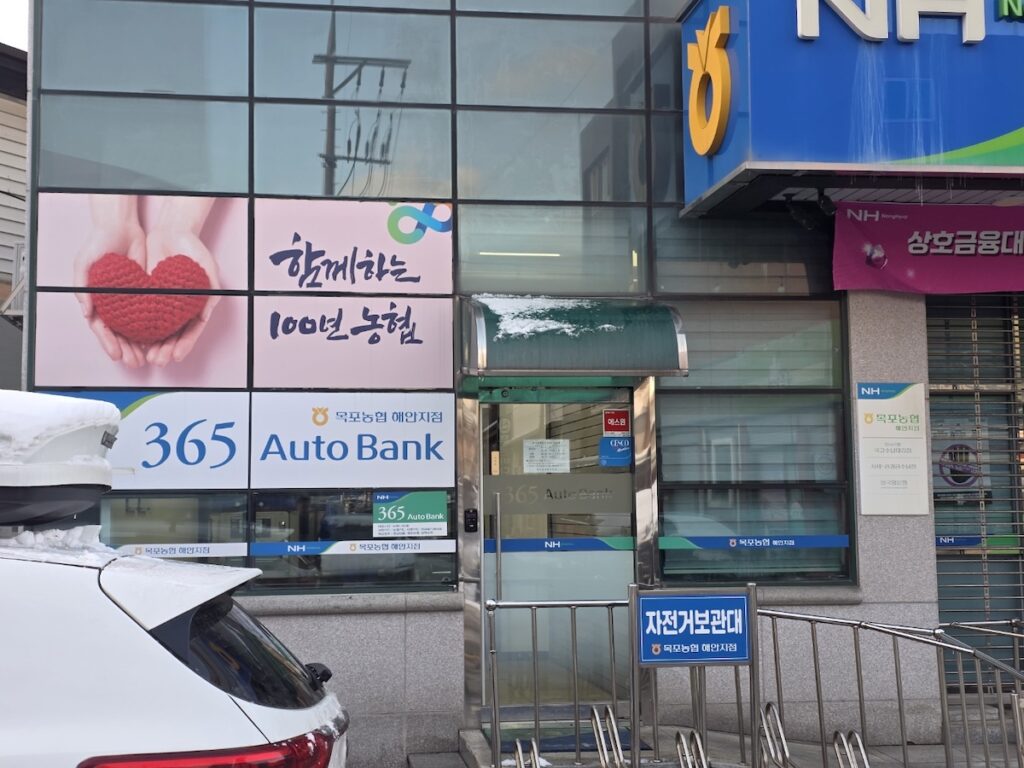
My 400km dash to Mokpo wasn’t just about a KTX standing ticket; it was a head-on collision with the complex infrastructure of South Korea’s rural economy. Standing in front of Mokpo Nonghyup, I realized that for a foreigner, this isn’t just a bank—it’s a cryptic financial institution that bridges the gap between the state and the soil.
2. The Legal Distinction: 1st Tier Bank vs. 2nd Tier Cooperative
To understand Korea Banking: NH Bank vs Local Nonghyup, one must look at the legal and scientific structures of these entities.
- NH Nonghyup Bank (The Central Giant): This is a 1st-tier commercial bank, part of the NH Financial Group. It operates under the same national regulations as global players like Woori or Hana.
- Local Nonghyup (The Community Shield): Entities like Mokpo Nonghyup are separate legal corporations owned by local farmers. They are 2nd-tier “Mutual Finance” institutions.
- The System Paradox: Even though they share the “NH” logo, their IT systems are decoupled. A transaction ritual started at a Local Nonghyup cannot always be finalized at a Central NH Bank.
3. The Economic Guardians: Nonghyup, Chukhyup, and Shinhyup
In the provinces, these organizations are the oxygen of the economy.
- Nonghyup: Controls the agricultural supply chain and credit rituals.
- Chukhyup: A specialized arm of the Nonghyup system, safeguarding the livestock and Hanwoo (Korean beef) industries.
- Shinhyup: A community-driven credit union focused on local micro-finance, often offering higher interest rates to compensate for its 2nd-tier status.
4. The Foreigner’s Compliance: A Survival Protocol for Expats and Nomads
For the global citizen navigating the 400km stretch between Seoul and Mokpo, the Korea Banking: NH Bank vs Local Nonghyup distinction is not a trivia point—it is the difference between financial liquidity and being stranded without a single Won. In 2026, the ritual of “proving your existence” to a Korean bank has reached a cinematic level of complexity.
4.1 The ATM Lottery: Global vs. Local Infrastructure
Not all green machines are created equal. If you are holding a Chase, HSBC, or Revolut card, you are participating in a high-stakes lottery every time you approach a terminal in the countryside.
- NH Nonghyup Bank (The Global Gatekeeper): These branches are equipped with “Global ATMs” that support the international ritual of Visa, Mastercard, and UnionPay. They are linked to the central 1st-tier server, ensuring your transaction breathes the same air as the global financial market.
- Local Nonghyup (The Corridor of Rejection): Walking into a Mokpo Nonghyup or a rural “Chukhyup,” you will find ATMs designed strictly for the local cooperative’s ecosystem. These machines often lack the internal firmware to communicate with foreign banks, leading to the dreaded “Transaction Declined” message despite having a healthy balance.
- Tactical Advice: Always carry a secondary 1st-tier card (Hana or Shinhan) or ensure you have withdrawn sufficient cash at an NH Nonghyup Bank before entering deep rural zones.
4.2 The 2026 ARC Mandate: The Death of the Passport Ritual
The days of opening a “Tourist Account” with just a passport and a smile are dead. Under the 2026 Anti-Money Laundering (AML) and Know Your Customer (KYC) protocols, the Alien Registration Card (ARC) is the only “Golden Key” to the Korean banking kingdom.
- The ARC Hierarchy: Without an ARC, you are invisible to the system. You cannot verify your identity via a Korean SIM card—a ritual known as Bon-in-in-jeung—which is the oxygen of all digital banking in Korea.
- The Proof of Residence: Even with an ARC, a Local Nonghyup may demand a “Certificate of Entry & Exit” or a formal lease agreement to prove your connection to that specific district. They are protecting their cooperative’s assets, and they take this ritual seriously.
- Employment Verification: For those seeking more than a basic savings account, you must present a “Certificate of Employment” (Jaechik-jeungmyeong-seo). Banks are now legally required to limit daily transfer amounts (often to 300,000 KRW) for “New Accounts” until proof of income is established.
4.3 The Interoperability Crisis: When the Green Logos Fail
This is where the Korea Banking: NH Bank vs Local Nonghyup paradox becomes truly painful for expats.
The Financial Shield Ritual: If the bank fails, your 50 million KRW is safe, but the process of reclaiming it differs. Central NH Bank relies on the government’s KDIC, while the Local Nonghyup relies on a mutual fund. In a crisis, the government-backed ritual is always faster.
The Silo Effect: Imagine opening an account at an NH Bank in Seoul and then trying to resolve a lost card at a Mokpo Nonghyup. Because they are separate legal entities, the teller at the local cooperative may not even be able to pull up your central account details.
The Digital Nomad Trap: If you use a Local Nonghyup for its higher interest rates, be aware that their mobile app (NH All One Bank) might have different functionality or language support compared to the central NH Global Wing.
Related Guides: Mastering the Korean Financial Ritual
If the Korea Banking: NH Bank vs Local Nonghyup divide has reshaped your understanding of rural finance, these cinematic guides will further optimize your capital in the Land of the Morning Calm.
1. Beyond Major Banks: Why I Switched My Savings to Community Banks in Korea (2026)
While NH Nonghyup Bank offers global convenience, the real “Shared Breath” of interest rates is found in local cooperatives. Discover why I moved my primary savings to 2nd-tier community banks like Shinhyup and Local Nonghyup to capture higher yields and unique tax-exempt rituals.
2. 3 Critical Secrets to Access Korean Bank from USA (2026 Guide)
The Korea Banking: NH Bank vs Local Nonghyup protocol doesn’t stop at the border. Learn the three essential digital rituals—including the Bon-in-in-jeung SMS verification—required to manage your Korean assets while breathing the air of the United States.
3. 🏦 Best Banks for Foreigners in Korea (2025 Edition)— A Complete Guide to Opening, Using, and Choosing the Right Bank as an Expat
Before you face the Mokpo Nonghyup challenge, you need a foundation. This master guide breaks down the documentation hierarchy (the ARC Mandate) and helps you choose between the global-facing 1st-tier banks and the community-driven cooperatives.