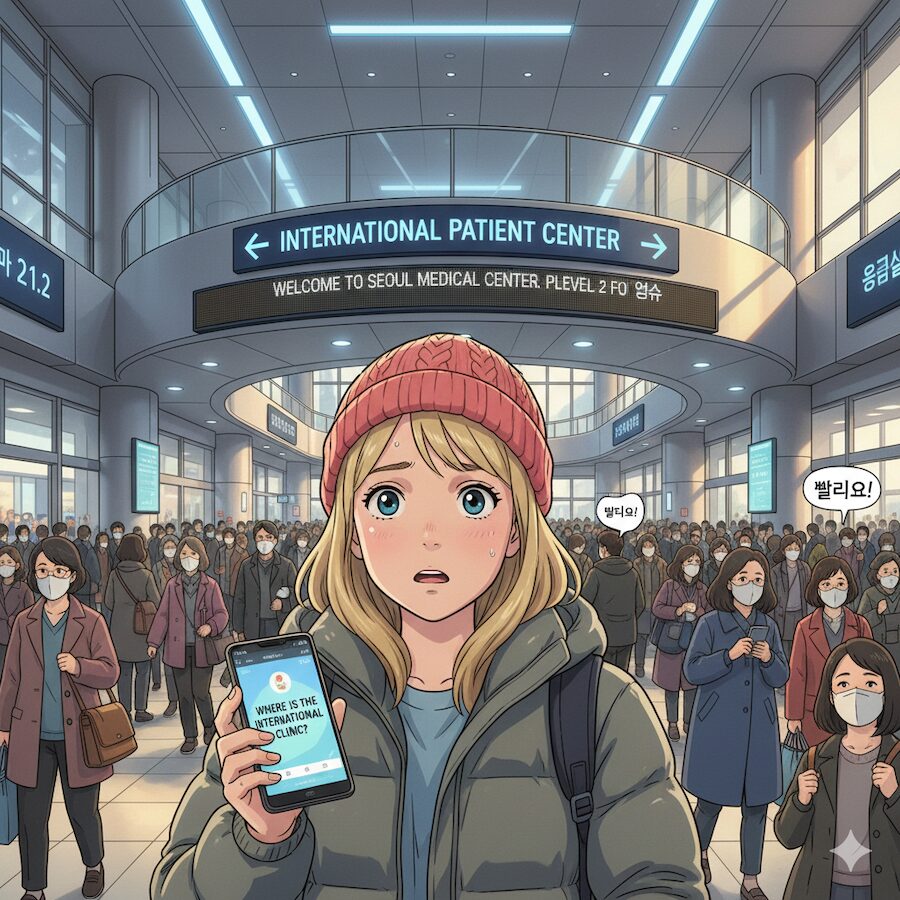
English-speaking hospitals in Seoul are something many foreigners search for only after they already feel sick, stressed, or unsure where to go.
That is the difficult part of medical care while traveling or living abroad. You may understand Seoul’s subway system, know how to pay at convenience stores, and have a list of restaurants saved on your phone. But when your body suddenly feels wrong, the city can become confusing very quickly.
Do you need a local clinic or a big hospital?
Should you go to an emergency room?
Will anyone speak English?
Do you need a passport, Residence Card, or insurance card?
Can a tourist visit a hospital in Korea?
What happens if you need an ambulance?
Korea has a strong healthcare system, many clinics, and major hospitals with international healthcare centers. In Seoul, medical access can be fast compared with many countries. But for foreigners, the hardest part is often not the quality of care. It is choosing the right place at the right level of urgency.
In Korea, “hospital” is not always the first answer.
Sometimes you need a neighborhood clinic. Sometimes you need a specialist clinic. Sometimes a pharmacy is enough. Sometimes you need an emergency room. And sometimes you should call 119 immediately.
This guide is meant to help foreign travelers, expats, students, and short-term visitors understand how to think through medical care in Seoul before panic takes over.
Quick Answer: Where Should Foreigners Go for Medical Help in Seoul?
Foreigners in Seoul can visit local clinics, specialist clinics, larger hospitals, international clinics, emergency rooms, or pharmacies depending on the situation. For mild symptoms such as a cold, stomach pain, skin rash, minor infection, or simple pain, a local clinic may be faster and cheaper than a major hospital.
For serious symptoms, injuries, chest pain, breathing problems, severe allergic reactions, fainting, or emergencies, call 119 or go to an emergency room. If language support is important, look for English-speaking hospitals in Seoul with international healthcare centers, or ask your hotel, insurance company, embassy resources, or the 1330 Korea Travel Hotline for help. VisitKorea lists 119 for medical emergencies and 1330 for travel assistance and interpretation support.

The First Question: Clinic, Hospital, ER, or Pharmacy?
One of the most common mistakes foreigners make in Seoul is assuming that every medical problem requires a large hospital.
In Korea, many everyday health issues are handled at local clinics. These clinics may be small, fast, and focused on specific areas such as internal medicine, ENT, dermatology, orthopedics, ophthalmology, pediatrics, or women’s health.
A local clinic may be enough for a cold, sore throat, stomach discomfort, mild skin issue, eye irritation, minor muscle pain, or simple prescription need. In many cases, going to a large hospital for a mild issue can be slower, more expensive, and more complicated.
But there are also situations where a larger hospital or emergency room is the right choice.
| Situation | Better first option in Seoul |
|---|---|
| Cold, fever, sore throat, mild stomach pain | Local internal medicine clinic |
| Ear, nose, throat symptoms | ENT clinic |
| Skin rash, acne flare, allergic skin reaction | Dermatology clinic |
| Eye pain, infection, vision concern | Eye clinic or hospital ophthalmology |
| Sprain, back pain, minor joint pain | Orthopedic clinic |
| Mild symptoms and basic medicine questions | Pharmacy or local clinic |
| Need English support for non-urgent care | International clinic or English-friendly clinic |
| Severe pain, injury, breathing difficulty, chest pain | Emergency room or call 119 |
| Loss of consciousness, stroke symptoms, major accident | Call 119 immediately |
This distinction matters because Seoul has many layers of medical care. The best choice is not always the biggest hospital. The best choice is the place that matches your symptoms, urgency, language needs, and budget.
When You Really Need an English-Speaking Hospital
You may not need an English-speaking hospital for every small issue.
For example, if you have a mild cold and can use a translation app, a local clinic may be enough. Many doctors in Korea can read basic English medical terms, and simple symptoms can often be explained clearly with short sentences.
But English support becomes much more important when:
- your symptoms are serious or complicated
- you need tests, scans, or follow-up visits
- you have allergies or existing medical conditions
- you take regular medication
- you need surgery or inpatient care
- you are pregnant
- you need psychiatric or specialist care
- you need insurance documents in English
- you are not comfortable making medical decisions through translation apps
This is where major hospitals and international healthcare centers can be useful.
Large Seoul hospitals may have international clinics or international healthcare centers that help foreign patients with appointments, interpretation, billing, documents, and coordination between departments. These services can make the process much easier, especially if your situation is not simple.
The trade-off is that larger hospitals may require appointments, referrals, longer waits, higher costs, or more administrative steps.
Major Hospital Areas Foreigners Often Search For
This article is not ranking hospitals. Medical needs are personal, and hospital quality, availability, language support, and departments can change. Always confirm directly before visiting.
That said, foreigners in Seoul often search for English-speaking care around major university hospitals, international healthcare centers, and expat-heavy areas.
Common search patterns include:
- English-speaking hospital Seoul
- international clinic Seoul
- university hospital international healthcare center
- English doctor Gangnam
- English clinic Itaewon
- hospital near Myeongdong English
- hospital near Hongdae English
- emergency room Seoul foreigners
Large medical areas and institutions that foreigners often look up include major university hospitals and international healthcare centers in Seoul. These may be useful for complex cases, specialist care, English coordination, or insurance documents.
But for mild symptoms, do not automatically assume you need a famous hospital. A nearby clinic may be enough, especially if you need quick care rather than a full specialist evaluation.
How to Find an English-Speaking Hospital or Clinic
Google is useful for English searches, but it may not show every local clinic. Naver Map and KakaoMap often have more local information in Korea, though they can be harder for first-time visitors.
Try searching with combinations such as:
- English-speaking hospital in Seoul
- English clinic Seoul
- international clinic Seoul
- English-speaking doctor Seoul
- hospital for foreigners Seoul
- internal medicine clinic English Seoul
- ENT clinic English Seoul
- dermatologist English Seoul
- emergency room Seoul foreigner
If you are staying at a hotel, ask the front desk. Hotel staff may know nearby clinics, international hospitals, or emergency procedures. They may also help call ahead and ask whether English support is available.
If you have travel insurance, contact your insurer before visiting if your situation is not an immediate emergency. Some insurance companies have preferred hospitals or procedures for reimbursement.
For non-life-threatening travel help, the 1330 Korea Travel Hotline can provide multilingual travel assistance. VisitKorea lists 1330 as available in multiple languages, including Korean, English, Japanese, Chinese, Russian, Vietnamese, Thai, and Indonesian.
What to Ask Before You Go
Before visiting a hospital or clinic, ask direct questions if you can.
You do not need perfect English. You need clear answers.
Ask:
- Do you have English-speaking staff?
- Is an appointment required?
- Do you accept walk-in patients?
- Is this a clinic, hospital, or emergency room?
- What department should I visit?
- What is the approximate consultation fee?
- Are tests charged separately?
- Do you accept foreign credit cards?
- Do you provide English receipts or medical documents?
- Can I use Korean National Health Insurance if I am enrolled?
- If I am a tourist, can I get documents for travel insurance?
For emergency symptoms, do not delay care just to ask every question. But for non-urgent care, these questions can prevent confusion and unexpected costs.
What to Bring to a Hospital or Clinic in Seoul
Bring documents and information that help the clinic understand who you are, what you need, and how you will pay.
Tourists should bring:
- Passport
- Travel insurance details
- Credit card and backup payment
- Hotel address in Korean
- Phone number or contact method
- List of symptoms
- Medication list
- Allergy information
- Any relevant medical documents or photos
Foreign residents should bring:
- Residence Card, if available
- Korean National Health Insurance information, if enrolled
- Korean phone number
- Payment card
- Previous hospital records, if relevant
- Medication list and allergies
If you do not speak Korean, write your symptoms in short English sentences before you arrive. Translation apps work better with simple phrases.
Examples:
“I have had a fever for two days.”
“I have severe stomach pain on the right side.”
“I am allergic to penicillin.”
“I take blood pressure medication.”
“I need a receipt for travel insurance.”
“I need English interpretation if possible.”
In medical settings, short and clear is better than long and emotional.
What Happens at a Korean Clinic or Hospital?
At a local clinic, the process may be fairly simple. You register, wait, see the doctor, possibly receive a prescription, pay, and then take the prescription to a nearby pharmacy.
At larger hospitals, the process can involve more steps: registration, department assignment, consultation, tests, payment, prescription, follow-up appointment, or referral to another department. If you are using an international healthcare center, staff may help coordinate some of this.
For foreigners, the most confusing part can be the separation between hospital treatment and pharmacy medicine.
In Korea, after seeing a doctor, you often receive a prescription and take it to a pharmacy outside or near the clinic. The medicine is usually packaged with instructions. If you are unsure how to take it, ask the pharmacist to explain clearly.
This system can feel efficient, but it moves quickly. Do not leave the clinic or pharmacy until you understand:
- what your diagnosis is
- what medicine you received
- how often to take it
- whether you should avoid alcohol or certain foods
- whether you need follow-up care
- when to return if symptoms worsen
Medical Costs and Insurance in Korea
Medical costs in Korea depend on several factors: clinic type, hospital level, tests, scans, treatment, medication, insurance status, and whether the service is covered or non-covered.
Foreign residents enrolled in Korea’s National Health Insurance generally receive the same coverage structure as Korean citizens. The National Health Insurance Service explains that National Health Insurance for foreigners has the same coverage as it does for Korean citizens, including benefits for preventing, diagnosing, treating, or rehabilitating diseases or injuries.
However, this does not mean every medical service is free or fully covered.
Tourists usually do not have Korean National Health Insurance. They may need to pay first and claim reimbursement later through travel insurance, depending on their policy. Foreign residents may have NHIS coverage, but out-of-pocket costs still depend on the treatment and whether the service is covered.
| Medical situation | Cost note for foreigners |
|---|---|
| Local clinic visit | Usually simpler and often cheaper than large hospitals, but costs vary |
| Large hospital outpatient visit | Can cost more and may require appointment or referral |
| Emergency room visit | Can be significantly more expensive than a regular clinic |
| Blood tests, X-rays, CT, MRI | Costs can rise quickly depending on tests and insurance |
| Prescription medicine | Usually paid separately at a pharmacy |
| Tourist with travel insurance | May need to pay first and claim later |
| Resident with NHIS | Covered services may cost less, but not everything is covered |
| Non-covered treatment | Can be expensive regardless of nationality |
The most important question is not simply, “Am I foreign?”
The better question is:
Is this service covered by Korean National Health Insurance, private insurance, travel insurance, or not covered at all?
Before non-emergency treatment, ask for an estimated cost. For expensive tests or procedures, ask whether the service is covered or non-covered.
Tourists vs Foreign Residents
Tourists and foreign residents have different medical needs in Korea.
Tourists usually need short-term solutions. They may need a doctor for food poisoning, fever, injury, allergic reaction, medication replacement, dental pain, or a sudden illness during travel. The main goal is usually safe short-term care, documentation for insurance, and enough recovery to continue or adjust the trip.
Foreign residents need a more stable medical routine. They may need a regular clinic near home or work, a hospital for specialist care, Korean National Health Insurance, a pharmacy they understand, and a record of ongoing treatment.
For tourists, convenience and English support may matter most.
For residents, long-term trust and system understanding matter more.
If you live in Korea, it is worth learning the difference between clinic types, keeping your insurance status updated, and saving one or two English-friendly medical options before you need them.
When to Call 119 or Go to the Emergency Room
Call 119 or seek emergency care if the situation may be serious.
Examples include:
- chest pain
- trouble breathing
- signs of stroke
- loss of consciousness
- severe allergic reaction
- severe injury or bleeding
- major accident
- high fever with serious symptoms
- severe abdominal pain
- serious head injury
- sudden weakness, confusion, or speech problems
Visit Seoul states that 119 can be dialed from anywhere in Korea, operates 24 hours a day year-round, and can provide emergency medical help. Seoul’s foreign resident information also explains that 119 ambulance service is free of charge and that interpreters are available for foreign nationals who do not speak Korean.
If you ask for an ambulance in English, emergency services may arrange help, but you should still speak clearly and give your location as simply as possible.
Useful phrases:
“I need an ambulance.”
“I am in Seoul.”
“My address is…”
“I am near Exit 3 of…”
“I do not speak Korean well.”
“English, please.”
“My friend is unconscious.”
“I have chest pain.”
“I cannot breathe.”
For emergencies, location matters. Save your hotel address in Korean. If you are outside, look for a subway exit number, building name, store sign, street address, or landmark.
112, 119, 1330, and 1339: Which Number Matters?
Foreigners sometimes confuse emergency numbers in Korea.
Here is the simple version.
| Number | Use for |
|---|---|
| 119 | Fire, ambulance, rescue, medical emergencies |
| 112 | Police, crime, threats, theft, assault |
| 1330 | Korea travel hotline, interpretation and travel help |
| 1339 | Infectious disease-related emergencies and health information |
VisitKorea lists 112 for police, 119 for fire and medical emergencies, 1339 for infectious disease emergencies, and 1330 for travel hotline support.
For a medical emergency, remember 119 first.
For a crime or safety threat, remember 112.
For travel interpretation or non-life-threatening assistance, 1330 can be useful.
Prescriptions and Pharmacies in Korea
Korean pharmacies are important because many hospital or clinic visits end with a prescription.
After seeing a doctor, you may receive a prescription slip. You take it to a nearby pharmacy, where the pharmacist prepares the medicine. Pharmacies are often located near clinics and hospitals for this reason.
Foreigners should check:
- how many times per day to take each medicine
- whether to take it before or after meals
- whether it causes drowsiness
- whether it can be mixed with alcohol
- whether it conflicts with medication you already take
- whether you need to finish the full course
For mild symptoms, you may be able to ask a pharmacist for over-the-counter medicine. But if symptoms are serious, persistent, or unclear, a pharmacy should not replace medical care.
This is especially true for high fever, severe pain, breathing problems, major allergic reactions, chest pain, serious infection, or symptoms that worsen quickly.
Red Flags and Practical Tips
Most medical care in Seoul is professional and efficient, but foreigners should still protect themselves from confusion.
Be careful if:
- you do not understand the diagnosis
- you are asked to agree to expensive tests without explanation
- no one can explain the cost
- you do not understand whether insurance applies
- you are not sure what medicine you received
- you feel pressured into non-urgent treatment
- you cannot get a receipt or documentation for insurance
- you are too sick to communicate and no one is helping with interpretation
For serious or expensive treatment, ask for written information. For non-urgent procedures, a second opinion is reasonable. For emergencies, prioritize immediate care over perfect language support.
Also, do not wait too long because you are embarrassed about language. Many foreigners delay care because they worry about Korean communication. But if symptoms are serious, it is better to seek help early.
Before You Need Medical Help, Prepare These Things
Medical problems feel less scary when you prepare before anything happens.
Before or soon after arriving in Korea, save:
- your hotel or home address in Korean
- passport photo or scan
- travel insurance policy number
- emergency contact
- medication list
- allergy list
- nearby English-speaking hospital or clinic
- 119 and 1330 numbers
- one pharmacy near your accommodation
If you live in Korea, also save:
- Residence Card information
- NHIS status
- Korean phone number
- nearest clinic and hospital
- preferred English-speaking medical center
- regular medication names in English and Korean if possible
This takes a few minutes, but it can save a lot of stress later.
Final Thoughts
English-speaking hospitals in Seoul can make medical care much easier for foreigners, but the most important thing is knowing what kind of care you actually need.
For mild symptoms, a local clinic may be faster and more practical than a major hospital. For specialist issues, choose the right department or clinic type. For serious symptoms, injuries, breathing problems, chest pain, severe allergic reactions, or emergencies, call 119 or go to an emergency room.
Seoul has strong medical infrastructure, but foreign patients need clear communication, insurance awareness, and a basic understanding of how the system works.
Do not wait until you are sick to learn the difference between a clinic, hospital, emergency room, pharmacy, and ambulance.
A little preparation can turn a frightening moment in Korea into a manageable one.