English-speaking dentist in Korea is one of those searches you may not think about until your tooth suddenly starts hurting in Seoul.
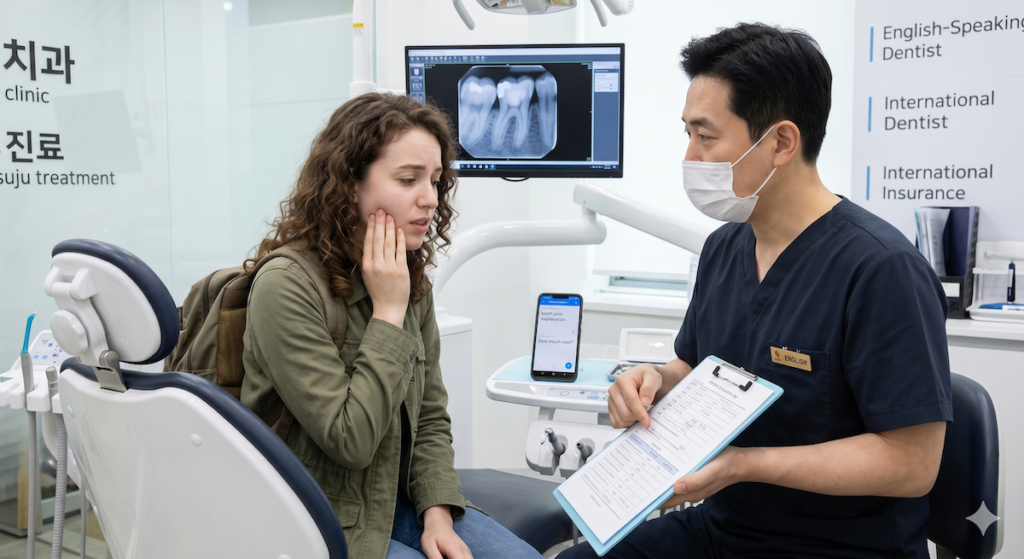
Most travelers prepare for transportation, SIM cards, hotels, food, and maybe travel insurance. Very few people imagine themselves sitting in a Korean dental clinic, trying to explain tooth pain through a translation app while wondering how much the treatment will cost.
But dental problems do not wait for a convenient time. A cracked tooth, swollen gum, wisdom tooth pain, broken crown, lost retainer, or sudden cavity pain can happen during a short trip, a study-abroad semester, or the first few months of living in Korea.
The good news is that Korea has a strong dental system, many clinics, and a high level of everyday medical access. In Seoul especially, it is not difficult to find dental clinics in busy neighborhoods, near subway stations, inside office districts, and around expat-heavy areas.
The harder part is not always finding a dentist.
The harder part is knowing what kind of clinic you need, whether English support is actually available, what the treatment may cost, whether insurance applies, and how to agree to treatment before anything begins.
That is where foreigners need a little more practical context.
Quick Answer: How Do Foreigners Find an English-Speaking Dentist in Korea?
Foreigners can find an English-speaking dentist in Korea by searching around expat-heavy or international areas such as Gangnam, Itaewon, Hannam-dong, Hyehwa, Songdo, and Haeundae, or by checking international clinics, university dental hospitals, embassy resources, expat communities, and recent map reviews. For simple cleaning, cavities, mild tooth pain, or basic dental checks, a local dental clinic may be enough. For complicated surgery, implants, severe swelling, trauma, or serious emergencies, a larger dental hospital or emergency facility may be safer. Before booking, confirm English support, estimated cost, insurance coverage, X-ray fees, and the treatment plan.
Korea Has Many Dentists, But English Support Varies
In Korea, dental clinics are common. In many Seoul neighborhoods, you may see several dental signs within a short walking distance. Clinics are often located near subway exits, office buildings, apartment areas, university districts, and shopping streets.
This accessibility can be reassuring. If you have a minor problem, you may not need to wait weeks for an appointment like in some countries.
But English support is not guaranteed.
Some dentists speak English comfortably. Some clinics have English-speaking coordinators. Some international clinics are used to foreign patients. Other local clinics may provide excellent treatment but have limited English communication at reception, during explanation, or when discussing cost.
This matters because dental treatment often requires consent.
You need to understand what the dentist found, whether the treatment is urgent, what alternatives exist, how many visits are needed, what materials are being used, and how much you may need to pay. Dental care is not just about sitting in a chair and opening your mouth. It is also about agreeing clearly to what happens next.
For foreigners, communication is part of the treatment.
Dental Clinic vs Dental Hospital in Korea
One common mistake is assuming every dental problem requires a big hospital. In Korea, many dental issues are handled by local dental clinics. These clinics can be fast, convenient, and appropriate for ordinary problems.
But not every case belongs in a small neighborhood clinic.
| Situation | Where to consider going in Korea |
|---|---|
| Basic cleaning or scaling | Local dental clinic |
| Mild tooth pain or small cavity | Local dental clinic |
| Gum discomfort or simple checkup | Local dental clinic |
| Wisdom tooth pain | Larger dental clinic, oral surgery clinic, or dental hospital |
| Complex implant consultation | Specialized clinic or dental hospital |
| Jaw injury, facial trauma, severe swelling | Emergency room or dental hospital |
| Dental pain with fever or spreading infection | Larger hospital or emergency facility |
| Need detailed English coordination | International clinic or university hospital dental center |
A local clinic may be best for simple problems. A dental hospital may be better when the problem is surgical, complicated, urgent, or difficult to explain.
The goal is not to choose the biggest hospital every time. The goal is to choose the right level of care.
How to Search for an English-Speaking Dentist
If you are in Seoul, start with location and language.
Search terms like these can help:
- English-speaking dentist in Korea
- English dentist Seoul
- dentist in Gangnam English
- dentist in Itaewon English
- dental clinic Korea foreigners
- international dental clinic Seoul
- university dental hospital Seoul
Google can be useful for English-language searches, but Naver Map and KakaoMap may show more local clinic information. The challenge is that Korean map apps may not always be easy for first-time visitors. If you are staying at a hotel, the front desk may be able to call a clinic for you, confirm English support, or help you explain the situation.
You can also search around areas where foreign residents, diplomats, students, and international workers are more common. Gangnam, Itaewon, Hannam-dong, Hyehwa, Sinchon, Songdo, and parts of Busan such as Haeundae may have more foreigner-friendly medical and dental services than quieter residential areas.
But do not rely only on a clinic’s English website.
Before you go, call or message the clinic and ask direct questions.
What to Ask Before Booking
When booking a dental appointment in Korea, keep your questions simple and practical.
Ask:
- Do you have English-speaking staff or an English-speaking dentist?
- Can I make an appointment today or this week?
- Do you treat foreign tourists or foreign residents?
- How much is the basic consultation?
- Is there an extra charge for X-rays?
- Can you give me an estimate before treatment?
- Do you accept foreign credit cards?
- Do you accept Korean National Health Insurance?
- Can I get a receipt or medical document for travel insurance?
This may feel too direct, but it is better to ask before sitting in the chair.
A good clinic should be willing to explain the basic process and approximate cost range. Exact costs may change after examination, especially if X-rays or additional procedures are needed. But you should not feel pressured into treatment without understanding the reason and the price.
What to Bring to a Dental Clinic in Korea
Bring more than just your phone.
For tourists, bring:
- Passport
- Travel insurance information
- Credit card and some backup payment
- Hotel address in Korean
- List of symptoms
- Medication list
- Allergy information
- Any dental records or X-rays if available
For foreign residents, bring:
- Residence Card, if you have one
- Korean National Health Insurance information, if enrolled
- Korean phone number
- Payment card
- Previous clinic records, if relevant
If you do not speak Korean, prepare a short written explanation of your symptoms. Translation apps can help, but symptoms are easier to translate when they are written clearly.
For example:
“I have sharp pain on the upper right side when chewing.”
“My gum is swollen near my wisdom tooth.”
“My crown fell out yesterday.”
“I am allergic to penicillin.”
“I need a cost estimate before treatment.”
Simple sentences are better than long explanations.
What to Expect During the Visit
A typical dental visit in Korea may begin at reception, where you fill out basic information. If you are a tourist, they may ask for your passport or contact details. If you are a resident, they may ask for your Residence Card or insurance information.
Then you may have a consultation, examination, and possibly X-rays. X-rays are common in dental clinics, especially if the dentist needs to check cavities, roots, wisdom teeth, bone condition, or hidden infection.
After the examination, the dentist or staff should explain the problem and treatment options. This is the moment when language support becomes important.
Do not agree to a procedure until you understand:
- what the diagnosis is
- whether treatment is urgent
- what the treatment includes
- how many visits may be needed
- what materials will be used
- what the approximate cost is
- whether insurance applies
- what happens if you wait
If you feel confused, ask for the explanation in writing or use a translation app. For expensive or non-urgent treatment, it is reasonable to get a second opinion.
Dental Costs and Insurance in Korea
Dental costs in Korea vary widely depending on the clinic, location, procedure, materials, insurance status, and whether the treatment is considered medically necessary or cosmetic.
Foreign residents enrolled in Korea’s National Health Insurance are generally covered under the same system as Korean citizens. The National Health Insurance Service explains that foreigners have the same coverage as Korean citizens, including benefits related to preventing, diagnosing, treating, and rehabilitating diseases or injuries.
However, that does not mean every dental treatment is fully covered.
Basic medically necessary treatments may receive some coverage for eligible residents, but cosmetic procedures, whitening, veneers, some implants, orthodontics, and premium materials may require significant out-of-pocket payment. Tourists usually need to rely on travel insurance or private insurance, depending on their policy.
| Dental service | Cost and insurance note |
|---|---|
| Basic checkup | Cost varies by clinic; ask before examination |
| Scaling / cleaning | May be partly covered for eligible residents, but tourists usually pay out of pocket |
| Filling | Cost depends on material and tooth location |
| Root canal | May require multiple visits and additional crown cost |
| Wisdom tooth extraction | Simple cases may be easier; surgical cases can cost more |
| Implant | Often expensive and usually needs careful consultation |
| Whitening / cosmetic work | Usually cosmetic and not usually covered |
| Emergency dental care | Cost depends on facility, tests, and treatment needed |
Always ask for a cost estimate before treatment begins. If the treatment is expensive and not urgent, ask whether there are alternatives.
For official information on eligibility and coverage, foreign residents should check the National Health Insurance Service guidance for foreigners.
Do Foreigners Pay More Than Koreans at Dentists in Korea?
Foreigners do not automatically pay more than Koreans at dental clinics in Korea just because they are foreign. The real difference is usually whether the patient is covered by Korea’s National Health Insurance Service, private insurance, travel insurance, or no insurance at all.
A Korean citizen with National Health Insurance usually pays according to the Korean insurance system for covered treatments. A foreign resident enrolled in National Health Insurance generally receives the same coverage structure as Korean citizens. A short-term tourist, however, usually does not have Korean National Health Insurance, so they may need to pay the clinic directly and later claim the cost through travel insurance if their policy covers dental care.
This is why two foreign patients can have very different bills.
A long-term resident with Korean National Health Insurance may pay less for some medically necessary treatment. A tourist with no Korean insurance may pay the full clinic price. A patient choosing cosmetic whitening, veneers, orthodontics, premium crowns, or implant-related treatment may face high out-of-pocket costs regardless of nationality.
The important question is not simply, “Am I foreign?”
The better question is:
“Is this treatment covered by Korean National Health Insurance, private insurance, travel insurance, or not covered at all?”
Before treatment begins, ask the clinic:
- Is this treatment covered by Korean National Health Insurance?
- If I am a tourist, what is the full out-of-pocket price?
- Are X-rays, anesthesia, medication, or follow-up visits included?
- Is this material covered or considered non-covered?
- Can I receive an English receipt or medical document for insurance?
In Korea, dental care can feel efficient and relatively accessible, but cost clarity matters. Always confirm the estimated price before agreeing to treatment, especially for crowns, root canals, implants, wisdom tooth surgery, whitening, veneers, or orthodontic care.
What If You Have a Dental Emergency in Korea?
Some dental problems can wait a day or two. Others should not.
Seek urgent help if you have:
- severe facial swelling
- dental pain with fever
- uncontrolled bleeding
- injury to the mouth, jaw, or face
- difficulty breathing or swallowing
- trauma after an accident
- signs of spreading infection
For life-threatening or serious medical emergencies in Korea, call 119. Visit Seoul’s medical emergency guidance states that emergency medical help is available through 119, and if you ask for an ambulance in English, one can be sent to your location. Seoul’s foreign resident information also notes that 119 emergency assistance includes ambulance service and interpretation support for foreign nationals.
For non-life-threatening travel help or interpretation, the 1330 Korea Travel Hotline can also be useful. Visit Korea lists 112 for police, 119 for fire and medical emergencies, and 1330 for travel assistance and interpretation support.
If you are not sure whether your dental problem is an emergency, err on the side of caution. Severe swelling, fever, trauma, or spreading pain should not be treated like a normal cleaning appointment.
Red Flags and When to Get a Second Opinion
Most dental clinics in Korea are professional, but foreign patients should still protect themselves from confusion.
Be careful if:
- you do not understand the treatment but feel pressured to agree
- the clinic will not explain the cost before treatment
- several expensive procedures are recommended immediately
- cosmetic treatment is pushed when you came for pain
- you are not told whether insurance applies
- the clinic avoids giving written estimates
- you feel language support is too weak for a major procedure
For small treatments, you may be comfortable proceeding. For implants, orthodontics, major surgery, cosmetic work, or expensive multi-visit treatment, a second opinion can be wise.
This is especially true if you are leaving Korea soon. Some dental procedures need follow-up visits. Starting a complex treatment right before departure can create problems if something goes wrong after you return home.
Tourists vs Foreign Residents: Different Needs
Tourists usually need fast, clear, short-term solutions. If you are visiting Korea for one or two weeks, you may need pain relief, temporary repair, emergency care, or enough treatment to continue your trip safely. Starting a long and complex dental plan may not make sense unless you already planned dental travel.
Foreign residents have different needs. If you live in Korea, it is worth finding a regular dentist you can trust. You may want a clinic near home or work, a dentist who explains treatment clearly, and staff who can help with insurance, appointments, and follow-up care.
For residents, dental care is part of everyday life in Korea. For tourists, it is usually crisis management.
Know which situation you are in.
Final Thoughts
Finding an English-speaking dentist in Korea is possible, especially in Seoul and other large cities. The real challenge is not only finding a clinic. It is understanding what level of care you need, whether English support is strong enough, how much treatment may cost, and whether you clearly consent before anything begins.
For simple cleaning or mild tooth pain, a local dental clinic may be enough. For complicated surgery, serious swelling, trauma, or emergency symptoms, a larger hospital or emergency service may be safer. For expensive or non-urgent treatment, do not be afraid to ask questions or get a second opinion.
Korea’s dental system can be fast and efficient, but foreign patients need clear communication.
Before you sit in the chair, make sure you understand the treatment, the cost, the insurance situation, and the next step.
That small pause can make a big difference.