A few months into life in Seoul, a friend wants to split a rental car for a weekend on the east coast. You have a license from home and an International Driving Permit somewhere in a drawer. Is that still enough? Do you need a Korean license? And if you do, does it mean driving school all over again?
For most people the answer is easier than they fear. Depending on where your license is from, you may be able to swap it for a Korean one with an eye test and some paperwork. The part people underestimate is the paperwork, and then the handful of road rules that work differently here. This is the version I give friends who are about to start driving in Korea.
Visiting: when an International Driving Permit is enough
If you’re here short term, you can drive on an International Driving Permit (IDP, 국제운전면허증) together with your original license from home. Korea accepts IDPs issued under the 1949 Geneva Convention and, since 2002, the 1968 Vienna Convention, as well as some licenses recognised under bilateral agreements.
The key limit: an IDP lets you drive in Korea for one year from the date you entered the country, regardless of the expiry date printed on the permit. Once that year is up, driving on it counts as driving without a license.
Two practical points. Carry your passport, home license, and IDP together, because rental counters will ask for all three. And check that your country issues IDPs under one of those conventions: China, for example, is not part of either, so a Chinese IDP isn’t valid here.
Living here: exchanging your foreign license
If you’re staying longer, the usual route is exchanging your foreign license for a Korean one (외국면허 교환발급) at a driver’s license examination office (운전면허시험장). Bring:
- your original foreign license, which must be valid
- your passport, showing your entry and exit history from the country that issued the license
- your Alien Registration Card (ARC)
- three color photos, 3.5 cm × 4.5 cm, taken within the last six months
- an embassy certificate or an apostille confirming your license, issued within one year of your application and written in Korean or English
- a certificate of entry and exit (출입국사실증명서)
If the license was issued in a country other than your nationality, you’ll also need proof that you lived there for at least 90 days, such as a certificate of employment or enrollment, a green card, or a long-term visa.
What happens next depends on where the license is from. If your license comes from a country that recognises Korean licenses, you take only an aptitude test, which is essentially an eye and physical check done on site. If not, you also take a 40-question multiple-choice written test, available in Korean, English, Chinese, or Vietnamese. There are exceptions inside “recognised” places: in the United States, licenses from Oregon and Idaho still require the written test, and New Zealand holders with a restricted license, or a full license held for less than two years, need it too.
The list of recognised countries is long and changes, so check the current notice on the KoROAD Safe Driving site (safedriving.or.kr) or call 1577-1120 before you gather documents.
Fees are modest: ₩6,000 for the physical check and ₩10,000 for a standard license card, or ₩15,000 for the IC card that can be added to your phone. You must apply in person, and the office asks you to arrive by 5 p.m. (by 4 p.m. if you need the written test).
Starting from scratch
If your license can’t be exchanged, or you’ve never driven, you take the full Korean process. In order: a one-hour traffic safety class, a physical check, the written test (again offered in English, Chinese, and Vietnamese), a course test on the closed track, a learner’s permit, and finally an on-road test. Most people go through a driving school (운전학원), which bundles the lessons and the track test.
The ordinary car licenses come in two classes. Class 2 Ordinary (2종 보통) covers regular passenger cars and is what most people need. Class 1 Ordinary (1종 보통) also covers vans with up to 15 seats and heavier trucks. Both can be taken in an automatic, but an automatic-only license doesn’t let you drive a manual car.
There are 27 examination offices across the country. In Seoul they are Gangnam, Dobong, Gangseo, and Seobu, and you can use any of them regardless of where you live.
Rules that catch newcomers
Speed limits in the city are low. Under the Safe Speed 5030 policy, most main city roads are capped at 50 km/h and smaller residential streets at 30 km/h. Urban expressways like the Olympic-daero and Gangbyeon-buk-ro keep higher limits, so go by the signs.
School zones (어린이보호구역) are marked with red road surfaces and signs, and the limit is usually 30 km/h. Camera fines are higher there. Hitting a child in a school zone is a criminal matter under what’s known as the Min-sik Law (민식이법): injuring a child carries one to fifteen years in prison or a fine of ₩5 million to ₩30 million. Drive through them as if a child could step out at any moment.
Right turns mean stopping first. Since January 2023, when the traffic light facing you is red, you must stop before the crosswalk before turning right, even if no one is crossing. Whatever the light, if a pedestrian is crossing or about to cross, you wait. The fine for a car is ₩60,000 plus penalty points, and police run regular campaigns on it.
The drink-driving limit is 0.03%. That’s a blood alcohol level of 0.03%, which can mean a single drink. At 0.08% your license is cancelled. The simple rule locals follow is to take a designated driver service (대리운전) home.
Parking is the other daily trap. A double yellow line at the curb means no stopping or parking at any time, a single solid yellow line means restricted (check nearby signs for hours), and a white line generally means you can park. Fire hydrants, crosswalks, bus stops, and intersection corners are strictly off limits, and residents can report cars there through the Safety Report app (안전신문고) with time-stamped photos, which is why tickets in those spots arrive so reliably.
Renewing and carrying your license
A Korean license needs renewing (갱신) every ten years if you’re under 65, with shorter cycles after that. The renewal window is printed on the card; leave it too long and you’ll pay a fine, and eventually the license can be cancelled.
If you chose the IC card, you can register it in the government Mobile ID app (모바일 신분증) and show your phone instead of the plastic card. Keep the physical card anyway, especially for rental counters.
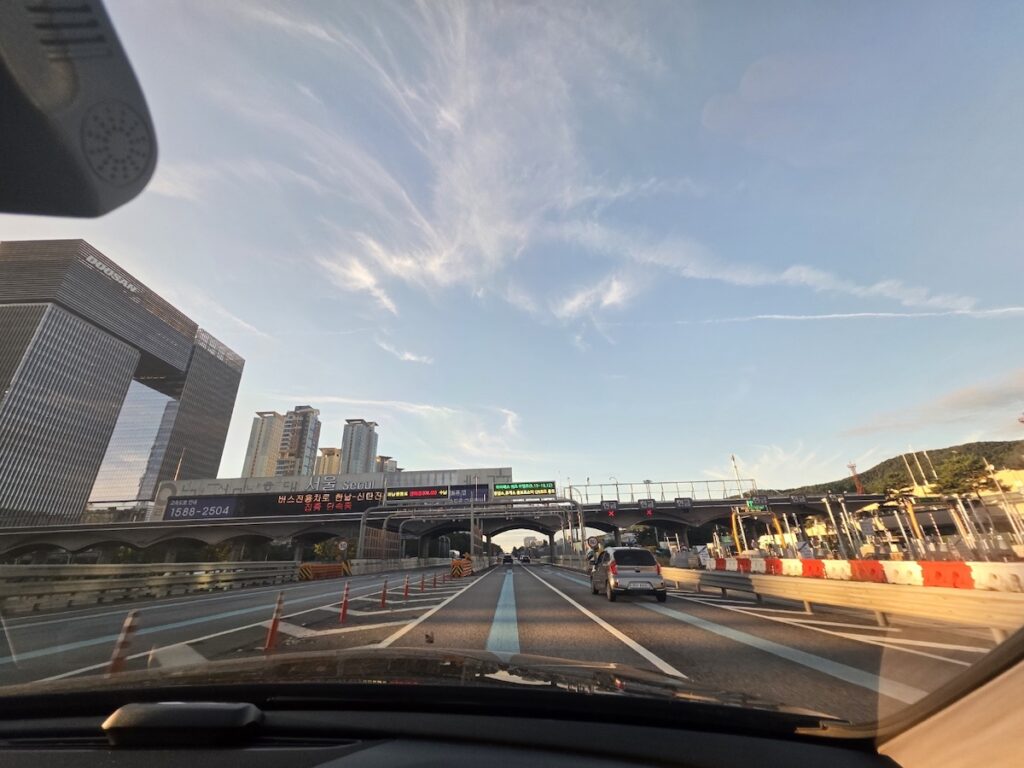
For long trips out of Seoul, our Korean expressway guide covers tolls, Hi-Pass lanes, the bus lane, and rest areas. And if your ARC is still on its way, start with our ARC guide, since you’ll need it for the exchange.
The quick version
Visitors can drive on an International Driving Permit plus their home license for one year from the date they entered Korea. Residents exchange their foreign license at a driver’s license examination office with the original license, passport, ARC, three 3.5 × 4.5 cm photos, an embassy certificate or apostille, and an entry-and-exit certificate. Licenses from recognised countries need only an eye and physical check; others add a 40-question written test that can be taken in English. Once you’re driving, remember 50 km/h on most city roads, 30 km/h in school zones, a full stop before right turns on a red light, and a 0.03% alcohol limit.
Document requirements and the recognised-country list change from time to time. Check safedriving.or.kr or call 1577-1120 the week before you go.