Yesterday, a routine task turned into a minor disaster. While I was retrieving an electric fan from storage to prepare for the upcoming Seoul summer, I felt a sharp, sickening SNAP in my wrist. As the pain intensified, I didn’t reach for an X-ray or a bottle of ibuprofen. Instead, I did what most locals do: I headed straight for a Haniwon (Korean Traditional Medicine Clinic).
For international travelers and expats, the concept of Acupuncture in Seoul can feel intimidating. However, for those of us living in the city, it is our go-to “Survival Guide” for musculoskeletal injuries. If you’ve ever wondered why Koreans prioritize thin needles over heavy painkillers for sprains, this is your deep dive into the world of K-Wellness.
The Great Korean Dilemma: Western vs. Traditional Medicine
In Korea, we are blessed with a dual-medical system. When a local suffers a sprain or a ligament injury, we immediately weigh our options: Orthopedics (Western) or Acupuncture in Seoul (Traditional).
While Western medicine excels at fixing structural breaks, Korean Traditional Medicine is unparalleled at managing inflammation and restoring the natural flow of energy (Qi) to the soft tissue. The logic is simple: for bone structure issues, you go to the hospital; for soft tissue, ligament flow, and inflammation, the local choice is always the Haniwon. The fact that these clinics are always packed with locals isn’t just about tradition—it’s about effective, fast-acting results.
What to Expect: My Sprained Wrist Recovery Journey
To demystify the experience for you, here is what the process actually looks like. Many fear the needles, but in a professional clinic for Acupuncture in Seoul, the experience is far more relaxing than it is painful.
The treatment typically begins with “Prep Work.” Initial muscle stimulation and heat therapy are used to relax the area. Warming infrared lamps and EMS pads soothe the muscles, ensuring the body is receptive to the healing process. This is a crucial stage for Acupuncture for Foreigners who might be nervous, as it makes the subsequent treatment virtually painless.
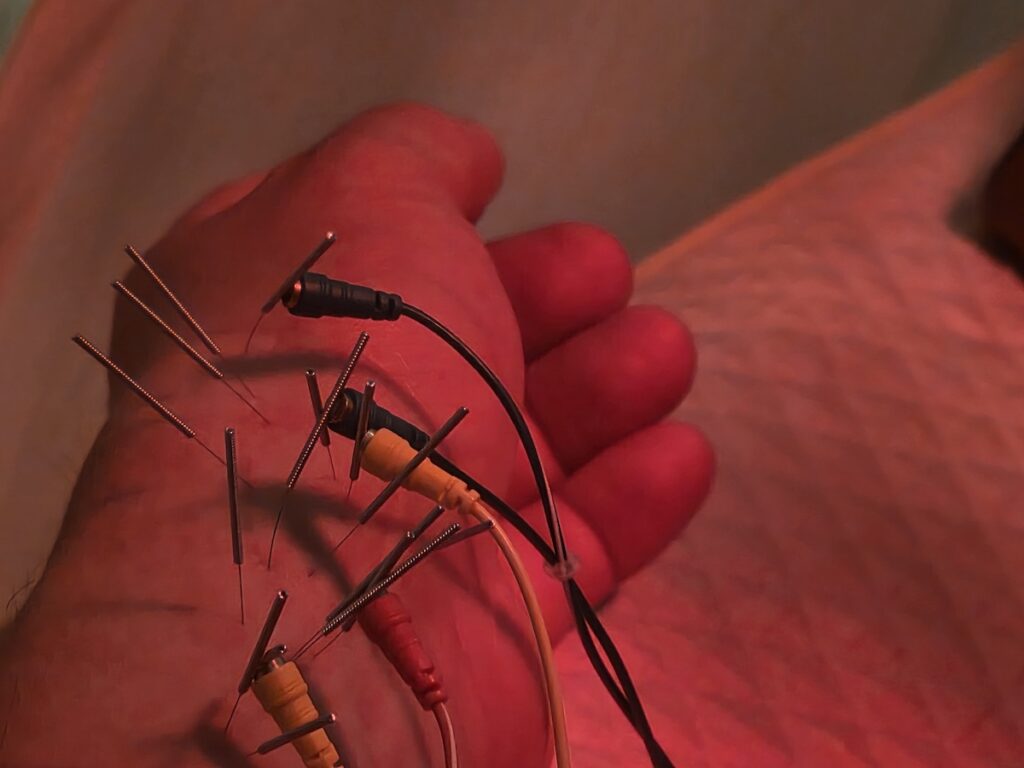
Once the muscles are relaxed, the core of the treatment—Precision E-Acupuncture—begins. This is where ancient art meets modern technology. Sterile, hair-thin needles are strategically inserted around the sprained ligament, and a mild, pulsing electrical current is passed through them. It doesn’t hurt; it feels like a rhythmic, deep-tissue massage from the inside out, directly targeting the deep-tissue inflammation in the sprained wrist.
How to Find and Book a Clinic: A Practical Guide for 2026
Now that you know why and where to go, the next step is actually finding a clinic near you and securing an appointment. In Korea, the digital infrastructure is excellent, but for a traveler, knowing the right keywords and apps is essential.
1. The Best Way to Search: Kakao Maps
Google Maps is often outdated in Korea. For real-time information, Kakao Maps is the gold standard. Even if you don’t speak Korean, you can use these specific keywords to find the best spots:
- What to search: Type “Haniwon” or “Acupuncture” in the search bar.
- Filter for Excellence: Look for places with a rating above 4.0.
- Check the “Open” Status: Kakao Maps shows real-time opening hours, including lunch breaks (usually 1 PM – 2 PM).
2. Is There an App? (The “Ddoddak” Factor)
You might hear locals talking about “Ddoddak” (똑닥), a popular app used to book medical appointments and check waiting times in real-time.
- Can Foreigners Use It? It requires a Korean phone number and resident identity, so it’s mostly for expats.
- The Alternative: For short-term travelers, the best “app” is actually Google or Instagram. Many global-focused clinics in areas like Gangnam or Myeongdong accept reservations via Instagram DM or their official website in English.
3. Understanding Clinic Hours & Weekend Care
One of the best things about Seoul’s medical scene is the accessibility during weekends.
- Standard Hours: Typically 9:30 AM – 7:00 PM (Weekdays).
- Night Clinics (야간진료): Many clinics stay open until 9:00 PM on Tuesdays or Thursdays for office workers.
- Weekend & Holiday Care: Don’t panic if you get injured on a Saturday. Many Haniwons are open on Saturdays (usually until 2 PM or 4 PM). Some even operate on Sundays in high-traffic areas like department stores or major subway hubs.
4. Making the Reservation
- Phone Calls: If you are calling a major hospital like Jaseng or Kyung Hee, they have dedicated English lines.
- Walk-ins: For smaller local clinics, walk-ins are usually fine, but you might have to wait 20-30 minutes.
- Essential Phrase: If you need to call a small local spot, just say: “I am a foreigner. Do you have an English-speaking doctor?” Even a little English goes a long way in Seoul today.
Where to Go: Top-Rated Global Korean Medicine Hospitals
For many expats and travelers, the biggest hurdle is communication. You don’t want to explain your nerve pain through a translation app. Fortunately, Seoul has world-class institutions with dedicated International Healthcare Centers that offer services in English, Russian, French, and Japanese.
1. Jaseng Hospital of Korean Medicine (The Spine Specialist)
Jaseng is perhaps the most famous institution for musculoskeletal issues in Korea. They specialize in non-surgical spine and joint treatment.
- Language Support: They have a robust International Clinic with coordinators fluent in English, Russian, and Japanese.
- Why Visit: If you have severe back pain or a herniated disc, their “Chuna” manual therapy and specialized herbal injections are world-renowned.
- Location: Gangnam (Main branch).
2. Kyung Hee University Medical Center (The Academic Authority)
As the leading academic institution for Korean medicine, Kyung Hee offers a blend of traditional wisdom and modern diagnostic technology.
- Language Support: Their International Medical Service (IMS) provides comprehensive support in English and Russian, with specific arrangements often available for French-speaking patients upon request.
- Why Visit: This is where you go for complex internal issues or chronic conditions that require a multidisciplinary approach (combining Western and Eastern medicine).
3. Myeongdong & Jongno Local Clinics (The Tourist-Friendly Hubs)
If you are looking for Acupuncture in Seoul while sightseeing, clinics in these areas are highly experienced with short-term travelers.
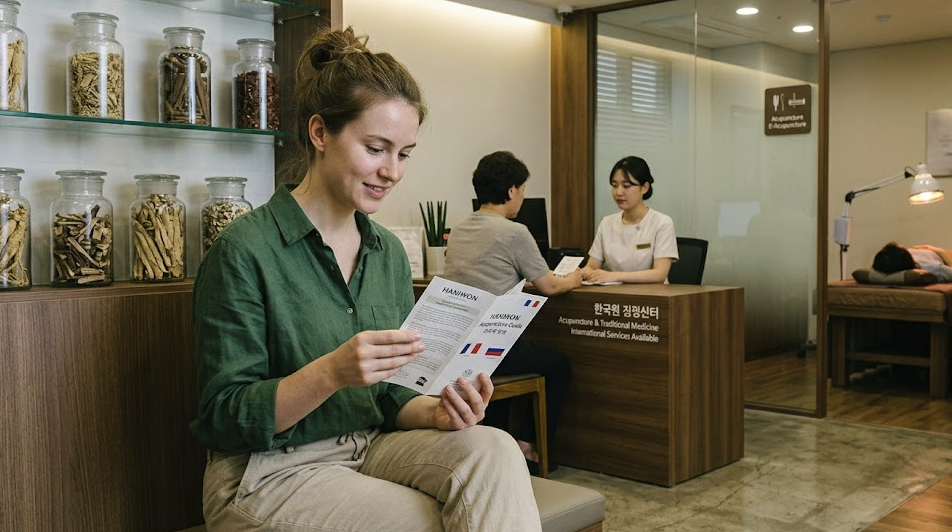
- Language Support: Most major clinics in Myeongdong have staff fluent in English and Chinese. Some specialized wellness centers in this district also cater to European travelers with multi-language brochures.
- Why Visit: Perfect for “Quick Fixes”—relieving foot pain after a long day of walking or a quick session for a stiff neck.
[International Patient Service Matrix]
| Hospital Name | Languages Offered | Specialization | Best For |
| Jaseng Hospital | English, Russian, Japanese | Spine & Joint (Chuna) | Serious Sprains / Back Pain |
| Kyung Hee Univ. | English, Russian, French(on-call) | Holistic & Internal Medicine | Chronic Fatigue / Complex Diagnosis |
| Dongguk Univ. | English, Russian | Sports Medicine | Athletic Injuries / Wellness |
[Pro Tips for a Seamless Visit]
- Make a Reservation: While walk-ins are sometimes accepted, it is highly recommended to email or call their International Center 1-2 days in advance to ensure a translator is available.
- Bring Your Records: If you have recent X-rays or MRI results from your home country, bring them (on a USB or hard copy). Korean medicine doctors use these as a reference to supplement their own pulse diagnosis.
- Check Your Insurance: Some international travel insurance plans cover acupuncture if it’s for an acute injury. Always ask for an English receipt (Medical Certificate) before you leave.
Costs and Logistics: A Guide for Non-Residents Without Insurance
One of the most common questions from expats and travelers is: “Can I even visit a clinic without Korean National Health Insurance?” The answer is a resounding yes. While the local medical system is built on a robust insurance platform, it is highly accessible and surprisingly affordable for international visitors paying out-of-pocket.
1. Insurance vs. Non-Insurance (Self-Pay)
In Korea, citizens pay a small co-payment (usually under $10) for acupuncture thanks to national insurance. As a visitor, you will be paying the “uninsured rate.” However, unlike in the US or Europe, where specialist visits can cost hundreds of dollars, the self-pay rates in Seoul remain incredibly reasonable for the quality of care provided.
2. Estimated Costs for Common Treatments (Self-Pay)
While prices vary depending on the clinic’s location and the complexity of the treatment, here are the general price ranges for non-residents in 2026:
| Service Type | Estimated Cost (KRW) | Estimated Cost (USD) |
| Consultation & Diagnosis | 10,000 – 30,000 | $7 – $22 |
| Standard Acupuncture | 30,000 – 60,000 | $22 – $45 |
| Pharmacopuncture (Herbal Injection) | 20,000 – 50,000 | $15 – $37 |
| Chuna (Manual Therapy) | 50,000 – 100,000 | $37 – $75 |
| Cupping Therapy | 10,000 – 20,000 | $7 – $15 |
Note: Most acute sprain treatments involve a combination of the above, typically totaling around 50,000 to 80,000 KRW per session.
3. Required Documentation: What to Bring
To ensure a smooth registration process, make sure you have the following ready:
- Passport: This is your primary ID. The clinic needs it to create your patient profile and issue a formal medical receipt.
- Travel Insurance Details: If you plan to claim the costs later, bring your policy information.
- Current Medications: If you are taking any Western medications, have a list ready so the doctor can ensure there are no contraindications with any herbal prescriptions.
4. Payment Methods
Almost all Haniwon in Seoul accept major international credit cards (Visa, Mastercard). However, it is always a good idea to have some KRW (cash) or a T-Money card for smaller local clinics just in case.
If your visit to the Haniwon in Seoul was about medical recovery, your next stop should be about total rejuvenation. For a premium, sensory deep-dive into Korean wellness, I highly recommend the Yeoyongkuk Oriental Spa.
Unlike standard spas, Yeoyongkuk uses the “Sasang Constitution” (the four body types in Korean medicine) to customize your treatment. They use traditional tools like ceramic ‘Hwa-sa’ and premium herbal oils to balance your energy. It’s the perfect “After-Care” following your acupuncture session.
Final Thoughts: Embracing the Future of Wellness in Seoul
Looking back at my “summer fan accident,” I realize it was a blessing in disguise. It reminded me that living in Seoul offers a unique luxury: the choice between the best of modern science and the wisdom of ancient traditions. For me, choosing Acupuncture in Seoul wasn’t just about fixing a sprained wrist; it was about choosing a holistic recovery that respected my body’s natural rhythm.
As we move through 2026, the boundaries of medical travel are disappearing. Whether you are an expat living in a high-rise or a traveler just passing through for a week, the Haniwon is no longer a “locals-only” secret. With world-class institutions like Jaseng and Kyung Hee offering services in English, Russian, and French, and the sheer convenience of finding a clinic via Kakao Maps, your path to recovery is clearer than ever.
Don’t let a sprained ankle on a hiking trail or a sore wrist from a flight dampen your Seoul adventure. Take your passport, find a highly-rated clinic near your subway station, and experience the “E-Acupuncture” magic for yourself. For the cost of a nice dinner (approx. 30,000 to 60,000 KRW), you aren’t just getting medical treatment—you are participating in a K-Wellness tradition that has been perfected over millennia.
Stay sharp, stay healthy, and don’t be afraid of the needles. Your body—and your Seoul itinerary—will thank you.