Korea bathroom etiquette for tourists is one of those topics that every travel guide skips — and every traveler eventually wishes they had read.
Not because Korean bathrooms are complicated. They are not.
But because the rules are different depending on where you are. What is correct in a Seoul subway station is different from what is expected in a Korean restaurant. What feels obvious in a hotel bathroom is completely wrong in a Korean friend’s home. And the mistakes foreigners make — quietly, invisibly, without anyone saying anything — are almost always the same ones.
This guide covers all of it. Public restrooms, restaurant bathrooms, Korean homes, and the specific situations where foreigners consistently get it wrong without realizing it.
Quick Answer: What Is Korea Bathroom Etiquette for Tourists?
Korea bathroom etiquette varies significantly by location. In public restrooms and subways, toilet paper goes in the toilet — not the bin. In restaurant bathrooms, air freshener use after number two is considered basic courtesy. In Korean homes and Airbnbs, bathroom slippers must stay inside the bathroom, the floor must be kept dry, and the toilet lid should be closed before flushing. The biggest mistake tourists make is applying the same rules everywhere — when in fact each setting has its own unspoken code.
The Biggest Misconception: One Rule Does Not Cover Everything
Most bathroom guides for Korea give you a single rule and call it done.
“Flush your toilet paper.” “Use the bidet.” “Don’t leave the bin overflowing.”
These are all correct. They are also incomplete.
Because Korea bathroom etiquette shifts depending on the setting you are in. The subway bathroom, the restaurant bathroom, and your Korean host’s home bathroom are three completely different social environments — each with its own expectations, its own unspoken rules, and its own specific ways a foreigner can get it quietly wrong.
Understanding the difference between these three settings is the actual skill.
Setting 1: Public Restrooms and Subway Bathrooms
Flush the Toilet Paper — This Is Now the Law
Since January 2018, South Korea’s Public Toilets Act mandated the removal of waste bins from public restroom cubicles nationwide. The goal was to eliminate the overflowing bins that had been a common complaint among international visitors for decades.
The result: in most subway stations, shopping malls, and public facilities, there is no bin inside the cubicle. Toilet paper goes directly into the toilet.
Korean commercial toilet paper is water-soluble by design — engineered to dissolve almost instantly in water. It will not block the pipes. Flush it.
→ Related: Korean Toilet Culture — Why Public Restrooms Are Free in Korea
What Still Goes in the Bin
The small wall-mounted container you sometimes see — labeled 위생수거함 — is exclusively for sanitary products. Not toilet paper. Not wet wipes.
Wet wipes (물티슈) are the most common mistake. Despite “flushable” labeling, they contain synthetic fibers that do not dissolve in Korean plumbing systems — particularly in older districts like Jongno or Ikseon-dong where pipes were laid decades ago. Always bin them.
The Subway Sign You Should Read
![Seoul subway bathroom sign in Korean English Chinese and Japanese explaining Korea bathroom etiquette for tourists about flushing toilet paper]
Most Seoul subway bathrooms display a multilingual notice — Korean, English, Chinese, Japanese — explaining exactly what to flush and what not to. Take thirty seconds to read it. It tells you everything specific to that facility.
This sign exists because the rules genuinely vary by building age and plumbing capacity. The sign is not decoration. It is infrastructure information.
Setting 2: Restaurant Bathrooms
Restaurant bathrooms in Korea occupy a different social space from public restrooms. They are semi-private — used by a small group of diners who are all connected to the same meal, the same table, the same experience.
This changes the etiquette significantly.
The Air Freshener Question
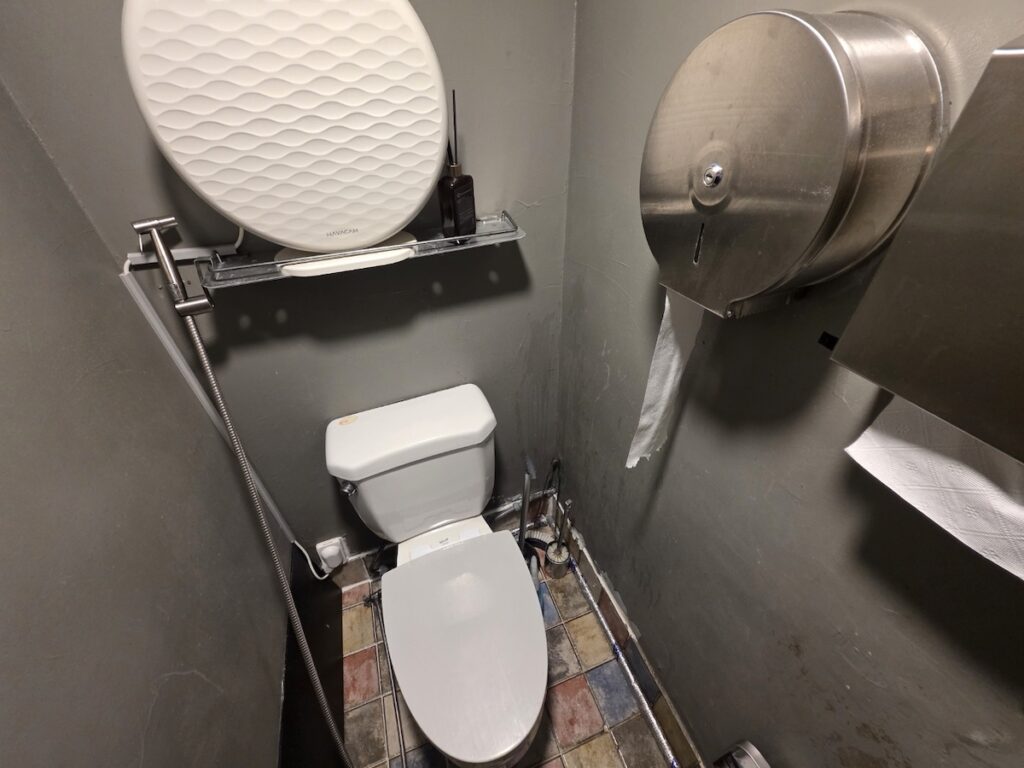
In many Korean restaurants, particularly smaller family-run establishments, you will find an air freshener or odor spray sitting on the back of the toilet or on a small shelf nearby.
This is not decorative.
In Korean restaurant culture, using the air freshener after a bowel movement is considered basic consideration for the next person — who is almost certainly someone sitting at a nearby table. The spray is there because it is expected to be used.
Foreigners often ignore it, either out of unfamiliarity or because they do not notice it. Koreans notice.
Keep It Fast
Restaurant bathrooms in busy Korean dining establishments are shared by all tables. Spending an extended amount of time inside — especially during peak dining hours — creates a quiet social pressure that is very Korean in its invisibility. Nobody will knock. Nobody will say anything. But the awareness exists.
The Lock and the Sink
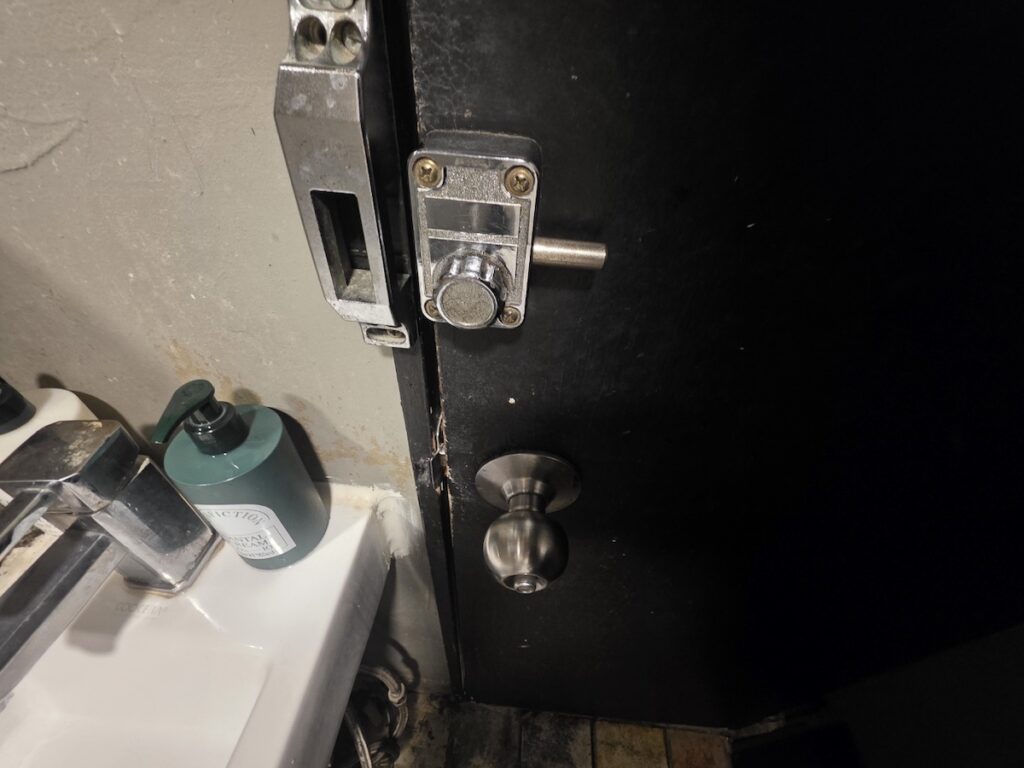
![Clean Korean restaurant bathroom showing sink handwashing area and door lock mechanism representing proper Korea bathroom etiquette for tourists]
Korean restaurant bathrooms — even small ones — almost always have a functioning lock and a dedicated handwashing sink. Both are expected to be used.
Washing hands after using the toilet is not optional in Korean social culture. It is observed. In smaller restaurants where the bathroom is adjacent to the dining area, the sound of water running after a bathroom visit is a social signal that people register — consciously or not.
Lock the door. Wash your hands. Use the air freshener if it is there.
These three things cover almost everything expected of you in a Korean restaurant bathroom.
Korean Bathroom Etiquette 2025 — Why Toilet Seat and Hygiene Habits Became a Cultural Debate
Don’t Panic! The Ultimate Survival Guide to Finding a Toilet in Korea
Need a Bathroom in Korea? Head to the Subway — A Foreigner’s Guide to Korea’s Cleanest Public Toilets
Setting 3: Korean Homes and Airbnbs
This is where the most significant etiquette gaps appear — and where foreigners are least likely to receive direct correction, because Korean hosts will almost never say anything to a guest’s face.
The Slipper Rule
Most Korean homes have dedicated bathroom slippers — a separate pair kept inside the bathroom door, used only inside the bathroom. You switch into them when entering. You switch back when leaving.
Wearing bathroom slippers back into the living area is one of the most consistently mentioned foreigner mistakes among Korean hosts. It tracks bathroom bacteria into the living space, which in Korean home culture — where people sit and eat close to the floor — is a significant hygiene violation.
The slippers stay inside the bathroom. Always.
Keep the Floor Dry
Korean home bathrooms are wet rooms — the entire floor is designed to get wet during showering. This is intentional. What is not intentional: leaving the floor soaking wet after you are finished, with no attempt to direct water toward the drain.
After showering, use the handheld showerhead to rinse excess water toward the floor drain. If a squeegee is present — and it often is — use it. This is standard practice for Korean residents and signals awareness of shared space.
Close the Lid Before Flushing
Korean health media has widely reported on aerosol spread during toilet flushing — fine water particles that can travel up to 1.5 meters when the lid is open. Closing the lid before flushing is standard practice in Korean homes, particularly among younger generations and couples sharing a bathroom.
In a Korean host’s home, leaving the lid open during flushing is noticed. In a shared apartment or Airbnb with Korean roommates, it will likely come up eventually — usually not directly, but through a note or a hint.
Close the lid. It takes one second.
The Ventilation Door
Unlike Western bathroom habits where the door is pulled shut after use, Korean bathroom etiquette — particularly in homes — involves leaving the door slightly ajar when the bathroom is not in use.
This allows the wet room to ventilate and dry faster. A closed bathroom door in a Korean home signals the room is occupied. An ajar door signals it is free and drying.
If you close the bathroom door completely after every use in a Korean home, your host may quietly reopen it each time. Now you know why.
The One Table That Covers Everything
| Setting | Toilet Paper | Air Freshener | Slippers | Lid | Door After |
|---|---|---|---|---|---|
| Subway / Public | Flush ✅ | N/A | N/A | Recommended | Close |
| Restaurant | Flush ✅ | Use it ✅ | N/A | Recommended | Close |
| Korean Home | Flush ✅ | Use it ✅ | Stay inside ✅ | Always close ✅ | Leave ajar ✅ |
| Hotel | Flush ✅ | Optional | N/A | Optional | Close |
What Happens When You Get It Wrong
Nothing dramatic.
This is important to understand about Korean bathroom etiquette — violations are almost never called out directly. Korean social culture places significant value on avoiding confrontation and preserving the comfort of shared space. A host who notices bathroom slippers were worn into the living room will clean the floor quietly. A restaurant owner whose air freshener was not used will say nothing.
The correction happens invisibly. The awareness, however, is there.
For foreigners who want to move through Korean social spaces with genuine awareness rather than surface-level politeness, understanding bathroom etiquette is part of the picture. Not because anyone is judging dramatically. But because these small signals — closing the lid, using the spray, keeping the slippers inside — communicate that you understand the space you are in and the people sharing it with you.
That communication matters in Korean social culture, even when nobody says a word about it.
→ Related: Why Koreans Never Say No Directly — Korean Indirect Communication Explained
→ Related: Korean Bathroom Culture — Wet Rooms, Bidets, and Slippers Explained
→ Related: Korean Bathroom Etiquette — The Seated Urination Debate