Why Getting Around Seoul Feels Easy Until It Doesn’t
How to get around Seoul is something most visitors think they understand after one subway ride.
At first, Seoul feels incredibly convenient. The subway is clean. Buses are frequent. Taxis are everywhere. Airport trains are simple. Signs are often written in English. Payment is usually fast.
But then the small problems start.
You stand in front of a subway gate and wonder why your card is not working.
You get on a bus but do not know whether you need to tap again when getting off.
You take the expressway and suddenly realize highway rest areas in Korea are a whole system of their own.
You lose something on the subway and have no idea where to start.
You arrive at Incheon Airport and wonder which route into Seoul is actually easiest.
Seoul transportation is not difficult. But it has its own rhythm.
This guide brings together the most important transport systems visitors and new residents should understand first, so moving around Seoul feels less stressful and more natural.
Quick Answer: What Is the Best Way to Get Around Seoul?
For most visitors, the best way to get around Seoul is:
- Subway for long distances inside the city
- Buses for local neighborhoods and routes subway does not cover
- T-money card for public transportation
- Airport Railroad or airport bus from Incheon Airport
- Taxi when traveling late, carrying luggage, or going somewhere less connected
- Express buses or highways for travel outside Seoul
If you are staying in Seoul for more than a few days, learning the subway and T-money system first will make everything else easier.
For official information about Seoul’s subway, buses, and transportation cards, you can also check the Seoul Metropolitan Government’s public transportation guide.
Seoul Subway: The Backbone of the City
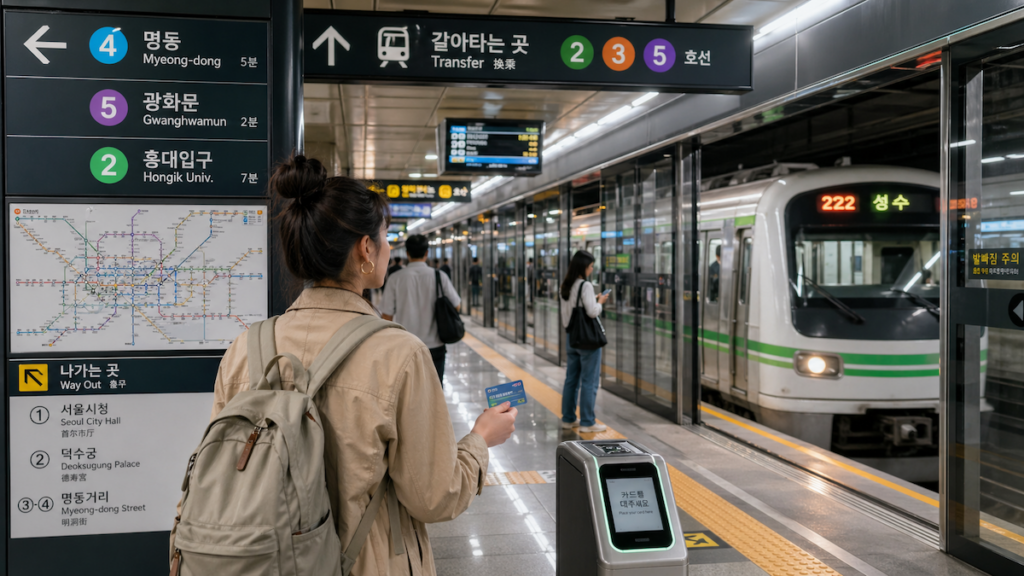
The Seoul subway is usually the easiest and most reliable way to move around the city.
It connects major districts like:
- Gangnam
- Hongdae
- Myeongdong
- Jamsil
- Seoul Station
- City Hall
- Dongdaemun
- Yeouido
For foreigners, the subway is often the least stressful option because station names and announcements are usually available in English.
But there are still things that can confuse first-time riders.
Transfer stations can be large. Some exits are far apart. Certain lines get extremely crowded. And in busy stations, choosing the wrong exit can add 10 or 15 minutes to your walk.
The most important subway habit is simple: check the exit number before leaving the station.
In Seoul, the exit number often matters as much as the station name.
Subway Rules and Fines: What Visitors Should Know
Seoul’s subway is convenient, but it is not rule-free.
Many visitors focus on route maps and fares, but subway etiquette also matters.
Common mistakes include:
- Blocking train doors
- Sitting in priority seats without awareness
- Being too loud
- Carrying large luggage during rush hour
- Eating strong-smelling food
- Misusing emergency equipment
- Ignoring station signs
Most of these mistakes will not lead to immediate trouble, but some prohibited actions can result in fines.
The subway is treated as a shared public space. Even when people do not say anything, they may notice behavior that feels disruptive.
If you are new to Seoul, watch how locals move. They line up, move quickly, stand on the correct side, and usually keep noise low inside trains.
T-money Cards: The Small Card That Makes Seoul Easier
A T-money card is one of the first things you should get in Seoul.
You can use it for:
- Subway
- Buses
- Some taxis
- Convenience store payments in some cases
You can buy and recharge T-money cards at convenience stores or subway stations. The card saves time because you do not need to buy a ticket every time you ride.
The important thing is to tap correctly.
On the subway, you tap when entering and exiting.
On buses, you usually tap when boarding and again when getting off, especially if you plan to transfer.
This matters because Seoul’s public transportation system calculates transfer discounts. If you forget to tap properly, you may lose the discount or pay more than expected.
For short-term visitors, T-money is not just convenient. It helps you move like a local.
Seoul Buses: Useful, But More Intimidating Than the Subway
Buses in Seoul are very useful once you understand them.
They can take you closer to local neighborhoods, apartment areas, parks, markets, and places where subway stations are not nearby.
But for many foreigners, buses feel harder than the subway.
Why?
Because:
- Stops can be confusing
- Bus routes may look complicated
- Announcements can feel fast
- You need to know when to tap off
- Some stops serve many different buses
- Traffic can change travel time
Still, buses are worth learning. They are especially useful when traveling short distances or reaching places that require a long walk from the subway.
A simple tip is to use map apps carefully and check the bus number before boarding. In Seoul, one wrong bus can take you in the opposite direction very quickly.
Taxis in Seoul: Convenient, But Know the Basics
Taxis in Seoul are usually safe, clean, and reasonably priced compared to many major cities.
They are especially useful when:
- You have heavy luggage
- You are traveling late at night
- You are with children or elderly parents
- Your destination is far from a subway station
- You do not want to transfer multiple times
However, taxis can still confuse foreigners.
Some drivers may not speak English. Addresses can be difficult if you only know the English name of a place. During late-night hours, demand can be high. Some areas are harder to get a taxi from.
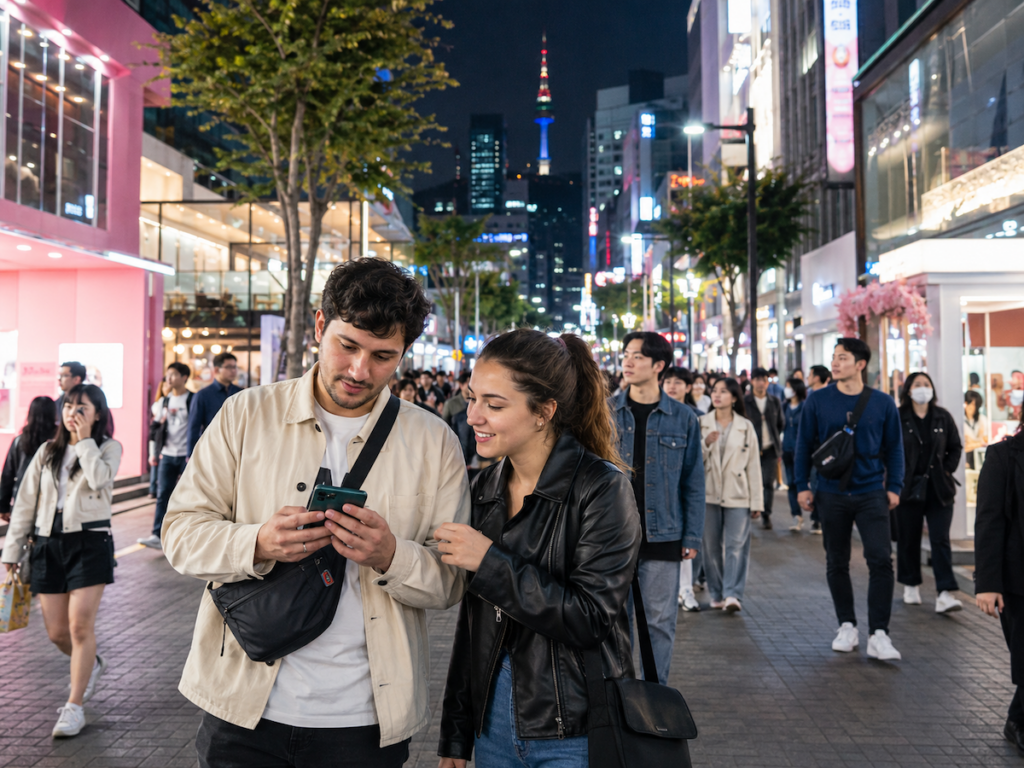
Using a taxi app can help, but some apps may require a Korean phone number or local payment method.
If you cannot communicate clearly, prepare the destination address in Korean before getting in. Showing the address on your phone is often enough.
Incheon Airport to Seoul: Choose the Route Based on Your Situation
Getting from Incheon Airport to Seoul depends on your luggage, time, budget, and destination.
The main options are:
- Airport Railroad
- Airport limousine bus
- Taxi
- Private transfer
The Airport Railroad is efficient and affordable, especially if you are going to Seoul Station, Hongdae, or areas connected by subway.
Airport buses are often better if your hotel is near a bus stop. They are comfortable and useful when you have luggage.
Taxis are convenient but more expensive. They can be worth it if you are arriving late, traveling with family, or staying somewhere difficult to reach by public transport.
There is no single best option. The best route depends on where you are staying.
Expressways and Intercity Travel: Korea Is More Than Seoul
If you travel outside Seoul, you may use express buses, intercity buses, highways, or trains.
Korean expressways are modern and efficient, but they come with their own travel culture.
You may notice:
- Toll gates
- Highway rest areas
- Express bus terminals
- Dedicated bus lanes
- Fast-moving traffic
- Rest stops with surprisingly good food
For many foreigners, Korean highway rest areas are one of the most interesting parts of road travel. They are not just gas stations. They often have food courts, snacks, restrooms, local specialties, and small shops.
If you are traveling by car or express bus, understanding how Korean highways work makes the trip much more comfortable.
Highway Rest Areas: More Useful Than You Expect
Korean highway rest areas are surprisingly important.
They are places where travelers stop for:
- Food
- Restrooms
- Coffee
- Snacks
- Local specialties
- Fuel
- Short breaks
If you are used to simple gas stations in other countries, Korean rest areas may feel more developed.
Some are famous for specific foods. Others are large enough to feel like small travel centers. During holiday seasons, they can become extremely crowded.
For foreign visitors, rest areas are worth understanding because they are part of the Korean travel experience. If you take a bus or car outside Seoul, you will probably encounter them.
They also show something important about Korea: even travel breaks are organized, fast, and food-centered.
Lost and Found: What to Do If You Lose Something
Losing something in Seoul is stressful, but the recovery system can be better than visitors expect.
If you lose an item on the subway, bus, taxi, or in a station, there are usually official lost-and-found channels.
The key is to act quickly.
You should try to remember:
- The line or bus number
- Station or stop
- Direction of travel
- Time
- Seat or area if possible
- Description of the item
Seoul’s transportation system is highly organized, and items are sometimes recovered faster than foreigners expect.
Still, it helps to know where to report and what information to provide. If you wait too long, the process becomes harder.
Walking in Seoul: Sometimes the Best Option Is Your Feet
Seoul is a public transport city, but walking still matters.
Some neighborhoods are best experienced on foot:
- Hongdae
- Ikseon-dong
- Myeongdong
- Seongsu
- Euljiro
- Gwangjang Market area
- Han River parks
Walking helps you understand how Seoul changes from district to district. One subway stop can feel completely different from the next.
But Seoul is not always flat or simple. Sidewalks can be crowded. Some areas have hills. Underground passages can be confusing. Crosswalks may not always be exactly where you expect.
If you are traveling with elderly parents, children, or a wheelchair user, check walking distance carefully. A “10-minute walk” on a map can feel very different depending on slopes, crowds, and crossings.
Transportation in Seoul: What Feels Different?
Here is a simple comparison.
| Transport System | In Seoul | What Foreigners Often Expect |
|---|---|---|
| Subway | Fast, clean, exit-number based | Station name is enough |
| Bus | Useful but route-heavy | Easier to understand at first |
| Taxi | Safe, but address communication matters | Driver understands English place names |
| Airport transfer | Multiple good options | One obvious best route |
| Expressways | Organized with strong rest-area culture | Mostly just highways |
| T-money | Essential for smooth movement | Optional transit card |
| Walking | Useful but sometimes crowded | Short distances always feel easy |
The pattern is clear.
Seoul’s transport system is excellent, but it works best when you understand the details.
Where Should You Start First?
If you are new to Seoul, start in this order:
- Get a T-money card
- Learn the subway map and exit numbers
- Understand bus tapping and transfers
- Save your hotel address in Korean
- Learn airport transfer options before arrival
- Use taxis when public transport becomes inconvenient
- Read basic subway rules and fines
- Know what to do if you lose something
This order works because each step removes one layer of confusion.
Once you understand the subway and T-money system, Seoul becomes much easier. Once you understand buses and taxis, the city opens up even more. Once you understand airport transfers and intercity travel, Korea becomes much easier to explore beyond Seoul.
Final Thoughts
Learning how to get around Seoul is not just about memorizing subway lines.
It is about understanding how the city moves.
Seoul is fast, organized, and extremely connected. But that same efficiency can feel confusing when you are new.
The subway, buses, taxis, airport trains, expressways, rest areas, and lost-and-found systems all work well once you understand the logic behind them.
Start with the basics. Get a T-money card. Learn subway exits. Watch how locals move. Prepare Korean addresses. Do not panic if you make a mistake.
Once the system clicks, Seoul becomes one of the easiest big cities in the world to move through.