Introduction
This Korean expressway guide is for foreigners who plan to rent a car, take an intercity bus, or simply understand how highways work in Korea before traveling between cities.
Korean expressways are efficient, well-maintained, and usually easy to use once you understand a few local details. The parts that can confuse visitors are not the roads themselves, but the toll system, Hi-Pass lanes, bus-only lanes, rest areas, speed cameras, and the way Korean drivers use different lanes.
If you are used to highways in the United States, Europe, Japan, Australia, or Singapore, Korea may feel familiar in some ways and surprisingly different in others. You drive on the right side of the road, most major signs include English, and navigation apps are helpful. But you also need to know when not to enter a Hi-Pass lane, why highway rest stops are a big part of Korean travel culture, and how strictly cameras enforce speed and lane rules.
This guide explains the essentials of Korean expressways in a practical way, including tolls, Hi-Pass, rest stops, bus-only lanes, drowsy driving rest areas, safety rules, and tips for foreign drivers using rental cars in Korea.
Quick Answer: What Foreigners Should Know About Korean Expressways
If you are driving in Korea for the first time, Korean expressways are usually easy to use, but a few local rules can surprise foreign drivers.
The most important things to know are simple: Korea drives on the right side of the road, expressways are toll roads, Hi-Pass lanes are only for vehicles with an electronic toll device, rest stops are a major part of highway travel, and bus-only lanes should be avoided unless you are legally allowed to use them.
For most foreign visitors, the road itself is not the hardest part. The confusing moments usually happen at toll gates, rest areas, navigation exits, speed cameras, and lane markings.
Here is the quick version before we go deeper.
| Topic | What You Need to Know |
|---|---|
| Driving side | Korea drives on the right side of the road |
| Tolls | Most expressways require toll payment |
| Hi-Pass lanes | Use only if your rental car has Hi-Pass installed |
| Rest stops | Korean expressway rest areas are large and useful |
| Bus-only lanes | Do not use them unless your vehicle is allowed |
| Navigation | Naver Map, KakaoMap, or in-car navigation may be more useful than Google Maps |
| Speed cameras | Speed enforcement is common and often automated |
If you remember only one thing, remember this: do not enter a Hi-Pass lane unless you are sure your car is equipped for it. For many foreign drivers, this is one of the easiest mistakes to make on a Korean expressway.
After that, the rest becomes much easier. Follow the signs, keep an eye on lane markings, take breaks at rest stops, and use navigation carefully before exits and toll gates.
Driving Direction in Korea vs. Other Countries
Korea uses right-hand traffic, meaning you drive on the right side of the road and overtake on the left. This is the same system as the U.S., Canada, and most European countries, but different from Japan, the U.K., Australia, and Singapore, where people drive on the left.
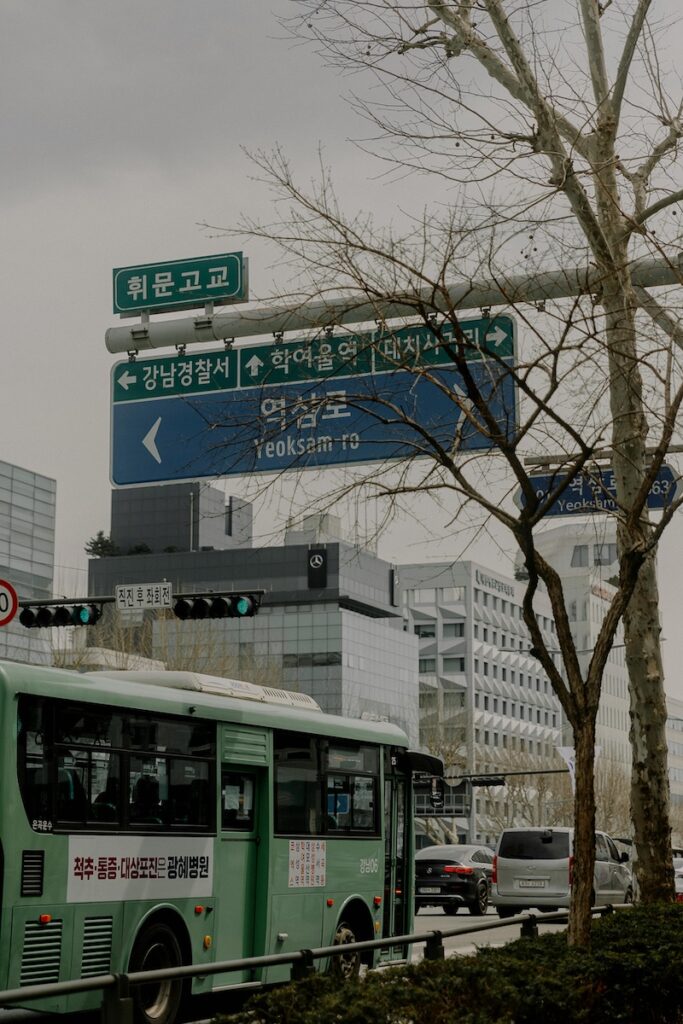
Road signage in Korea is relatively foreigner-friendly. Most major highways use bilingual signs in Korean and English. Direction signs are typically green with white text, while expressway route numbers are marked with blue shields. Unlike the U.S. Interstate system, expressway numbers in Korea are often two-digit numbers starting with “1” for major north-south corridors and “0” for circular beltways.
For foreigners used to left-side driving, such as British or Japanese travelers, adjusting to right-hand driving can be tricky at first. Car rentals usually provide a quick orientation, and many vehicles have navigation systems available in English.
The Development of Korea’s Expressway Network
The first expressway in South Korea, the Gyeongbu Expressway, was completed in 1970, connecting Seoul and Busan. At the time, the project was seen as overly ambitious, since few Koreans owned cars. Yet, it symbolized the nation’s industrial push, and today it remains the busiest expressway in the country.
Over the decades, the network expanded dramatically, and now over 4,000 kilometers of expressways connect every major city. The Korea Expressway Corporation (KEC) manages most of the system, ensuring safety, maintenance, and technological upgrades.
Some of the most important routes include:
- Gyeongbu Expressway (경부고속도로) – Seoul to Busan, the backbone of the system.
- Seohaean Expressway (서해안고속도로) – running along the west coast.
- Jungbu Expressway (중부고속도로) – central inland connection.
- Donghae Expressway (동해고속도로) – scenic coastal drive along the East Sea.
The network not only supports passenger traffic but also plays a vital role in Korea’s logistics and export-driven economy.
| Destination (From Seoul) | Primary Route | Toll Fee (Approx. KRW) | Travel Time (By Car) |
| Incheon Int’l Airport | Route 130 | ₩6,600 | 1h 00m |
| Gangneung (East Coast) | Yeongdong (No. 50) | ₩13,100 | 2h 40m |
| Busan (South Coast) | Gyeongbu (No. 1) | ₩25,200 | 4h 30m |
| Jeonju (Hanok Village) | Honam (No. 25) | ₩11,500 | 2h 20m |
| Sokcho (Seoraksan) | Seoul-Yangyang | ₩12,500 | 2h 10m |
Ready for a Korean Road Trip? > Don’t worry about public transit schedules. Rent a car and explore the hidden gems of Korea at your own pace.
Toll System on Korean Expressways
Manual Toll Collection
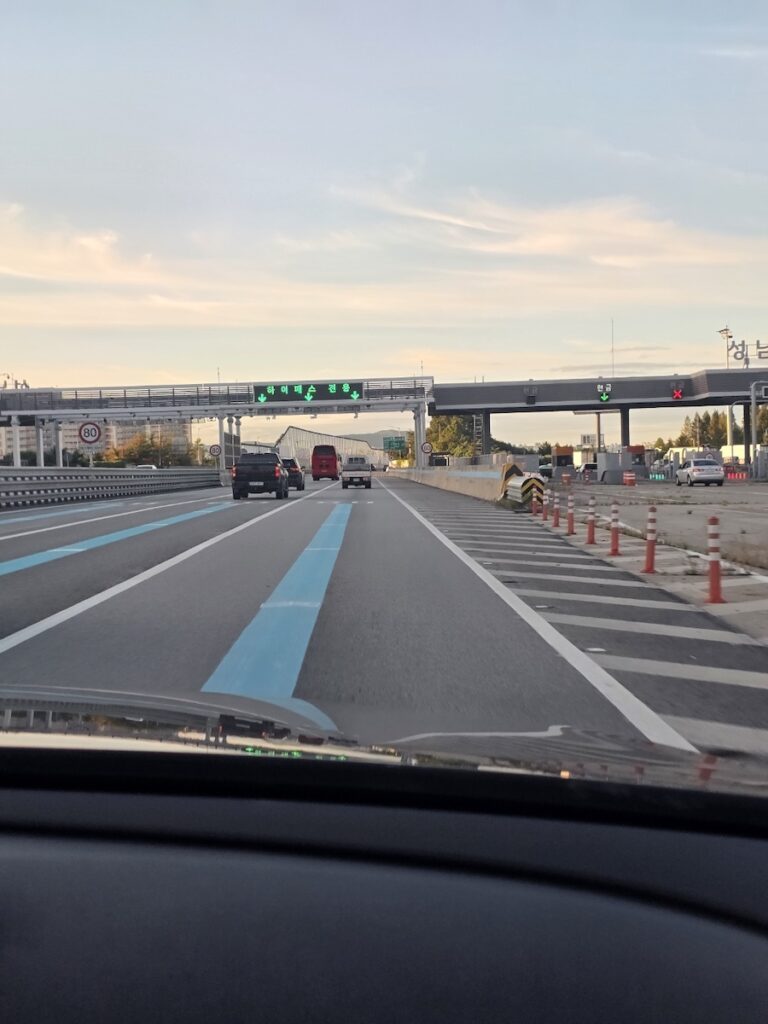
Traditional toll booths still exist on many highways, especially at entrances and exits. Drivers stop, take a ticket, and pay upon exiting based on distance traveled. Payment can be made in cash or card.
Hi-Pass Electronic Tolling
Most Korean drivers now use Hi-Pass, an electronic toll collection system similar to EZ-Pass in the U.S. or Telepass in Europe. Vehicles are equipped with an onboard device, and toll fees are automatically deducted when passing through Hi-Pass lanes without stopping.
Foreigners renting a car can usually request a Hi-Pass device for a small daily fee, which saves time and avoids traffic jams at toll plazas.
Comparing Toll Costs
Toll fees in Korea are moderately priced compared to other countries. For example:
- Driving from Seoul to Busan (about 325 km) costs around ₩25,000 ($18–20).
- In Japan, the same distance could cost over $100.
- In Germany, the Autobahn is free for cars but tolled for trucks.
- In the U.S., turnpike costs vary by state but can range from $20–40.
Thus, Korea’s expressways strike a balance: not free like some countries, but far cheaper than Japan’s.
Service Areas (휴게소) – A Korean Highway Icon
Perhaps the most beloved part of driving in Korea is stopping at a service area (휴게소). Unlike basic rest areas in many countries, Korean service areas are destinations in themselves.
Food Culture
Every 휴게소 is famous for at least one local dish. Travelers often choose which rest stop to visit based on food reputation. Popular items include:
- Hotteok (호떡) – sweet pancakes filled with sugar and nuts.
- Tteokbokki (떡볶이) – spicy rice cakes.
- Hodu-gwaja (호두과자) – walnut-shaped pastries filled with red bean paste.
- Regional specialties – like octopus dishes on the West Coast or dumplings in mountain areas.
For foreigners, highway rest stops are a perfect place to sample Korean street food in a safe, convenient environment.
Facilities
In addition to food, service areas include:
- Restrooms (clean and regularly maintained).
- Convenience stores and ATMs.
- Souvenir shops with local products.
- Playgrounds and dog-friendly areas.
- Even gas stations and EV charging stations.
Comparison with Other Countries
- U.S. rest areas: usually just bathrooms and vending machines.
- European motorway services: closer to Korea but often more expensive.
- Japan’s expressway rest stops: similar in concept, but Korean service areas emphasize regional snacks more.
Bus-Only Lanes (버스전용차로)
To combat holiday traffic jams, Korea introduced bus-only lanes on the Gyeongbu Expressway. These lanes, usually the far-left lane, are reserved for buses during designated hours.
- Weekends & holidays: typically from 7 AM to 9 PM.
- Enforcement: cameras record violators, and fines are high.
For foreigners, this is similar to the HOV (carpool) lanes in the U.S., but with stricter enforcement.
Shoulder Lanes (갓길)
The shoulder, or 갓길 in Korean, is reserved for emergencies only. It may be temporarily opened during holiday congestion, but normally it is illegal to drive on it.
Misuse of the shoulder results in heavy fines and penalty points. Emergency vehicles have priority, and drivers must pull over if an ambulance approaches.
Drowsy Driving Rest Areas (졸음쉼터)
One of Korea’s unique road safety innovations is the 졸음쉼터 (drowsy driving rest area). These are small stops placed every 20–30 km on busy expressways, designed to reduce accidents caused by fatigue.
They typically have:
- Parking spaces.
- Basic restrooms.
- Benches and vending machines.
They are not full service areas, but they are life-saving for tired drivers. This concept is relatively rare outside of Asia, making it uniquely Korean.
Lane Discipline: Driving and Passing Lanes
Korea enforces strict lane discipline:
- Right lanes = driving lanes.
- Left lane = passing only.
Hogging the passing lane is punishable by fines. This is similar to Germany’s Autobahn, where lane rules are enforced rigorously. Foreign drivers must adapt quickly, since lingering in the left lane may cause frustration and penalties.
Safety and Traffic Rules on Korean Highways
- Speed limits: usually 100–120 km/h on expressways, 80–90 km/h for buses and trucks.
- CCTV enforcement: automated cameras issue tickets, with almost no exceptions.
- Alcohol limit: 0.03% BAC, far stricter than in the U.S. (0.08%).
- Seat belts: mandatory for all passengers.
- Child seats: required for young children.
Foreigners should note that Korea’s traffic system is digitally monitored, so rule-breaking is almost always caught.
Tips for Foreigners Renting Cars
- International Driving Permit (IDP) is required.
- Many rental agencies provide Hi-Pass devices for tolls.
- Navigation apps: Naver Map and Kakao Map are more reliable than Google Maps.
- Parking at service areas is usually free and well-organized.
Expressways and Public Transport
Intercity buses are the backbone of Korea’s highway transport. These buses use the expressway system heavily and often stop at rest areas to let passengers stretch.
Express buses are comfortable, affordable, and convenient for foreigners who don’t want to drive themselves.
Future of Expressways in Korea
The government is pushing toward:
- Smart tolling with license plate recognition.
- Eco-friendly sound barriers with solar panels.
- Potential expansion of underground expressways.
- Debates about an expressway in Jeju Island (currently controversial).
Conclusion
Korea’s expressways are more than roads—they are a blend of efficiency, culture, and safety. For foreigners, they offer a chance to experience not only convenient travel but also unique cultural encounters, from legendary rest stop snacks to innovative safety systems like drowsy rest areas.
Whether you’re planning a road trip, renting a car for business, or simply curious about how Korean highways compare with those of other countries, knowing these details will help you travel confidently and safely.