Making a korea subway phone call feels completely normal the first time you do it.
Your phone rings somewhere between Hongdae and Sinchon. You answer. Normal volume. Normal conversation. Maybe 90 seconds. Nothing aggressive, nothing unusual.
You hang up and look around.
Nobody said anything. Nobody moved. The car is still packed and still silent.
But something shifted. A kind of atmospheric pressure change that had nothing to do with the tunnel outside.
That feeling is what this guide is about.
Quick Answer: Why Don’t Koreans Make a Phone Call on the Subway?
Korean subway culture treats the shared acoustic space of a train car as collective property. A korea subway phone call does not violate any written law. But it signals to everyone around you that you are prioritizing your own comfort over theirs. In a culture where group consideration operates almost automatically, that signal lands harder than most foreigners expect.
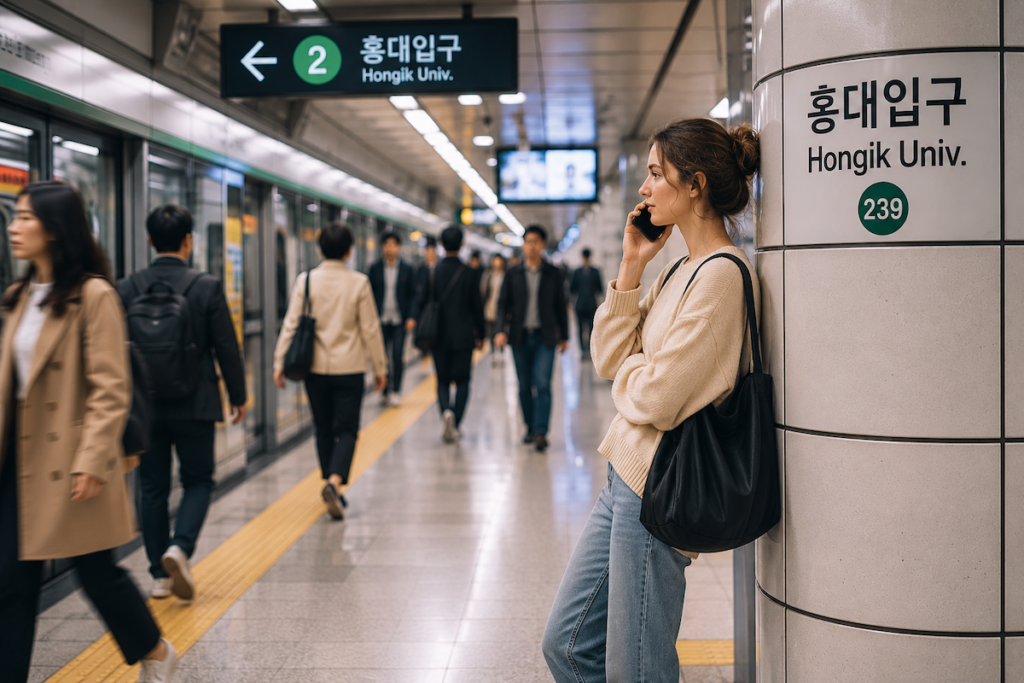
Korea Subway Phone Call Culture: The Silence Is Not Shyness
First-time visitors make the same misread.
They board a Seoul subway car, see hundreds of people in absolute silence, and conclude that Koreans must be introverted. Reserved. Possibly unfriendly.
That interpretation is wrong in an interesting way.
Walk those same people into a samgyeopsal restaurant at 9 PM on a Friday and the noise becomes something completely different. Laughter, overlapping conversations, soju glasses meeting across cramped tables.
The silence on the subway is not a personality trait. It is a mode.
Tokyo operates similarly, but for different reasons. Japan’s train silence tends toward rule-following — recorded announcements on most lines explicitly discourage phone calls. The compliance is visible and enforced.
London is messier. Phone conversations happen regularly on the Tube. People tolerate it with varying degrees of resentment.
Seoul sits in its own category. There are no widespread recorded prohibitions against a korea subway phone call. Nobody will fine you. There is just a collective agreement so deeply embedded it functions like gravity. You only notice it when something pushes against it.
What Foreigners Usually Get Wrong About Korea Subway Etiquette
The common assumption: if nobody is talking, nobody wants to interact.
Wrong frame entirely.
Korean public spaces operate on a concept with no clean English translation — shared restraint in collective environments. The subway car is not your space. It belongs to everyone on it simultaneously, and everyone has implicitly agreed to minimize their claim on the shared atmosphere.
This is not politeness in the Western sense.
It is structural. Assumed.
When you board a Seoul subway car, you enter a temporary collective where the unspoken agreement is: minimize your acoustic footprint. Let the shared space stay neutral.
A korea subway phone call breaks that agreement. Not loudly. Not aggressively. Just clearly.
What Actually Happens When You Make a Korea Subway Phone Call
Most foreigners expect one of two outcomes: either nobody cares, or someone says something directly.
Neither usually happens.
| What foreigners expect | What Koreans actually do |
|---|---|
| Nobody notices or cares | Everyone notices immediately |
| Someone asks you to stop | Nobody says a word |
| A visible reaction | Eyes stay on phones, posture shifts slightly |
| Confrontation if it continues | Silence hardens. Space around you expands. |
| Forgiveness once you hang up | The call is remembered for the rest of the ride |
The absence of confrontation is not acceptance.
Korean social culture avoids direct public conflict with strangers. Expressing displeasure openly would itself violate the same collective restraint your phone call already broke. So nobody says anything.
What happens instead is a quality of awareness that becomes almost physical. You become the most salient object in the car. Not because anyone looked at you. Because everyone very deliberately did not.
The One Exception That Confuses Everyone
Elderly passengers call freely.
Spend enough time on Seoul’s subway and you will see it. An older man past 70, answering his phone at full volume. A lengthy conversation about dinner or family business, delivered to the entire car without apparent awareness that the unwritten rules exist.
And around him: nothing.
This confuses foreigners who just got silently judged for a 90-second korea subway phone call.
The exception reveals how the rule actually works. The subway’s acoustic agreement applies most forcefully to people understood to know better. Younger Koreans. Working-age adults. Anyone who has internalized modern Seoul’s collective urban contract.
Elderly passengers exist in a different social category. Confronting or visibly judging an older person would be more transgressive than the call itself.
As a foreign visitor, you do not get that exemption.
Why Young Koreans Would Rather Stand for 40 Minutes Than Sit There
There is a specific type of exhaustion that happens on Seoul’s rush hour subway.
Every regular seat is taken. The car is packed. Your legs ache. The priority seats at the far end of the car are completely empty.
Most foreigners would sit down and plan to move when someone needs it.
Most young Koreans would not sit there under almost any circumstances.
This is not a rule. There is no sign that says young people are forbidden. The priority seats exist, technically, for anyone who needs them.
But something else is happening.
Young Koreans have been publicly confronted in those seats enough times — or watched enough viral videos of it happening to others — that the calculus has shifted. The risk of sitting there and having an elderly passenger board is not worth the few minutes of rest. The confrontation that might follow, the stares, the voice loud enough for the entire car to hear, costs more socially than standing.
So they stand.
What makes this interesting for foreigners is how it mirrors the phone call dynamic exactly. The silence in the subway car is not just about sound. It is about risk management in a public space where judgment can arrive without warning and without the option to argue back.
A Korean in their 20s who takes a phone call in the subway and a Korean in their 20s who sits in the priority seat are doing the same calculation. Both know the rule is unwritten. Both know enforcement is unpredictable. Both know the cost of getting it wrong is visible, social, and shared with everyone in the car.
The result is a generation that has learned to preemptively erase themselves from situations that could attract that attention.
For foreigners, this looks like extreme politeness. From the inside, it often feels more like low-level vigilance.
What Foreigners Should Actually Do With Priority Seats
Sit in them if you need to. You are not breaking a law.
But watch the doors at every stop. If an elderly passenger, a pregnant woman, or anyone visibly in need boards, stand before they have to ask. Do it quickly and without making it a performance.
That is the actual standard. Not the empty seat. The speed of the response.
The Earphone War Nobody Told You About
Seoul Metro logged 2,734 noise complaints in just four months of 2025. Nearly 23 complaints per day, almost all of them about one thing: passengers playing phone audio without earphones.
That number matters because it tells you something the quiet subway car hides.
The silence is not natural. It is maintained.
Underneath it is a constant low-pressure negotiation between what people want to do on their phones and what the shared space permits. The subway’s acoustic agreement does not enforce itself automatically. It requires ongoing collective participation, and when that participation breaks down — usually via an elderly passenger playing a video at full speaker volume — the reaction online and in person is immediate and heated.
In 2026, Seoul Metropolitan Government and Seoul Metro ran a formal campaign with KT and LG U+ specifically to promote earphone use on the subway. Not a suggestion. A campaign.
The fact that a government campaign was necessary tells you everything about how contested this space actually is.
The Earphone as Social Armor
Look around any Seoul subway car and you will notice something beyond the silence.
Almost everyone is wearing earphones. Not because they are all listening to something. Many are not. The earphones are in, but the audio is off, or low, or nonexistent.
Earphones in Seoul function as social signaling as much as audio equipment. They communicate: I am in my own space. I am not going to bother you. I am participating in the collective agreement.
A person wearing earphones who takes a phone call still breaks the agreement, but less severely than someone with no earphones who answers at full volume. The earphones establish intent. They say: I understand the rules of this space.
For foreigners who do not own earphones or forget them, that missing signal reads differently than intended. It is not a major problem. But it removes a layer of social context that makes the subway easier to move through.
Carrying earphones in Seoul — even cheap ones — is less about the audio and more about showing up to the shared space correctly equipped.
How to Handle a Korea Subway Phone Call Without Embarrassing Yourself
Four steps.
Step 1: Let it go to voicemail. Text back immediately. This is what most younger Koreans do automatically.
Step 2: Exit at the next platform. Korean stations have open platform areas. Step off, take the call, board the next train. Five minutes. Worth it.
Step 3: If you cannot exit, drop volume and keep it under 30 seconds. Move toward the door. Face slightly away from the car interior. Treat it as a whisper-level emergency.
Step 4: Hang up before the conversation feels finished. Every extra sentence past the essential information is a cost paid by everyone around you.
This Is Not About Politeness. It Is About Density.
Seoul moves approximately 7.5 million subway passengers per day.
At that scale, the acoustic environment of a train car becomes a shared resource the same way air is a shared resource. In lower-density cities, one korea subway phone call disappears into the background. In Seoul, the commons are compressed and the collective has no choice but to develop strong norms about how they get used.
The subway silence is not a cultural quirk.
It is a rational adaptation to density.
Once you understand that, the silence stops feeling like a rule imposed on you and starts feeling like something worth choosing.
→ This article is part of our complete guide: [Korean Social Culture for Foreigners]
Closing
There is a moment that happens to almost every foreigner after a few weeks in Seoul.
Your phone rings on the subway. Your hand moves toward it automatically.
And then stops.
Not because you remembered a rule. Not because you are afraid of a reaction.
Because the silence around you already feels like something worth keeping.
That is when you stop being a visitor on Seoul’s subway and start being part of how it works.