Korean social culture for foreigners is full of moments nobody warns you about.
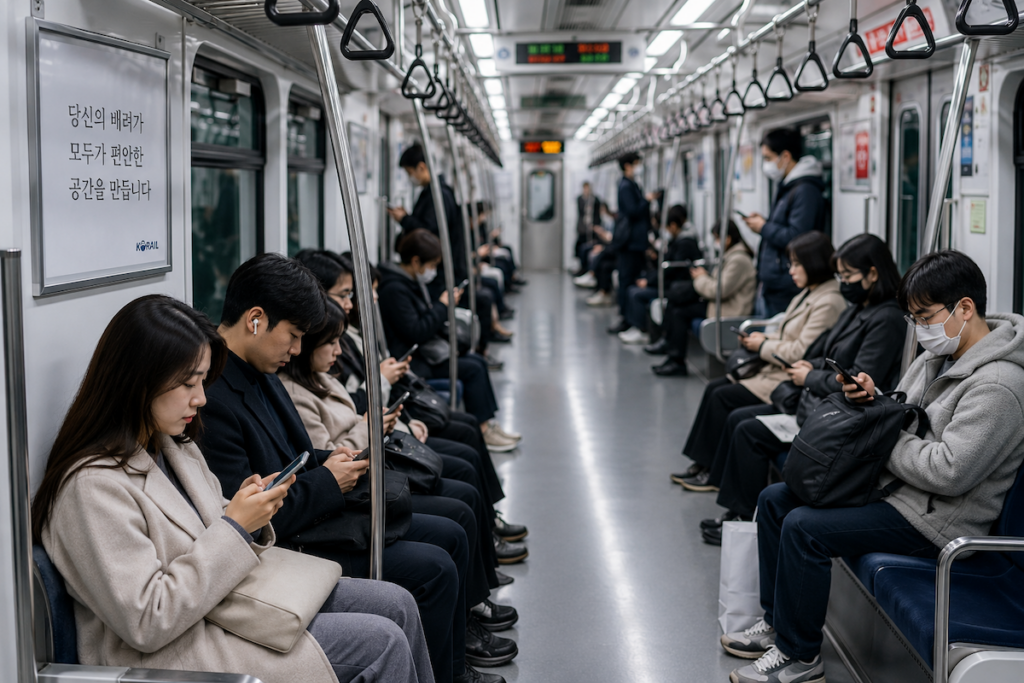
The subway car packed with hundreds of people — and complete silence.
Someone asking your age within ten minutes of meeting you.
A friend you’ve eaten with twenty times who has never once said “come over.”
A “yes” that slowly, quietly turns into nothing.
At first, these moments feel random. Confusing. Sometimes even rude.
But they are not random at all.
Every single one of them is connected — by the same invisible cultural logic that shapes how Koreans move through the world, build relationships, and communicate without words.
This guide explains that logic.
Once you understand it, Korea stops feeling like a place full of confusing contradictions. It starts feeling like a city operating on a frequency you simply hadn’t tuned into yet.
Quick Answer: Why Do Koreans Behave So Differently From Foreigners’ Expectations?
Korean social behavior is shaped by a deeply ingrained awareness of collective harmony, group comfort, and unspoken social hierarchy. Unlike many Western cultures where individual expression drives interaction, Korean social culture often prioritizes shared space, group emotional balance, and relationship context. This shows up across nearly every daily behavior — from subway silence and indirect communication to age-based hierarchy and slow-building friendships. Once foreigners understand the underlying logic, behaviors that initially seemed cold, intrusive, or confusing begin to feel purposeful and even considerate.
The One Concept That Explains Almost Everything: 눈치 (Nunchi)
Before explaining any specific behavior, there is one word every foreigner in Korea eventually encounters.
눈치 (Nunchi).
There is no perfect English translation.
The closest approximation: the ability to read a room. To sense what someone needs before they say it. To pick up on social atmosphere, group mood, and unspoken expectations — and adjust accordingly.
In Korean culture, Nunchi is not considered a personality trait. It is considered a social skill. A form of intelligence.
People with good Nunchi are admired. People with poor Nunchi — those who miss obvious social signals, who speak too loudly in quiet spaces, who push when pulling would work better — are quietly noticed.
This matters for foreigners because nearly every behavior described in this guide is, at its root, an expression of Nunchi.
The quiet subway. The indirect “no.” The slow friendship. The age question. The decision not to invite you home.
All of it connects back to a single social instinct:
Read the atmosphere. Adjust. Don’t inconvenience others. Don’t disrupt the shared space.
→ Dive deeper: Why Nunchi is Your Secret Key to Luxury Hotels and Dining in Seoul
The 6 Behaviors That Confuse Foreigners Most — And What They Actually Mean
1. Why Koreans Are So Quiet in Public
Walk into a Seoul subway car at rush hour. Eight hundred people. Standing room only. And the silence is so complete you can hear the train brake.
Most foreigners misread this immediately.
They must be introverted. Reserved. Maybe unfriendly.
That interpretation misses what is actually happening.
Korean public silence is not a personality trait. It is a mode — a collective agreement that shared physical space comes with shared acoustic responsibility. When you are on the Seoul subway, you are not in your space. You are in everyone’s space simultaneously.
This connects directly to the concept of 민폐 (minpye) — the feeling of causing inconvenience to others. In Korean social culture, becoming a burden to people around you, especially strangers in shared spaces, carries significant social weight. People grow up hearing: don’t bother others. Be aware of the people around you. Adjust.
The result is a city where:
- Phone calls on the subway feel like a violation of collective contract
- Loud conversations in quiet spaces attract quiet, invisible social pressure
- Even small courtesies — stepping aside, moving quickly through crowds, lowering voices — happen automatically
What foreigners experience as intensity or coldness is often something closer to collective consideration.
And strangely enough, after enough time in Seoul, most foreigners find themselves lowering their voices on the subway too — not because anyone told them to, but because the social logic eventually makes sense.
→ Read the full guide: Why Koreans Are So Quiet in Public
→ Related: Korea Subway Phone Call — Why Koreans Go Silent
2. Why Koreans Ask Your Age So Quickly
You meet someone. Five minutes pass.
Then: “How old are you?”
In many Western countries, age is private information. Asking too soon feels intrusive. In some workplace contexts, it is even legally sensitive.
In Korea, the question lands completely differently.
Age in Korean social culture is not personal data. It is relationship infrastructure.
The Korean language has multiple speech levels — formal, polite, casual, intimate — and which one you use depends significantly on the relative age and social position of the people involved. Asking age early is not nosiness. It is practical. It answers the question underneath the question:
How should we relate to each other?
Once age is established, other things click into place. Titles like 형 (hyung), 누나 (noona), 오빠 (oppa), and 언니 (unnie) — which roughly translate to older brother/sister figures — enter the relationship. Speech levels adjust. Social expectations clarify.
What foreigners experience as a surprisingly personal question is often a social shortcut — a way to establish the structure of a relationship quickly so that both people can interact more comfortably.
The system feels rigid from outside. From inside Korean social logic, it often functions as a tool for reducing awkwardness, not creating it.
→ Read the full guide: Why Koreans Ask Your Age So Quickly
3. Why Koreans Ask Personal Questions So Early
Age is usually just the beginning.
Within the first conversation, questions may arrive about your job, your salary range, your relationship status, your family situation, and where you live.
For foreigners from cultures where privacy is protected early in relationships, this feels disorienting. Sometimes even offensive.
The cultural gap here is significant.
In many Western social frameworks, respect = protecting someone’s privacy. You wait to be invited into personal territory. Asking too soon feels presumptuous.
In Korean social culture, the logic often reverses. Familiarity = interest. Personal questions signal that someone wants to understand your life, not catalog your data. The underlying motivation is usually:
Help me understand who you are so I know how to relate to you comfortably.
There is also a mutuality that foreigners sometimes miss. Koreans asking personal questions are usually willing — often eager — to answer the same questions themselves. The exchange is not interrogation. It is context-building. Both people reveal. Both people understand.
This dynamic becomes especially visible with older Koreans — particularly grandparent-generation figures — where questions about marriage, children, eating habits, and health are expressions of care rather than intrusion. The cultural code translates roughly to: I’m asking because I’m paying attention to you.
Understanding the intention does not mean foreigners have to answer everything. Polite deflection is always acceptable. But the misread — they’re being rude — usually dissolves once the intention becomes clear.
→ Read the full guide: Why Koreans Ask Personal Questions So Early
4. Why Koreans Never Say “No” Directly
This one may be the most practically important behavior for foreigners to understand.
You ask a Korean colleague if they can meet Friday.
They say: “That might be a bit difficult.”
You wait.
Friday comes and goes.
In many Western communication cultures, a “no” is a “no.” Said directly, clearly, often with an explanation. The discomfort of delivering bad news is considered worth the clarity it provides.
Korean communication culture often operates from a different priority: protecting the social atmosphere and saving face — for both people.
Direct rejection can feel socially risky. It can embarrass the person being rejected. It can create awkward tension. It can damage the relational climate between two people. So the rejection gets softened. The “no” gets wrapped in something that looks, from the outside, like a “maybe.”
Common phrases and what they often actually mean:
| What is said | What it often means |
|---|---|
| “Let’s meet sometime” | Warm farewell, not a real plan |
| “Maybe next time” | Usually no |
| “That might be difficult” | Soft rejection |
| “I’ll think about it” | Likely already decided |
| “I’m busy these days” | Not interested right now |
The practical key for foreigners: watch actions more than words. Someone who genuinely wants to meet will suggest an alternative date. Someone being politely indirect will stay vague indefinitely.
This is not dishonesty. It is a different communication system — one that prioritizes relational harmony over explicit information transfer.
→ Read the full guide: Why Koreans Never Say No Directly
5. Why Korean Friendships Feel So Slow
You’ve had dinner with someone six times. You’ve stayed out until 2 AM together. You’ve laughed, shared food, exchanged numbers.
And yet — something still feels uncertain.
Are we actually friends?
For foreigners accustomed to fast emotional bonding, Korean friendships can feel like they’re moving through thick water. Warm, but carefully. Present, but guarded.
Understanding this requires separating two things that foreigners often conflate: friendliness and closeness.
In Korean social culture, someone can be genuinely warm — enthusiastic, attentive, generous — while still maintaining emotional distance. Warmth does not automatically equal intimacy. Friendliness is not the same as closeness.
Closeness in Korea tends to build through a different mechanism: consistency and shared experience over time, rather than immediate emotional disclosure. The question a Korean friendship is quietly answering is not do we have chemistry? but can I trust this person to be reliable over time?
This is why school and university friendships in Korea often become some of the deepest relationships in a person’s life. Years of shared routine, shared stress, shared meals — trust accumulates slowly, and then becomes surprisingly durable.
For foreigners, the practical shift in approach makes a significant difference:
- Consistency matters more than intensity. Showing up repeatedly outperforms one dramatic emotional conversation.
- Group settings often feel more natural than one-on-one early on. Korean friendships frequently develop inside shared social contexts — work dinners, hiking groups, language exchanges — before becoming more personal.
- Distance is not rejection. What feels like coldness in month one may become quiet loyalty by month six.
The moment many foreigners describe as a turning point: when a Korean person they know does something unexpectedly practical and caring — shows up with medicine, helps them find a hospital, insists on walking them to the station — without making it emotional. That is often when the friendship has already become real.
→ Read the full guide: Why Korean Friendships Feel Slow at First
6. Why Koreans Rarely Invite You to Their Home
Months pass. You eat together regularly. The friendship feels real.
And yet: no invitation to come over.
For foreigners from cultures where casual home visits signal genuine closeness, this absence can feel like a wall. Are we not actually close? Is something wrong?
Usually, nothing is wrong.
Understanding the home invitation gap requires understanding something about what home means in Korean social culture — particularly in Seoul.
Korean homes, especially apartments in Seoul, carry significant social information. Apartment size, neighborhood, building type — these things quietly communicate financial position and social status in ways many Koreans are acutely aware of. Inviting someone home can feel, to some people, like revealing more about their life than they’re comfortable sharing — not out of shame, but out of a preference for keeping private life private.
There is also a practical dimension. Seoul apartments are often small. Many younger Koreans live in studio-sized spaces or with family. Hosting casually is simply not always physically comfortable.
But perhaps most importantly: Korean hospitality often expresses itself outside the home rather than inside it.
The friend who never says “come over” may still:
- Insist on paying for dinner
- Spend an hour helping you navigate a bureaucratic problem
- Text to ask if you got home safely
- Show up when you’re sick with food you didn’t ask for
This is care expressed differently — through action, effort, and time rather than through physical space. It is not lesser friendship. It is friendship in a different language.
When a Korean person does eventually invite you home, pay attention. In many cases, it is a quiet signal: we’re actually close now.
→ Read the full guide: Why Koreans Rarely Invite You to Their Home
The Bigger Picture: How These Behaviors Connect
These six behaviors are not isolated cultural quirks. They form a coherent system.
At the center of that system is a fundamental difference in how Korean social culture conceptualizes the relationship between the individual and the group.
In many Western cultural frameworks, the starting point is individual: What do I want? What am I comfortable with? What are my preferences? Social behavior is built outward from that individual core.
Korean social culture often starts from a different point: What does the situation require? What does the group need? What will maintain harmony? Individual preference is real and present, but it is filtered through a constant awareness of collective comfort.
This creates the behaviors foreigners notice:
| Behavior | Western Reading | Korean Social Logic |
|---|---|---|
| Public silence | Coldness, introversion | Collective acoustic responsibility |
| Age questions | Intrusive, rude | Relationship infrastructure |
| Personal questions | Boundary violation | Context-building, interest |
| Indirect “no” | Dishonesty, confusion | Face-saving, harmony preservation |
| Slow friendship | Rejection, distance | Trust built through consistency |
| No home invitation | Not truly close | Privacy, hospitality expressed differently |
None of these behaviors are about disliking foreigners. None of them are about exclusion. They are the natural expression of a social operating system that runs on different assumptions than the ones most foreigners grew up with.
What Changes When You Understand This
Something real happens when foreigners internalize Korean social logic rather than just tolerating it.
The subway silence stops feeling oppressive and starts feeling considerate.
The age question stops feeling invasive and starts feeling like an attempt at connection.
The slow friendship stops feeling like rejection and starts feeling like trust being built carefully.
The indirect “no” stops feeling like confusion and starts feeling like someone trying not to hurt you.
None of this requires foreigners to abandon their own cultural instincts. You do not need to become Korean. But understanding the logic — really understanding it, not just knowing it intellectually — changes how Korea feels on a daily basis.
Most long-term foreigners in Seoul describe some version of the same experience: there is a before and an after. Before the system makes sense, and after. The after is dramatically easier.
Frequently Asked Questions
Do foreigners have to follow Korean social rules?
No — but understanding them makes daily life significantly easier. Most Koreans are not expecting foreigners to perform Korean social etiquette perfectly. What people usually appreciate is awareness and genuine effort. Small signals — lowering your voice on the subway, showing interest in the age hierarchy, reading the atmosphere before acting — communicate respect more effectively than perfect rule-following.
Why do Koreans seem warm but emotionally distant at the same time?
This is one of the most common descriptions foreigners use for early experiences in Korea. The warmth is genuine. The distance is also genuine. In Korean social culture, friendliness and closeness are not the same thing. Warmth can exist at a surface level while emotional trust builds slowly underneath. The distance usually decreases over time — often dramatically — once trust has accumulated through repeated experience.
Is Korean social culture changing?
Yes, significantly. Younger Koreans — particularly those in their twenties and early thirties — often hold different social values than previous generations. Many are more individualistic, more direct, more comfortable with foreigners, and more skeptical of rigid hierarchy. The behaviors described in this guide are most consistent across older generations and more traditional social contexts. Modern Seoul contains enormous variation, and many younger Koreans actively resist some of the norms described here.
How long does it take to really understand Korean social culture?
Most long-term residents describe a meaningful shift happening somewhere between six months and two years. The first months are typically the most disorienting. The moment when patterns start making intuitive sense — not just intellectual sense — is different for everyone, but almost everyone who stays long enough describes it happening.
What is the single most important thing to understand about Korean social behavior?
눈치 (Nunchi). If you understand what Nunchi is — the constant, subtle reading of social atmosphere and adjustment to collective needs — you have the key to almost every behavior that initially confuses foreigners. The quiet subway, the indirect communication, the slow friendship, the age hierarchy: all of it is, at some level, Nunchi in action.
The Guides in This Series
This article is the hub for a complete series on Korean social culture for foreigners. Each guide below goes deep on one specific behavior or concept:
- Why Koreans Are So Quiet in Public — The social logic behind Korea’s famously quiet public spaces
- Korea Subway Phone Call: Why Koreans Go Silent — What a phone call on the Seoul subway actually signals — and what to do instead
- Why Koreans Ask Your Age So Quickly — The relationship infrastructure behind Korea’s most famous question
- Why Koreans Ask Personal Questions So Early — What looks like boundary violation is usually an attempt at connection
- Why Koreans Never Say No Directly — How to read what Koreans actually mean when they say “maybe next time”
- Why Korean Friendships Feel Slow at First — Why Korean friendships take longer to start — and often last longer as a result
- Why Koreans Rarely Invite You to Their Home — What the absence of a home invitation actually means in Korea
- Nunchi Culture in Seoul for Luxury Travelers — How mastering Nunchi unlocks a completely different level of experience in Seoul
Final Thoughts
Korea rewards patience in a specific way.
The city does not give itself up immediately. The social culture has a learning curve. And for foreigners used to faster emotional access, the early weeks and months can feel genuinely disorienting.
But the understanding, when it arrives, tends to be solid.
Once you see the logic behind the quiet subway and the slow friendship and the indirect communication, you stop experiencing Korea as a place full of invisible walls. You start experiencing it as a place operating with a different kind of social intelligence — one built for density, for long-term relationships, for collective comfort, and for a form of consideration that often runs so quietly it looks, from outside, like coldness.
It is not coldness.
It is a city of eight hundred people in a subway car, all quietly agreeing not to make things harder for each other.
Once you see it that way, the silence starts feeling like something worth keeping.