Why Koreans never say no was something I didn’t even realize I was struggling with until a Korean friend smiled, said “Yeah, let’s meet sometime,” and then quietly disappeared from the conversation for the next three months.
At first, I thought something bad had happened.
Did I say something wrong?
Were they offended?
Did they secretly dislike me?
If you’re new to Korea — whether you’re visiting, studying, working, or simply trying to make Korean friends — this moment can feel surprisingly confusing. Especially if you come from places where people are more direct.
In many Western countries, a “yes” often means yes, a “no” means no, and “maybe” usually means uncertainty.
In Korea, things can feel… blurrier.
Someone says:
“Let’s eat sometime.”
But nothing happens.
Someone replies:
“That might be difficult.”
And you later realize they meant no.
Someone says:
“I’ll think about it.”
But you slowly learn the answer was already decided.
At first, this can feel frustrating. Even exhausting.
But after living in Korea for a while, you begin to understand something important:
Koreans are often not avoiding honesty.
They’re trying to avoid discomfort.
And once you understand the social logic behind indirect communication, daily life in Korea suddenly becomes much easier to navigate.
Quick Answer: Why Don’t Koreans Say “No” Directly?
In Korea, direct rejection can sometimes feel too harsh, embarrassing, or socially uncomfortable. Instead of saying “no” immediately, many Koreans soften the message to protect harmony, avoid awkwardness, or help the other person save face. This doesn’t mean Koreans are dishonest — it’s often a cultural communication style shaped by relationships and social context. Phrases like “Maybe next time” or “It might be difficult” can sometimes actually mean no, depending on the situation, tone, and timing.

The First Time This Feels Confusing in Korea
For many foreigners, the confusion starts with friendship.
You meet someone in Seoul.
Maybe at a language exchange in Hongdae. Maybe through work in Gangnam. Maybe over drinks near Itaewon.
The conversation goes well.
They smile.
They seem genuinely friendly.
Before leaving, they say:
“We should meet again sometime.”
Naturally, you think:
Great. We’re making plans.
Then you send a message.
No reply.
Or maybe:
“I’m busy these days.”
“Let’s do it next time.”
“We’ll see.”
Weeks pass.
Nothing happens.
For many foreigners, this feels personal.
In places like the US, Canada, Germany, Australia, or Northern Europe, declining plans is often straightforward:
“Sorry, I’m busy.”
“I don’t think I can.”
“I’m not interested.”
The answer may sting, but at least it’s clear.
In Korea, clarity is not always considered the most polite option.
Sometimes maintaining social comfort matters more.
And that difference changes everything.
Why Koreans Avoid Saying “No” Directly
The biggest misunderstanding foreigners make is assuming Koreans avoid direct rejection because they are being fake.
Usually, that’s not what’s happening.
To understand Korean communication, you have to understand something deeper about Korean social culture:
Relationships matter.
A lot.
Korean society traditionally values social harmony, emotional balance, and maintaining good interpersonal relationships.
In Korean, there’s even an unspoken awareness around keeping situations emotionally smooth — avoiding tension when possible.
Direct confrontation can feel unnecessarily uncomfortable.
Especially with:
- Someone older
- Someone you just met
- A coworker
- A friend of a friend
- Someone in a group setting
Saying a hard “no” can sometimes feel socially risky.
Instead, people often soften the rejection.
Not necessarily to deceive you.
But to reduce awkwardness.
Saving Face Matters More Than You Think
One thing foreigners often underestimate in Korea is how much people try to protect each other’s feelings publicly.
Imagine this:
Someone asks:
“Do you want to come to dinner this weekend?”
Instead of saying:
“No, I don’t really want to.”
A Korean person might say:
“Ah… I think I might be busy.”
Or:
“Maybe next time.”
Even if there are no actual plans.
Why?
Because directly rejecting someone can feel emotionally uncomfortable for both people.
The speaker avoids feeling rude.
The listener avoids feeling embarrassed.
Everyone leaves the interaction politely.
At least on the surface.
For foreigners, this can feel inefficient.
For many Koreans, it feels considerate.
Neither side is necessarily wrong.
They’re just operating under different social expectations.
What Koreans Say vs What They Often Mean
This is the part many foreigners wish someone explained earlier.
Because in Korea, meaning often lives between the lines.
Tone matters.
Timing matters.
Relationship context matters.
And yes — words sometimes mean something slightly different than their literal translation.
Here’s a simple way to think about it.
| What Koreans Say | What It Often Means |
|---|---|
| “Let’s meet sometime” | Friendly gesture, not a fixed plan |
| “Maybe next time” | Probably no |
| “I’ll think about it” | Usually unlikely |
| “That might be difficult” | Soft rejection |
| “I’m busy these days” | Often not interested right now |
| “We’ll see” | Uncertain or no |
Of course, context matters.
A close Korean friend might genuinely mean:
“Let’s meet next week.”
But someone you just met at a social event?
It may simply be a polite way to end the interaction warmly.
“Let’s Meet Sometime” Is Often Social Politeness
This one surprises foreigners the most.
In many countries, saying:
“We should hang out sometime”
usually implies real effort later.
In Korea, it can sometimes function more like:
“I enjoyed meeting you.”
“Let’s end this conversation positively.”
Think of it less like a calendar appointment.
And more like social warmth.
Especially after dinners, networking events, or drinking gatherings.
This becomes very obvious in Seoul.
You’ll notice people say things like:
“Come visit our office sometime.”
“Let’s grab coffee.”
“We should eat together.”
And then… nobody follows up.
At first, it feels confusing.
Later, you stop taking every sentence literally.
And life gets much easier.
Why This Happens More in Korea Than in Some Western Countries
A lot of foreigners notice this quickly because Korean communication feels different from more low-context cultures.
Here’s a simplified comparison:
| Situation | More Direct Cultures | Korea |
|---|---|---|
| Rejecting plans | “Sorry, I can’t.” | “Maybe next time.” |
| Disagreeing | Direct opinion | Softer wording |
| Criticism | Often explicit | Usually indirect |
| Invitations | Literal | Sometimes symbolic/social |
In countries like Germany or the Netherlands, directness can signal honesty.
In Korea, too much directness can sometimes feel cold.
Or unnecessarily harsh.
This doesn’t mean Koreans dislike honesty.
It just means social harmony is often prioritized differently.
And for foreigners, understanding this can prevent a surprising amount of misunderstanding.
Because once you stop translating Korean communication word-for-word, you start understanding the actual message underneath.
Why Foreigners Misread Korean Communication So Often
The hardest part about living in Korea is not usually the language.
It’s learning what people actually mean.
For many foreigners, confusion starts because the words themselves sound positive.
Someone smiles.
They sound warm.
They seem friendly.
Nothing sounds negative.
So naturally, you assume:
Great — this is going somewhere.
But in Korea, communication is often more contextual than literal.
Many Western cultures are considered low-context communication cultures. The meaning is usually in the words themselves.
Korea tends to lean much more toward high-context communication.
That means the real meaning often lives in:
- Tone
- Timing
- Relationship
- Context
- Social situation
- What is left unsaid
This is why foreigners sometimes feel confused or even emotionally hurt.
You think:
“Why didn’t they just tell me no?”
Meanwhile, the Korean person may think:
“I already said no politely.”
Nobody is trying to be rude.
You’re simply reading the same moment through two completely different cultural systems.
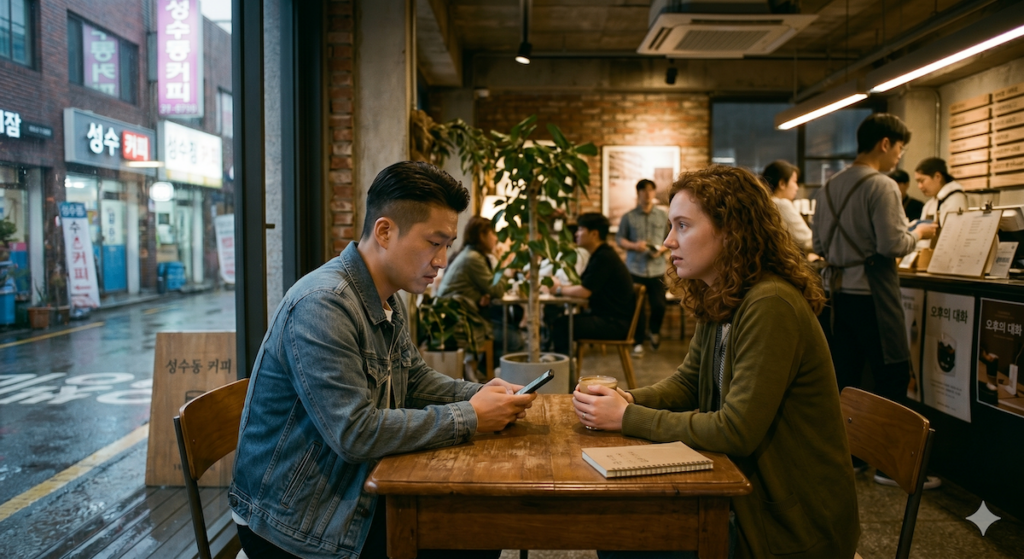
The KakaoTalk Situation Every Foreigner Eventually Experiences
If you stay in Korea long enough, there’s one moment that almost feels inevitable.
You message someone:
“Hey, are you free this Friday?”
And they reply:
“Maybe… I’m kind of busy these days.”
You wait.
Maybe they’ll confirm later?
Friday comes.
Nothing.
This is one of the biggest communication differences foreigners struggle with in Korea.
In some countries, people prefer certainty:
“No, sorry. I’m not available.”
In Korea, uncertainty can feel softer.
More polite.
Less emotionally uncomfortable.
Especially if:
- The relationship is still new
- They don’t want to hurt feelings
- They want to avoid awkwardness later
- They aren’t sure how directly they can speak
What feels vague to foreigners often feels considerate to Koreans.
That doesn’t mean you have to love it.
But understanding it helps prevent unnecessary stress.
What Koreans Really Mean in Everyday Situations
One thing that helps is learning patterns.
After living in Seoul for a while, you begin noticing certain phrases repeat themselves.
And over time, you stop hearing only the literal meaning.
You start hearing the intention.
Situation 1: Friendship
You meet someone at a language exchange near Hongdae.
You spend three hours talking.
Everything feels easy.
At the end:
“Let’s definitely hang out again!”
A week later?
Silence.
This does not automatically mean they disliked you.
Sometimes it simply means:
“I enjoyed meeting you.”
not:
“I am actively committing to future plans.”
In Korea, warmth in conversation does not always equal future action.
That distinction takes time for foreigners to learn.
Situation 2: Work Culture
This one surprises many expats.
You suggest an idea during a meeting.
Nobody says:
“No, that’s a bad idea.”
Instead you hear:
“Hmm… maybe we should think more.”
Or:
“That might be difficult.”
Or the classic:
“Let’s discuss later.”
At first, this feels hopeful.
Later, you realize:
Nothing is happening.
In many Korean workplaces, direct disagreement can feel uncomfortable, especially across hierarchy.
People often reject ideas indirectly.
This is not necessarily passive aggression.
It is often conflict avoidance.
Once you understand this, meetings suddenly become much easier to interpret.
Situation 3: Dating
This is where foreigners probably become the most confused.
You ask someone out.
They reply:
“Maybe later.”
“I’m busy these days.”
“These days are hectic.”
Weeks go by.
No alternative suggestion.
No new plan.
This is often the key difference.
In Korea, when someone genuinely wants to see you but is busy, they usually offer another possibility.
For example:
“This week is hard, but next Tuesday?”
Or:
“After work next week?”
No alternative at all?
That is often your answer.
Not always.
But often.
→ This article is part of our complete guide: [Korean Social Culture for Foreigners]
So How Do You Read the Real Meaning?
This is the practical part foreigners wish someone told them earlier.
The easiest rule?
Watch actions more than words.
Words in Korea can sometimes prioritize politeness.
Actions tend to reveal intention.
Ask yourself:
Are they making real effort?
Someone who genuinely wants to meet usually:
- Suggests another date
- Replies consistently
- Follows up later
- Makes specific plans
Someone being polite often stays vague.
Examples:
Likely genuine:
“I’m busy this weekend, but how about Wednesday?”
Likely polite decline:
“Let’s do it sometime.”
Are they being specific?
Specificity matters.
In Korea:
“We should grab coffee.”
can mean politeness.
But:
“Let’s meet at 2 PM Sunday near Euljiro.”
usually means commitment.
The more detailed someone becomes, the more likely the plan is real.
Are they consistent?
One delayed reply means nothing.
Koreans are busy.
Work culture is intense.
Long hours are normal.
But repeated vagueness?
Repeated avoidance?
Repeated “maybe next time”?
That often tells you something.
Try not to take it personally.
Sometimes people simply want to avoid hurting feelings.
When “Yes” Actually Means Yes in Korea
At this point, you might start wondering:
So can I trust anyone’s answer?
Yes.
Absolutely.
You just learn to recognize different signals.
In Korea, enthusiasm often appears through behavior rather than dramatic words.
A Korean friend who genuinely likes you may:
- Send restaurant suggestions
- Check your schedule
- Create a group chat
- Recommend places near your neighborhood
- Follow up days later
Korean friendship often grows slowly.
But once it becomes real, it can become surprisingly loyal.
Sometimes foreigners misjudge Korean relationships because they expect instant openness.
Korean friendships often warm up gradually.
Especially outside nightlife or social drinking settings.
Someone may seem reserved for months.
Then suddenly invite you to dinner with close friends.
That is often a big signal of trust.
Don’t Take It Too Personally
This might be the most important advice for foreigners in Korea.
If someone says:
“Maybe next time.”
And nothing happens?
Try not to interpret it as rejection of you.
Many Koreans grow up learning to avoid uncomfortable social situations.
Directly saying:
“I don’t want to.”
can feel emotionally difficult.
Especially in a culture where harmony matters.
Sometimes indirect communication is simply the social default.
Not a personal attack.
Not dishonesty.
Just a different communication system.
The moment you stop translating Korean words literally, life in Korea becomes much less frustrating.
You stop obsessing over mixed signals.
You stop overthinking every KakaoTalk message.
You stop wondering:
“Did I do something wrong?”
Sometimes, nothing went wrong at all.
You were simply hearing Korean politeness through foreign expectations.
Final Thoughts
Living in Korea becomes easier the moment you understand that communication here is often softer, subtler, and more layered than it first appears.
When Koreans avoid saying “no” directly, it usually isn’t about being fake or dishonest.
More often, it is about protecting social harmony, avoiding awkwardness, and trying not to hurt someone’s feelings.
Yes, it can feel confusing at first.
Especially if you come from a culture where directness equals honesty.
But once you learn how to read the real meaning behind phrases like “maybe next time” or “that might be difficult,” everyday interactions suddenly make much more sense.
And strangely enough, after enough time in Korea, you may even find yourself doing it too.
Instead of saying:
“No.”
You hear yourself saying:
“Maybe next time.”
And somehow, finally, it makes perfect sense.