Paying in Korea can feel strangely easy and strangely difficult at the same time.
That was one of the first things I noticed after watching how smoothly daily life moves in Seoul. A person taps a card at a convenience store, another person scans a QR code at a café, someone orders lunch from a kiosk without speaking to staff, and a subway rider passes through the gate with a transport card as if the whole city were designed to remove friction.
And in many ways, it is.
Korea is one of those countries where payment often feels invisible once you are inside the system. You do not usually need to count coins. You rarely need to wait long for card approval. Even small restaurants, taxis, cafés, convenience stores, and pharmacies commonly accept cards. In Seoul, paying for a bottle of water, a bowl of noodles, a subway ride, or a late-night snack can be very fast.
But for foreign travelers and new expats, there is another side to this convenience.
The same country that feels almost cashless for locals can suddenly become confusing when you do not have a Korean phone number, a local bank account, a Korean card, or identity verification connected to your name. A card may work perfectly at a convenience store but fail inside an app. A kiosk may accept payment but offer no useful English. A local payment service may look simple until it asks for Korean mobile verification.
This is the real difference. Korea is not hard because it is old-fashioned. It can be hard because it is highly digital, highly connected, and often built around systems that assume you already live here.
Quick Answer: Why Does Paying in Korea Feel Different?
Paying in Korea is usually very easy for locals because cards, mobile payments, kiosks, transport cards, and delivery apps are deeply built into daily life. For foreigners, the confusing part is not basic card payment, but access to the full system. Overseas cards often work in shops, cafés, hotels, and restaurants, but Korean payment apps, online orders, delivery platforms, ticketing systems, and some transit-related services may require a Korean phone number, local identity verification, or a Korean-issued card. In short, Korea is convenient once you are inside the payment system, but less intuitive before you are fully connected to it.
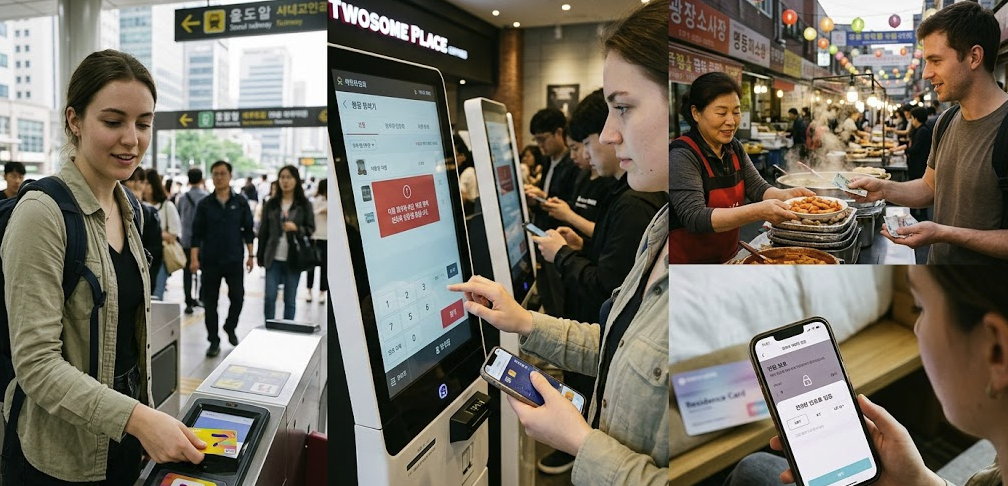
Korea Is Card-Friendly, But Not Always Foreigner-Friendly
The good news is simple: you do not need to carry large amounts of cash in Seoul.
Most everyday places accept cards. Convenience stores, cafés, restaurants, department stores, cosmetic shops, pharmacies, hotels, and many taxis are used to card payments. For visitors from countries where cash is still common in small shops, this can feel surprisingly convenient.
In many Western countries, card payment is also common, but Korea has a particular speed to it. The payment terminal is usually ready. Staff often expect card. Receipts are printed quickly. There is no tipping screen asking you to choose 18%, 20%, or 25%. The transaction can feel clean and almost emotionless.
But there is a difference between “card-friendly” and “foreigner-friendly.”
A Korean resident paying with a local card connected to a Korean phone number and bank account is moving through the system as intended. A short-term visitor using an overseas card is moving through only part of that system. In physical stores, this is usually fine. In apps, websites, memberships, delivery services, and local payment platforms, the experience can change quickly.
That is where many foreigners get surprised. They assume that if their card works in Seoul, the rest of Korea’s digital services will also work. Not always.
Cash Still Matters in Small Moments
Korea may feel cashless, but cash is not useless.
It is still smart to keep some Korean won with you, especially as a visitor. Traditional markets, small food stalls, older restaurants, coin lockers, laundry machines, street vendors, and certain small local businesses may still be easier with cash. Even when card is technically accepted, cash can sometimes feel faster or less awkward in older places.
This does not mean you need to carry a huge amount. For most Seoul travel days, a small emergency amount is enough. Something like 50,000 to 100,000 won can be useful as backup, especially if you are moving between neighborhoods, using older facilities, or visiting markets outside the most tourist-heavy areas.
The mistake is going too far in either direction.
Some visitors arrive thinking Korea is cash-only because they have heard about traditional markets. Others arrive thinking they can survive with only Apple Pay, Google Pay, or one overseas card. Both assumptions can create problems.
The safest approach is simple: carry at least one physical card, a backup card, and a small amount of cash. Korea is efficient, but efficiency feels better when you have options.
The Real Wall: Korean Phone Verification
For foreigners, the biggest payment problem in Korea is often not money. It is identity.
Many Korean digital services are built around mobile phone verification. This means your phone number is not just a contact number. It often works as part of your identity inside the system. Banking, shopping, delivery apps, ticketing, memberships, reservations, and payment services may ask for verification through a Korean mobile carrier or a name-matched phone number.
This can be confusing for visitors because in many Western countries, a phone number is just a phone number. In Korea, it can become a gate.
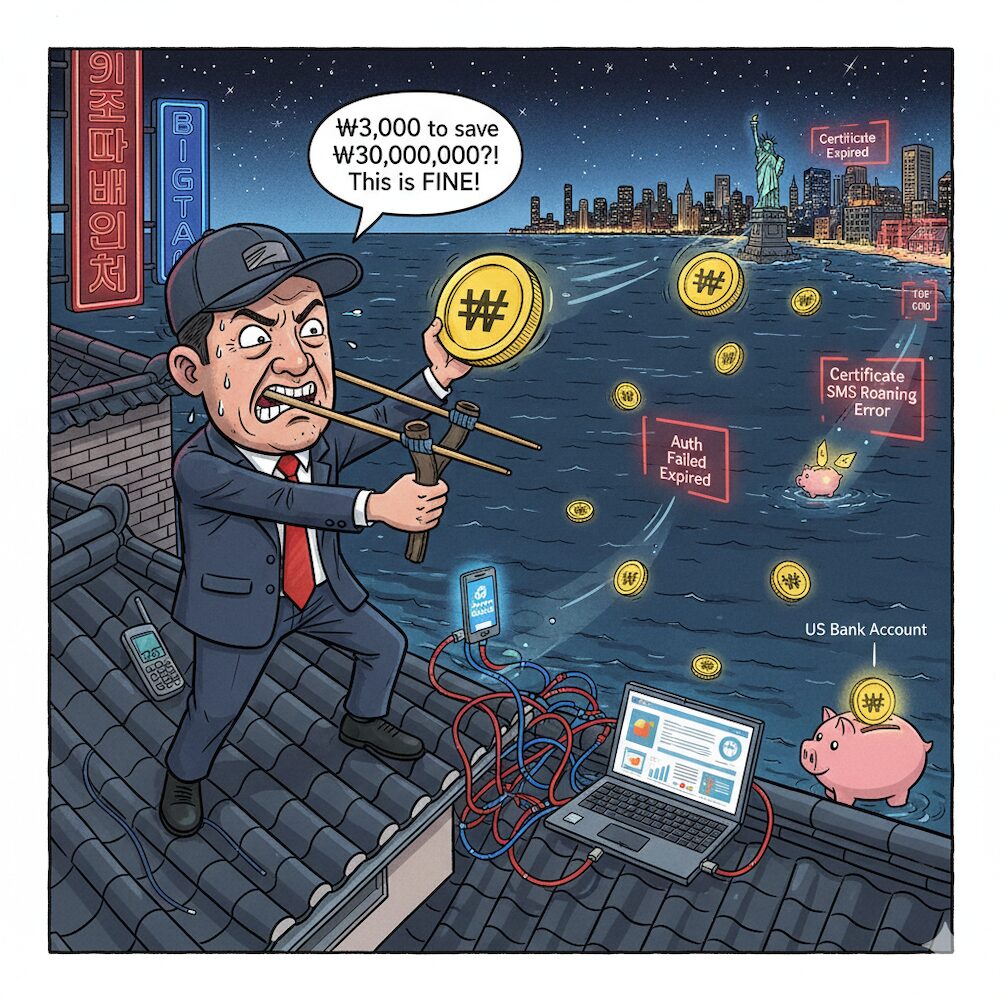
For short-term travelers, this matters when trying to use local apps. You may be able to browse, but not pay. You may be able to install an app, but not verify yourself. You may be able to place items in a cart, but fail at checkout. You may be able to use a card in person, but not inside a Korean platform.
For expats, the issue can continue until your Korean phone number, Residence Card, bank account, and identity information all match properly. The Korea Times has described this broader issue as part of Korea’s “authentication” environment, where many systems are fast for residents but difficult for visitors without domestic mobile verification.
This is why a foreigner can stand in one of the world’s most connected cities and still feel strangely locked out.
Kiosks Are Convenient Until They Are Not
Kiosks are everywhere in Korea now.
You may see them at fast-food restaurants, cafés, cinemas, food courts, casual dining chains, museums, transport facilities, and even small restaurants. For locals, kiosks can make ordering faster. For foreigners, they can be helpful when there are photos and simple menu buttons. But they can also be one of the most frustrating parts of paying in Korea.
The problem is not only language.
Some kiosks do offer English, but the English version may be limited. Some menu items may be translated awkwardly. Some options may be hidden under Korean categories. Some machines may ask for a local phone number for points or membership before payment. Some may reject certain overseas cards. And in busy locations, there may be a line behind you while you are still trying to understand whether you ordered one burger or a full set meal.
Kiosks also change the emotional feeling of service.
In a Western restaurant, if you are confused, you might expect to ask a staff member first. In Korea, especially in busy chain restaurants, the staff may expect customers to use the kiosk before approaching the counter. This is not rude. It is just how the system has been arranged.
For first-time visitors, the practical advice is simple. Look for the language button first. Take your time if the place is not crowded. Use a physical card rather than relying only on mobile payment. And when a kiosk feels impossible, it is okay to ask staff politely.
Transport Payments Are Their Own World
Transportation payment in Korea deserves special attention because it does not always work like ordinary shopping payment.
For years, many visitors learned to use T-money or another transport card for buses and subways. You bought or charged the card, tapped in and out, and used it across much of the public transport network. That system is still important for travelers to understand.
But Seoul is gradually making transit payments easier for international visitors. In 2026, Seoul announced that internationally issued credit and debit cards such as Visa and Mastercard would be accepted at hundreds of new transit card vending machines across subway stations on Lines 1–8, including for single-journey tickets and Climate Cards. The city has also discussed broader open-loop payment plans for international tourists, including overseas-card-based mobile payment options through Tmoney via Apple Pay and a longer-term shift toward open-loop transit payment by 2030.
This is useful progress, but visitors should still be careful.
Being able to buy or reload certain transit products with an overseas card does not always mean every gate, bus, app, or transport situation will work exactly like London, New York, Sydney, or Singapore. Korea’s transport payment system is improving for visitors, but it is still worth checking the latest rules when you arrive.
For now, many travelers will still find it easiest to understand the local transport card system rather than assuming their regular bank card will work everywhere.
Korea vs Western Countries: What Feels Different?
| Payment situation | In Korea | In many Western countries |
|---|---|---|
| In-store card payment | Very common, fast, and widely accepted | Common, but speed and acceptance vary by country |
| Cash use | Less necessary in Seoul, but useful as backup | Still common in some countries and small businesses |
| Tipping | Not expected in normal restaurants and cafés | Often expected or prompted in places like the U.S. |
| Mobile payment apps | Very convenient for locals, harder for visitors without verification | Often easier to use with international cards |
| Phone verification | Central to many services | Less connected to everyday payment identity |
| Kiosks | Common in restaurants, cafés, transport, and chains | Increasing, but not always as dominant |
| Transit payment | Often uses local transport cards or specific systems | Some cities allow direct tap with bank cards |
This is why paying in Korea can feel advanced and restrictive at the same time. The system is not slow. It is not outdated. It is actually very efficient. But it is efficient around local assumptions.
Mobile Payment: Easy for Locals, Complicated for Visitors
When Koreans use mobile payment, the experience can look effortless.
Kakao Pay, Naver Pay, Samsung Pay, banking apps, QR payments, membership points, delivery app payments, and online checkout systems are part of daily life. A local resident may move through a payment flow with only a few taps.
For a visitor, that same flow may not even open properly.
The issue is usually not interest or ability. It is access. You may need a Korean phone number. The phone number may need to be registered under your name. Your name may need to match your ID. You may need a local bank account. You may need a Korean-issued card. You may need to pass identity verification through a local carrier or verification service.
This is the hidden structure behind the smooth surface.
A foreign traveler watching locals pay with one tap may think, “Why can’t I just do that?” The answer is that locals are not just using an app. They are using an entire identity-payment-bank-phone ecosystem that has already been connected behind the scenes.
For short-term travelers, the best strategy is not to force yourself into every Korean payment app. Use physical cards, cash backup, transport cards, hotel assistance, and foreigner-friendly services when possible. For long-term residents, the goal is different: gradually build the local stack of phone number, Residence Card, bank account, and Korean card.
Online Payments Can Be Harder Than Offline Payments
One of the strangest things about Korea is that offline payment can be easier than online payment.
You might pay smoothly at a restaurant with an overseas Visa or Mastercard, then go back to your hotel and fail to order something online. You might buy coffee with no problem, then struggle to reserve a service through a Korean website. You might pay in person at a shop, but fail when the same brand’s Korean app asks for local verification.
This can feel backward if you come from a country where online card payment is usually simple.
In Korea, the online environment often adds layers: identity verification, local payment gateways, Korean-language forms, phone confirmation, app installation, browser requirements, or name-format issues. Foreign names can also create practical problems because Korean systems may handle spacing, capitalization, middle names, or passport-style names differently from your bank or card issuer.
This is not always visible until checkout. That is what makes it frustrating.
For important bookings, do not wait until the last minute. If a Korean website fails, try the mobile app, the English version, the global platform, the hotel concierge, or in-person payment. Sometimes the most modern-looking option is not the easiest one for foreigners.
What Foreign Travelers Should Prepare
For a short trip to Seoul, you do not need to master every Korean payment system. You need a practical setup.
Bring at least two cards, preferably from different networks or banks. Keep a small amount of Korean won. Get a transport card or understand the latest foreign-card transit options when you arrive. Do not rely only on mobile wallets. Save your hotel address in Korean. Keep screenshots of reservations. And when using kiosks, check whether English mode exists before joining a long line.
It also helps to understand that payment problems in Korea are often situational.
Your card may work at one café and fail at another machine. A kiosk may reject your card while the counter terminal accepts it. A website may fail while the physical store works. A taxi may accept card, but an app-based service may require local verification.
The solution is not panic. It is flexibility.
What New Expats Should Understand
For expats, paying in Korea becomes much easier after the first few administrative steps are complete.
The usual path is not instant. You may need to arrange a Korean phone number, register your identity properly, receive your Residence Card, open a bank account, and apply for a debit or credit card. Depending on your visa, employer, bank branch, and documentation, the timeline and restrictions can vary.
This is where many new residents feel the gap between “Korea is convenient” and “Korea is convenient for people already inside the system.”
Once everything is connected, life becomes smoother. You can use banking apps, local cards, delivery services, online shopping, payment apps, and membership systems more easily. But before that point, daily life can feel full of small locked doors.
The most important thing is to be patient with the sequence. In Korea, payment convenience often comes after identity setup, not before it.
Final Thoughts
Paying in Korea is one of the best examples of how Seoul works.
On the surface, it is fast, modern, and convenient. You can buy food at midnight, tap a card for tiny purchases, order from a kiosk, ride public transport, and move through the city with very little cash. Compared with many places, everyday payment in Seoul can feel beautifully efficient.
But for foreigners, the deeper truth is more complicated.
Korea’s payment culture is not just about cards or cash. It is connected to phone numbers, identity verification, bank accounts, transport cards, local apps, and digital systems that often assume you are already part of Korean daily life. That is why visitors can feel both impressed and confused in the same afternoon.
The best way to understand it is this: Korea is not difficult because it is behind. Korea can be difficult because it is already very far ahead in its own direction.
Once you know that, paying in Korea becomes less frustrating. You stop expecting every system to work like it does back home. You carry a backup card. You keep some cash. You learn when to use a transport card, when to try a kiosk, when to ask staff, and when a Korean phone number matters more than the card in your wallet.
And slowly, the city starts to make sense.