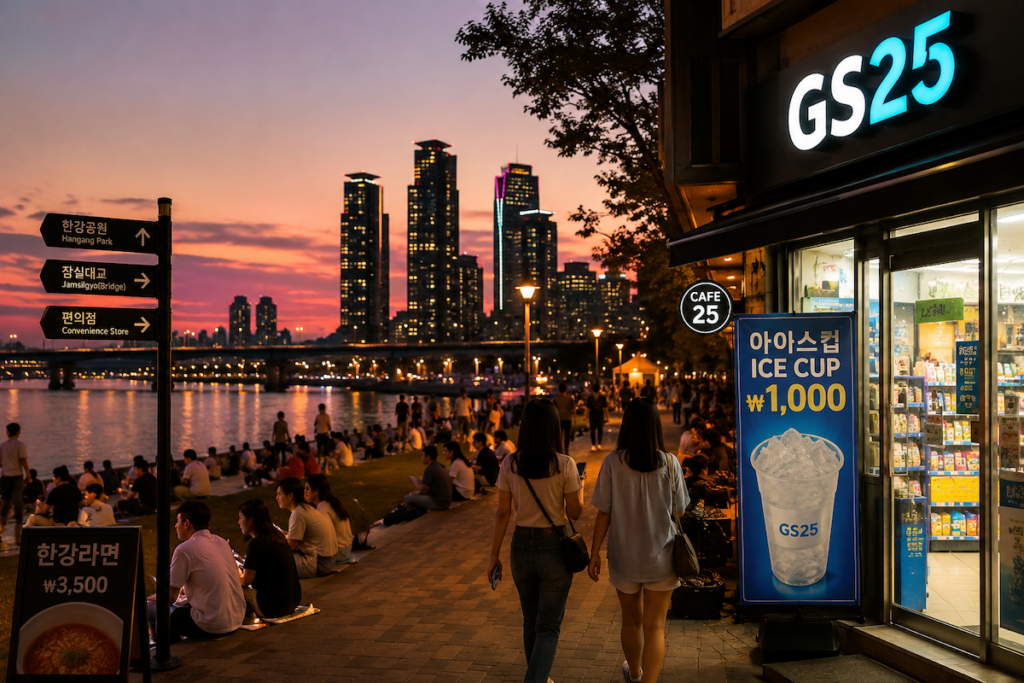
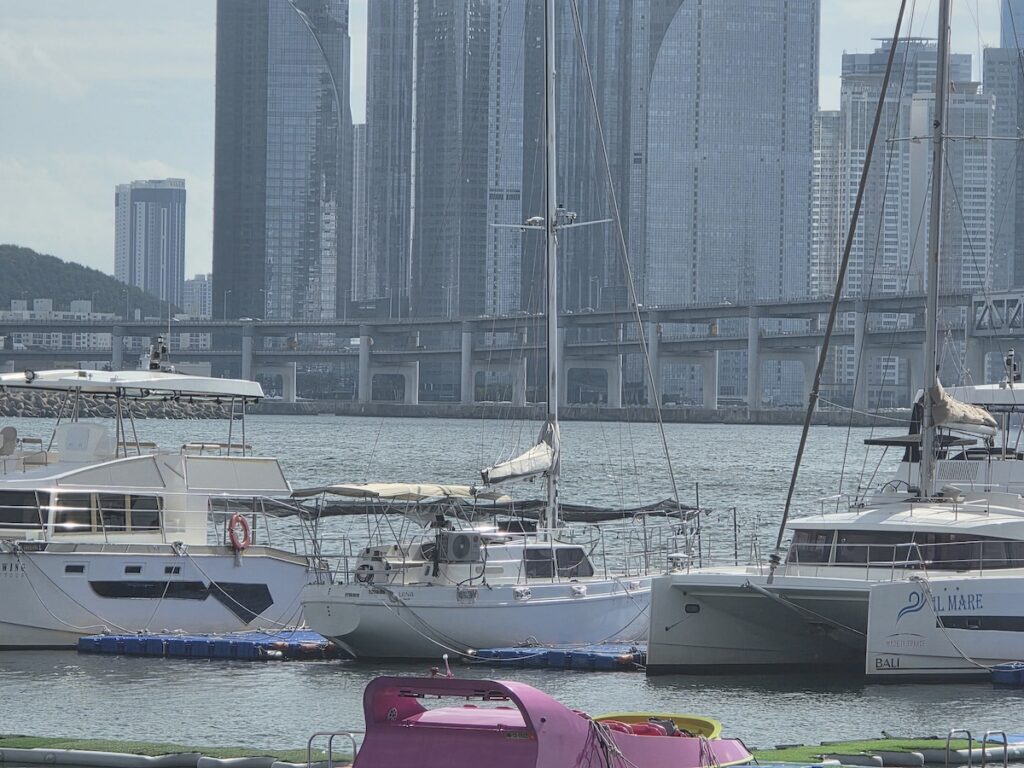
I went to Gwangalli Beach in Busan expecting a swim and a view of the bridge. What I found instead was a whole working waterfront. Surfboards drying against a fence. A marina packed with yachts and catamarans. Kids climbing an inflatable water park bobbing on the bay. A pink jet boat idling near the pontoon. And behind all of it, the great white sweep of Gwangan Bridge and the Marine City skyscrapers.
That’s the thing nobody tells you about Gwangalli water sports: this beach isn’t just for lying on the sand. It’s one of the few places in Korea where you can surf, sail, paddle, and ride a boat — all in the same afternoon, all with a city skyline behind you. Here’s what’s actually on offer, what it costs, and one honest caveat about surfing in Korea before you get too excited.
First, where you actually are
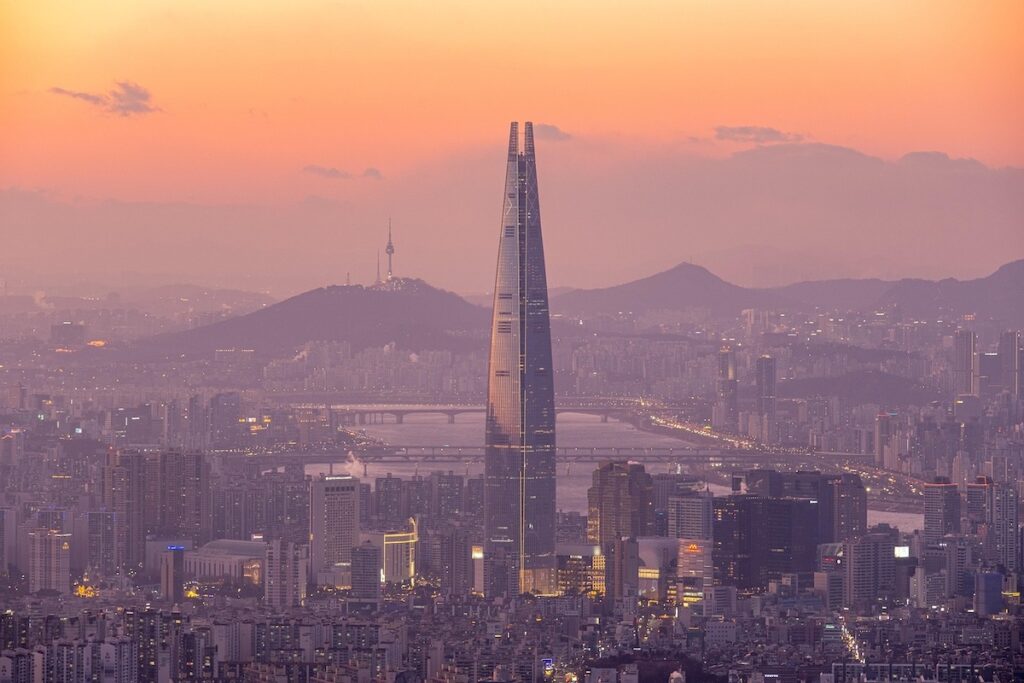
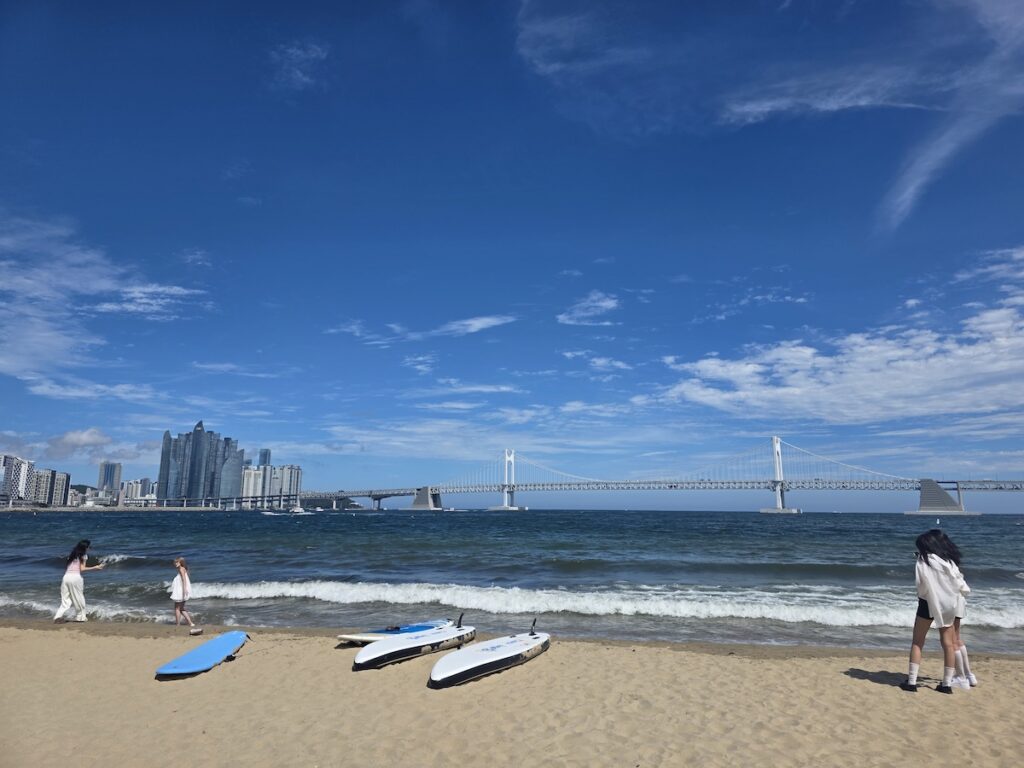
Gwangalli Beach (광안리해수욕장, Gwangalli Haesuyokjang) sits in Suyeong-gu, on the eastern side of Busan. Its defining feature is the view: the 7.4km Gwangan Bridge (광안대교) arcs across the whole bay, lit up at night, with the towers of Marine City and Haeundae rising behind it. It’s the most photogenic urban beach in Korea, and that scenery is the backdrop to everything below.
Getting there: Gwangan Station (광안역) or Geumnyeonsan Station (금련산역) on Busan Metro Line 2, then a short walk down to the water.
Unlike a remote surf beach, Gwangalli is right in the middle of the city — cafés, restaurants, and a subway stop are all a few minutes from the sand. That’s its whole personality: water sports without leaving the city.
Surfing at Gwangalli — and the honest caveat
Yes, people surf here. Surf shops set up right on the beach (you’ll spot their flags and tents on the sand), renting boards and running lessons through the warm months. Lessons typically run in two daily blocks — a morning session around 10:00–12:00 and an afternoon one around 14:00–16:00 — and a beginner class includes the board and wetsuit.
Now the honest part, since I promised one: Korea is not Bali, and Gwangalli is not even Korea’s best surf spot.
Korea’s waves are, by world standards, small and inconsistent. You’re not going to find towering barrels here. And within Busan, the actual surfing mecca is Songjeong Beach (송정), a little further east — shallow, gently sloped, with more reliable, steady waves. Songjeong is where Korea’s surf culture was born, it’s calmer and less crowded, and it’s lined end to end with surf shops. If your entire trip is about surfing, go to Songjeong.
So why surf Gwangalli at all? Two reasons. First, for beginners the modest waves are a feature, not a bug — small, forgiving water is exactly where you want to learn to stand up on a board, and you won’t get punished for mistakes. Second, and this is the part Songjeong can’t offer: you’re surfing under Gwangan Bridge, with a skyline in front of you. That’s a genuinely rare thing. Surfing inside a major city, bridge and towers filling your view, is an experience in itself — even if the wave underneath you is a gentle one.
Treat Gwangalli surfing as “learn to surf with the best view in Korea,” not “chase the best wave in Korea,” and you’ll have the right expectations.
SUP: the easier way onto the water
If surfing sounds like too much, stand-up paddleboarding (SUP) is the gentler cousin, and Gwangalli is well suited to it. On calm days you paddle out on a flat board, standing or kneeling, and take in the bridge from the water. Operators on the beach run SUP experiences aimed squarely at first-timers — it’s far easier to pick up than surfing, and it gets you that on-the-water skyline view with almost no learning curve. For a lot of visitors, SUP is the sweet spot: real time on the bay, no wipeouts.
Yacht and boat tours: the low-effort, high-view option
Not everyone wants to get wet, and Gwangalli has that covered too. The bay is a hub for yacht tours, and this is the easiest way to get out on the water in a nice outfit with a drink in hand.
Most tours actually depart from the nearby Haeundae side (The Bay 101 / the Suyeongman marina) and loop the same gorgeous circuit: out past Dongbaek Island, along Haeundae Beach, under Gwangan Bridge, past Gwangalli and Marine City, and back. A typical loop runs around 55 minutes.
Rough pricing to set expectations (per adult, shared public tours):
- Daytime: from around 15,000 KRW
- Night (bridge lit up): around 25,000 KRW
- Sunset / peak slots: around 30,000 KRW
- Private charters: run into the hundreds of thousands of won, depending on the boat
The night tour, with Gwangan Bridge fully illuminated, is the one people rave about — the whole bay turns into a light show, and you’re in the middle of it. Prices and operators change constantly, so confirm the live rate when you book rather than treating these as fixed.
Jet boats, water parks, and the rest
Along the pontoon you’ll also find the higher-adrenaline and family stuff:
- Jet boats — short, fast, spray-in-your-face rides around the bay (that pink boat I saw).
- Floating water park — an inflatable obstacle course anchored off the beach, slides and climbing frames included; great for kids and groups.
- Banana boat and towed rides — the classic scream-and-splash stuff, seasonal.
None of these require skill or booking ahead in the way surfing does — you turn up, pay, and go.
How to actually plan a day here
If you want the full spread without overthinking it:
- Morning: a surf or SUP lesson (book the ~10:00 block ahead in summer — weekend slots fill fast).
- Midday: dry off, eat along the Gwangalli café strip, watch the water park crowd.
- Late afternoon / evening: a sunset or night yacht tour under the lit bridge to end on the view.
That sequence takes you from in-the-water to on-the-water to above-the-water, and uses the bridge — Gwangalli’s whole reason for being — at the exact moment it looks best.
The honest bottom line
Gwangalli won’t give you world-class surf. What it gives you instead is range and setting: a single city beach where a complete beginner can stand on a board in the morning, paddle a SUP at noon, and toast the illuminated Gwangan Bridge from a yacht at night — without ever leaving Busan. If you’re a serious surfer, catch the metro to Songjeong. If you want a full day of water on the water, with the best urban view in the country wrapped around all of it, Gwangalli is hard to beat.
I visited Gwangalli in summer 2026; the scene on the bay — surf tents, marina, water park, jet boat — is what I actually saw that morning. Prices for lessons and yacht tours shift by season and operator, so treat the numbers here as a starting point and confirm before you book. Surfed Gwangalli or Songjeong yourself and see it differently? I’d like to hear it.