The other night K-beauty was on the MBC evening news again — export records, foreign tourists filming themselves in Myeongdong, another Korean skincare brand cracking the US top ten. I’ve seen this segment a hundred times. And every time, the same small thought surfaces: the K-beauty the world is celebrating isn’t quite the one I see around me.
Because here’s what almost no foreign guide mentions. If you want to know what Koreans actually buy, you have to ask which Koreans. A nineteen-year-old and her mother do not shop in the same place, for the same brands, at the same price — and the gap between them tells you more about K-beauty than any export figure.
I’m not writing this to debunk anything. K-beauty is real, the quality is real, the global success is real. I’m writing it because I got curious about a contradiction I see every day, and when I finally looked into it, the answer turned out to be more interesting than the news version.
The K-beauty the world sees
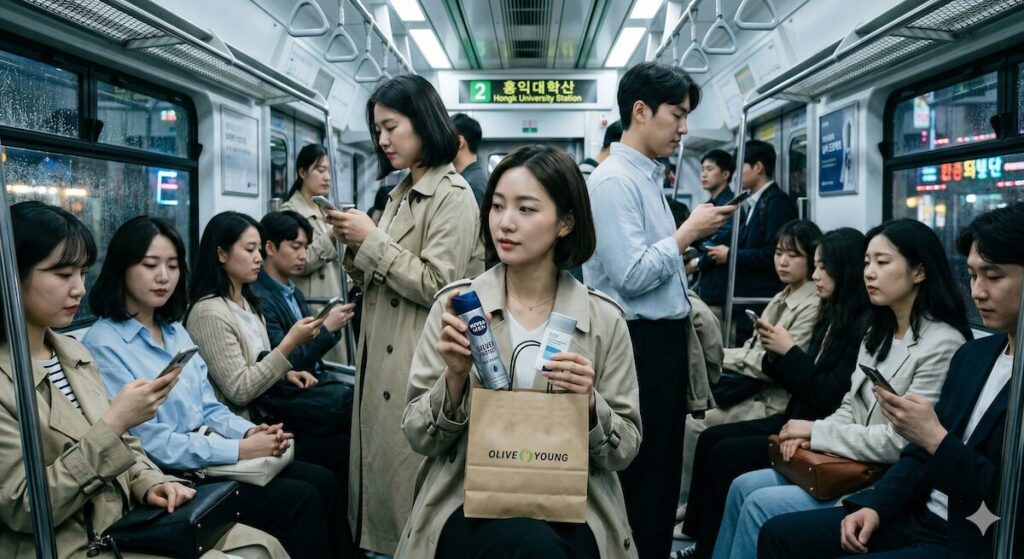
If you’ve researched Korea at all, you know the story. Olive Young — Korea’s dominant health-and-beauty chain, with well over a thousand stores and something like 70% of the market — is the temple. You walk in, you find the viral serums and toners you saw on TikTok, you buy a basket of them for a fraction of what a “luxury” product costs back home, and you go home with a ten-step routine.
That story is true. Those brands — the ones that went viral abroad — really did launch and prove themselves on Olive Young shelves before going global. The chain genuinely is where Korean indie beauty is discovered.
But notice who’s actually standing in that store.
What Koreans actually buy, by age
Here’s the part the export story leaves out: the affordable, viral K-beauty the world associates with “Korea” is, inside Korea, largely a teenage and twenty-something market.
This isn’t an impression. Consumer surveys show that teens and people in their twenties use Olive Young and Daiso at noticeably higher rates than older age groups. Olive Young leaned into this so hard that in 2024 it launched Korea’s first membership tier built specifically for 14-to-19-year-olds — extra coupons, free shipping, the works. The chain openly courts high-schoolers, because today’s teenager is tomorrow’s loyal customer.
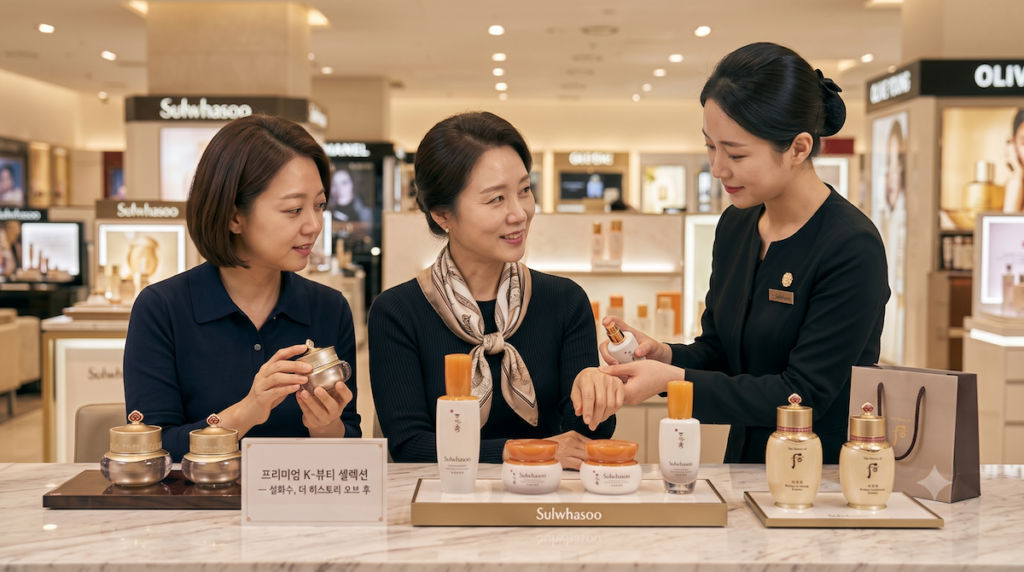
Now walk into a duty-free cosmetics floor, or the beauty counter of a department store, and the scene changes completely. There you’ll find imported luxury houses sitting alongside Korea’s own premium lines — Sulwhasoo, The History of Whoo, Su:m37. These are what a great many older Korean women actually put on their faces. They are not what most foreign tourists mean when they say “K-beauty,” yet they are unmistakably Korean.
So when an older Korean reaches for Sulwhasoo while her daughter fills a basket at Olive Young, neither of them is doing something strange. They’re occupying two different floors of the same building. The tourist usually only sees one floor.
So where do all these brands even come from?
This is the question that actually got me curious. Stand in an Olive Young for ten minutes and you’ll see dozens of brand names you’ve never heard of — and new ones appear constantly. Korea registered over 4,200 new cosmetics-distribution licenses in a single recent year, more than double the number from just a few years earlier.
How does a country produce that many beauty brands? A tiny team with no factory, no chemists, no lab — how do they put a genuinely good serum on the shelf?
The answer is a piece of Korean industry that foreigners almost never hear about: ODM manufacturing.
Two companies dominate it — Cosmax and Kolmar Korea. Under the ODM model (Original Development & Manufacturing), the manufacturer handles the research, the formula, the sourcing, the regulatory approval, sometimes even the naming and trend forecasting. The “brand” handles the concept and the marketing. That’s it. A brand can own nothing but an idea and an Instagram account, and still ship a high-quality product — because Cosmax or Kolmar built everything behind it.
The scale of this is genuinely hard to believe. Between them, these two ODM firms count dozens of client brands each pulling in over 100 billion won a year. One of them reportedly develops and manufactures for 18 of the world’s top 20 beauty companies. When you buy a trendy Korean indie brand, there’s a very real chance it rolled off the same production line in Hwaseong or Pyeongtaek as a dozen of its “competitors.”
The twist: this isn’t a scam, it’s the actual engine
It would be easy to turn this into a cynical takedown — see, the indie brands are hollow, it’s all the same stuff in different bottles, K-beauty is a marketing trick.
But that reading is lazy, and after looking into it, I don’t think it’s true.
The ODM system isn’t K-beauty’s dirty secret. It is K-beauty. It’s the reason a small Korean brand can go from idea to a viral global product in months, while a legacy Western brand is still scheduling meetings. The competitive edge moved — from “which brand has the best heritage” to “which manufacturer can develop a new texture or ingredient fastest.” Korea happens to have the two companies that win that race. That’s not a weakness dressed up as a strength. It’s a genuine structural advantage, and it’s a big part of why Korean cosmetics recently overtook France to become the top source of imported beauty in the US market.
So the “system” my instinct kept pointing at is real. It’s just that the system is the achievement, not the trick.
So what are you actually buying?
Which brings the whole thing back around to that contradiction I started with.
When a tourist buys a basket of Olive Young serums, and an older Korean woman buys a jar of Sulwhasoo, and a teenager grabs a Daiso collab off a peg — are they buying three different things, or one? I’d argue it’s one. All three are outputs of the same remarkable manufacturing ecosystem, sorted onto different shelves by price and age. The luxury jar and the 3,000-won toner may even share a lab.
That’s the part worth carrying around when you shop here. “K-beauty” isn’t really a look, or a price point, or a single aisle. It’s a production system so efficient it can serve a fourteen-year-old and her grandmother at the same time, in the same country, and make both of them feel they’re buying something made for them.
Understanding that — not the ten-step routine, not the viral toner — is what it actually means to understand what Koreans buy.
This started as a personal observation — that the K-beauty on the news didn’t match the K-beauty in my own family — and turned into something I had to go read up on. The market data and manufacturing figures here are drawn from Korean industry reporting; the shelf-level observations are my own, from living here. If you shop K-beauty differently than I’ve described, I’d genuinely like to hear it.