The Korean hyung system started as a small word between me and an American friend, and ended up being the way I finally understood a part of my own country.
He is not a special case. He had lived in Seoul for about six years by the time this conversation happened. He worked at a Korean company. His spoken Korean was rough but functional, and his sense of the culture was better than his grammar suggested.
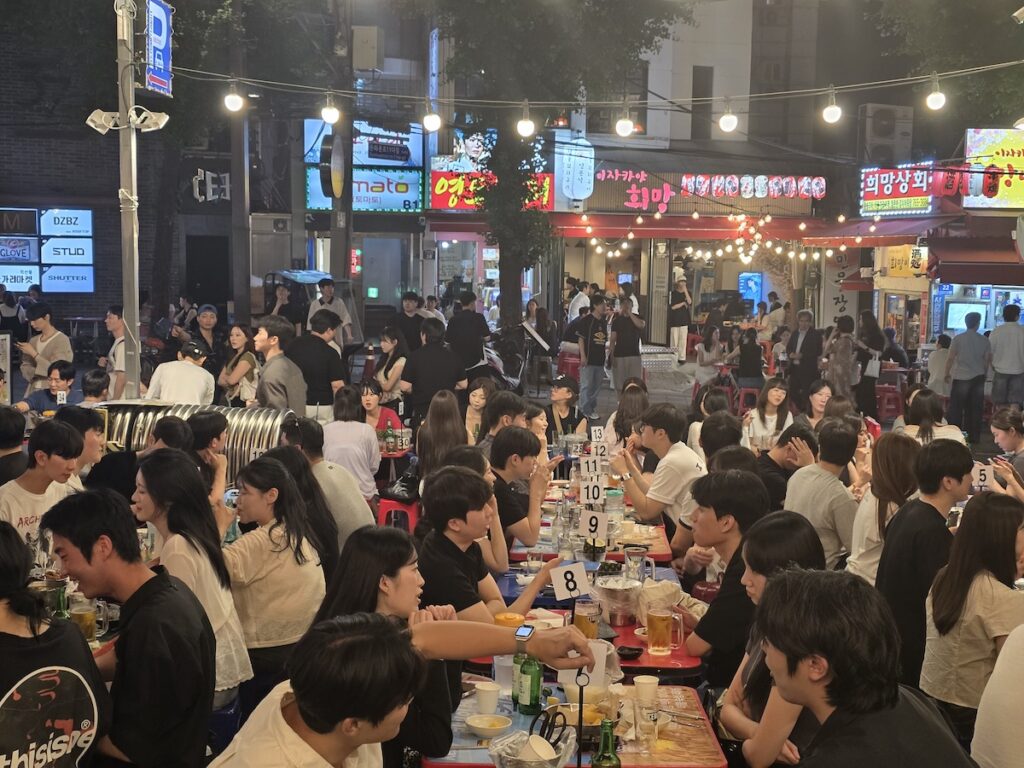
We were sitting at a low table in a small restaurant in Yeonhui-dong on a Saturday, and he had just called me hyung for maybe the twentieth time that year. That day, for some reason, I finally asked him the question I had been meaning to ask.
What does it feel like, when you call me that?
The answer he gave me over the next hour is the reason this article exists. And the reason it exists on a Korean local-observation site, not a Korean-language-learning one, is that what he taught me was not about the word. It was about the country the word belongs to.
Quick Answer: The Korean hyung system refers to the age-based address hierarchy in Korean relationships. Hyung (형) is the term a younger man uses for an older man in a close relationship. On the surface it means “older brother.” In practice it is the entry point to a whole set of obligations — the older person tends to pay, protect, advise, and be arrived-at-first-by-the-younger. The equivalent terms are oppa (older man, spoken by a woman), unnie (older woman, spoken by a woman), and noona (older woman, spoken by a man). A foreigner who uses these terms is stepping into a system with rules that go far beyond the word itself. Understanding that system tells you more about Korea than almost any other single thing.
What he heard when he first said the word
He told me that when he first started using hyung, he did not think about it much. Someone had told him that in Korean, when a younger man addresses an older man in a friendly setting, you say hyung. It sounded like a nickname. It felt informal, close, warm. He said the word without loading anything onto it.
He said that for about the first two years.
Then something shifted. He does not remember the exact moment, but at some point he registered that when he said hyung, the other person’s face responded slightly. Not in a big way. Just a small settling, as if the word had confirmed something. He started noticing that Korean men did not use the word lightly. It was not thrown around. It was placed.
That was the first stop. The word was not casual. It was elevated. It signaled that the person being addressed was above him in some soft, unspecified way. Once he understood this, he said, he actually got uncomfortable using it for a while. Not because he minded elevating someone. He minded doing so automatically, without knowing what he was consenting to.
This is where a lot of foreigners get stuck, he told me. The word is easy. The elevation is easy. What is hard is realizing that the elevation is not neutral. It has an economic weight, a temporal weight, and an emotional weight — and none of that is explained anywhere.
The elder pays. The elder protects. The elder is arrived at.
Once he started paying attention, he said, the invisible rules became visible one by one.
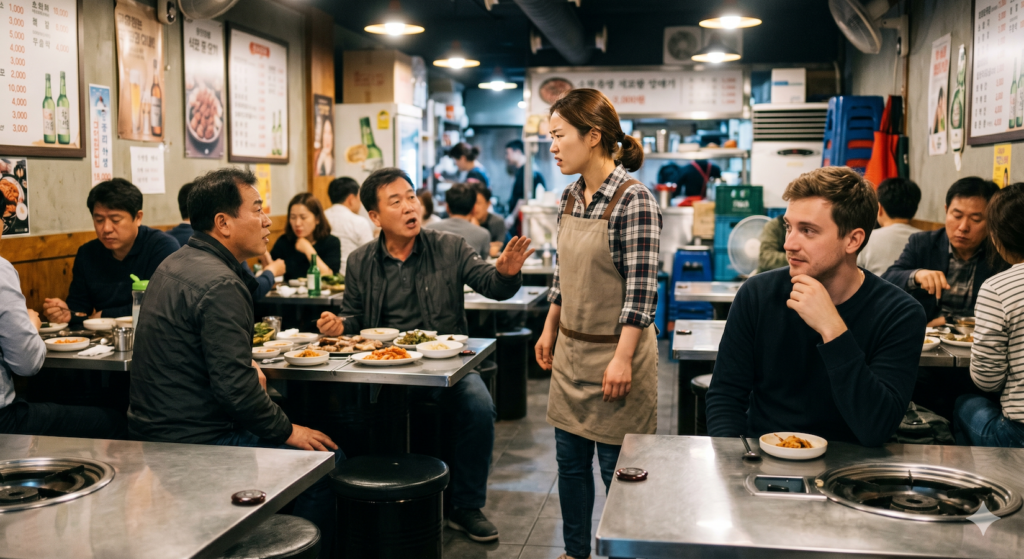
The hyung pays for meals. Not always. Not every time. But enough of the time that when the check comes and there is any ambiguity, the hyung reaches for it. If the younger person tries to pay, the hyung refuses with a specific kind of firmness that is not offended by insistence but expects only one round of it.
The hyung offers advice, and the dongsaeng — the younger one — accepts it, even when the advice is bad, even when the dongsaeng knows more about the topic than the hyung does. Rejection of a hyung’s advice is done through implementation delay, not verbal disagreement.
The hyung is asked how his week was. The dongsaeng answers his own week only after the hyung’s has been discussed.
The dongsaeng arrives first. This one surprised him. He said he had noticed that his Korean friends — when meeting him at a bar or restaurant — would show up ten to fifteen minutes before the agreed time. It took him a while to understand that this was not about punctuality. It was about the hyung not being made to wait. If the hyung arrived first, the dongsaeng had failed a small but real test of the relationship.
The hyung buys the drinks at the second round. The dongsaeng pours for the hyung with two hands. The hyung offers the first glass to the dongsaeng, and the dongsaeng receives it with a small turn of the body.
None of these are written anywhere. He said he had learned every one of them by making a mistake, feeling the small correction in his hyung’s face, and adjusting.
It’s like Korean grammar, he told me. Except grammar has textbooks. This has no textbook. You just make errors until you stop making them.
The complication he understood before I did
He told me something that stopped me for a moment.
He said that what he had come to understand, after six years, was that this was not a rulebook. It was a relationship shape. The Korean word hyung was not naming a role the way manager or father names a role. It was creating one. Saying hyung to someone was, in a small but real way, agreeing to be inside a specific shape of relationship with that person — one where obligations flowed in specific directions.
And, he said, this was the thing that had taken him longest to accept: the complexity of the system was not decorative. It was the point.
He said American friendship, by contrast, was designed to minimize obligation. You could be close to someone in New York or Chicago and have almost no expected behavior toward them beyond showing up when they needed you. Korean friendship, at least in the hyung-dongsaeng form, was almost the opposite. The obligations were the container. Take away the small dance of who arrives first, who pays, who pours, and the relationship itself would lose its shape.
He said he had come to like this. It made friendship feel structural rather than dependent on mood. But it had also taken him years to stop feeling that every dinner was an exam.
I sat there listening to a foreigner explain to me, in halting Korean and clean English, what my own culture actually was. And I want to tell you what happened in my head.
The moment I realized he was more serious about it than I was
I was quietly embarrassed.
Not by him. By me.
I had grown up inside this system. I had called older men hyung since I was old enough to have friends. I had received hyung from younger men since I was old enough to have juniors. And in that time, I had never once articulated to myself what he had just articulated in an hour. I had not thought about who arrives first. I had thought about the check but not systematically. I had performed the shape of the relationship without ever looking at its blueprint.
Meanwhile this American, whose own culture had no such shape, had studied the shape more carefully than I ever had. He knew the rules I only followed by reflex.
And here is the part I want to be careful with, because it is easy to mishandle. I had always thought of Americans as more individualistic than Koreans. That was the story I had grown up with — Americans are direct, self-sufficient, less concerned with the web of obligations that structures Korean life. I still think that story is broadly true.
But sitting across from this specific American, who had bent his sense of individualism to fit inside a Korean relational shape that was not native to him, I had to ask myself a question I did not have a clean answer to. Was he adapting more than I would have adapted, if the roles were reversed?
If I had lived in the U.S. for six years, would I have studied their unwritten social rules with the same seriousness he had studied ours? Would I have adjusted my behavior to fit their shape as carefully as he had adjusted to fit ours? Or would I have kept a Korean core, quietly assuming that my culture’s shape was the one that mattered, and treated American norms as a kind of costume I put on for work and took off at home?
I do not know the answer. I suspect it depends on the person, and I suspect the truthful version of my answer would embarrass me a little.
What I can say is this. I had always thought of the American as the individualist and the Korean as the collectivist. Sitting there, I was not so sure which of us was which anymore.
Why the hyung system exists in the first place
The other thing that came out of that conversation, though he did not say it in these words, was a question. Why does Korea have this system at all? Why does age carry this much relational weight? Why are the rules so tightly written?
The answer I gave him, and the answer I have been thinking about since, is that the hyung system does not exist by itself. It is one visible piece of a much larger infrastructure that runs on age.
In Korea, if you are twenty years old, you are in your first year of university. If you are twenty-one, you are in your second year, or you have gone to the military, and you have a military number (gunbeon) that indicates when. If you are twenty-two, you are a junior. If you are twenty-three, you are graduating and your company number (sabeon) will slot you into a hiring cohort, which will define who your seniors and juniors are for the next twenty years of your working life. If you are thirty, you are expected to be married, or on the way. If you are thirty-five, you are expected to have a kid. If you are forty and you are none of these things, the culture has a specific word for you, and that word is not kind.
Every one of these milestones is age-indexed. And every one of them creates a cohort — people who did the same thing at the same age. Your hakbeon (student number, 학번) is the university class you belonged to. Your gunbeon is the military class. Your sabeon is the company class. These are not casual identifiers. They are, in practice, the primary map of the Korean adult social world.
Once you accept that Korea runs on age-indexed cohorts, the hyung system stops looking like an ornament and starts looking like plumbing. It is the vocabulary that lets the cohort system function. If you and I share a cohort — same age, same year — we are peers, and we can be chingu (친구, friends without hierarchy). If we do not share one, we cannot be friends in the flat sense, so we build the relationship on the hyung-dongsaeng axis instead, and the axis works because the plumbing works.
This is the part that took me thirty years and one American to see clearly. The hyung system is not really about the word. It is about the country that put you in a hakbeon at eighteen and a sabeon at twenty-four and a marriage cohort at thirty, and needed a vocabulary for everyone who was slightly ahead of or behind you on the same track.
What the system gives, and what it takes
I want to be balanced about this, because the story is not simple.
What the hyung system gives is real. It is a country where a younger person is rarely alone. If you have any hyungs at all — from school, from work, from your neighborhood, from your hometown — you have a network of people who feel a specific obligation to keep an eye on you. You are advised, fed, warned, corrected, occasionally rescued. In hard times, this is not a small thing.
The system also gives shape. In a country that has changed as fast as Korea has over the last fifty years — where the physical city, the economy, the language, the family structure have all been rebuilt within living memory — the hyung system is one of the few social technologies that has held its form. It gives Koreans a stable relational grammar in a world that has otherwise been continuously renegotiated.
What the system takes is also real. It takes the possibility of horizontal friendship across ages. A Korean cannot be simply friends with someone eight years older; the relationship will bend into hyung-dongsaeng whether either of them wants it to or not. It takes flexibility from the older person, who has to keep paying and keep protecting long past the point where either of you needs it. It takes some of the freedom of the younger person, who has to keep arriving first, keep pouring with two hands, keep accepting advice they know is wrong.
And it takes something specific from anyone who does not fit the standard cohorts. If you took a gap year at eighteen, if you delayed military service, if you switched careers at thirty-two, if you never married — the system does not have a comfortable slot for you, and you feel it every time someone asks how old you are before they ask what you do.
For a broader look at how Koreans experience these unwritten social rules from the inside, we have written separately about Korean social culture for foreigners and how to read them from the outside.
The longest hyung-dongsaeng I have
I have been calling my American friend’s story an education. That is true, but it is only half true. The other half is that his story sent me back to a relationship I had never actually examined.
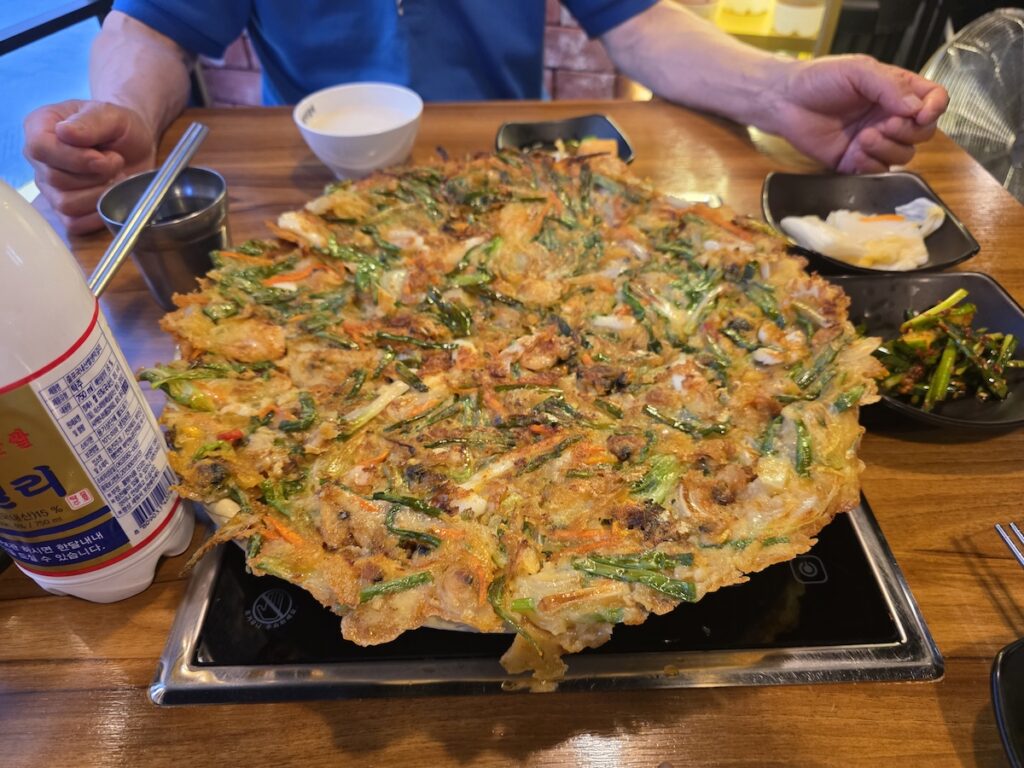
Last weekend, before I wrote any of this down, I sat across a low table from my father at a small makgeolli place near his neighborhood. He is in his mid-seventies. He was wearing his blue collared shirt, the one he keeps for going out to eat. The waitress brought us a bottle of Julpo makgeolli, a large haemul-pajeon seafood pancake, and three small side dishes. We ate. We drank. We talked about not much.
I have had this exact dinner with my father, in one form or another, several hundred times over the course of my life. It is the most ordinary meal in my calendar.
But sitting there — a few days after the conversation with my American friend was still ringing in my head — I saw the meal for the first time as an example of the thing I had just been trying to explain. My father is my oldest hyung. Not by the word, of course. Fathers are not called hyung. But by every function in the system, he is the person I have been in a hyung-dongsaeng shape with the longest. He arrived first at every table. He paid. He advised. He worried. I received. I poured with two hands. I did not argue.
My American friend had spent six years learning the shape of this relationship. I had spent forty-something years inside it, and had never once stepped back to look at it. It took a foreigner naming the shape for me to see that I had been living in it since I was old enough to hold chopsticks.
That is the other lesson of the hyung system. Once you are inside it long enough, you stop seeing it. The person who can name it for you is almost always someone from outside.
The bottle of makgeolli was 6% alcohol. My father poured me the first glass. I received it with both hands, without thinking. It was the most Korean thing I did all week.
What the American Friend Actually Gave Me
At the end of that Saturday afternoon, my friend paid for his half of the meal without argument, because I had insisted, because he was younger than me by exactly one year and had somewhere along the way accepted my hyung status.
He walked me to the subway. He arrived at the ticket gate about four steps before me, without thinking about it. He had gone first the way a dongsaeng goes first. I noticed and did not say anything.
At the gate he turned around and said, in English this time, thanks for the meal, hyung.
I want to end with what I felt in that moment, because it is the real answer to what this whole article is about.
I felt affection. He had spent six years learning to say a word that his own culture did not require him to learn. He had studied the shape of my country’s friendship, and he was, in his own American way, being Korean at me. It was touching.
I also felt, quietly, that he understood something about my country that I had not, until that afternoon, fully understood myself. He had made the invisible visible. He had told me the shape I had been swimming inside my whole life.
The hyung system is not what I had thought it was. It is not a set of manners. It is not a linguistic quirk. It is the vocabulary of a country that decided a long time ago that age would carry the weight of relationship, and built a hundred small rituals on top of that decision. It gives a lot. It takes some. It shapes almost everything.
And, on that Saturday afternoon, a man from a country with no hyungs at all taught it back to me in his second language.
I paid the bill anyway. I am, after all, his hyung.