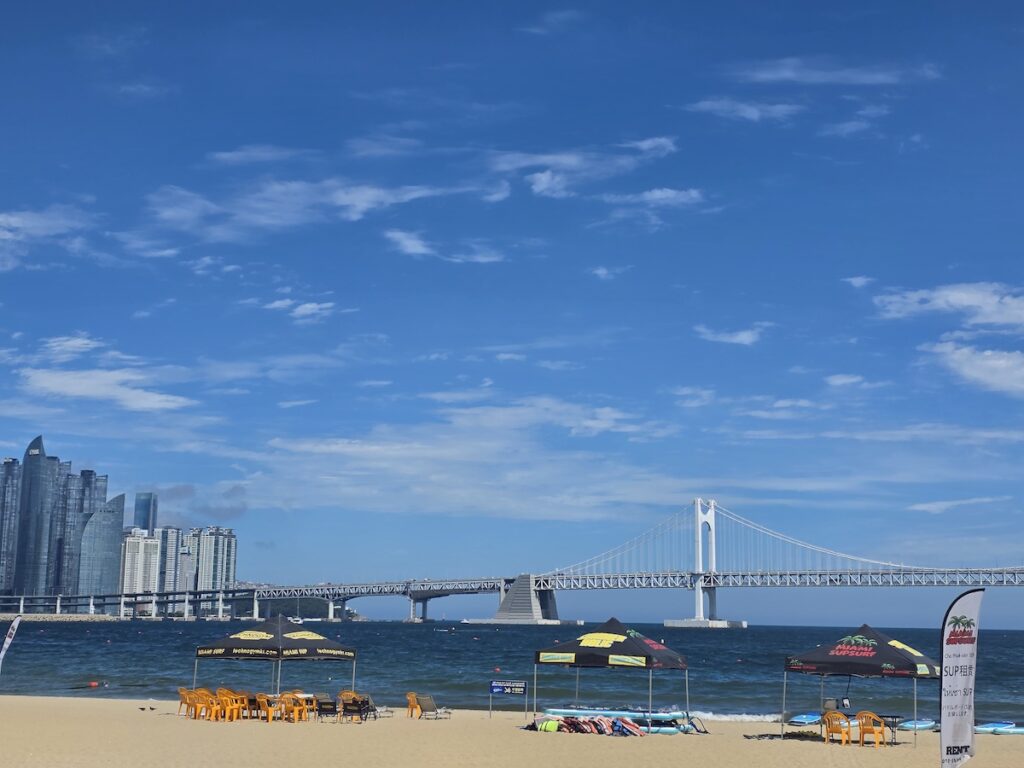
The UK Korea Fashion Futures DDP exhibition was not on my Sunday plan. I was going to the neighborhood for something else. Then I saw the sign, and the doors were open, and I went in.
Two hours later I walked out with three things Googled, one Korea Times article read on my phone at the subway station, and a small suspicion that I had been marketed to. I liked it.
This is the write-up.
Quick Answer: UK Korea Fashion Futures is a free sustainable fashion exhibition at DDP’s Igansumun Exhibition Hall in Seoul, running July 15–25, 2026. It is organized by the British Embassy in Seoul and the British Council Korea, in partnership with the University of the Arts London and Samsung C&T’s fashion division. Two connected shows sit inside — “New Landscapes” (research on bio-based materials and upcycling) and “Circle Back; Connect. Wear.” (twenty UAL graduates turning unsold Samsung clothes into new pieces). It takes about ninety minutes if you read the wall text. Entry is free. The building sits on top of a 600-year-old Joseon-era water gate that most visitors walk past without noticing.
A quiet holiday, and a road I used to know at night
It was a public holiday. In Korea a public holiday is a small negotiation. You have earned the right not to do anything, and you also feel the pull of doing something — self-development, they call it, or jagi gyebal — because the country runs on the quiet expectation that the day off should still produce something.
Going to an exhibition alone on a holiday is a compromise between those two pulls. It is not lazy, because you are consuming culture. It is not work, because you paid nothing and no one asked for a report. It is, I want to say, a little romantic. You are inside a room where the only pressure is your own curiosity.
The location made it more so, for me specifically.
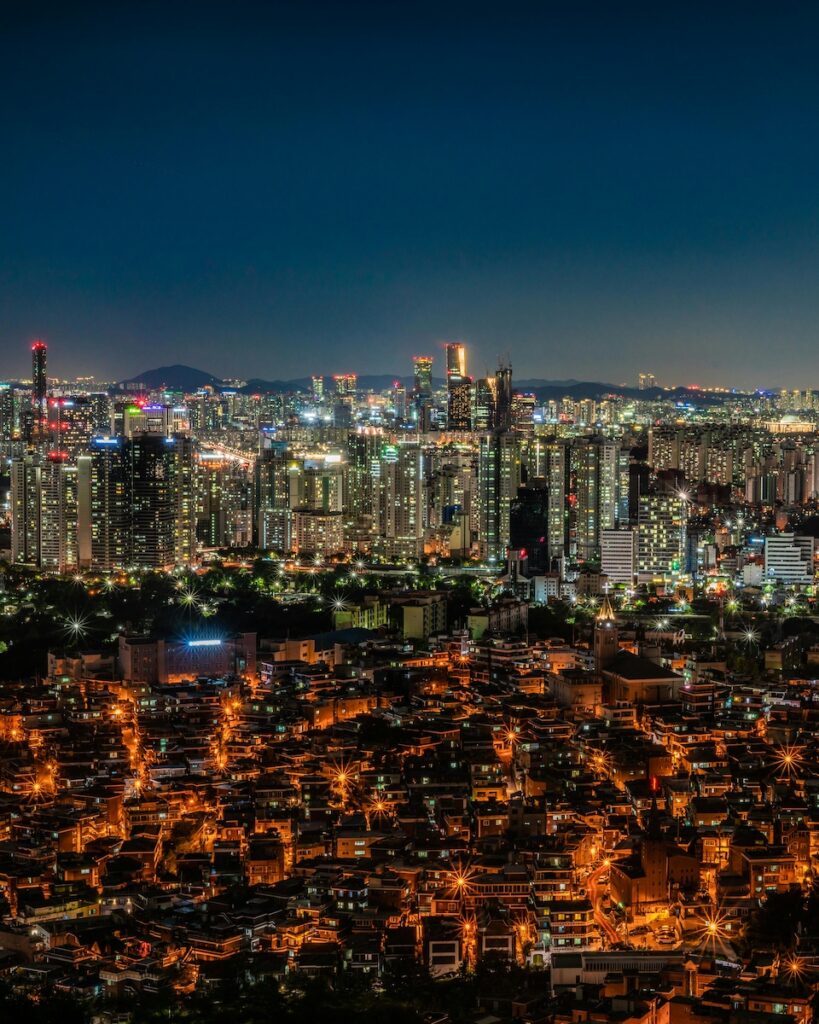
Seventeen years ago I met a friend on the road right next to this exhibition hall. She ran a small clothing business in a regional city. She had come up to Dongdaemun on one of the overnight buses that used to pack this stretch of road, wall to wall, every single night. Retailers from every corner of the country would arrive after midnight, load up on wholesale garments from the surrounding markets, and be gone before sunrise. The street I remember from 2009 was loud, crowded, lit by the headlights of forty tour buses parked bumper to bumper.
That street is gone. DDP was built on top of the old Dongdaemun Stadium starting in 2009 and opened in 2014, and the whole area was cleaned up around it. The overnight bus traffic has thinned out — partly because of the construction, partly because logistics moved online, partly because parcel delivery in this country got so absurdly good that a shop in Busan no longer needs to send a person to Seoul at 2 AM to fetch inventory.
I know the road looks better now. I know the DDP is one of Zaha Hadid’s most famous buildings in Asia. I still remember the buses. Standing at the entrance of the exhibition, I had one foot in 2026 and one foot in 2009, and neither foot was uncomfortable.
Three minutes standing in front of a chair full of clothes
You walk in. The first room is what you see, and in an exhibition the first room does the heaviest lifting.
Names of designers are printed on hanging panels near the ceiling. Below them, clothes are draped over chairs — not on mannequins, not on hangers, just laid over the seats and backs of ordinary chairs like someone had gotten dressed in a hurry and left the alternatives behind. A large sign on the wall says HOW DO YOU WANT TO BE REMEMBERED?
I stood in front of one of the chairs and gave myself three minutes.
I was looking for Britain in the clothes. That was my starting question. Where is the UK in these garments? Something in the cut, the color, the fabric — something that would let a Korean visitor point and say yes, that is what makes it British.
Three minutes passed. I did not find it.
The only British art I could recall from my university-era Western Art History class was Turner’s Snow Storm. I tried to see Turner in the sleeve of a white shirt draped over a wooden stool. The shirt was polite about my effort and offered nothing back. My mind, which I like to think of as reasonably round, was rolling in a smaller and smaller circle inside my skull.
Silence. The silence of not knowing.
This is the real report from the middle of a fashion exhibition when you are not in the fashion industry — a lot of the first minutes are spent standing very still, trying to look like you understand, waiting for something to click. Most of the time you are helped by wall text and video, which is what saved me here too. Which brings me to the next thing I did not know.
The 3+1 I did not know: Great Britain and Northern Ireland
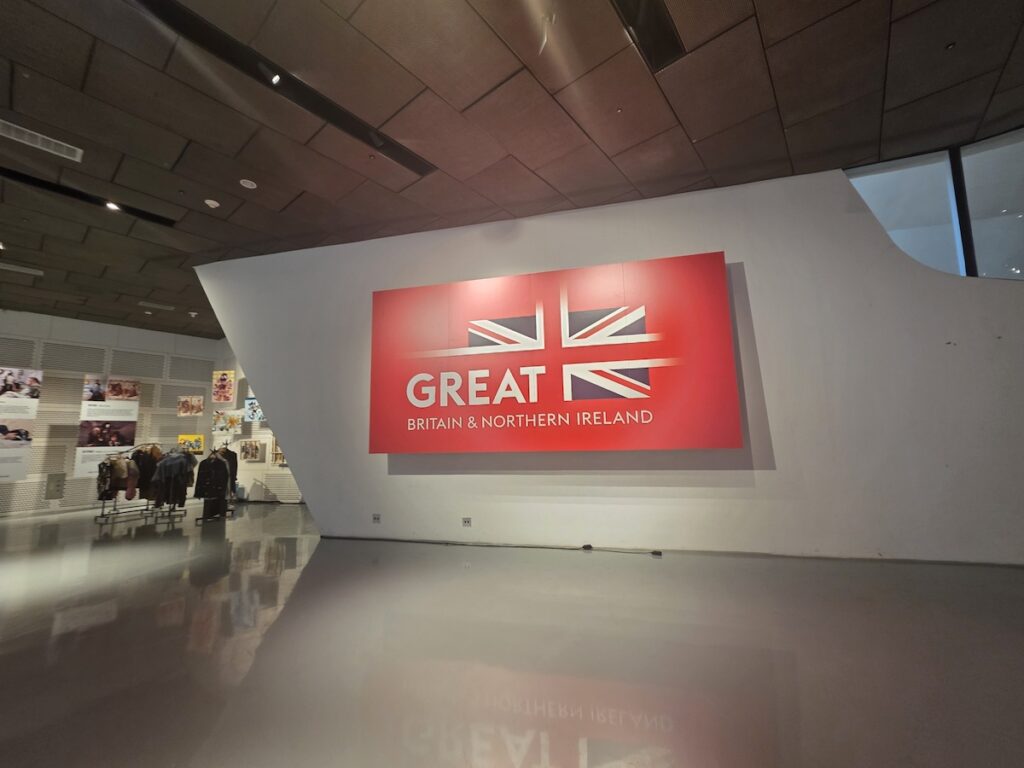
Downstairs, on the wall next to the staircase, in enormous red letters, was the campaign logo of the exhibition’s country of origin.
GREAT BRITAIN & NORTHERN IRELAND
I stared at it. I had lived my whole life thinking of the UK as one thing with four names — England, Scotland, Wales, Northern Ireland, all under one flag. I had never once paused on why they were written the way they were written. Great Britain and Northern Ireland. Three plus one. Why the punctuation?
I pulled out my phone and searched, standing right there under the sign.
Great Britain, it turns out, is the geographic name of the island containing England, Scotland, and Wales. Northern Ireland is on a different island. The whole country’s formal name — the one that shows up on treaties and passports — is the United Kingdom of Great Britain and Northern Ireland. The 3+1 is not a design decision. It is a coastline.
I stood there for maybe another minute reading. This is small knowledge. I could have lived the rest of my life without it. But I had walked into a British exhibition wondering where the “British” was, and the first real answer was in the country’s own name, printed on the wall in a font the size of my head.
I want to be specific about what happened next in my head. It was two things at once. First, mild embarrassment. I am a Korean adult with a university degree and I did not know the basic name of a G7 country. Second, cheerfulness. I had walked into a room and left it with a piece of information I did not have before. This is the entire pitch of any exhibition, and this one had just landed the pitch on me.
Which is when I noticed what was happening. The exhibition had marketed the UK to me, and I had bought it. I was standing in a room, in a country I have lived in my whole life, feeling a small warm affection for a country I have never been to.
I was marketed to. I liked it.
I do not think that is a bad thing. I think that is what a good exhibition does. It arrives with intent, it opens a door, and it lets you walk in on your own two feet.
Pass your legacy to the next generation
The panels near the first-room chairs had a phrase printed across them in English.
How do you want to be remembered? Pass your legacy to the next generation.
That is a heavy sentence to hang in the entrance of a fashion show. It is a mortality sentence. It is the sort of thing a grandparent says at the end of a long dinner. Reading it inside a hall full of upcycled clothing — clothing that used to be someone else’s, now becoming somebody’s next thing — the sentence started to make more sense to me. Legacy is not what you keep. It is what you pass on.
I do not want to overplay this. I was on a Sunday walk. I was not having a spiritual event in DDP. But the sentence stayed with me long enough to make me think about my own closet, which is full of things I neither wear nor throw away, and about the concept that clothes are one of the very few objects most of us pass to strangers by default. The stranger might be a thrift shop, might be a landfill, might be a UAL graduate turning them into a new coat. I had never sorted that hierarchy in my head before.
The exhibition, I realized somewhere on the stairs down to the second floor, was not really about clothes. It was about the small print on the tag of every garment you have ever owned, blown up to the size of a wall.
Downstairs, upcycled: touching with the eyes
The lower floor is where the second half of the exhibition sits — “Circle Back; Connect. Wear.”
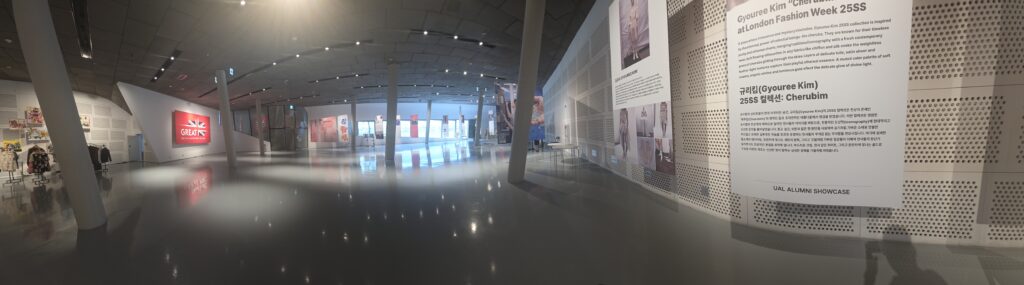
Twenty graduates of the University of the Arts London (UAL) were given a stack of unsold garments from Samsung C&T’s fashion division and asked to turn them into new original pieces. Not repair. Not clean. Reimagine. The result was hanging around the room in installations that ranged from wearable to sculptural.
I stood in front of one piece and had the polite Korean thought that comes to every visitor of every exhibition here. Can I touch this? The label said nothing about touching. The staff member across the room said nothing about touching. My hands stayed at my sides.
I have been thinking, since I got home, that I should have asked. The worst answer would have been no. The best answer would have been of course, please, it is fabric, and my understanding of the piece would have doubled. Instead I looked with my eyes only, in the way Korean adults are trained to look at anything that might be either art or someone else’s property, which for our generation is most things.
The words that came back to me while I looked were the two English words I had learned during my old shopping-mall photography days: textile and fabric swatch. Seventeen years since I last had to use them for work, and they arrived on cue. I looked at the seams, the weave, the way one garment had been cut and rejoined into something that did not look repaired but reborn. Old cloth carrying a new intention.
I want to say something direct here about my own history with these objects. When I was in university I paid part of my tuition by photographing clothes for online shopping malls. I was, in the actual hierarchy of the fashion industry, near the bottom — the person who arrived after the designer had made the piece, after the buyer had chosen it, after the model had worn it, and simply pointed a camera at it so it could be sold. I saw hundreds of garments a week. Most of them were, in retrospect, exactly the kind of unsold overstock that ends up in projects like this one seventeen years later.
I was standing, in other words, in a room where my old career and the current climate crisis had accidentally shaken hands. It was not a pleasant handshake. It was clarifying.
The honeycomb moment: when the material became the message
Near the end of the lower floor I stopped in front of a display panel and did what I had already done twice that afternoon. I pulled out my phone.
The panel was thick. Not a normal poster board — something with a cross-section you could see if you looked at it from the side, which I did, because it was strange enough to notice. Cardboard. But not flat cardboard. Cardboard folded into a honeycomb pattern between two paper skins.
I photographed the edge. I searched the image.
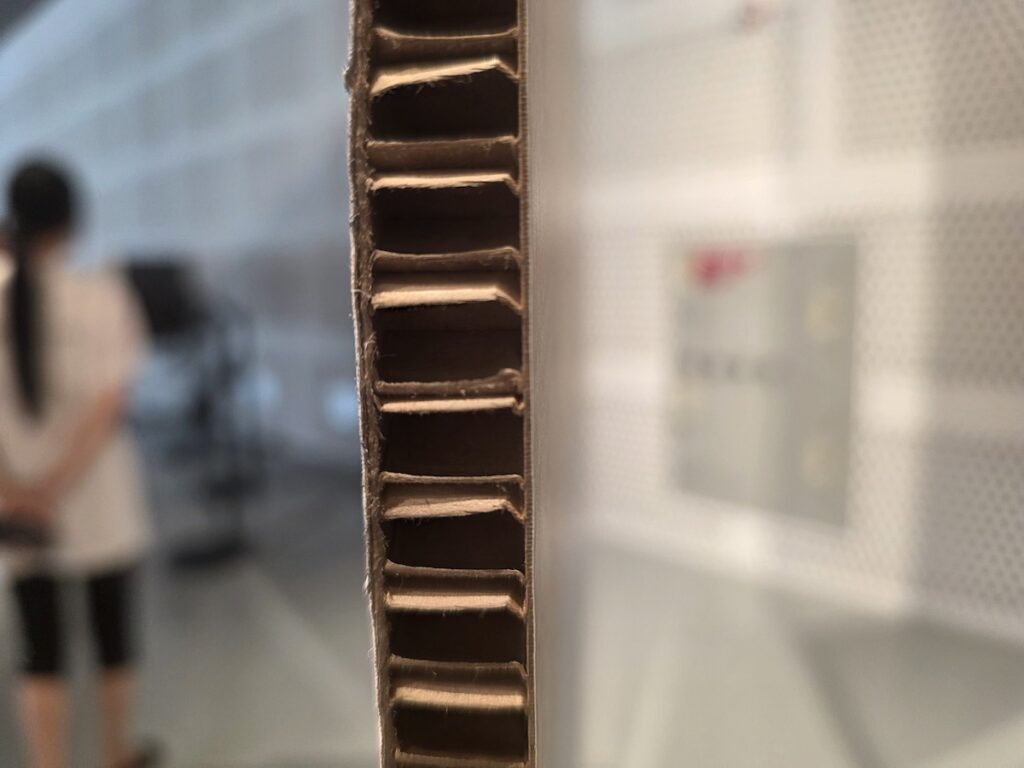
Honeycomb board. A lightweight, high-strength material made from recycled paper, used increasingly in exhibition construction as a low-carbon alternative to foam board and plywood. Recyclable at end of use. Structural at fraction of the weight.
I did not know that phrase before. I did know, the moment I saw the panel from the side, that it was a recycled material of some kind. Its structure said it. Another visitor beside me paused to look at the same edge and made a small sound of recognition. She had noticed too.
This was the moment the exhibition’s whole concept clicked. The message of the exhibition was not only on the panels. It was in the panels themselves. The display material was the display. A show about circular design, mounted on circular-design cardboard.
There is a specific pleasure in this kind of small recognition. It is the pleasure of the maker’s intent reaching you without being explained. If I had not stopped, if I had not looked at the edge, I would have walked past this. Which is, in the end, most of what happens at exhibitions. Most of it walks past you. The hits are the ones you happen to stop in front of.
A monitor, a font, and one more small search
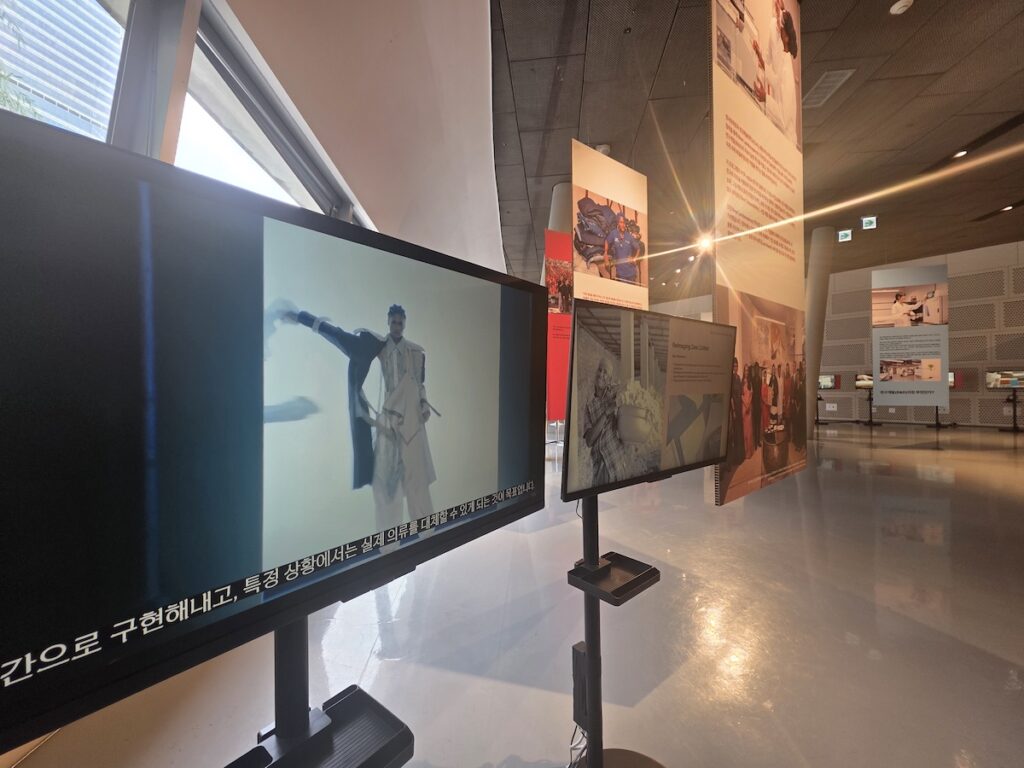
Near the exit of the lower floor, a large monitor was playing a supporting video. I watched it for maybe two minutes. It was the kind of video that assumes you will not stop, and rewards you if you do.
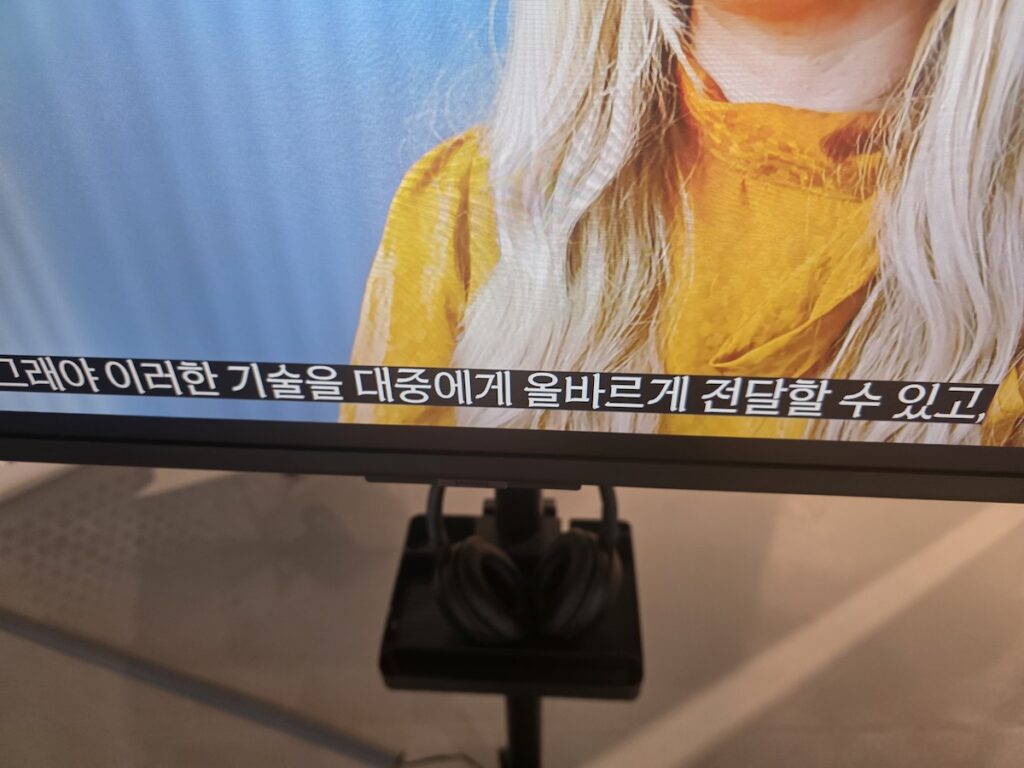
I did stop, for a strange reason. The Korean subtitles on the screen were set in a font I did not recognize. Something clean, low-contrast, warm — a modern Korean sans-serif with the calm confidence of a font that had been chosen, not defaulted to.
I photographed the screen. I searched again.
The results suggested it was likely from the Sandoll Jeongho Gothic family, or possibly Hangeulnuri, a display font released by the National Hangeul Museum. I could not confirm which. What I could confirm was that someone at this exhibition had thought about the typeface. In a room full of upcycled coats and honeycomb walls, someone had also cared about which shape the Korean characters took on the video subtitles.
This was the third search of the day. And it is, I think, the thing that finally convinced me the exhibition was thoughtful all the way down. Big exhibitions get sloppy at the edges — cheap fonts, wrong-colored labels, badly translated captions — because the budget goes to the headline pieces. This one did not.
I walked out.
Three days before me, the Princess had come
It was hot and humid on the street. I decided to walk to Dongdaemun History and Culture Park Station rather than take a bus. On the way I was still holding my phone from the last search, and I did what I always do on the walk after a good exhibition — I searched the name of the thing to see if the internet had noticed.
The internet had.
A Yonhap News article on my screen, dated a few days earlier, said Princess Anne of the United Kingdom — Her Royal Highness The Princess Royal, formally — had visited this same exhibition on July 14, the day before it opened. Her husband, Sir Tim Laurence, was with her. She had walked the same rooms I had just walked. She had been briefed on the Circle Back project. There were photographs.
I stood on the sidewalk near the station and read the piece slowly.
I have almost no informed opinion about the British royal family. Growing up in Korea in the 1990s and 2000s meant knowing that Princess Diana existed and had died young, that Queen Elizabeth had reigned for so long she felt like weather, and that beyond that the whole institution was somebody else’s problem. I could not have named the current Prime Minister of the UK without a Google search. I could not, if pressed, have explained the difference between a monarch’s role and a Prime Minister’s role in a country like the UK today.
Standing at the crosswalk, holding a piece of news that a princess had been in this room three days before me, I realized I now wanted to know. Not because I was starstruck — I was not — but because the exhibition I had just walked through had been quietly, patiently, systematically opening the door of a country I had never bothered to look inside. Now that I was looking inside, I wanted to know the shape of the government too. I wanted to know how a monarch and a Prime Minister split the work. I wanted to know why an eighty-year-old princess flies to Seoul to open an exhibition about clothes.
That is the fourth search I have promised myself for this week. I have not done it yet. I wanted to write this down first.
What I am left with
A quiet holiday. A road I used to know at night. Three minutes of not understanding, then a Google search. A wall-sized sentence about legacy. A downstairs of unsold Samsung clothes remade by London graduates. A honeycomb of recycled cardboard I would have walked past. A well-chosen font. A princess who came three days before me.
I entered thinking I would look at an exhibition. I left having been quietly educated by it, and by the country that put it together. The word for that experience, I think, is marketing. But marketing that assumes the visitor is a full adult, capable of looking, searching, learning, and deciding what to feel about what they learned. That is the version of marketing I am willing to receive.
The UK Korea Fashion Futures DDP exhibition runs until July 25. Entry is free. It takes ninety minutes if you read. It takes two hours if you also stop in front of the chairs, look at the honeycomb from the side, and stand on the sidewalk afterward reading Yonhap for another ten.
If you are on a public holiday in Seoul and looking for something small and unpressured to do, this is that thing.
For another free international-collaboration exhibition worth the walk this year, SeMA’s UAE Proximities showcase is the other side of the same idea.
Bring your phone. You will need it.