Finding a reliable ATM in Korea is the first challenge for any international traveler landing in Seoul. While the city is a high-tech wonderland, knowing which ATM in Korea offers the best rates and lowest fees is essential to protect your travel budget. In this expert guide, we deconstruct the truth behind street-side kiosks and how to use an ATM in Korea like a seasoned local pro.
Traveling or living in South Korea is a seamless, futuristic experience, yet it presents a classic dilemma for international visitors: “How do I access my cash without falling victim to predatory transaction fees?”
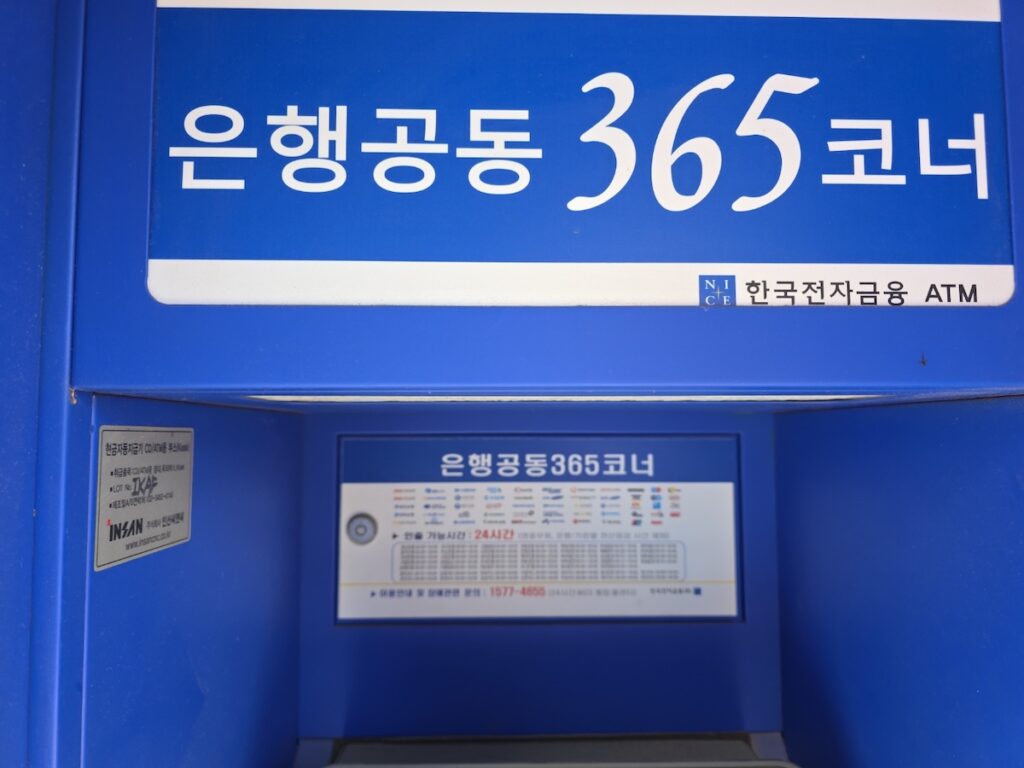
If you have navigated the vibrant streets of Seoul, you’ve likely encountered the ubiquitous blue kiosks labeled “Joint Bank 365” or “Global ATM.” To the untrained traveler, they may look like a high-cost trap. To the seasoned expat, they are a strategic tool for 24/7 liquidity. Today, we deconstruct the technical and financial architecture of street ATMs in Korea to help you navigate them like a high-level local pro.
1. The Anatomy of the “Convenience Fee”
Most travelers suffer from Loss Aversion. The psychological pain of losing $3 to an ATM fee often outweighs the benefit of having immediate cash. However, in Korea, the financial ecosystem is bifurcated into two distinct categories: Commercial Bank ATMs (Shinhan, KB, Woori) and IADs (Independent ATM Deployers).
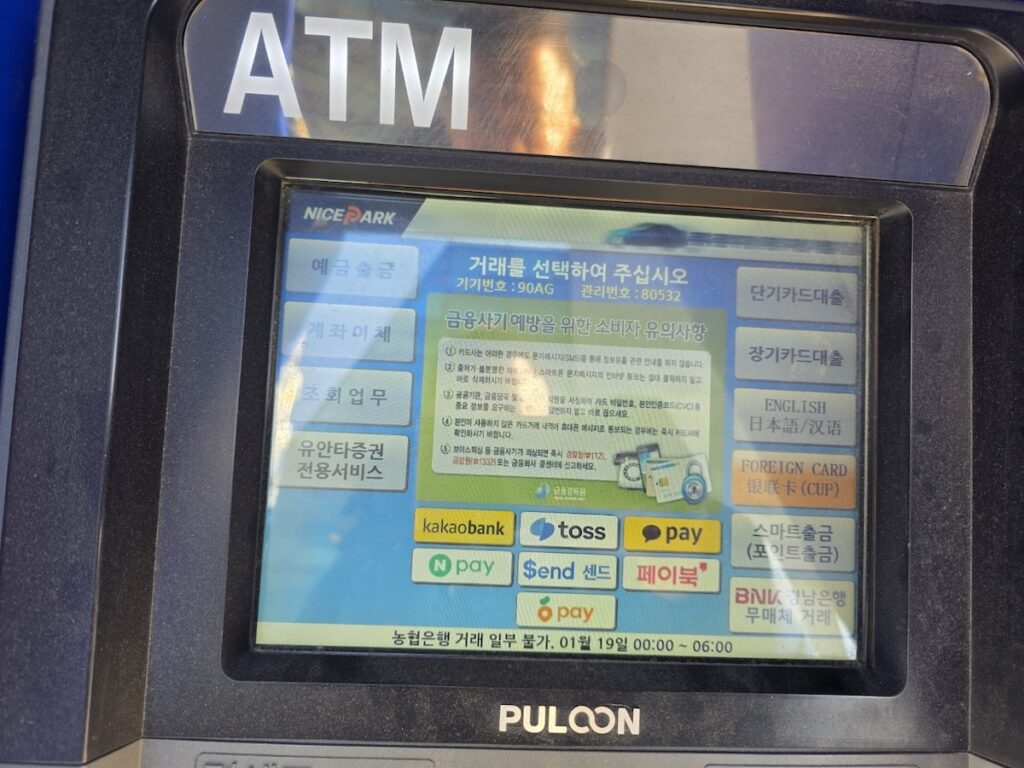
These street-side kiosks (like those from NICE PARK or PULCON) are IADs. They are not “scams”; they are high-maintenance service points situated in prime real estate, such as GS25 or CU convenience stores. When you use these, you aren’t just paying for the currency; you are paying for 24/7 hyper-accessibility and a multilingual UI/UX that many local bank branches still fail to provide.
2. Strategic Tips for Using an ATM in Korea
As seen in the latest hardware deployments across Korea, these machines are far more advanced than their counterparts in the West.
- Verified Global Access: The “FOREIGN CARD” (Visa, Mastercard, JCB, UnionPay) protocol is hardwired into these systems, ensuring a significantly higher success rate for international chips compared to older bank terminals.
- Fintech Integration: Observe the logos for KakaoBank, Toss, and Paybooc on the screen. These machines are integrated into Korea’s cutting-edge open-banking network, meaning your international data is processed under the same rigorous encryption standards as Korea’s multi-billion dollar fintech giants.
- The “Global ATM” Requirement: Always look for the specific “Global” branding. While most street ATMs are technically capable, those explicitly labeled “Global” are optimized for the ISO 8583 standard, reducing the risk of a “timed-out” transaction that leaves your funds in limbo.
3. Fee Structure: A Mathematical Breakdown
When you insert your card, you face a two-tier fee structure that every smart traveler must understand:
- The Access Fee: The flat fee charged by the Korean ATM operator (typically ₩1,100 to ₩1,500).
- The Network Fee: The percentage-based fee charged by your home bank or card network (often 1-3% plus a flat international service fee).
Marcus’s Strategic Advice: To minimize the overhead, avoid small, frequent withdrawals. A ₩3,000 total fee on a ₩20,000 withdrawal is a staggering 15% loss. On a ₩200,000 withdrawal, that same fee drops to a manageable 1.5% overhead.
4. Avoiding the DCC (Dynamic Currency Conversion) Trap
This is where most travelers lose their money. If an ATM asks whether you want to be charged in your “Home Currency” (USD, EUR, GBP) or the “Local Currency” (KRW), ALWAYS choose KRW. Choosing your home currency allows the ATM provider to set a proprietary exchange rate, often hiding a 5% to 10% markup.
🏛️ Master Your Korean Financial Strategy
Understanding street ATMs is only the first step. To truly optimize your financial footprint in Korea, explore our deep-dive expert guides:
- [Strategy] Beyond Major Banks: Why I Switched My Savings to Community Banks in Korea – Discover why traditional big banks might not be the best place for your long-term savings.
- [Expert Guide] The Complete Guide: How to Own and Manage a Korean Bank Account While Living in America (2026 Edition) – Navigate the complexities of cross-border banking without losing your mind or your money.
- [Essential Read] Everything You Need to Know: Opening a Korean Bank Account as a Foreigner (2025 Updates) – The definitive, updated roadmap for getting your first local account.