For international travelers seeking a definitive Dongseoul Bus Terminal Guide, understanding the contrast between Seoul’s transit hubs is the first step toward a seamless journey. While the Express Bus Terminal in Gangnam functions as a polished commercial monolith, Dongseoul Bus Terminal (East Seoul Terminal) remains the most vital, high-frequency gateway for those looking to secure a Seoul to Yangyang bus or a Seoul to Sokcho bus. Strategically positioned at the edge of the Han River and directly synchronized with Gangbyeon Station (Line 2), this hub is the undisputed starting point for the city’s most efficient routes to the East Coast’s premium surf spots and rugged mountain peaks.
However, do not let its strategic convenience fool you; the current state of the terminal demands professional-grade navigational focus. As of 2026, with the massive modernization project transforming the skyline, the terminal operates in a high-intensity, “raw” environment that feels worlds apart from the sterile luxury of the south. This is a place where urban grit meets logistical efficiency. For anyone stay-ing in the creative districts of Seongsu or the residential hubs of Jamsil, mastering this specific terminal is not just an option—it is a necessity for bypassing the city’s notorious southern traffic congestion and reaching the “real” Korea in record time.
The atmosphere inside is unapologetically local, characterized by the visceral hum of idling engines and a no-nonsense approach to transit. Unlike the multi-language friendliness of tourist-heavy zones, Dongseoul requires you to stay sharp, cross-referencing your tickets with aging electronic displays and navigating platforms that are currently evolving amidst heavy construction. It is a rite of passage for the authentic traveler. Whether you are chasing the early morning swells via a Seoul to Yangyang bus or heading for a sunrise hike through a Seoul to Sokcho bus route, this guide provides the tactical intelligence required to conquer the chaos and travel with the confidence of a seasoned Seoul local.
Why Every Traveler Needs a Dongseoul Bus Terminal Guide
For travelers heading to the East Coast or deep into the mountains, Dongseoul is often faster and more convenient than the massive Gangnam complex. It’s strategically positioned for those staying in Seongsu, Jamsil, or Gwang진, offering direct access to destinations that Gangnam sometimes overlooks.
Top Destinations: Why Dongseoul is the Undisputed King of Local Routes
While other terminals in Seoul focus on major metropolitan cities, Dongseoul Bus Terminal specializes in getting you to the most iconic, specific, and culturally rich regions of Korea’s East and Southeast. If your itinerary includes surfing on the East Coast or exploring UNESCO World Heritage sites, this is your starting point.
The beauty of Dongseoul lies in its frequency and efficiency. For many of these routes, the buses are not just the “cheap” option; they are often the fastest way to reach your destination, beating out trains that require multiple transfers or long taxi rides from distant stations.
Destinations Overview: Time & Cost
To help you plan your journey with VVIP precision, here is a breakdown of the most popular routes from Dongseoul.
| Destination | Est. Travel Time | Frequency | Ticket Price (Approx.) | Key Highlight |
| Yangyang | 2h 10m – 2h 30m | Every 30–60 mins | 17,000 – 22,000 KRW | Surfing & Luxury Resorts |
| Sokcho | 2h 10m – 2h 20m | Every 15–30 mins | 19,000 – 25,000 KRW | Seoraksan National Park |
| Andong | 2h 50m – 3h 10m | Every 40–60 mins | 22,000 – 28,000 KRW | UNESCO Hahoe Village |
1. Seoul to Yangyang Bus: The Surfer’s Expressway
Yangyang has rapidly evolved from a quiet fishing town into Korea’s “Surf City” and a hub for high-end boutique stays. It is the destination of choice for Seoul’s trendsetters.
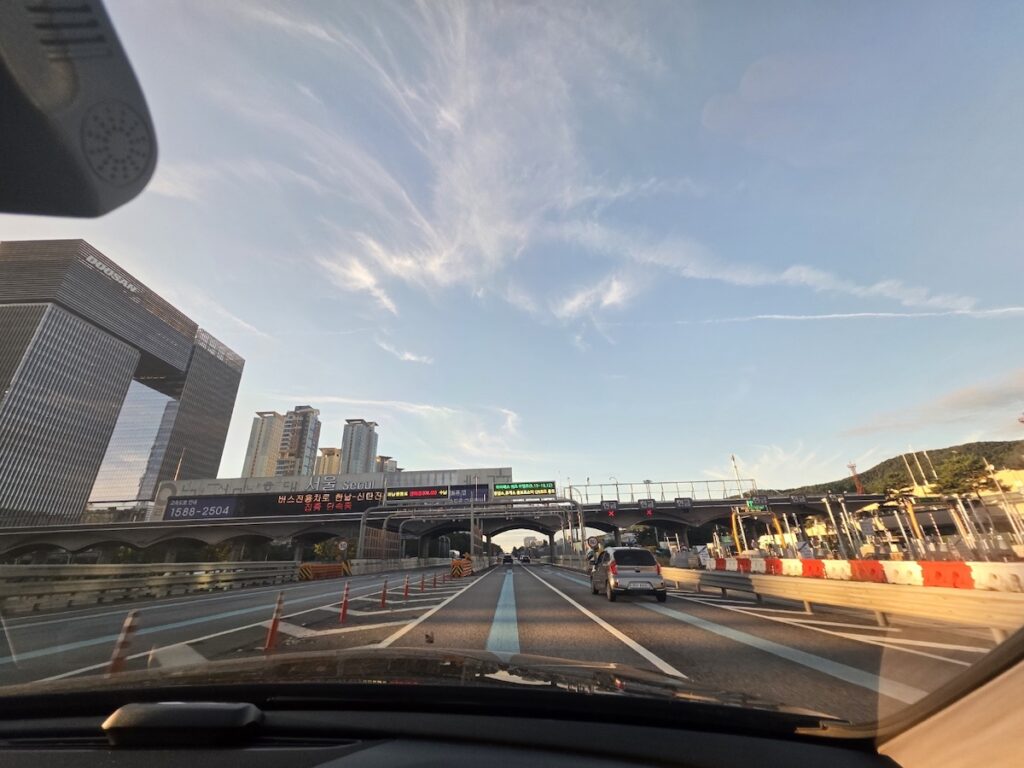
- Why Dongseoul? The route from Dongseoul to Yangyang is incredibly efficient, utilizing the Seoul-Yangyang Expressway to get you from the city center to the beach in just over two hours.
- Local Insight: If you are heading to Naksan Beach or the trendy Hajodae (Surfyy Beach) area, make sure to check if your bus is a “Direct” (Moo-정차) service. Some buses make brief stops in smaller towns, which can add 30 minutes to your trip. For a premium experience, book an “Excellent” (Woo-deung) bus, which offers wider, reclining seats in a 2+1 layout.
2. Seoul to Sokcho Bus: Gateway to the Peaks
Sokcho is the ultimate basecamp for anyone looking to conquer Seoraksan National Park. It’s where the mountains meet the sea, offering a rugged natural beauty that is a stark contrast to Seoul’s concrete jungle.
- Why Dongseoul? Dongseoul offers more frequent departures to Sokcho than almost any other hub in the city. You can literally show up without a reservation and likely find a seat on a bus leaving within 20 minutes.
- Local Insight: There are two main arrival points in Sokcho: the Sokcho Intercity Bus Terminal and the Sokcho High Speed Bus Terminal. Dongseoul primarily serves the Intercity terminal, which is actually closer to the famous Sokcho Tourist & Fishery Market—perfect for grabbing a box of Dakgangjeong (sweet and spicy fried chicken) before heading to your hotel.
3. Bus to Andong: The Cultural Deep Dive
For travelers seeking the soul of traditional Korea, Andong is non-negotiable. Home to the UNESCO-listed Hahoe Folk Village, it is the epicenter of Confucian heritage and traditional architecture.
- Why Dongseoul? While there is a KTX train to Andong from Cheongnyangni Station, the Dongseoul bus remains a favorite for its competitive pricing and the fact that it drops you at the Andong Bus Terminal, which has excellent local bus connections directly to the Folk Village.
- Local Insight: The journey to Andong takes about 3 hours, making it a perfect mid-range trip. Use this time to enjoy the changing landscape as you leave the skyscrapers of Gyeonggi-do behind and enter the rolling hills of Gyeongsang-do. Unlike the bustling East Coast routes, the Andong line offers a quieter, more contemplative travel vibe.
Survival Guide: Stay Sharp or Get Lost
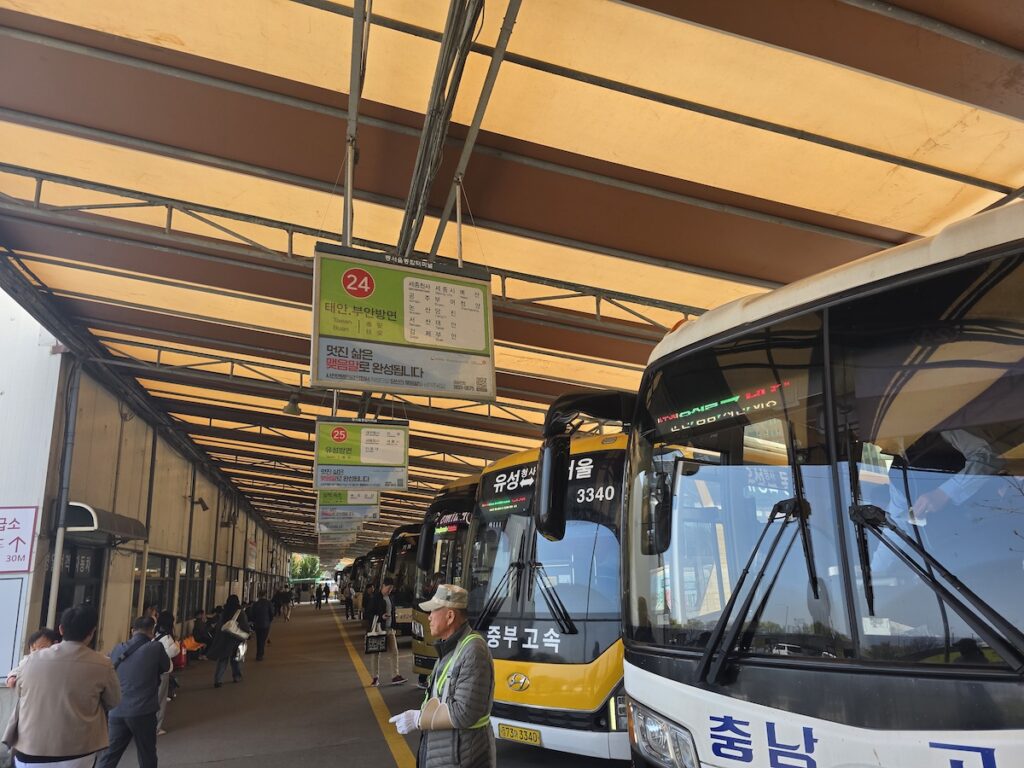
Here is the honest truth: Dongseoul Terminal is chaotic. Unlike modern terminals where gates are clearly color-coded, the platforms here can feel like a maze of 1990s signage and exhaust fumes.
Marcus’s Pro Tips for VVIPs:
- Don’t Relax at the Gate: The bus platforms are not always clearly separated. A bus heading to a completely different province might be parked right next to yours.
- Match the Number, Not Just the Destination: Check your ticket’s platform number, but also double-check the electronic display on the bus windshield.
- The “Old-school” Factor: Expect a lack of English signage compared to Gangnam. Keep your Google Maps or a screenshot of your destination in Korean ready.
2026 Status Report: The Dongseoul Terminal Modernization Project
As of 2026, the long-awaited Dongseoul Terminal Modernization Project has transitioned from the planning phase to active execution. This massive redevelopment, led by the Seoul Metropolitan Government and Shinsegae Property, is not merely a renovation but a complete urban transformation. According to recent city planning reports, the site is being redeveloped into a 39-story, 197-meter-tall multi-purpose landmark with a total floor area of approximately 360,000 square meters.
The project, often compared to the iconic Hudson Yards in New York, aims to consolidate transit, commerce, and global business into a single vertical hub. Key features of the 2026 development phase include:
- Underground Transit Consolidation: In a move to alleviate chronic traffic congestion, the bus terminals—which previously occupied the ground floor—are being relocated to three underground levels (B1 to B3).
- Public Pedestrian Spaces: The rooftop is designated as the ‘Seoul Sky Yard,’ a public observation deck offering panoramic views of the Han River, intended to become a major tourist attraction.
- Transit-Oriented Development (TOD): Direct underground links to Gangbyeon Station (Line 2) are being reinforced to facilitate a seamless transition between intercity buses and the Seoul subway system.
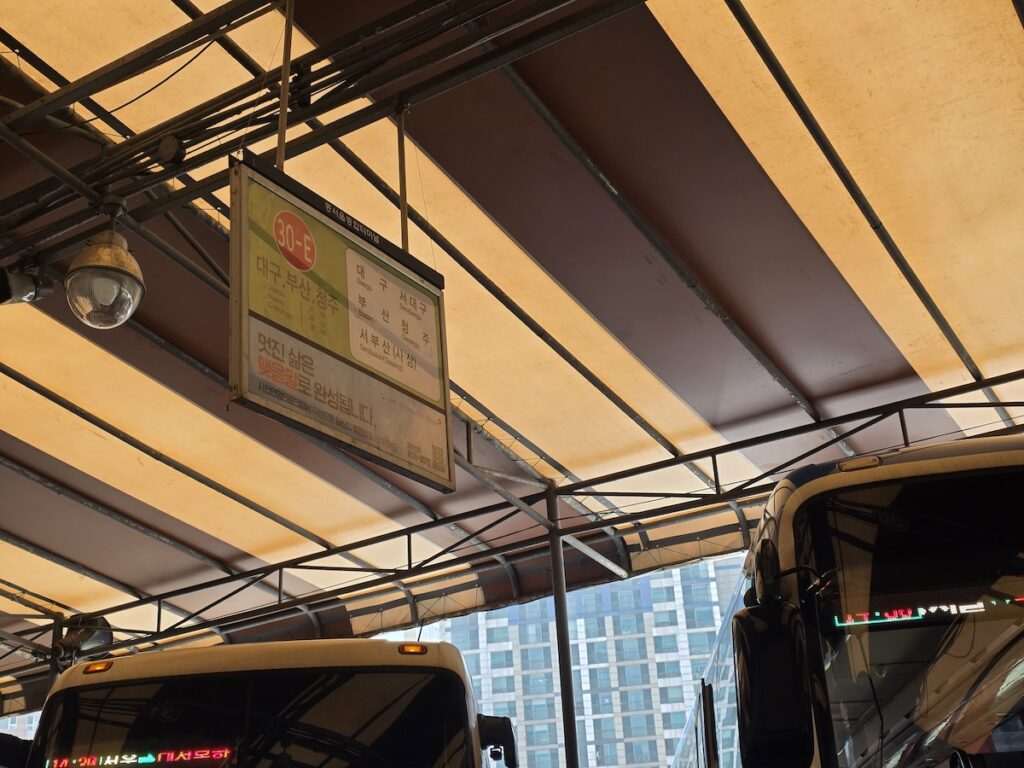
Critical Advisory for 2026 Travelers: While the construction is underway, terminal operations are utilizing temporary boarding zones and shifted lanes. As reported in local transport news, platform assignments are subject to frequent changes to accommodate heavy machinery and site safety protocols. Travelers are strictly advised to arrive at least 20 to 30 minutes prior to departure, as the path to the temporary gates may be significantly longer and less intuitive than the previous layout.
Strategic Topography: Mapping Seoul’s Intercity Transit Infrastructure
To navigate the South Korean peninsula effectively, one must understand the decentralized nature of Seoul’s transit hubs. Unlike major European cities centered around a single “Grand Central,” Seoul strategically distributes its intercity bus traffic across four primary nodes, each governed by its geographical orientation toward provincial regions.
For travelers based in eastern Seoul—specifically the burgeoning creative and luxury districts of Seongsu and Jamsil—the Dongseoul Bus Terminal serves as the most critical arterial link. It minimizes the cross-city transit time that would otherwise be wasted navigating the congested Seocho-gu hubs (Express Bus Terminal).
Comparative Infrastructure Matrix: Major Seoul Hubs
| Hub Classification | District (Gu) | Metro Synchronization | Primary Regional Focus | Strategic Advantage |
| Dongseoul Terminal | Gwangjin (East) | Line 2 (Gangbyeon) | East Coast / North Gyeongsang | Direct Han River exit to Expressways |
| Seoul Express (Gyeongbu) | Seocho (South) | Line 3, 7, 9 (Exp. Bus Term.) | Southeast (Busan/Daegu) | Multi-modal luxury commercial complex |
| Central City (Honam) | Seocho (South) | Line 3, 7, 9 (Exp. Bus Term.) | Southwest (Jeolla Region) | Integrated department store connectivity |
| Nambu Terminal | Seocho (South) | Line 3 (Nambu Terminal) | Rural Gyeonggi / Small Cities | Localized transit with niche provincial routes |
Geographic Dominance and Connectivity
1. The Eastern Gateway: Dongseoul Terminal
Strategically positioned on the northern banks of the Han River, Dongseoul is the definitive gateway for the Seoul-Yangyang Expressway. Its immediate proximity to Gangbyeon Station (Subway Line 2)—a mere 60-second walk via the underground link—makes it the most logistically sound choice for those avoiding the saturated traffic of the Banpo-dong area. For the VVIP traveler, it represents a “fast-track” escape from the city’s core to the luxury coastal retreats of Gangwon-do.
2. The Southern Megalopolis: Seocho Hubs (Gyeongbu & Central City)
Located in the heart of the Banpo residential and commercial belt, these terminals serve as the headquarters for Korea’s bus transit. While they offer the highest frequency of departures to major metropolitan cities, the sheer volume of traffic (both bus and pedestrian) requires a significant temporal buffer. They are connected via a complex tri-line metro station (Line 3, 7, 9), demanding higher navigational focus than the straightforward layout of Dongseoul.
3. The Specialized Node: Seoul Nambu Terminal
Targeting travelers heading toward the southern outskirts and specific arts-centric districts, Nambu Terminal operates as a specialized relief valve for the larger Seocho hubs. It remains a tactical choice for those whose destinations are the smaller, non-metropolitan municipalities that are often bypassed by the high-speed KTX rail network.
Technical Conclusion: Navigating the Evolution of Seoul’s Transit Hub
The current state of Dongseoul Terminal represents a pivotal era in Seoul’s urban evolution. It remains the most vital arterial link connecting the capital to the strategic regions of the East Coast and the cultural heartlands of the South. However, during this multi-year redevelopment period, the terminal demands a higher level of navigational vigilance from international visitors.
The efficiency of this hub is undeniable, yet the physical environment is currently characterized by the logistical complexities of a major construction site. Success in using this terminal today depends on precise timing and a thorough verification of platform data. By mastering the nuances of this transitional phase, travelers gain direct access to the most specialized local destinations in the peninsula through a system that is rapidly moving toward its future as a world-class global exchange.