Saju and Tarot in Seoul are not only tourist curiosities. They are part of how many Koreans talk about timing, personality, relationships, work, and uncertainty.
Walk through areas like Hongdae, Gangnam, Insadong, Sinchon, or university districts, and you may see signs for 사주, 타로, 운세, or 궁합. Some places feel traditional and quiet. Others look like casual tarot cafés where couples, friends, or office workers drop in after coffee.
For foreigners, the interesting part is not whether you personally believe in fortune-telling. The real value is cultural. A saju or tarot reading can show how Koreans think about fate, pressure, decision-making, love, career, marriage, and emotional reassurance in everyday life.
This guide explains how Saju and Tarot in Seoul work, what to expect, how much a reading may cost, where to try it, what to prepare, and how to approach the experience respectfully without treating it as a joke.
Quick Answer: What Is Saju and Tarot in Seoul?
Saju and Tarot in Seoul are two of the most common ways people experience Korean fortune-telling culture.
Saju is based on your birth year, month, day, and time. It is often connected to personality, life direction, career, marriage compatibility, timing, and major life choices.
Tarot uses cards to explore questions about love, relationships, work, timing, emotions, or personal decisions. It is usually more casual and flexible than saju.
| Type | Based On | Common Questions | Best For |
|---|---|---|---|
| Saju | Birth date and birth time | Career, marriage, personality, life direction | People curious about Korean tradition |
| Tarot | Card reading | Love, relationships, short-term choices | Quick and casual readings |
| Gungap | Compatibility reading | Marriage, dating, relationship match | Couples or people asking about love |
| Face reading | Facial features | Personality, luck, impression | Cultural curiosity |
| Palm reading | Hand lines | Wealth, health, future tendencies | Short informal readings |
If you are a foreigner, the most important thing to prepare for saju is your exact birth date and birth time. For tarot, you usually only need a clear question.
1. Saju Is More Traditional Than Tarot
What Saju Means
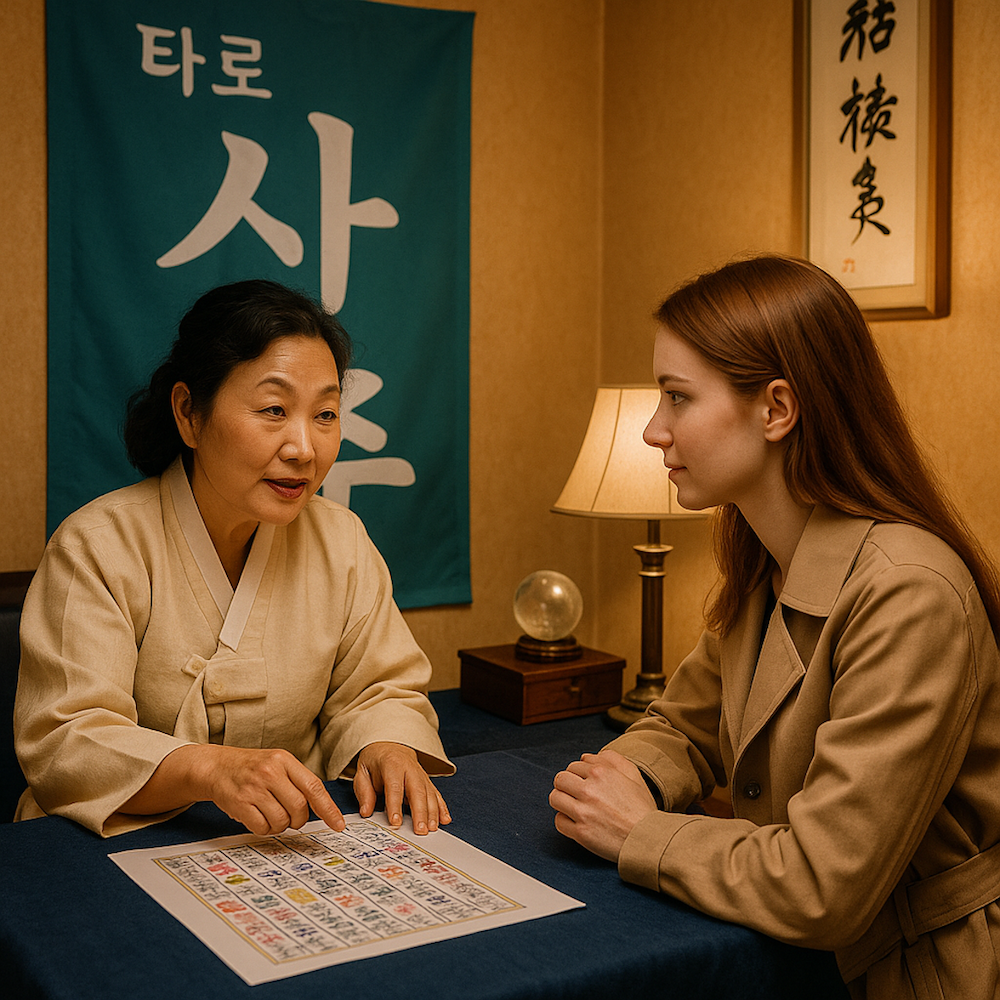
Saju, written in Korean as 사주, literally refers to the “four pillars.” These pillars are based on the year, month, day, and hour of your birth.
A saju reader uses this information to interpret patterns related to your personality, relationships, career, family, timing, and life direction. The reading may also include ideas from the five elements, yin and yang, and traditional East Asian fortune-telling systems.
For foreigners, the concept may feel similar to astrology in the sense that it uses birth information. But saju is not the same as Western zodiac signs. It is more detailed because the birth time matters.
Why Birth Time Matters
If you want a saju reading in Seoul, try to bring your exact birth time.
Without your birth time, the reader may still give a reading, but it can be less detailed. Some readers may ask whether you were born in the morning, afternoon, evening, or night if you do not know the exact hour.
If you are traveling in Korea and want to try saju just for cultural experience, this may be enough. But if you want a more serious reading, check your birth certificate or ask your family before going.
What Koreans Often Ask About
Koreans may use saju to ask about:
- career direction
- marriage timing
- dating compatibility
- business decisions
- family relationships
- moving house
- financial luck
- personal strengths and weaknesses
- whether a certain year may be lucky or difficult
Not everyone believes in it seriously. Some people treat it as entertainment. Others use it as a way to organize thoughts before making decisions.
That mixture is what makes saju culturally interesting.
2. Tarot Feels More Modern and Casual
Why Tarot Is Popular in Seoul
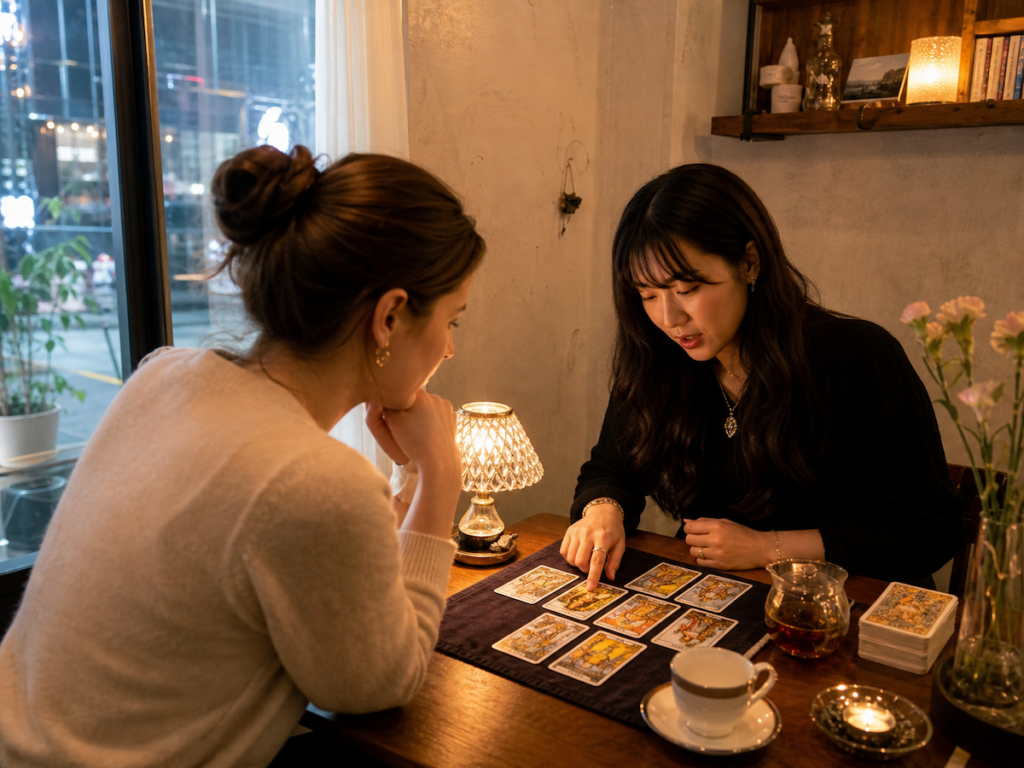
Tarot in Seoul often feels more casual than saju.
You may find tarot readers in cafés, small booths, university districts, shopping areas, and nightlife neighborhoods. Many tarot readings are short, affordable, and focused on one specific question.
For example:
- “Will this relationship work?”
- “Should I change jobs?”
- “What does this person think of me?”
- “Will this year be better?”
- “Should I move or stay?”
Tarot is popular because it is easy to try without much preparation. You do not need your birth time. You do not need to understand Korean philosophy. You can simply ask a question and listen to the interpretation.
Why Young People Like It
For many young Koreans, tarot is not necessarily a serious belief system. It can be a conversation starter, a date activity, a fun stop after dinner, or a way to talk about emotional uncertainty.
This is why tarot cafés or small reading booths can feel more relaxed than traditional saju shops.
For foreigners, tarot may be easier to try first because the structure is familiar in many countries. But the Korean setting still makes it feel different.
The questions, tone, and emotional atmosphere often reflect Korean concerns: relationships, exams, job changes, marriage pressure, family expectations, and timing.
3. Saju vs Tarot: Which One Should You Try?
If you are only going to try one, choose based on what you want from the experience.
| If You Want… | Choose |
|---|---|
| A traditional Korean fortune-telling experience | Saju |
| A quick and casual reading | Tarot |
| A reading about personality and life direction | Saju |
| A reading about love or a specific question | Tarot |
| A couple compatibility reading | Saju or gungap |
| A cultural experience with deeper Korean context | Saju |
| Something easy to try without preparation | Tarot |
Choose Saju If You Want Culture
If your main interest is Korean culture, saju is probably the better choice. It feels more connected to Korean ideas about destiny, timing, family, compatibility, and life direction.
A saju reading may help you understand why some Koreans still talk about good years, difficult years, marriage compatibility, or whether a person’s “energy” fits a certain job or partner.
Choose Tarot If You Want Something Light
If you want a lighter experience, tarot may be better.
It is usually easier to try spontaneously. You can ask one question, get a short reading, and move on. It can be fun with friends or as part of a casual Seoul evening.
Tarot is also less dependent on language-heavy background explanations. If the reader has basic English or you use a translation app, it may be easier to follow than a detailed saju reading.
4. Where to Try Saju and Tarot in Seoul
Hongdae
Hongdae is one of the easiest areas to find casual tarot and fortune-telling shops. The neighborhood already has a youthful, experimental, nightlife energy, so tarot fits naturally into the area.
You may see small signs for tarot near cafés, bars, photo booths, or street-level shops.
Hongdae is a good choice if you want:
- casual tarot
- a fun experience with friends
- a date activity
- a younger atmosphere
- short readings
Gangnam
Gangnam has many private consultation spaces, saju readers, tarot shops, and fortune-telling cafés. Some places may feel more polished or professional than casual street-style booths.
Gangnam is a good choice if you want:
- more private readings
- saju consultations
- readings near cafés or restaurants
- a modern Seoul atmosphere
Insadong and Jongno
Insadong and Jongno can feel more connected to traditional culture. If you want the atmosphere of old Seoul, tea houses, hanok streets, and traditional signs, this area may feel more fitting for saju.
This area is good for:
- traditional mood
- cultural experience
- saju or face reading
- combining with palaces or Insadong walking
If you want a more traditional central Seoul atmosphere, the Gwanghwamun and Jongno area can feel very different from a casual Hongdae tarot café.
Sinchon and University Areas
University districts often have affordable tarot or saju places. These may appeal to students or younger visitors who want a casual reading without paying too much.
They can be good for:
- budget readings
- quick tarot
- student atmosphere
- casual curiosity
Online and App-Based Readings
Fortune-telling in Korea is not limited to physical shops. Many Koreans also use apps, websites, YouTube readings, and mobile services for daily luck or light entertainment.
For foreigners, these digital options can be interesting, but many are Korean-language. Treat them as casual cultural content rather than serious advice.
If you want a more location-focused guide, start with a dedicated Seoul saju guide before choosing a neighborhood or shop.
5. How Much Does Saju or Tarot Cost in Seoul?
Prices vary depending on the reader, location, length, language support, and type of reading.
As a rough guide:
| Reading Type | Typical Style | Rough Price Range |
|---|---|---|
| Short tarot reading | One question or short session | Lower-cost, casual |
| Longer tarot reading | Love, career, or multiple questions | Higher than a short reading |
| Basic saju reading | Birth chart and general interpretation | Mid-range |
| Detailed saju consultation | Career, marriage, timing, compatibility | Higher |
| Couple compatibility | Two people’s birth information | Varies by depth |
It is better to confirm the price before sitting down.
You can ask:
얼마예요?
Eolmayeyo?
“How much is it?”
Or:
사주 보는 데 얼마예요?
Saju boneun de eolmayeyo?
“How much is a saju reading?”
For tarot:
타로 한 번 보는 데 얼마예요?
Taro han beon boneun de eolmayeyo?
“How much is one tarot reading?”
Some places charge by question. Others charge by time. Some have fixed menus. Always check first.
6. What to Prepare Before a Reading
For Saju
Bring:
- your birth year
- birth month
- birth day
- birth time
- birth country or city if asked
- clear questions if you have them
If your birth time is unknown, tell the reader honestly. Do not make it up.
You can say:
태어난 시간을 정확히 몰라요.
Tae-eonan siganeul jeonghwakhi mollayo.
“I don’t know my exact birth time.”
For Tarot
Prepare one or two clear questions.
Instead of asking something too broad like:
“What will happen to my life?”
Ask something more focused:
“What should I consider about changing jobs?”
“What is the energy around this relationship?”
“What should I pay attention to this year?”
Tarot readings usually work better when the question is specific.
For Foreigners Who Do Not Speak Korean
Language can be the biggest challenge.
Some readers may speak English, but many will not. If you do not speak Korean, look for places that clearly mention English support or bring a Korean-speaking friend if you want a more detailed reading.
A translation app can help, but it may not capture symbolic or emotional details perfectly.
If the reading is mainly for cultural experience, that may be fine. If you want a serious consultation, language support matters more.
7. Useful Korean Words for Saju and Tarot
These words can help you recognize signs or understand the basic menu.
| Korean | Meaning |
|---|---|
| 사주 | Saju / Four Pillars fortune-telling |
| 타로 | Tarot |
| 운세 | Fortune / luck reading |
| 궁합 | Compatibility |
| 연애운 | Love luck |
| 결혼운 | Marriage luck |
| 재물운 | Money luck |
| 직업운 | Career luck |
| 올해 운세 | This year’s fortune |
| 이름풀이 | Name interpretation |
| 관상 | Face reading |
| 손금 | Palm reading |
You do not need to memorize all of them. But if you see 사주, 타로, or 운세 on a sign, you are probably near a fortune-telling place.
8. Saju, Tarot, and Modern Korean Anxiety
One reason Saju and Tarot in Seoul remain popular is that they give people a way to talk about uncertainty.
Korea can be competitive. Students worry about exams. Young workers worry about jobs. Couples worry about marriage timing. Families may care about compatibility. Office workers may ask about career changes. People may visit fortune-tellers near the new year, before a major decision, or during emotionally confusing periods.
This does not mean every Korean believes fortune-telling completely.
For many people, it works more like emotional conversation. The reading gives structure to worries that are hard to say directly.
A person may not go because they expect a perfect prediction. They may go because they want reassurance, a second opinion, or a new way to think about a decision.
For foreigners, this is the deeper cultural point. Saju and tarot are not only about the future. They are also about how people handle pressure in the present.
To understand saju beyond a single reading, it helps to look at why many Koreans still use it when thinking about work, love, marriage, and timing.
9. Should You Believe the Reading?
You do not have to believe everything.
It is better to approach a saju or tarot reading as a cultural experience, not as a rule for your life.
A good reading may give you language for something you already feel. It may help you think about your personality, habits, fears, or decisions. But it should not replace legal, medical, financial, or professional advice.
Be careful if a reader pressures you to pay extra money, buy something expensive, or return many times because of fear. Most casual readings in Seoul are harmless, but you should still use common sense.
A healthy approach is:
- listen with curiosity
- enjoy the cultural experience
- take useful insights lightly
- do not make major decisions based only on a reading
- avoid fear-based upselling
10. Common Mistakes Foreigners Make
Treating It as a Joke
It is fine to be skeptical. But do not mock the reader or the people who take it seriously.
For many Koreans, saju can be connected to family, marriage, work, and emotional decisions. Even if you do not believe in it, treat the space respectfully.
Forgetting the Birth Time
For saju, birth time matters. If you forget it, the reading may be less detailed.
Asking Too Many Questions at Once
A short tarot session is not meant to solve every problem. Choose one or two questions.
Expecting English Everywhere
Some fortune-telling places may be foreigner-friendly, but many are local Korean spaces. Check language support before going if that matters to you.
Taking It Too Literally
Saju and tarot are part of Korean cultural life, but they should not control your decisions. Enjoy the reading without giving away your judgment.
11. Final Thoughts
Saju and Tarot in Seoul can be fun, strange, comforting, confusing, or surprisingly thoughtful depending on where you go and what you ask.
For foreigners, the value is not only in hearing a prediction. The value is in seeing how Korean culture talks about uncertainty. Through saju and tarot, you can glimpse how people think about timing, personality, relationships, work, marriage, and emotional pressure.
If you want the more traditional Korean experience, try saju and bring your birth information. If you want something casual and easy, try tarot with a clear question.
Either way, approach it with curiosity and respect.
You may not leave with a certain answer about your future. But you may leave with a better understanding of Korea, and perhaps a small insight into yourself.