Korean outdoor drinking culture doesn’t announce itself with a sign. It announces itself with a sound.
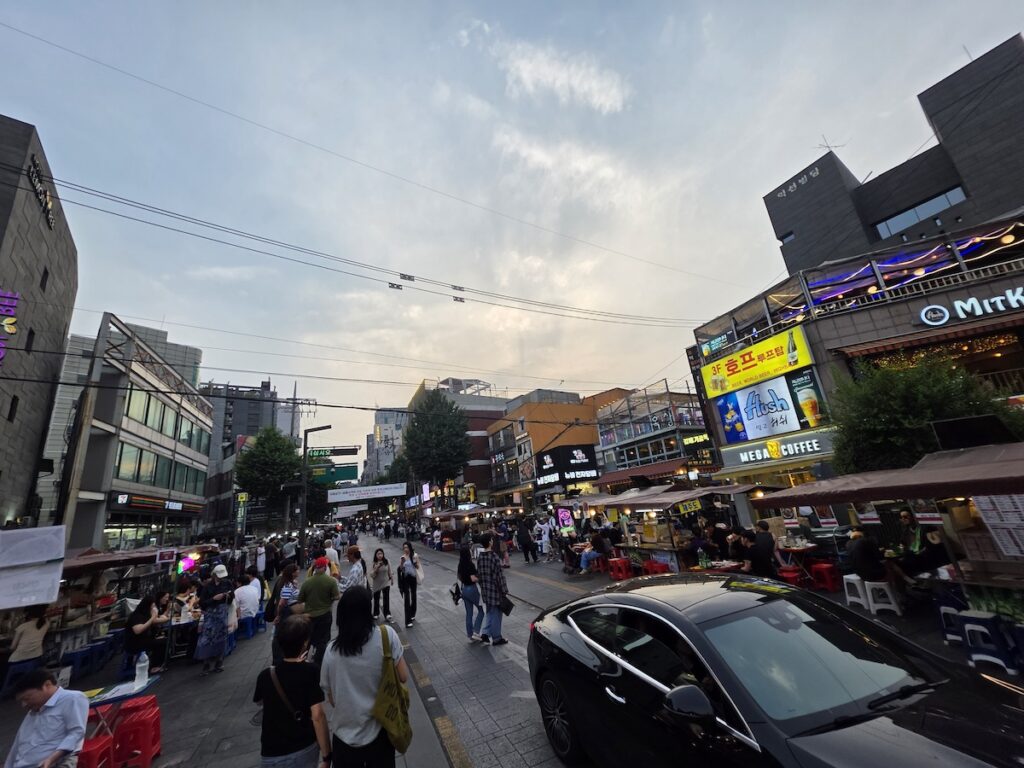
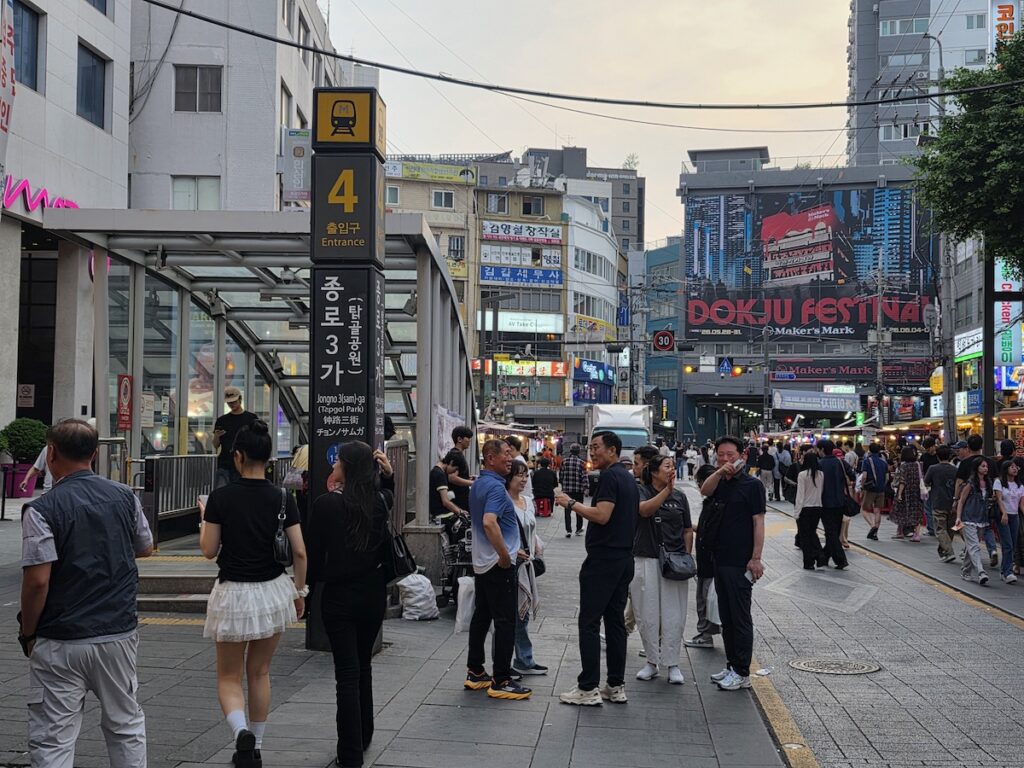
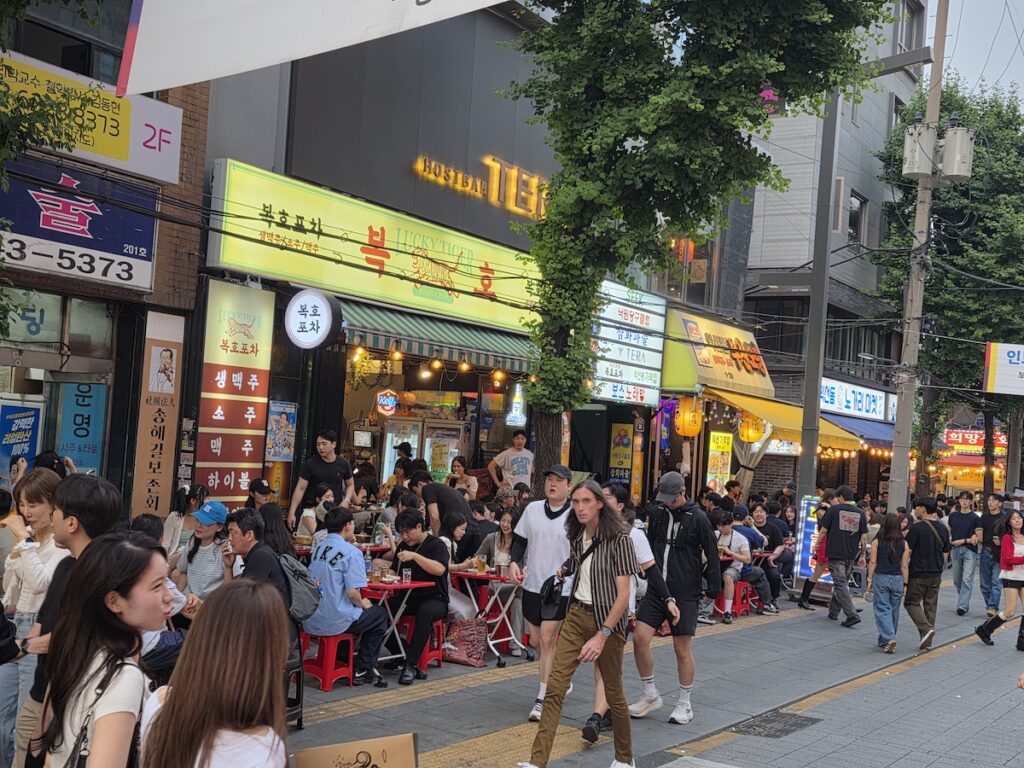
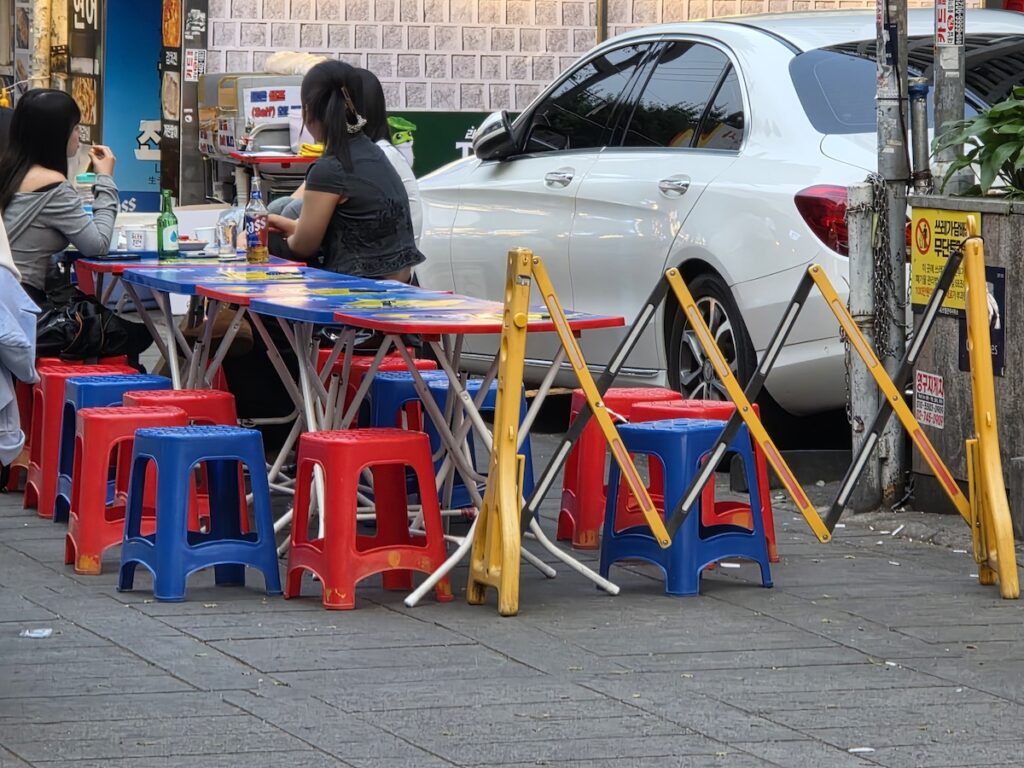
I live in Jamsil, in the southeast of the city. My friend lives somewhere north. So we met where people like us always meet: Jongno. We came up out of Jongno 5-ga, Exit 4, and the street was already full. Plastic tables on the pavement. Mismatched stools. A row of strangers eating and drinking under the open sky, packed close enough that you could read the label on the next table’s bottle.
The chairs were uncomfortable. The tables wobbled. The space was tight. None of that mattered. A cool evening breeze came through, the last of the sunset sat low over the buildings, and the whole street had a hum to it.
The table next to us was two women in their twenties. One had just come back from studying in Boston. The other was a singer-songwriter. I wasn’t trying to listen. I could hear every word anyway. That’s how close the tables are. And around us, in the air, was English, Chinese, French. American accents, British accents, and a few I couldn’t place. We hadn’t seen each other in a while, my friend and I, and somehow this loud, cramped, half-public street was exactly the right place to catch up.
This is the question this piece answers: why do Seoul streets turn into open-air bars, and why does that work?
Quick Answer
Korean outdoor drinking culture is built around yajang (야장), restaurants and bars that put tables out on the street, and pojangmacha (포장마차), the tented street-food stalls. It’s legal because Korea has no open-container law, so drinking in most public spaces is allowed. In summer the practice booms, especially among younger Koreans. The best-known spots cluster in Jongno and Euljiro. The appeal is the open air, the low prices, and the closeness to strangers. The downsides are real too: cash-only stalls, no toilets, the odd overcharging trap, and a small but growing list of alcohol-free zones.
What yajang and pojangmacha actually are
Two words cover most of what you’ll see. They overlap, but they aren’t the same thing.
Yajang means, loosely, an outdoor table setup. A normal restaurant or bar puts chairs and tables out on the sidewalk or in an alley, and the indoor business spills outside. It’s casual by design. Plastic seating, portable grills, shared plates. The Korean version is looser than the tidy terrace dining you see in Europe. The format grew out of the street stalls that appeared during Korea’s rapid industrialization in the 1960s, when workers wanted a cheap, informal place to unwind after a shift, and it has been evolving ever since.
Pojangmacha is the older, more specific thing. The word means “covered wagon.” A cart parks on a corner, the sides go up, tarps unroll, lights come on, and a scatter of plastic tables and stools appears. You get instant food and drink with no pretension at all. No fancy plating. Often no napkins, just a roll of toilet paper hanging from the tarp. If you’ve watched a Korean drama, you’ve seen one: the lead character alone with a bottle of soju, spilling their feelings under a plastic ceiling. That image is a cliché because it’s true.
So the simple rule: yajang is the broad idea of drinking outdoors at a business, and pojangmacha is the classic tented-stall version of it. Both put you on the street, under the sky, elbow to elbow with people you’ve never met. For the social side of why Koreans drink in groups at all, our guide to Korean social culture for foreigners fills in the background.
Why everyone meets in Jongno
Here’s something most travel guides skip. In Seoul, where you meet says something about who you are.
The city is quietly sorted by age and scene. Gangnam and Sinsa pull one crowd. Hongdae pulls a younger, louder one. Different neighborhoods belong, loosely, to different generations and moods. Locals know this without thinking about it. It shapes where you suggest meeting.
Jongno is the exception. It’s the neutral ground.
Part of that is transit. The Jongno corridor is where subway lines pile up. Jongno 3-ga alone sits on Lines 1, 3, and 5, and the surrounding area threads into still more. So when I’m coming from the southeast and a friend is coming from the north, nobody can argue about who has the longer trip. The lines converge here. The distance argument just disappears.
It’s worth being concrete, because the transit is the practical heart of it. Three lines meet right at Jongno 3-ga: Line 1, Line 3, and Line 5. On its own, that already reaches a huge spread of the city. Line 2, the big loop most visitors lean on, doesn’t stop here directly, but it doesn’t need to. Get off at Euljiro 3-ga, one stop south on Line 2, and the pocha street is about a five-minute walk north. Most other lines are a single transfer away. The upshot is simple: wherever you’re staying in Seoul, Jongno is usually a short trip with one change at most. For a group coming in from four different neighborhoods, that’s rare, and it’s the real reason nobody fights about the meeting point.
The other part is the crowd. Jongno doesn’t belong to one age group. You’ll see office workers in their fifties three tables down from students in their twenties, and tourists wedged in between. The pojangmacha scene here has always drawn that mix, and it has only widened as younger Koreans rediscovered it. That’s why it works as a meeting point. It isn’t anyone’s turf, so it’s everyone’s.
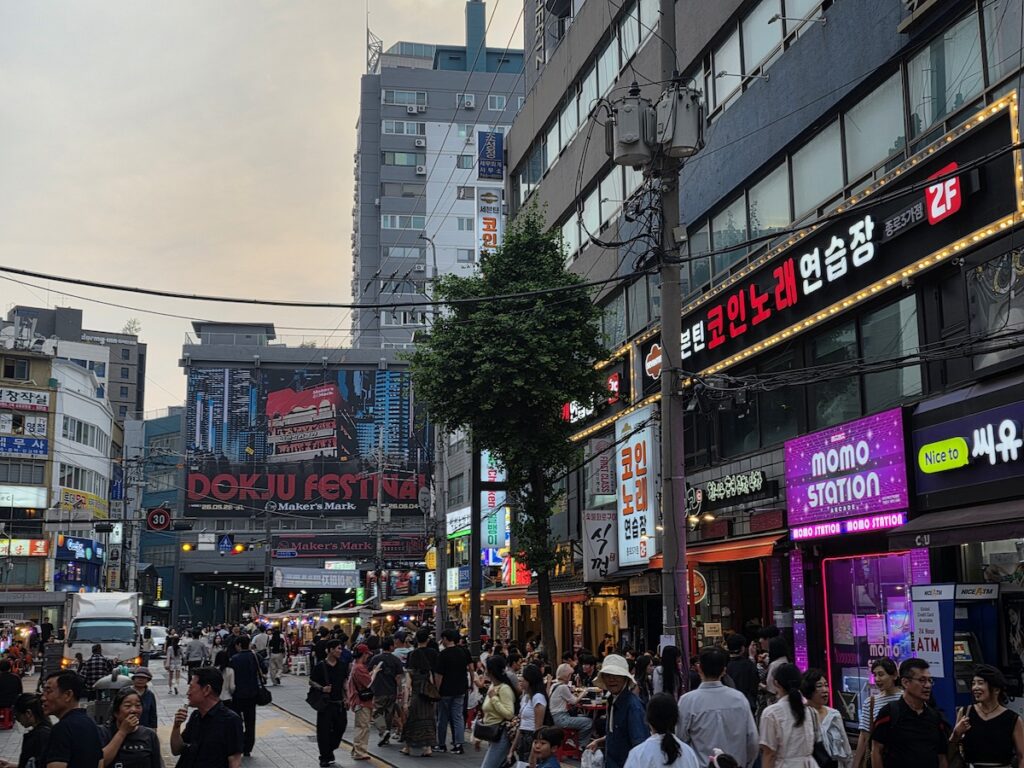
The dense street-drinking strip everyone talks about actually sits one stop west, at Jongno 3-ga, in the roughly 200-meter stretch between Exits 5 and 6. But the whole Jongno spine, from 3-ga past Exit 4 and on toward 5-ga and Gwangjang Market, carries the same energy on a warm night. You step out of almost any exit and there are tables waiting.
Why this is even allowed
The thing that surprises most foreigners is that none of this is a loophole. It’s just legal.
Korea has no open-container law. There is no general rule against carrying or drinking alcohol in public spaces, so a beer outside a convenience store, a bottle of soju by the river, or a full table on the sidewalk are all normal. The concept that an open bottle in public is itself a problem simply doesn’t exist here the way it does across much of the United States. That single legal blank space is the foundation the whole culture sits on. Take it away and the street empties.
For visitors from places with strict public-drinking rules, this can feel almost unreal at first. You can buy a can at a GS25 or 7-Eleven, sit at the tables they put out front, and drink it. Nobody minds. Police walk past. As long as you aren’t causing a scene, you’re fine.
There is a limit worth knowing, though, and it’s newer. Starting in 2024, some districts began designating specific alcohol-free zones, and these now carry real fines. Children’s parks, certain station plazas, and similar spots can cost you 50,000 to 100,000 won if you’re caught drinking there. The crackdown is targeted, not citywide, and the yajang and pojangmacha streets are not the target. But the takeaway for a newcomer is simple: read the signs. If a spot is posted as a no-drinking zone, take it seriously. Everywhere else, the old freedom holds.
The yajang boom is happening right now
This isn’t a fading tradition. Right now, it’s the opposite.
Yajang has become one of the defining summer trends among younger Koreans. A map service called “Yajang Map,” which lets people find outdoor-table spots across the country, went viral in 2026, racking up hundreds of registered locations and tens of thousands of weekly users almost entirely by word of mouth. People search it by format, filtering for street tables, rooftops, or folding-door bars that open onto the pavement. Part of the appeal is money. As Hongdae and other established nightlife areas got expensive, the street became the affordable alternative, and a frugal, “spend almost nothing” attitude grew up around it.
The other engine is foreign interest. Spots like Ikseon-dong, the Jongno pocha street, and the Euljiro alleys now show up on tourist itineraries as a way to experience real local nightlife rather than a polished version of it. The official Seoul tourism channels openly promote yajang as a summer thing to do. Walk through on a Friday in June and the soundtrack tells you everything: it’s not just Korean anymore.
There’s a cost to the boom, and locals feel it. Popular yajang spots now strain the streets they sit on, with long waits, hundreds of groups on a single night’s list, and ongoing friction over how much public pavement a business can take. Seoul is trying to manage this rather than ban it. In late 2023, Jongno District passed a revised ordinance allowing limited street-side dining in designated areas, letting businesses set out a single row of tables under defined conditions. It’s an attempt to make the informal thing official without killing what makes it good. Whether that balance holds is still an open question.
Outdoor drinking in Korea makes more sense when you understand the wider rhythm of Korean eating culture. Meals, shared plates, late-night snacks, and drinks often flow together, especially in busy Seoul neighborhoods.
Where to go, and what each place feels like
Not every outdoor drinking street has the same character. Here’s how the main Seoul options compare, so you can pick the one that fits your night.
| Spot | Vibe | Crowd | Nearest station | Best for |
|---|---|---|---|---|
| Jongno 3-ga Pocha Street | Classic tented stalls, busy, loud | Salarymen, students, tourists | Jongno 3-ga (Exits 5–6) | First taste of the real thing |
| Euljiro Nogari Alley | Retro, beer-and-dried-pollack, historic | Office workers, older regulars | Euljiro 3-ga | Old-school atmosphere |
| Ikseon-dong | Trendy, hanok alleys, photogenic | Younger couples, dates | Jongno 3-ga | A stylish, Instagram-friendly night |
| Haebangchon / Shinheung Market | Mixed, bistro-meets-pocha, international | Expats, younger locals | Noksapyeong | A more global, low-key crowd |
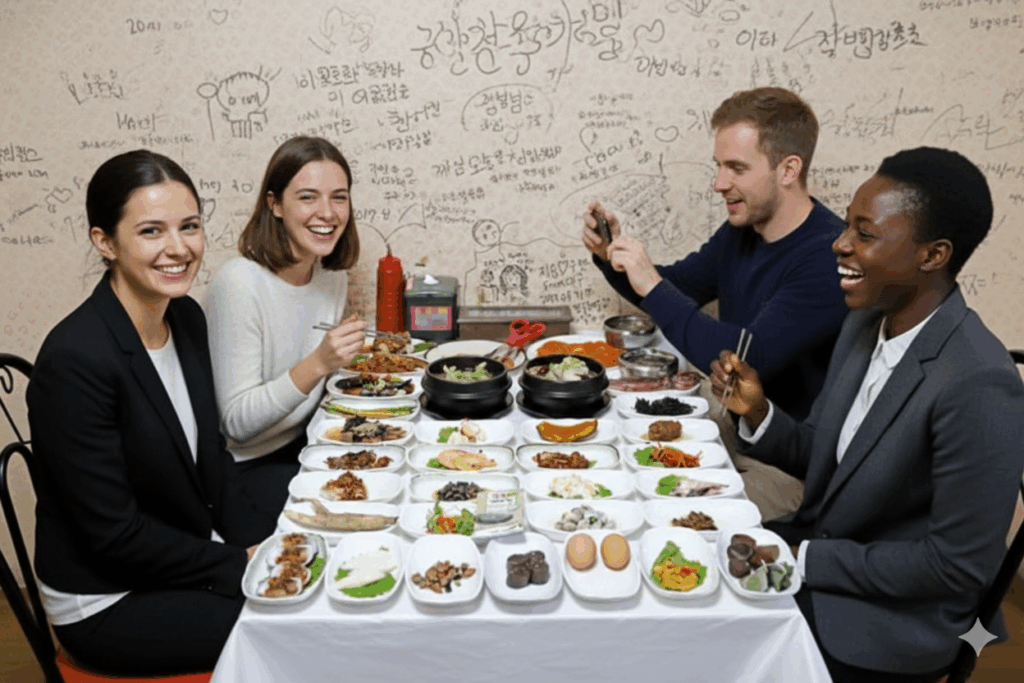
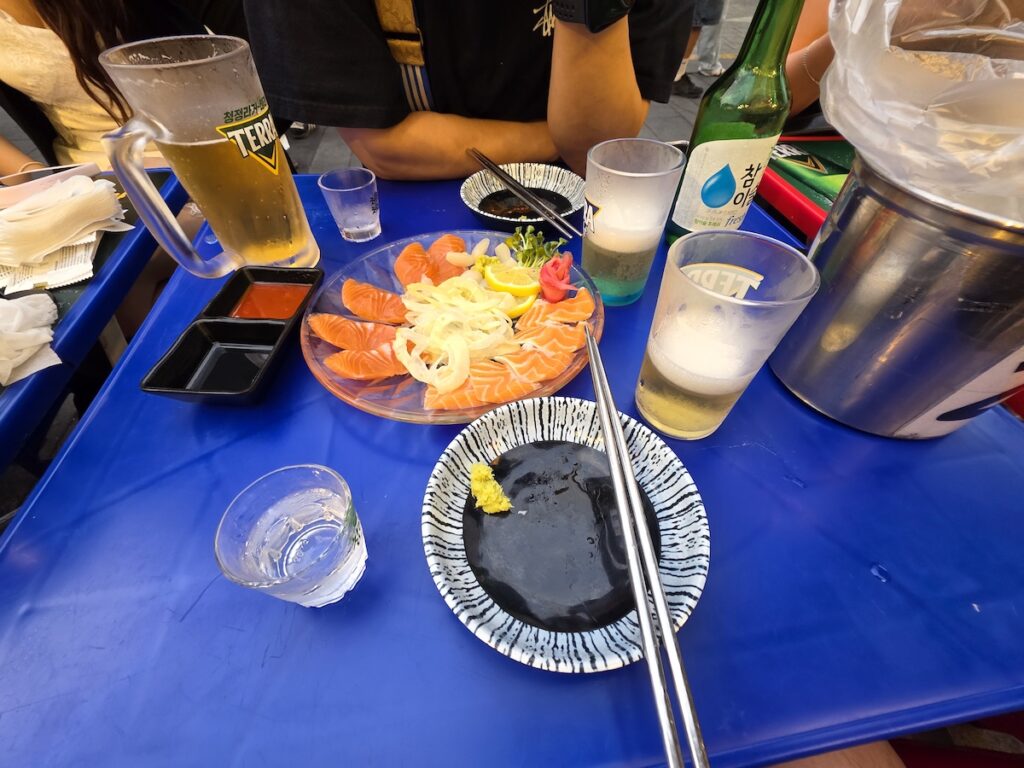
If it’s your first time, start at Jongno 3-ga between Exits 5 and 6. It’s the most concentrated, the easiest to find, and the most forgiving if you don’t know the rules yet. Stalls usually open around 6 p.m. and run late, often past midnight and sometimes to 3 or 4 a.m. on weekends. The menu is simple street fare, chicken feet, octopus, fish cake soup, pancakes, paired with soju, beer, makgeolli, or the two mixed together as somaek. Many Koreans eat dinner first, often Korean barbecue nearby, then come here for the second round of the night. On a busy evening, expect to chat with the table next to you whether you planned to or not.
The easiest version: the convenience store out front
You don’t have to find Jongno to taste this. The smallest version of Korean outdoor drinking culture is probably a two-minute walk from wherever you’re sleeping.
Every neighborhood in Seoul has convenience stores, GS25, CU, 7-Eleven, emart24, often several on one block. Most of them put a few plastic tables and stools out front, sometimes under a parasol. That’s the whole setup. You buy inside, you carry it out, and you sit. You don’t drink in the shop. You drink at the tables, in the open air, which is exactly where the yajang feeling lives.
I do this more often than I’d admit. A friend, a couple of cold beers or a cheap bottle of wine, and whatever food the store has on the shelf. The food is the quiet draw. Instant ramyeon you heat at the counter, triangle kimbap, fried snacks, dumplings from the warmer. None of it is special. All of it is cheap, and at eleven at night that’s the entire point.
The economics help. Convenience stores run constant beer promotions, and the classic one is four imported cans for around 10,000 won. Some stores have nudged that up to 11,000 or 12,000 lately, but it’s still one of the cheapest nights out in the city. For a traveler, it’s also one of the most genuinely local. No reservation, no menu in a language you can’t read, no minimum spend. Just a stool on a Seoul sidewalk and the same open air everyone else is drinking in.
The honest limits: it isn’t the full yajang. There’s no kitchen, no grill, no buzzing crowd, and if the weather turns, you’re packing up fast. You also clean up after yourself, so bin your cans and don’t leave a mess for whoever sits there next. But as a first taste, or as a quiet end to a long day of walking, the convenience store table is hard to beat. It’s the whole culture in miniature, right outside your door.
What it actually feels like
The honest version: the comfort is not the point.
The chairs are plastic and they hurt your back after an hour. The tables rock. The space between you and the next group is measured in centimeters. If it rains, the night is over. If it’s August and humid, you’ll sweat through your shirt. None of this is hidden. Anyone who tells you a pojangmacha is comfortable has never sat in one.
And yet. On the right evening, with the heat breaking and a breeze coming down the street, it’s one of the best places to be in the city. The lack of walls is the whole thing. You’re not in a sealed room with your own group. You’re in a shared space, and the boundary between tables is so thin that strangers become background characters in your night and you become one in theirs.
That’s how I ended up half-living the conversation of two women I’ll never meet again, the one back from Boston and the singer-songwriter, while catching up with an old friend. It would feel intrusive almost anywhere else. Here it’s just the texture of the place. Nobody’s offended, because everyone’s doing it. You overhear, you get overheard, and somehow that openness lowers everyone’s guard instead of raising it.
There’s also a seasonal honesty to it that’s easy to miss. This is not a year-round culture. The real window is late spring through early autumn, the months when an evening outdoors is a pleasure rather than a test. In deep winter the tables thin out or move under heavier tarps with gas heaters, and a lot of the magic goes with them.
That short season is part of why the summer boom feels urgent. Koreans know the good nights are limited, so they use them. The indoor bars that now copy the pojangmacha look, with retro signage and fold-out furniture, exist precisely because people want a piece of that feeling when the weather won’t allow the real thing. It’s a decent imitation. It is not the same as a breeze coming down an open street.
It helps that this all happens late, outdoors, among strangers, and still feels safe. That isn’t an accident; it’s the same quality we wrote about in why Seoul feels so safe. And the food on the table follows its own logic, including the chewy, salty staples like Korean dried squid that exist mainly to keep your hands busy while the talking goes on.
The practical stuff nobody tells you
Before you sit down, a few honest warnings. They’ll save you money and a bad mood.
Bring cash. Most pojangmacha are still cash-only, and while card readers are slowly appearing, you can’t count on one. Pull out 30,000 to 50,000 won before you go. Convenience-store ATMs from 7-Eleven or GS25 will take an international card if you’re caught short.
Check the price before you sit. In 2023 there was a real overcharging scandal at some Jongno 3-ga stalls, where dishes were priced high with a two-item minimum, so you were committed to a large bill the moment you sat down. There were self-regulation efforts afterward, but it isn’t fully settled. The defense is simple. Pick a stall with a visible menu board. If there’s no menu posted, walk on. Ask “eolmayeyo?” before you commit.
Use the bathroom first. The tents don’t have toilets. They’re tents. Jongno 3-ga Station and the nearby stations have restrooms inside, so go before you settle in for the night.
Mind the alcohol-free zones. As covered above, a handful of public spots now fine open drinking. The drinking streets aren’t among them, but if you wander off to a park or a station plaza with your bottle, check for signs first. And the legal drinking age is 19 by the international count, applied from January 1 of the year you turn 19, so carry ID.
One last note. The street fills up fast, and the best weather brings the biggest crowds. If you hate waiting, this overlaps with the same weekend crush we mapped in the most crowded places in Seoul on weekends. Going on a weeknight, or early, buys you a calmer table.
Conclusion: a city with the walls taken down
Most cities keep their drinking indoors, behind doors, in rooms you have to be let into. Seoul, on a warm night, does the opposite. It pushes the tables out, drops the walls, and turns the sidewalk into a room that anyone can join.
That’s the real reason the streets feel like open-air bars. It isn’t only the absence of an open-container law, though that’s what makes it possible. It’s that the culture treats public space as shared rather than off-limits, and it treats a stranger’s nearness as part of the fun instead of a problem to solve. The discomfort, the noise, the wobbly table, the conversation you didn’t mean to hear, all of it is the format working as intended.
So if you find yourself coming up out of a Jongno exit on a summer evening and the street is already full, don’t look for the comfortable option. There isn’t one. Pull up a plastic stool, order something cheap, and let the night happen around you. The people at the next table are closer than you’d like. That’s the whole point.
SOURCES
- VisitKorea / VisitSeoul — Jongno pocha street and yajang culture: https://english.visitkorea.or.kr/svc/contents/contentsView.do?vcontsId=215485 and https://visit.seoul.kr/en/articles/seoul-street-food-pojangmacha-guide-2025
- The Korea Herald — reporting on the Jongno pocha street and public-drinking fines: https://www.koreaherald.com/article/3149985 and https://www.koreaherald.com/article/3296344