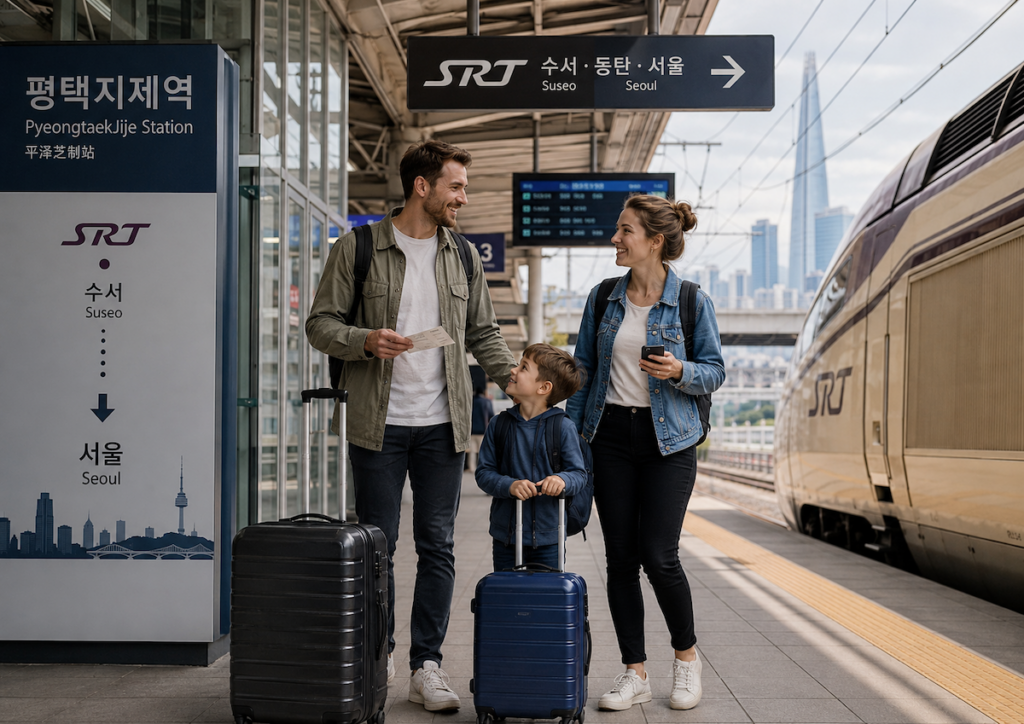
The Seoul subway transfer system is a marvel of urban engineering, but on a busy Sunday afternoon at Jamsil Station, it can feel like a psychological test for the uninitiated. I was walking through the underground passage that connects the green circular Line 2 with the pink Line 8, and the crowd was thick with weekend shoppers and families heading home. Amidst this rushing tide of people, I spotted a foreign family—a father, mother, and two young children who looked like they had just spent an entire day at Lotte World. The kids were still wearing their souvenir headbands, but the parents were looking up at the forest of overhead signs with a look of pure, frozen confusion.
They were standing in the middle of one of the widest corridors in the city, holding their phones and trying to reconcile their digital maps with the massive, neon-lit reality of the station. It reminded me that even though our subway is world-class, the sheer scale of a transfer can be an overwhelming homework assignment for anyone visiting Korea for the first time.
Quick Answer: How do I master a Seoul subway transfer without getting lost?
To navigate a Seoul subway transfer successfully, you must prioritize colors over text. Every line in the city is strictly color-coded (e.g., Line 2 is Green, Line 8 is Pink). Simply follow the colored floor strips or arrows on the ceiling that match your destination line. Unlike Western systems that often use North/South directions, Seoul uses the “Toward” system, where platforms are labeled by the name of the final station (terminus) or a major landmark station. To avoid boarding the wrong train, always check which final station your line is heading toward on a mapping app like Naver Maps or KakaoBus before you reach the platform.
The Underground Geography of Seoul
Seoul is not just a city of skyscrapers; it is a city of layers. When you are standing in a place like Jamsil, you aren’t just in a subway station. You are in a subterranean crossroads that links shopping malls, theme parks, and residential districts. The first thing that family at Jamsil needed to understand—and what every traveler should know—is that a transfer in Seoul is rarely just a flight of stairs. It is often a walk that can take five to ten minutes through climate-controlled tunnels lined with shops and bakeries.
This is why many foreigners feel lost. In cities like New York or Paris, a transfer is often a short, cramped tunnel where you can see the next platform almost immediately. In Seoul, the newer lines were built much deeper underground to avoid existing infrastructure. When you transfer from Line 2 to Line 8, you are essentially walking between two different eras of the city’s development. The Green Line represents the older, foundational loop of the city, while the Pink Line represents the later expansion toward the eastern residential zones like Songpa and Seongnam.
The Power of the Color-Coded Path
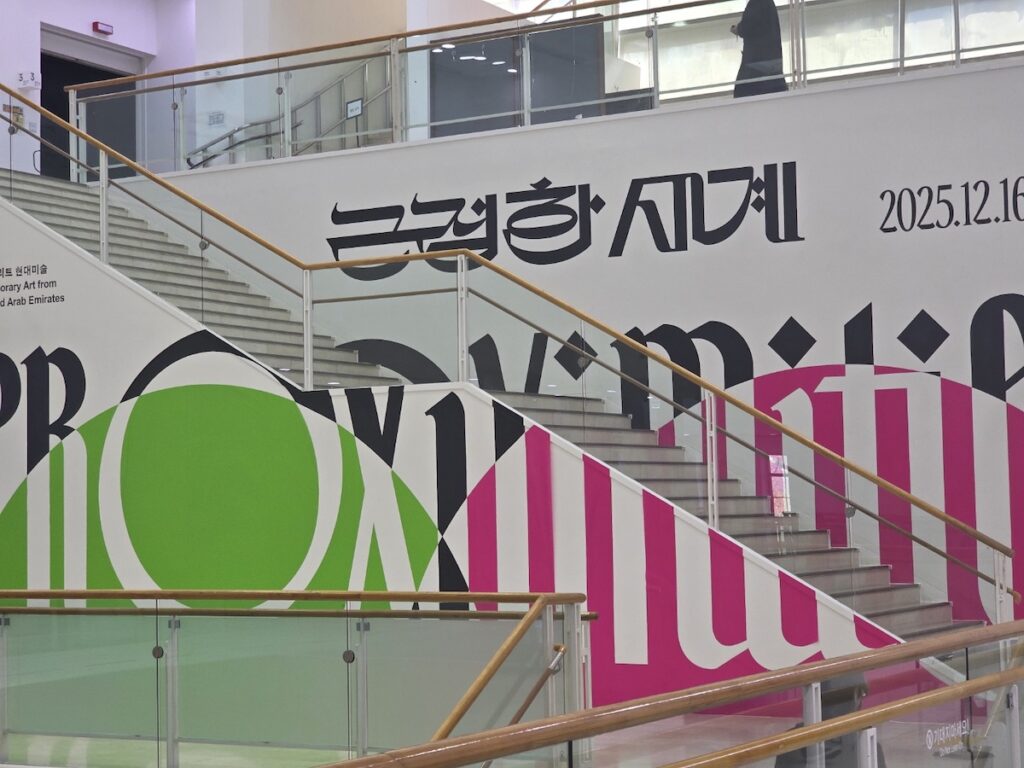
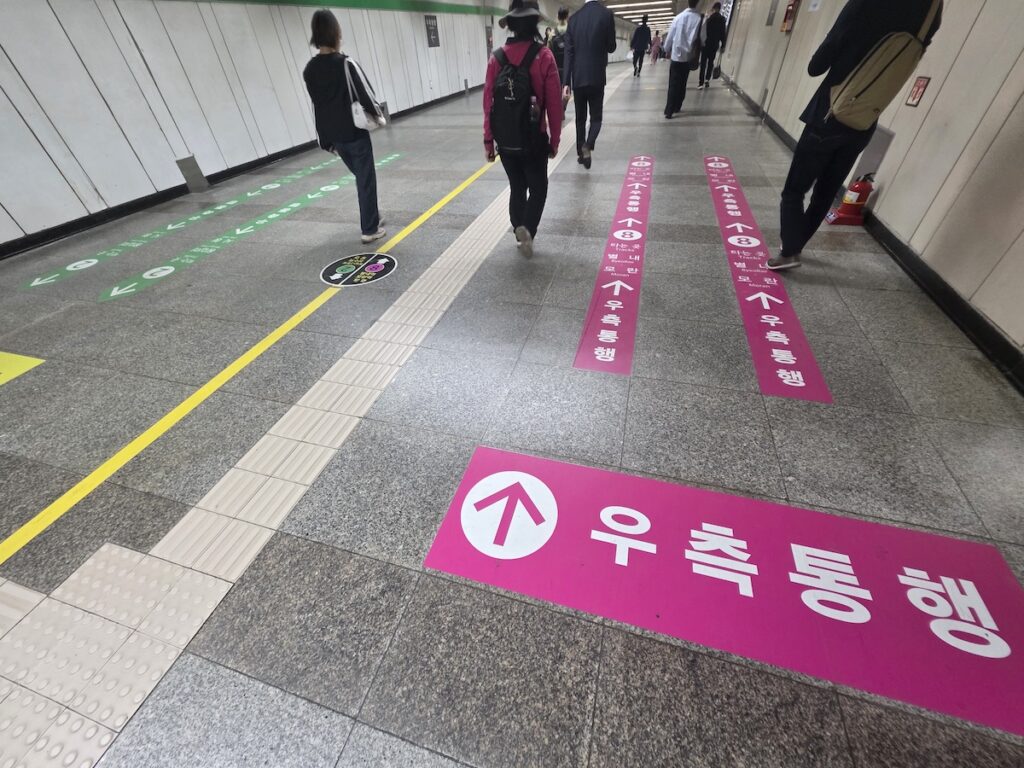
When I saw that family standing still, I wanted to tell them to stop looking for the number ‘8’ and just start hunting for the color pink. In Seoul, the color is the language of the underground. This is a design choice intended to solve the language barrier for the millions of people who use the system every day.
Each of the 23+ lines in the metropolitan area has a dedicated, unwavering color.
- Line 1: Dark Navy Blue
- Line 2: Grass Green
- Line 3: Orange
- Line 4: Sky Blue
- Line 5: Purple
- Line 9: Gold
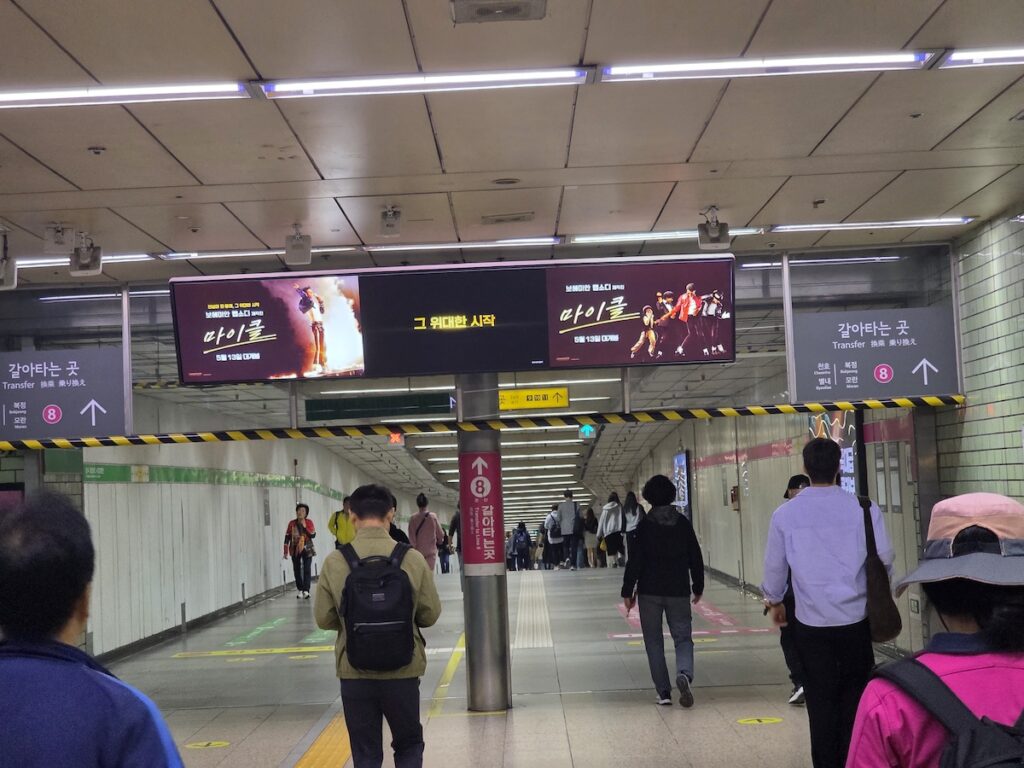
If you are transferring, you will see circles of these colors hanging from the ceiling and, most importantly, bright lines painted directly onto the floor tiles. If you keep your feet on the pink line, it will lead you through every turn, up every escalator, and past every shop until you arrive exactly at the Line 8 platform. Many visitors make the mistake of overthinking the English text on the signs, which can sometimes be crowded with too much information. If you just “follow your color,” the maze becomes a straight path.
Solving the Directional Mystery
Once that family found the Line 8 platform, they likely faced the second hurdle: which side of the tracks should they stand on? This is perhaps the most common point of failure for first-time visitors to Korea.
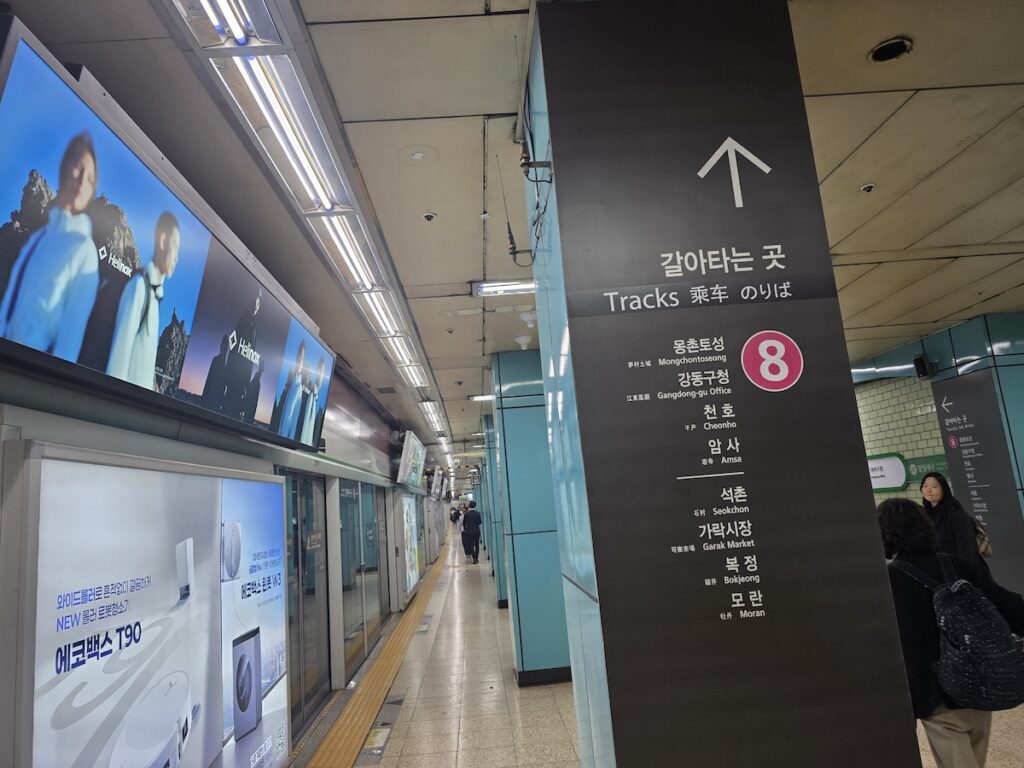
In Western systems, you are often looking for “Uptown” or “Downtown,” or perhaps “Northbound” or “Southbound.” This relies on a general sense of geography. In Seoul, we use the “Toward” (방면) system. Every sign on the platform will list the name of the last station on that line.
For example, on Line 8, you will see signs for “Toward Byeollae” or “Toward Moran.” If your destination is a small station in the middle, you have to know which of those two end-points it is closer to. This is why I always recommend that travelers keep a mapping app open. You shouldn’t just look for your destination station; you must look for the “Direction” station. If you are at Jamsil and want to go to Garak Market, you need to follow the sign for Moran. If you are going toward the Han River, you follow the sign for Byeollae.
The Circle Line Challenge
Line 2 (The Green Line) is the most used line in the city, but it is also the most confusing because it is a circle. It has no “end.” Instead of a terminus name, you will often see “Inner Circle” (내선순환) and “Outer Circle” (외선순환). These terms are even confusing for locals.
The secret is to ignore the “Inner/Outer” text and look at the smaller station names listed below it. In Jamsil, one side will say “Toward Samseong / Gangnam” and the other will say “Toward Seongsu / Wangsimni.” This requires a bit of knowledge about Seoul’s major neighborhoods, but it is the only way to ensure you don’t spend an extra 45 minutes going the long way around the city.
The Psychological Barrier of the Transfer Gate
As the family I observed moved toward the Line 8 section, they would have encountered a row of ticket gates right in the middle of the transfer tunnel. This is a moment where many tourists panic. They think, “I am already inside the system. Why is there another gate? If I tap my card, will I be charged again? Am I accidentally exiting?”
These are called “Transfer Gates.” They exist because the Seoul subway is operated by different entities—some are city-owned, like Seoul Metro, and some are private, like the Line 9 company. These gates act as checkpoints to track which company should receive a portion of your fare.
When you tap your T-money card or your international credit card at these internal gates, the screen will almost always show a “0” for the price. It is not taking more money from you. It is simply recording that you have moved from one operator to another. In fact, if you don’t tap at these gates, you might have trouble exiting at your final destination. It is a technicality that feels like an exit but is actually just a bridge.
Comparing the Underground Worlds: Seoul vs. The West
To understand why the Seoul system feels so different, it helps to look at it side-by-side with the transit systems many visitors are accustomed to.
| Feature | Seoul Subway System | Western Systems (NY, London, Paris) |
|---|---|---|
| Primary Navigation | Color-coded floor paths and terminus names | Cardinal directions (North/South) or letters |
| Transfer Distance | Often long (up to 10 mins) but fully indoors | Usually short, but often lacks elevators/lifts |
| Safety and Environment | Full-height screen doors on every platform | Open tracks are common; varyingly maintained |
| Station Amenities | Massive underground malls and food courts | Primarily functional; limited shopping/services |
| Payment Logic | Distance-based, integrated with buses | Often flat-fare; separate from bus systems |
| Accessibility | High (Elevators/Lifts at almost every exit) | Varies greatly; many older stations have stairs only |
The “long walk” in Seoul is often criticized, but when you compare it to a New York transfer where you might have to walk up to the street level and back down again in the heat, the Seoul experience is vastly superior. The stations are clean, bright, and filled with life. You can buy a pair of socks, a fresh pastry, and a new phone case all while moving between Line 2 and Line 8.
The “Fast Transfer” Secret
If you want to move like a local, you need to look at the numbers. On every platform, right in front of the screen doors, there are numbers on the floor—for example, 1-1, 4-3, or 10-4. These represent the car number and the door number.
In a station as massive as Jamsil, being at the wrong end of a ten-car train can mean an extra five-minute walk just to get to the escalator. Korean navigation apps like Naver Maps will actually tell you which door is the “Fast Transfer” (빠른 환승) door. If the app says “Fast transfer at 3-2,” and you board at door 3-2, you will be standing exactly in front of the stairs when the doors open at your transfer station. It is this level of micro-efficiency that allows Seoulites to move so quickly through the underground maze.
Practical Tips for the Sunday Traveler
Returning to that family at Jamsil, their struggle was compounded by the fact that it was a Sunday. On weekends, the subway becomes a different place. It is less about office workers and more about families, hikers in colorful mountain gear, and young couples heading to places like Seongsu-dong or Hongdae.
- Keep to the Right: On escalators, stand on the right. The left side is for people who are in a hurry. If you stand on the left as a family, you will find a long line of locals politely (or impatiently) waiting behind you.
- The ‘Way Out’ is Yellow: All exit signs in Seoul are bright yellow. If you see a yellow sign with a number, that leads to the street. If you are trying to transfer, ignore the yellow signs and look for the multicolored “Transfer” (환승) signs.
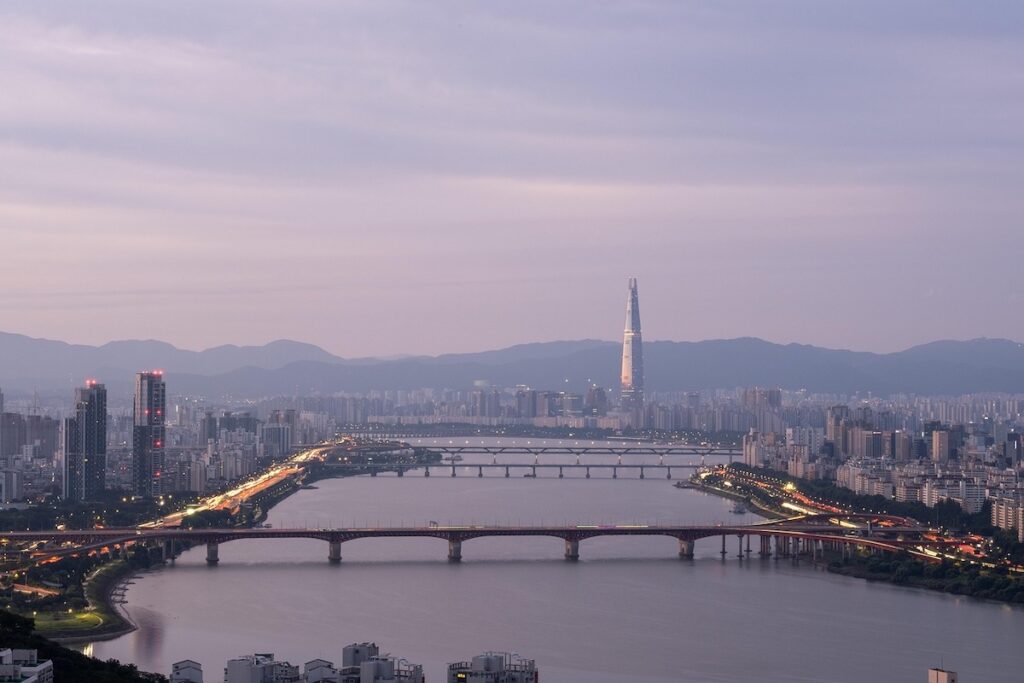
- Check the Exit Number: Jamsil Station has many exits. Exit 1 and 2 lead to Lotte World Tower, while Exit 3 and 4 lead toward the Lotte World theme park. If you come out of the wrong exit, you might have to walk an extra kilometer just to cross the street.
- The Screen Door Map: If you are on the platform and confused, look at the screen doors. There is usually a map that shows exactly where you are and which stations are coming next. If the next station on the map isn’t where you want to go, you are on the wrong side of the platform.
Why the Maze is Worth the Homework
By the time I reached the Line 8 platform myself, I saw the family again. They had finally made it through the long corridor and were waiting for the train. They looked tired, but they were in the right place. That is the beauty of the Seoul system: it is complex, but it is fair. It gives you all the tools you need—the colors, the floor markings, the digital displays—to get where you are going.
For a first-time visitor, the Seoul subway transfer is a rite of passage. It is a moment where you stop being a tourist who is “being moved” and start being a traveler who “knows how to move.” The complexity of the system is a reflection of the city’s growth. Each line represents a new layer of Seoul’s history, from the first line built in the 1970s to the ultra-modern private lines of today.
When you master the transfer, you master the city. You realize that for about $1.50, you can go almost anywhere in this massive metropolis safely, comfortably, and on time. You can go from the traditional palaces of Jongno to the glittering lights of Gangnam without ever having to worry about traffic or weather.
So, next time you are at Jamsil and the crowd feels too fast and the signs feel too many, just take a breath. Look down at the floor, find your color, and follow the path. The maze is only a maze until you learn to speak its language. Once you do, you’ll realize that the Seoul subway isn’t just a way to travel; it’s the heartbeat of the city itself.
The Human Element of the Subway
As a final thought, remember that the people around you are often willing to help. I have seen countless locals stop their own hurried journeys to help a traveler find the right platform. If you are truly lost, don’t be afraid to show your phone to someone and say the name of your destination. Most people will point you toward the right color.
Seoul is a city that moves fast, but it is also a city that values communal effort. The subway system is a shared space where millions of lives intersect every day. That family at Jamsil, the hikers, the students, and the office workers—everyone is following the same colors and the same logic. By joining them in the underground flow, you are participating in the most authentic version of Seoul life. It may be an “overwhelming homework assignment” at first, but it is one that pays off the moment you step off the train exactly where you intended to be, ready to explore another corner of this incredible city.
Conclusion: Embracing the Maze as a Rite of Passage
Watching that foreign family finally step onto the Line 8 train at Jamsil Station was a small but deeply satisfying moment. They looked a bit exhausted, but as they saw the pink doors open, a visible wave of relief washed over the parents’ faces. They had successfully decoded one of the most complex transit junctions in the world. It reminded me that a Seoul subway transfer is more than just a logistical necessity; for a traveler, it is a rite of passage. It is the moment you stop being a tourist who is “being moved” by a tour bus and start being a global citizen who knows how to move with the rhythm of a 10-million-person metropolis.
The complexity of our subway is, in many ways, a beautiful reflection of Seoul itself. It is a city built in layers, where 1970s infrastructure meets 21st-century digital displays, and where ancient palace neighborhoods are connected to glittering financial districts by a single T-money tap. Navigating this system requires a bit of patience and a willingness to learn a new visual language—the language of floor-coded colors and terminus names. But the reward for this “homework” is immense. Once you master the transfer, the entire city becomes remarkably small. You gain the freedom to travel from the traditional markets of the North to the neon skyscrapers of the South for less than two dollars, all while staying in a clean, safe, and efficient bubble.
So, the next time you find yourself at a massive hub like Jamsil, and the crowd feels too fast or the signs feel too many, just take a breath. Look down at the floor, find your color—whether it is the pink of Line 8 or the green of Line 2—and simply follow the line. Do not be intimidated by the long corridors or the “zero-won” transfer gates. These are not traps; they are the gears of a machine designed to help you explore. The maze of Seoul is vast, but it is one of the few mazes in the world that is truly rooting for you to find your way. Trust the colors, follow the flow, and enjoy the ride through the heart of Korea. Your journey through the underground is where your real adventure in Seoul begins.