“Many travelers want to Experience the Modern Seoul Subway, but few truly understand the cultural nuances hidden within the stations.”
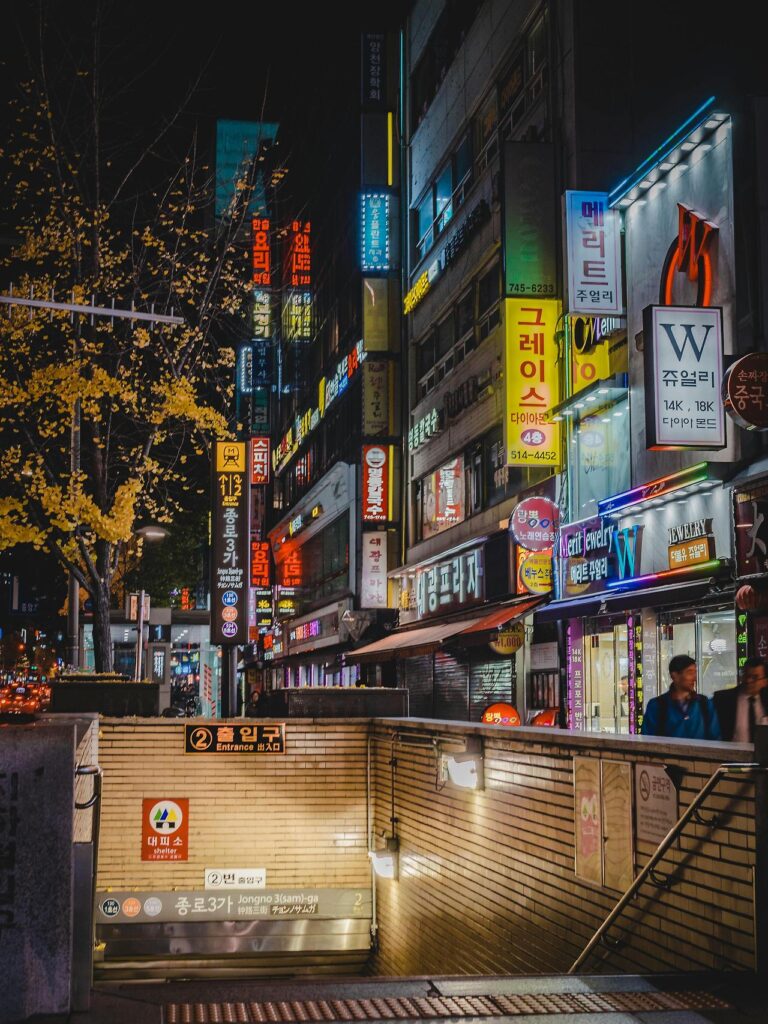
Last night, I found myself walking through the heart of the Seoul subway system, not as a tired commuter, but as a digital tour guide for an old friend. My friend, who moved to California in the late 90s, hasn’t stepped foot in Korea for over 25 years.
To him, the “subway” meant dark, cramped platforms and the smell of old grease. As I moved through the station, snapping photos and recording clips, his reactions over KakaoTalk were priceless: “Wait, is that a department store or a station?” or “How is it so clean at 11 PM?”
This isn’t your typical tourist guide. We aren’t talking about Line 2 or Line 9 fares. Instead, this is a deep dive into the Experience the Modern Seoul Subway—a look at the micro-details that make this transit system the envy of the world.
1. The Digital Compass: A New Way to Experience the Modern Seoul Subway“
The first photo I sent him was the massive digital information board at Jamsil Station. He was stunned by the clarity of the 4K screens.
- The Multilingual Relief: In the past, being a foreigner in Korea meant carrying a tattered paper map and hoping for the best. Today, the screens rotate through English, Japanese, and Chinese with a level of precision that makes it impossible to get lost. I explained to him that even the audio announcements are now quadrupled, ensuring that a traveler from San Francisco or Tokyo feels just as at home as a local.
- Real-Time Cultural Pulse: These boards aren’t just for directions; they display the “Seoul Top 10 News” and local weather alerts. I told my friend, “It’s like the city is talking to you, keeping you informed of everything from K-pop concerts to air quality.”
- The Interactive Search Revolution: I demonstrated how you can touch a building on the map and see exactly which exit leads to the front door. This “last-mile” navigation is something my friend in California, who relies solely on GPS, found absolutely revolutionary.
- Expert Tip for Expats: Always check the “Digital Information” kiosks near the ticket gates. They often hide vouchers or QR codes for nearby attractions that can save you significant money.
2. The Underground Oasis: Convenience Stores and Smart Vending
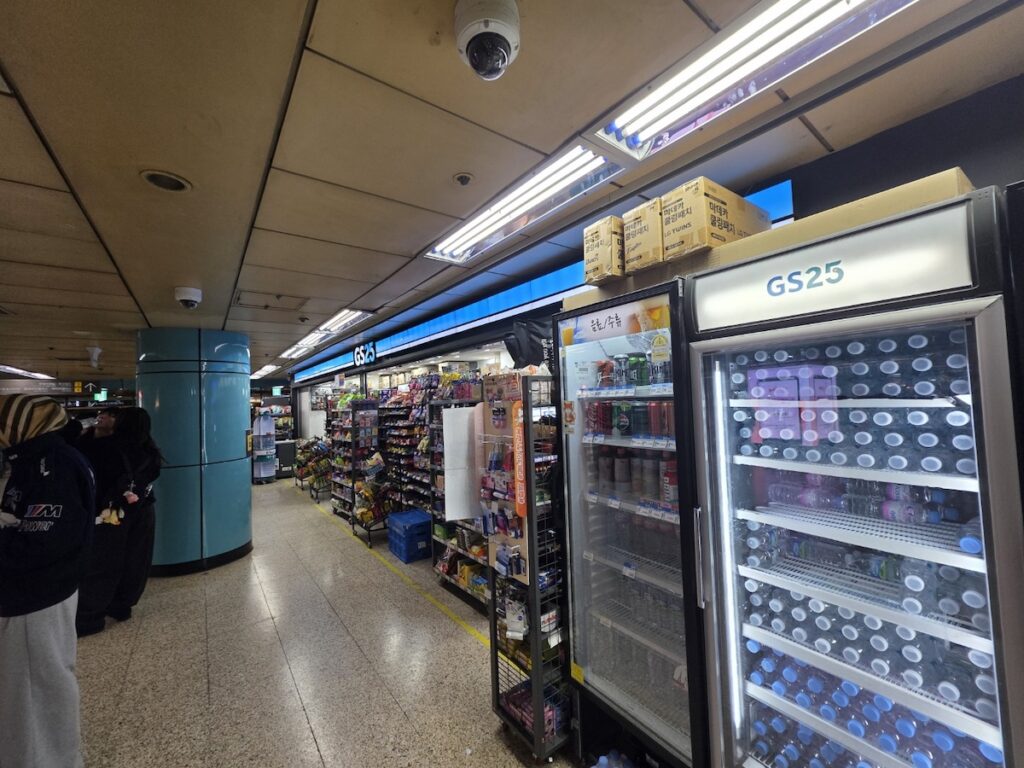
As I walked past a brightly lit GS25 store, my friend asked, “Is that outside the station?” I laughed and replied, “No, it’s right next to the turnstiles.”
- The “City Within a City” Concept: I explained that in Seoul, the subway is a living ecosystem. You can drop off laundry, pick up a fresh Kimbap, or even buy a new pair of socks without ever feeling the cold wind of the street. It’s a level of convenience that makes the commute part of your lifestyle, not just a chore.
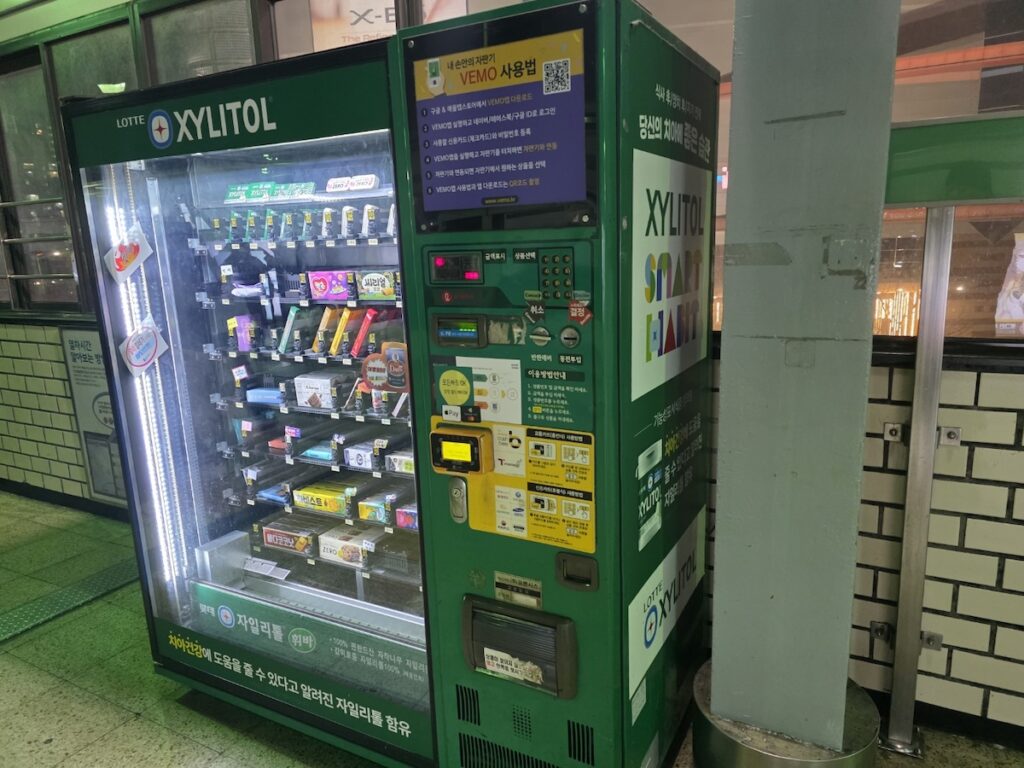
- Evolution of the Vending Machine: I showed him a specialized “Smart Vending Machine.” Forget sodas; these machines sell high-quality masks, smartphone cables, and even dental kits. It’s a symbol of how Korea anticipates the tiny emergencies of modern life.
- The Seamless Payment Ecosystem: I told him about the T-Money card. It’s not just a transit pass; it’s a digital wallet. You can tap it to buy a coffee at the station’s convenience store and then tap it again to board your train—no cash, no friction.
- A Hidden Fact: Many larger stations now house “Shared Office” pods. You can literally rent a tiny, soundproof office booth inside the station for an hour if you have an urgent Zoom meeting.
3. The Ritual of Cleanliness: Advanced Recycling Stations
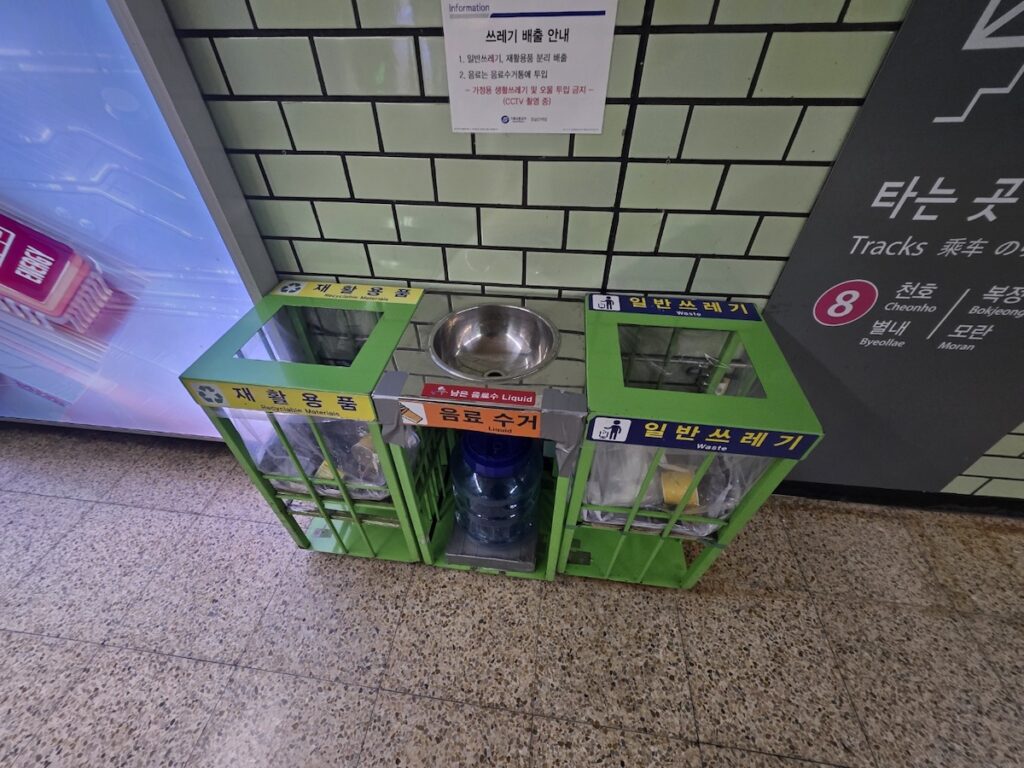
Next, I pointed my camera at a waste disposal area. This is where the cultural difference really hit home for him.
- A Masterclass in Civic Maturity: I sent him a close-up of the recycling bins. Unlike the overflowing, singular trash cans he sees in the U.S., these were meticulously divided into Liquids, Paper, and Plastic. It represents a society that values the collective environment over individual convenience.
- The Liquid Funnel Innovation: My friend was fascinated by the specific drain for leftover coffee. In many global subways, a half-empty latte is a recipe for a sticky mess. Here, it’s disposed of cleanly, keeping the station smelling like… well, nothing. And in a subway, “nothing” is the best smell possible.
- The Invisible Army: I explained that there is an army of maintenance staff working 24/7. Even at 11 PM, the floors are buffed to a mirror-like shine. This isn’t just for aesthetics; it’s about providing a sense of dignity to the millions who use the system every day.
- The Etiquette of the Trash: I reminded him that if you can’t find a bin immediately, the unspoken rule is to carry your trash until you do. It’s why you’ll never see a soda can left on a subway seat in Seoul.
4. The Station as a Gallery: Digital Art and Advertising
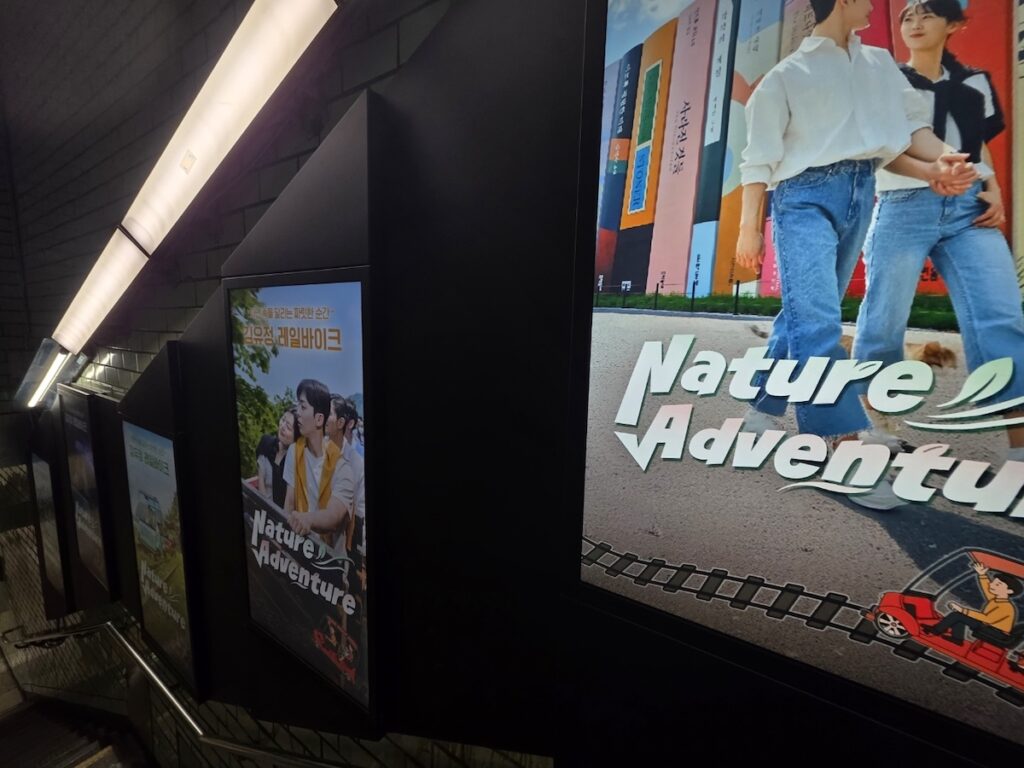
We moved toward the escalators, where massive LED walls transformed the concrete hallway into a vibrant forest.
- Digital Escapism: I showed him the “Nature Adventure” display. For a salaryman who has spent 10 hours in an office, this 30-second ride through a digital forest is a moment of pure zen. The subway is no longer just a tunnel; it’s an immersive media gallery.
- The Fandom phenomenon: I pointed out a massive ad for a K-pop idol’s birthday. I told him, “Fans pay thousands of dollars to put these up.” It turns a public space into a community notice board, where the city’s heartbeat—K-pop—is visible for everyone to see.
- The Psychology of Space: I explained that by using art and bright lights, Seoul has eliminated the “fear factor” of underground travel. You feel safe because the environment feels premium, cared for, and watched over.
- Interactive Ads: By 2026, many of these ads are AR-compatible. You can point your phone at a movie poster on the wall and watch the trailer instantly through your screen—a detail that made my friend say, “Okay, Korea is living in 2030.”
5. The Midnight Shutter: Survival When the City Sleeps
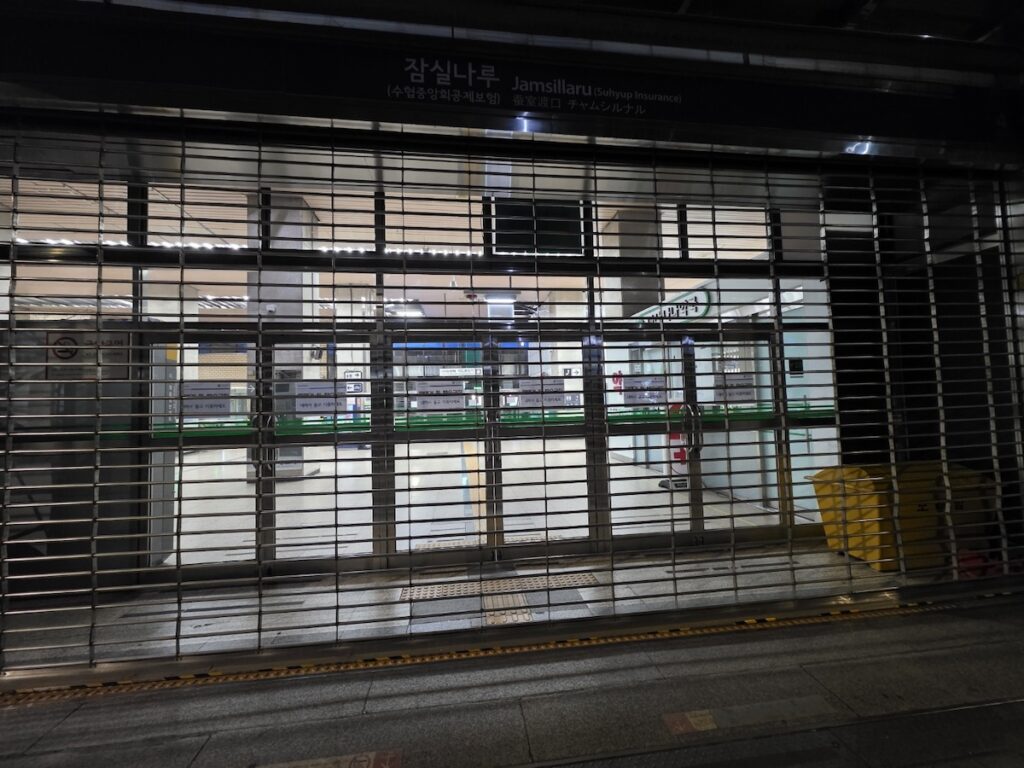
Finally, the mood shifted. It was nearly 1 AM, and at Jamsillaru Station, I heard the mechanical hum of the Heavy Steel Shutters descending.
- The Iron Curtain of Seoul: I captured the moment the shutter touched the floor. To a traveler, this is the most important image. It’s the sign that the rail journey has ended. I told my friend, “If you’re not out by now, you’re walking.”
- The Nighttime Survival Strategy: I shared the secret of the N-Bus (Owl Bus). While the subway rests, the N-Buses take over, tracing the same routes above ground. I explained how to use the KakaoBus app to find them, a lifesaver for anyone who loses track of time in Hongdae or Gangnam.
- Safety Even in the Dark: I pointed out the emergency buttons located near the closing shutters. Even as the station shuts down, help is only a button-press away. This built-in safety net is a core part of the Experience the Modern Seoul Subway.
- The Last Train Adrenaline: There’s a unique Korean culture called “Mak-cha” (Last Train) rush. Seeing hundreds of people sprinting to catch that final train is a sight to behold, and it’s a shared experience that every Seoulite has a story about.
Explore More of Seoul with Marcus
If you enjoyed this visual journey through the Seoul subway, you’ll find these guides equally essential for your life in Korea:
- 🏢 [K-pop Dance Locations in Korea: 2026 Seoul Busking Guide] – Discover the best spots to watch live performances near major subway stations like Hongdae and Gangnam.
- 🍗 [The Secret Logic of Half-and-Half: Why Koreans Eat Chicken Differently] – Master the local “Ban-Ban” culture and the etiquette of sharing Korea’s favorite soul food.
- 🚨 [How to Report to 112 and 119: Emergency Location Guide for Expats] – Stay safe while exploring the city by knowing exactly how to report your location in an emergency.