✨ Introduction: The Subterranean Pulse of a Cyberpunk Metropolis
Google Maps is a hallucination here. If you are arriving in Seoul in 2026 expecting a friendly, slow-paced tourist experience, prepare for a systemic shock. This city does not operate on “convenience”; it operates on Tactical Efficiency. From the Abyss at B8—a depth of 50 meters where the air pressure changes—to the 180km/h subterranean bullets known as the GTX, Seoul’s infrastructure is a cold, mathematical masterpiece.
You aren’t just a traveler; you are a participant in a high-stakes ritual of motion. This Seoul Transportation Guide 2026 is your primary weapon to decode the city’s complex geometry, reclaim your time, and survive the neon-lit gridlock. Master this guide, or the city will outpace you before you even leave the airport.
Phase 1: The B8 Ritual—GTX-A and the Depth of Innovation
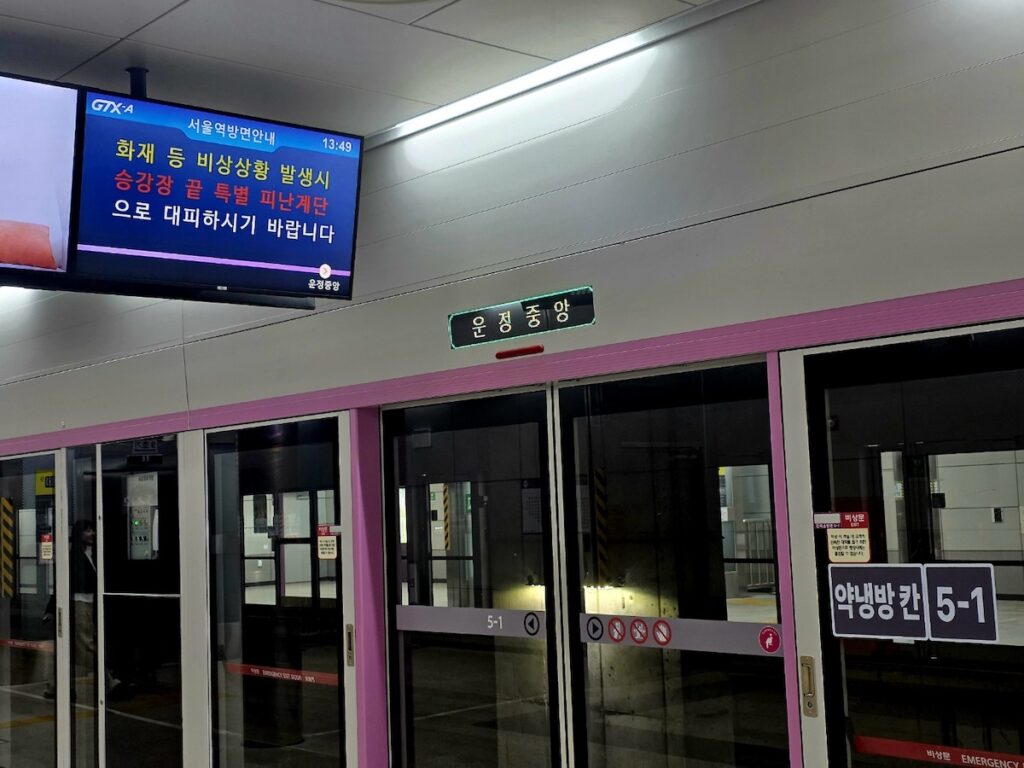
In London, they have the “Tube.” In New York, they have the “Subway.” In Seoul, we have the Abyss. The crown jewel of the Seoul Transportation Guide 2026 is the GTX-A (Great Train eXpress). This is not a standard metro; it is a long-distance subterranean bullet designed to shrink the Korean Peninsula. But to board it, you must perform the Vertical Ritual.
The Depth of B8 (50 Meters Down)
At stations like Unjeong Central, the platform isn’t just “underground”—it is at Level B8. Imagine a 15-story building buried vertically into the earth; that is where your train waits.
- The Survival Move: Do not look for the stairs. A descent via escalator will cost you 7 minutes of your life. Target the High-speed Glass Elevators. These industrial pods drop you into the abyss in under 60 seconds.
- The Sensation: As you descend, you will feel the “Ear-Popping Ritual.” It is the physical price of entering a system that travels at 180km/h beneath the city’s crust.
The Velocity Hierarchy: 180km/h vs. The Crawlers
Why go so deep? Because at B8, there is no traffic, only pure velocity.
- GTX-A Speed: 180km/h (Top) / 100km/h (Average).
- Standard Subway: 80km/h (Top) / 30km/h (Average).
- The Result: A journey from the northern border (Paju) to Seoul Station that used to take 90 minutes now takes 20 minutes. 🔗 Internal Link:
[GTX-A Seoul Guide 2026: Official Roadmap and the B8 Abyss Ritual]– Master the full timeline and the ‘Samsung Station Gap’ before you plan your route.
Phase 2: The Financial Shield—K-Pass vs. Climate Card
In the Seoul Transportation Guide 2026, your wallet is your armor. To navigate the high-frequency pulse of the city without draining your settlement fund, you must choose your Financial Shield. In 2026, the battle for subterranean dominance is fought between two primary systems: the K-Pass and the Climate Card. If you are still paying full price for every “Tap,” you are failing the urban ritual.
🛡️ The Tactical Choice: Which Shield Suits Your Mission?
Seoul’s transit pricing is no longer a flat fee; it is a mathematical calculation of your movement. By 2026, the system has evolved into a sophisticated refund-and-limit model.
| Feature | K-Pass (The Refund Warrior) | Climate Card (The Unlimited Fortress) |
| Best For | Long-term Expats / High-speed Commuters | Short-term Tourists / Urban Explorers |
| Coverage | Nation-wide (Subway, Bus, GTX, KTX-Chungmu) | Seoul City Only (Subway, Bus, Ttareungi) |
| The Ritual | Use 15+ times/month → Get 20~53% Cash Back | Pay a flat monthly/weekly fee → Unlimited Rides |
| 2026 Update | GTX-A fully integrated. High-speed refunds now available. | Foreigner Pass Expanded. 1, 3, 5, 7-day passes for tourists. |
💳 The K-Pass: Reclaiming Your Wealth from the Machine
For the sophisticated resident, the K-Pass is the ultimate weapon. It doesn’t give you a discount upfront; it tracks your loyalty and returns your capital.
- The Math: If you use the GTX-A to commute from the B8 abyss, your monthly spend could easily hit 150,000 KRW. The K-Pass rituals return up to 80,000 KRW directly to your bank account.
- 🔗 Internal Link:
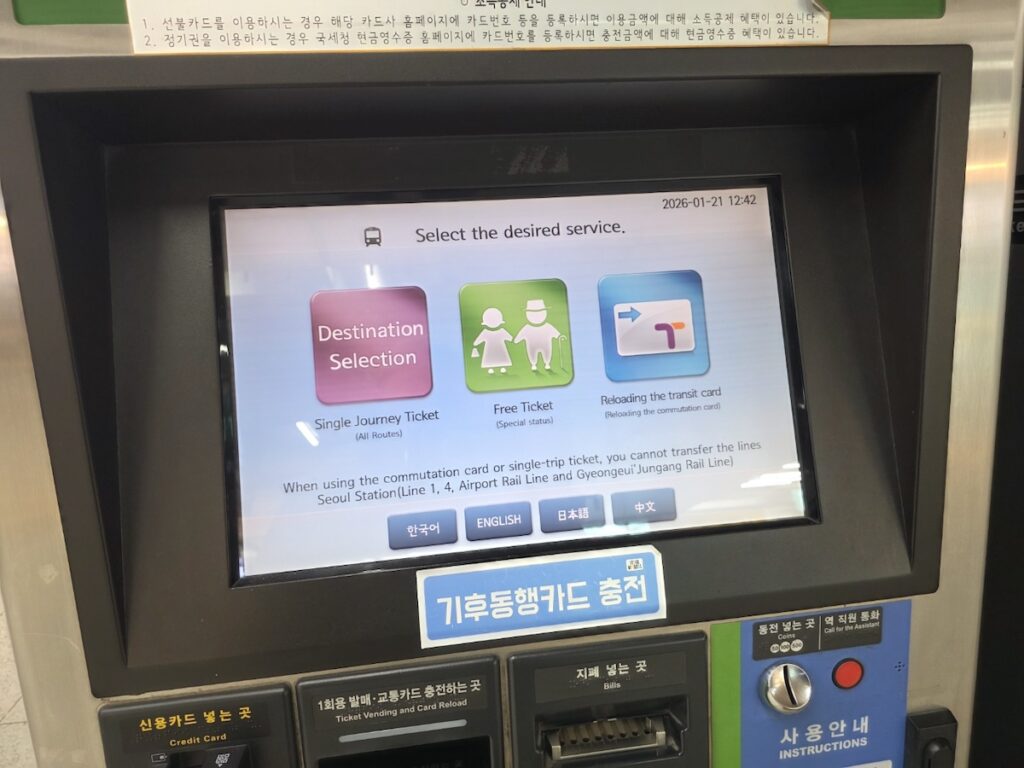
[Seoul Subway Kiosk Guide: 5 Rules to Save Your Money and Time]— Learn the physical ritual of topping up without losing your momentum.
🌍 The Climate Card (Gihu-Donghaeng): The 2026 Tourist Ritual
If you are here for a 72-hour surgical strike on the city’s sights, the Climate Card is your sanctuary.
- The 2026 Tactical Move: You can now purchase a 3-day Tourist Pass for roughly 10,000 KRW. This includes unlimited subway rides and the Ttareungi (Green Bike) ritual.
- The Cashless Fortress: As of 2026, most Seoul buses have abandoned physical currency. Your Climate Card is not just a discount; it is your Entry Permit to the surface fleet.
Phase 3: The Midnight Survival—Hongdae and the Last Train Ritual
When the clock strikes midnight, the Seoul Transportation Guide 2026 shifts from efficiency to Survival. The subway arteries begin to close, and the “Taxi War” begins. In the neon-lit sectors like Hongdae, thousands of people are stranded simultaneously.
🚕 The Taxi Paradox: Why You Should Not Wait
In 2026, the late-night taxi surcharge starts at 23:00 (11:00 PM) and can hit a 40% premium. Even with the Kakao T app, you are competing with 50,000 other ghosts in the machine.
- The Survival Rule: Do not stand on the curb like a tourist. If the app shows “High Demand,” abandon the taxi ritual immediately.
🚌 The Owl Bus: The Secret Arteries of the Night
While the world waits for an expensive Uber or Kakao Taxi, the tactical traveler looks for the ‘N’ (Night) Buses. * The Ritual: These buses run from 00:00 to 05:00. They follow the major subway lines but stay on the surface.
- 🔗 Internal Link:
[The Last Train Ritual: Why Taxis are Not the Only Answer in Hongdae (2026)]— The specific route numbers and boarding points to escape the Hongdae trap.
Phase 4: The High-Speed Sanctuary—KTX & SRT Survival
In the Seoul Transportation Guide 2026, “Distance” is a relative concept. While the GTX-A conquers the subterranean abyss, the KTX (Korea Train Express) and SRT (Super Rapid Train) are the heavy-duty arteries of the peninsula. Traveling at 300km/h, these are your high-speed sanctuaries—but only if you know how to claim your seat in the digital queue.
🚅 KTX vs. SRT: Choosing Your Trajectory
- KTX (The Traditional Power): Departs from Seoul Station and Yongsan. It is the primary artery for Busan, Daegu, and Gwangju.
- SRT (The Gangnam Elite): Departs from Suseo Station. It is faster for those staying in southern Seoul (Gangnam/Jamsil) and offers slightly more legroom.
- The 2026 Reality: Weekend tickets to Busan or Gyeongju are often sold out weeks in advance. If you are staring at a “Sold Out” screen, you have entered the Struggle Phase.
🛡️ The Standing Ticket Ritual: Survival at 300km/h
When the machine denies you a seat, you must master the Standing Ticket (Ipseok).
- Tactical Tip: Do not stand in the aisles. Target the Jump Seats located in the vestibules between cars. These are unassigned, and the first person to sit claims the territory for the next 2.5 hours.
- 🔗 Internal Link:
[Korea Travel: KTX & SRT Standing Ticket Ritual: 5 Tips to Survive a 400km Journey (2026)]— Learn the exact car numbers where jump seats are most abundant.
📱 The “600 Refresh” Maneuver
In Seoul, persistence is a currency. If a train is sold out, the SRT app allows for a last-minute cancellation ritual.
- The Move: Refresh the app precisely 45 minutes before departure. This is when unpaid reservations are purged by the system, creating a 5-second window to snatch a high-speed sanctuary.
- 🔗 Internal Link:
[The Art of the SRT Struggle: Why 600 Refreshes are Worth the $30 High-Speed Sanctuary]
Phase 5: The Aquatic Pulse—Han River Water Taxi and Ferries
The Seoul Transportation Guide 2026 is not just built of steel and concrete; it flows through the water. While the subway is for efficiency, the Han River (Hangang) is for the elite perspective.
🚤 The Han River Water Taxi: Sightseeing vs. Commuting
- The Truth: Locals rarely use water taxis to commute. It is an Aesthetic Ritual. * The 2026 Update: New “River Bus” routes have been introduced, attempting to bridge the gap between Jamsil and Yeouido.
- Tactical Warning: Do not use the water taxi if you are in a rush. Use it when the city’s neon lights are reflecting off the water at 19:00 (7:00 PM). It is the most sophisticated way to cross the city’s heart without the claustrophobia of the B8 abyss.
Phase 6: The Official Roadmap—Planning Your Escape
To conclude this Seoul Transportation Guide 2026, you must understand the hierarchy of transit. Your choice defines your urban status:
- GTX-A: For those living in the future (Paju/Dongtan) who value velocity over sunlight.
- Subway Line 2/9: The “Combat Zones.” High frequency, high pressure, essential for the Gangnam ritual.
- KTX/SRT: The long-distance escape pods.
- Kakao T / T-Money: Your digital and financial armor.
Conclusion: Mastering the 2026 Urban Machine
Seoul does not reward the passive observer; it rewards the tactician. Whether you are navigating the Abyss at B8 or securing a sanctuary on the 400km/h KTX, your quality of life in this city is defined by your mastery of the Seoul Transportation Guide. This isn’t just about moving through space—it’s about manipulating the city’s complex geometry to your advantage. The trillion-won infrastructure is at your feet, but it operates on a mathematical logic that demands your full attention.
The Reality Check: A car is a liability in Seoul. The true elite are those who can navigate the subterranean fortresses and high-speed corridors with surgical precision. If you are still relying on global intuition, you are losing hours of your life to the city’s relentless gears.
Your Final Action Plan:
- Ditch Google Maps: Download Naver Map or KakaoMap immediately—this is your primary digital umbilical cord.
- Armor Your Wallet: Secure a T-Money card or K-Pass at the airport; in the Cashless Fortress, a card is your only entry permit.
- Respect the Depth: When using the GTX-A or deep-level subways, account for the “Vertical Ritual”—that 7-minute descent matters more than the train’s velocity.
- Digitize Your Commute: Install the Korail, Kakao T, and Kobus apps before you even think about leaving your hotel.
Seoul is a masterpiece of efficiency, but it is also a battlefield. Master this guide, synchronize with the pulse, and the city is finally yours.