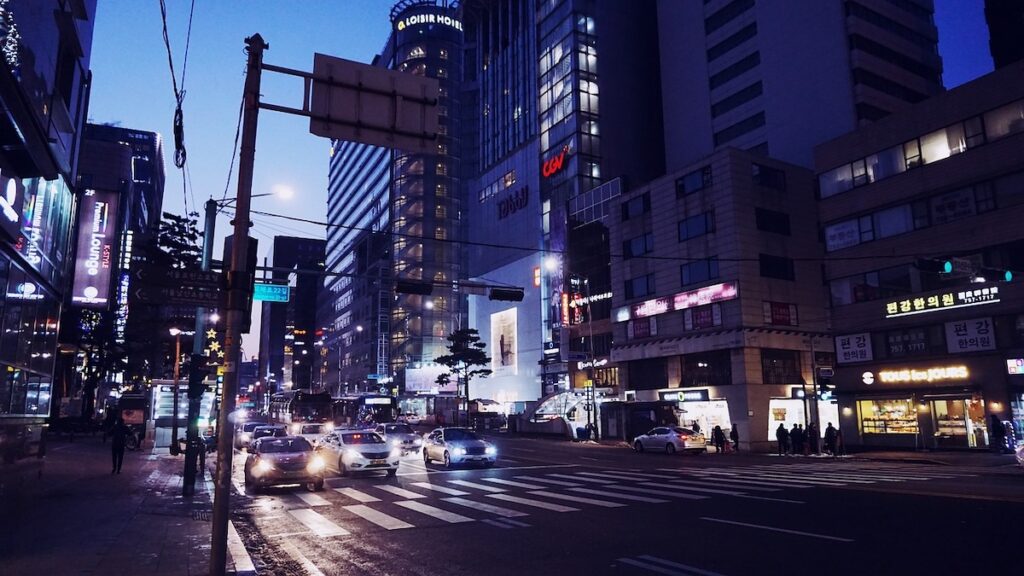
The Incheon Airport arrivals hall is small. The cultures inside it are not.
I was waiting for my mother. She had been on a trip with my older cousin and had texted me a deal — come to the airport, and the 1-liter Johnnie Walker Green I had been hinting about would be in her duty-free bag. So I went.
What I had not planned for was the show happening in front of me while I stood there. I had brought a paperback to kill time. I read maybe two pages.
Quick Answer: Incheon Airport arrivals hall is more than a transit point — it is one of the few places in Korea where you can watch several cultures arrive in their own language at the same time. Korean families lean toward quiet reserve and practical gestures (a duty-free bottle, a ride home). Korean American families lean toward verbal warmth and full hugs. Visitors from elsewhere bring their own scripts entirely, sometimes literally with live music. The hall is plain. What happens inside it is not.
The first scene: a Georgia family at arrivals
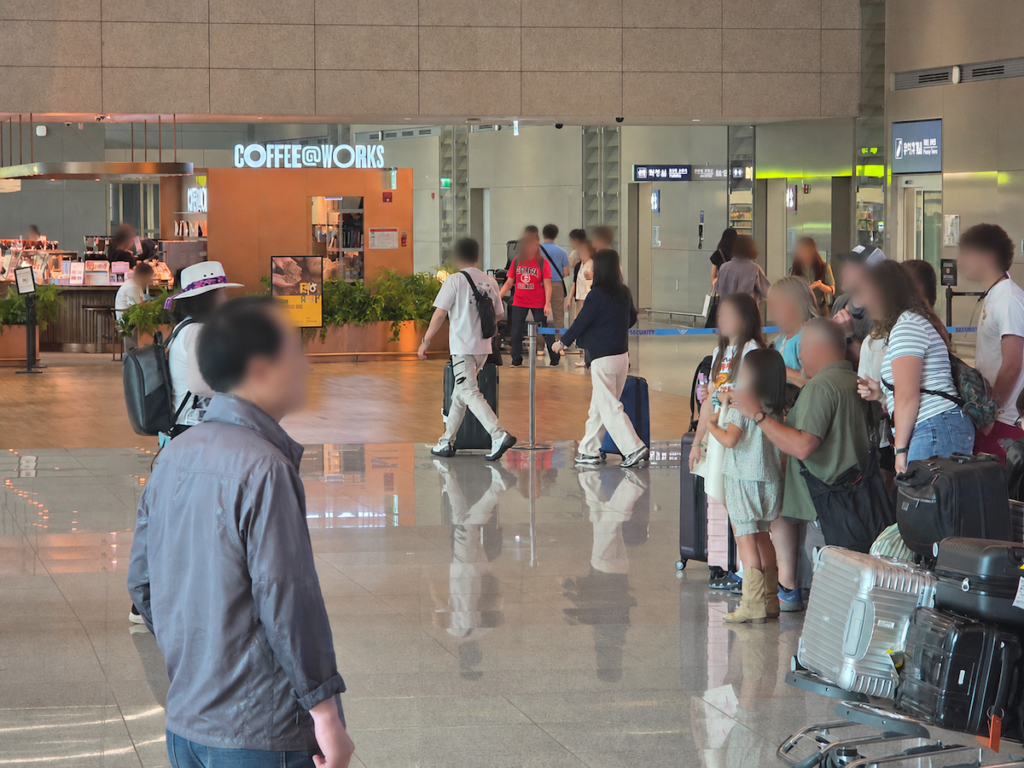
The first thing I noticed was a family standing about ten meters from the sliding doors. An older couple, two adults in their thirties, a girl maybe eight, another smaller one in cowboy boots. The grandfather had a faded red shirt that said Georgia Bulldogs — the American state, not the country.
They were waiting for someone too. I could tell because they kept looking at the doors, and because the smallest girl was bouncing on her toes in a way only children waiting for someone they love can do.
When the doors opened, a younger woman walked out — daughter or daughter-in-law, hard to tell from where I was standing. What happened next took about three minutes and felt longer.
She hugged the grandmother first. A full, two-armed hug, with the heads of both women resting briefly on the other’s shoulder. Then she stepped to the grandfather. Same hug. Then the husband, then each of the children in turn, kneeling down for the small one in the cowboy boots. Then back to the grandmother for a second one. I could hear pieces of what they were saying — I missed you, thank you for coming, we waited all morning.
It was the every person, one by one part that struck me. Nobody got skipped. Nobody got a wave from across the suitcases. The grandfather, who had not said much, said love you, kiddo to the little girl before she even let go of his leg.
I have watched a lot of Korean families do the same arrival. I have never seen one do it like that.
Why my Korean mother sent me to the airport with a whisky order
While the Georgia family was still hugging, my mother came through her own set of doors about thirty meters away.
She is in her sixties. She had been traveling for two weeks. She walked toward me with the same expression she has when she gets out of a taxi at home — mild, slightly tired, scanning for her son in the crowd. When she spotted me she said, in the order she said it: Did you have lunch? The bag is heavy. The whisky is in the side pocket.
There was no hug. There almost never is.
If you read that as cold, you would be reading it the way a tourist reads a temple — looking for the parts that match what you already know. The truth is gentler than that. My mother and I are close. We talk most days. She would, if I were in trouble, sell her apartment for me, and we both know it. What she does not do, what she has never done in my entire life, is say I missed you at an airport.
What she did instead was put a 1-liter bottle of whisky in a duty-free bag, carry it through two flights, and ask me to come pick her up. The whisky was the message. Come see me. I thought about you. In Korean families, this is fluent — the love arrives in objects, in food, in rides offered and accepted, in the long Sunday lunch where nobody says anything sentimental but everyone eats too much. To call that less affectionate than the Georgia family’s hug would be to mistake the alphabet for the language.
So I picked up the bag. I drove her home. On the way she asked me three times whether I had eaten properly while she was gone. That was, in her dialect, I love you. The Georgia family was saying the same thing in another language, ten meters to my left, both at once.
There was something quietly clarifying about hearing them both in the same hallway. The translation worked both ways.
The screen overhead that nobody talks about
While all this was happening on the floor, something else was happening above our heads.
The arrivals hall at Terminal 1 has a 150-meter LED media wall along the ceiling — a long, curved screen that runs the length of the walkway. It plays four-minute videos under themes the airport calls K-Heritage, K-Culture, K-Food, and K-Nature, in collaboration with the National Palace Museum of Korea and the Korea Cultural Heritage Foundation. Most of the time, when an arrival rush is light, nobody really stops for it.
That day was not light. A flight had just unloaded and the screen was running a stretch of K-Nature: coastlines I half-recognized, mountain ridges shot from above, kelp under shallow water, lit pink at the edges. The arrivals area went quiet in a particular way. People who were waiting for someone tilted their heads up. People who had just walked through customs slowed down without meaning to. A man in his sixties, Korean, leaning on the rail, pointed at the screen and said something to his wife, and they both smiled.
I had walked under that screen probably a hundred times before. I had never actually watched it.
The reason I am telling you about it is that the screen is doing the thing the Georgia family was doing, the thing my mother was doing with her whisky bag — saying welcome in a particular vocabulary. The country chose its words carefully. It did not put a slogan up there, or a smiling tourism mascot, or a list of things to see. It put a coastline. A pine forest from above. Pieces of land that have nothing to sell.
It is a gesture I have come to think of as very Korean: the host says we are happy you are here without ever using the word welcome. The room itself does the talking. And, the same way my mother’s whisky bag worked, you only catch the meaning if you stop expecting the message in the form you know.
If you are reading this and planning a first trip, this is the part that gets missed in every airport guide. Look up. The ceiling is part of the country greeting you, and it does it for about four minutes at a time, on loop, all day.
The second scene: mariachi at the next set of doors
About twenty minutes after my mother had gone to find a bathroom, a louder thing arrived.
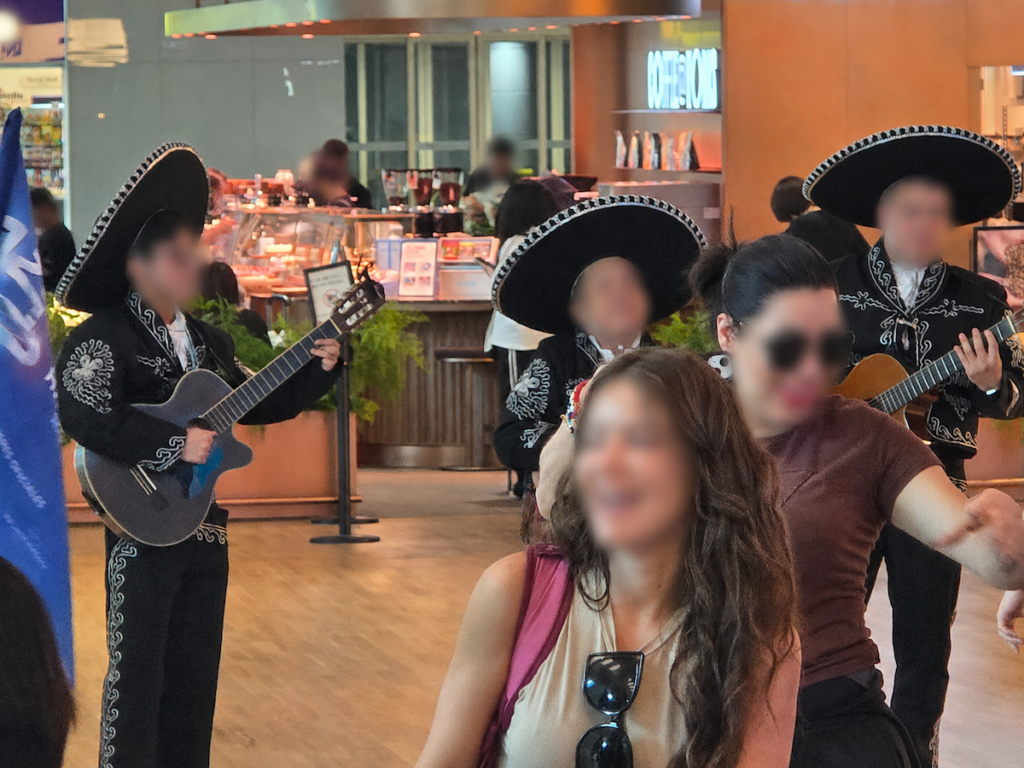
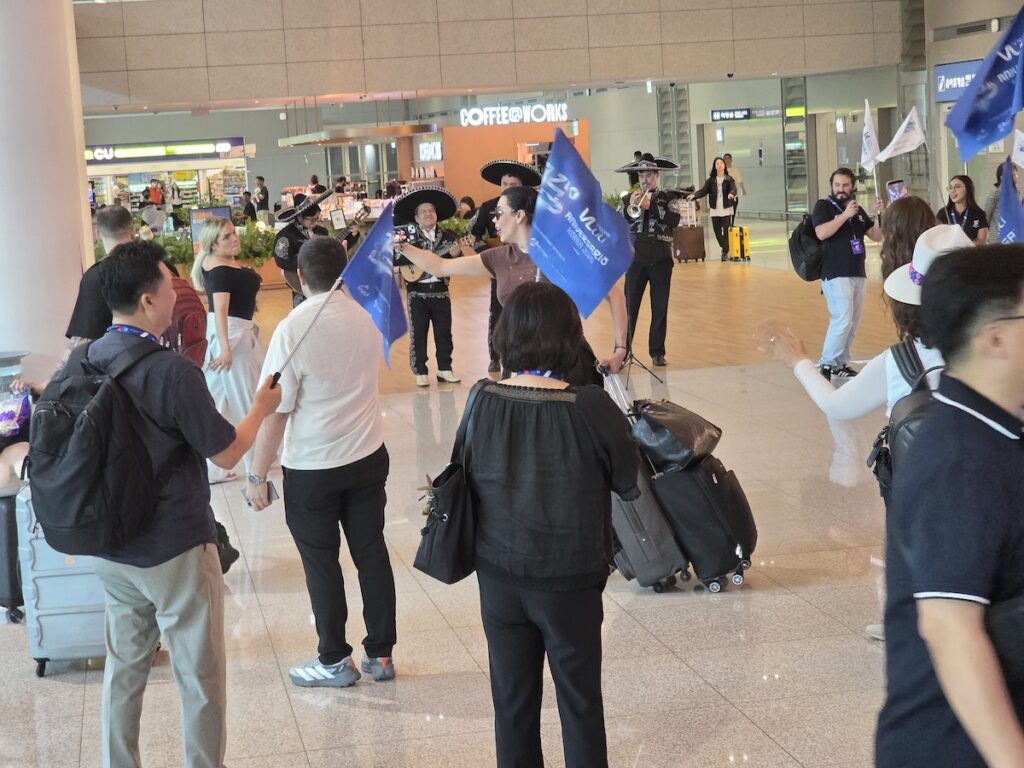
Three men in full mariachi outfits — black charro suits with white embroidery, the big sombreros, two guitars and a trumpet — set up near the coffee shop at the next gate over. A small group of Korean event staff were holding up blue flags that read ANIVERSARIO KOREA 2026, and a woman with a microphone was rehearsing a line in Spanish.
I figured out the situation in pieces. This was an official welcome, organized in Korea, for a delegation arriving from a Spanish-speaking country to mark some kind of anniversary year. The mariachi band looked partially Mexican, partially Korean — at least one of the guitarists had a face that could have been a high school friend of mine in Seoul.
The interesting part, the part I want to write about, was the waiting.
The musicians were not quite ready when the first members of the delegation came through the doors. The trumpet player was still adjusting his strap. The flag holders had not lined up. Somewhere there was an audio cue missing. In most contexts I have seen in Korea, that gap would have produced visible anxiety on at least three faces. The host side would have apologized profusely. Someone in a suit would have made calls. The whole thing would have been treated as a small disaster.
It did not go that way. The delegation members — who, judging by the boarding pass one of them was still holding, had just spent roughly fourteen hours in the air — stopped, smiled, took out their phones, and waited. Some of them started dancing in place before the music had even started. One woman in sunglasses laughed and shouted something at the musicians, who shouted back, and that exchange was, on its own, the start of the music.
When the band finally played, the delegation sang. The Korean staff stood to one side, holding their flags carefully, smiling but not quite singing.
I have lived in Seoul for more than ten years. I have watched a lot of corporate events run by Korean hosts. I have never once seen the guests be the ones who rescued the moment by being patient with their own welcome.
Two definitions of care: efficiency versus presence
What I was looking at, by then, was the same idea expressed in three different alphabets.
The Korean idea of care, the one I grew up inside of, is heavily weighted toward not wasting the other person’s time. My mother sent me to the airport with a clear job: pick her up, here is your reward. Korean hosts will, at almost any cost, try to keep an event running on schedule because making you wait is read, here, as a small failure of hospitality. Care, in this vocabulary, looks like efficiency. Like preparation. Like the absence of a screw-up.
The Korean American family in front of me was working with a different definition. Care, for them, looked like making physical contact with every single person individually, in order, without hurrying. The grandmother got two hugs. Nothing about it was efficient. Everything about it was present.
The mariachi crowd was a third version. Care, for them, looked like being inside the moment that was happening, regardless of whether it was going to plan. The musicians being late was not a failure to be apologized for. It was a few extra seconds of being together, in an airport, in a strange country, with people in cowboy hats playing the songs of home. The waiting itself was part of the welcome.
None of these is more loving than the other. I want to be careful about that, because it is easy, in a piece like this, to slide into ranking. The Korean version, my mother’s whisky-and-ride-home version, can look thin from the outside if you do not know the codes. The American version can look performative if you do not know the codes. The Latin version can look chaotic if you do not know the codes. They are not. They are three full languages, all spoken at native fluency, by people who deeply mean what they are saying.
The Incheon arrivals hall is one of the very few rooms in this country where you can stand in one spot and hear all three at once.
It plays four-minute videos under themes the airport calls K-Heritage, K-Culture, K-Food, and K-Nature, in collaboration with the National Palace Museum of Korea and the Korea Cultural Heritage Foundation, as documented on Incheon Airport’s official site.
Why arrivals halls have become longer stages in 2026
There is a structural reason the show has gotten longer this year, and it is worth knowing if you are flying in.
The Korea Times reported in April 2026 that immigration wait times for foreign nationals at Incheon Airport stretched to as long as one hour and 54 minutes during the Lunar New Year holiday in February. That is nearly double last year’s Chuseok peak, and well past the 45-minute target the International Civil Aviation Organization sets as the recommended ceiling for arrivals processing. The cited reasons are a reduced number of immigration officers and a steady rise in foreign visitor numbers, which were up more than 16 percent year over year in the first quarter.
What that means in practice, on the ground in the hall, is that people on the waiting side now stand there for a long time. A flight that lands at three can take until five for everyone to come out. The Georgia family had been there since lunch, easily. The mariachi band had time to retune three times.
This is the unromantic part, and worth stating plainly. If you are flying into Korea right now, especially on a weekend or around a holiday, plan for the wait. Eat before you land. Use the bathroom on the plane. If someone is picking you up, give them an extra hour and tell them not to worry. The airport itself is excellent. The bottleneck is the staffing.
The other side of the same coin is the one I have been writing about for the last 2,000 words. The wait is also why the welcomes are so visible. If immigration cleared everyone in twenty minutes, the Georgia family would have hugged for thirty seconds and gone. The mariachi band would not have had the patience-test moment. I would have driven my mother home before noticing any of it.
There is a version of Seoul I have written about elsewhere — the version where the city’s calm comes from things being deliberate, not slow. You can read it as the reasons Seoul feels safe and steady to most foreigners. The arrivals hall, right now, is operating on a different physics. It is slow because something is broken, and that broken thing has made it, for a while, the most expressive room in the country.
What you actually walk into, on your first arrival
If this is your first time flying into Seoul, here is the practical map of what is happening in the room, and where to stand inside it.
There is the immigration line, which you cannot avoid. Then a baggage hall, which is quick. Then the customs gate, beyond which you cannot go back. Once you walk through the sliding doors, you are on the stage I have been describing.
To your left and right, behind a rope, are people waiting. Some are family. Some are drivers in dark suits holding signs with names on them. Some are friends with flowers. Some are tour guides waving small flags. Some are event teams with banners. They have been there a long time. They have, by now, looked up at the media wall at least three or four times.
If someone is meeting you, agree on a precise spot in advance, because the room is wider than it looks and the phone signal is sometimes spotty in the first few minutes after immigration. The columns near the cafe — the one with the orange sign that says Coffee@Works — are a good landmark. Visible from both sides, hard to miss, and close to the bathrooms most people need within ten minutes of landing.
If nobody is meeting you, do not rush. Sit on one of the long wooden benches that run under the media wall. Look up for one full video — about four minutes. The country is greeting you in its own quiet way before you have even bought your subway card. There is a practical guide to getting from Incheon Airport into Seoul for the next step, when you are ready.
And if you are picking someone up, especially someone Korean, do not be surprised if they walk out and ask you whether you ate. That is the version of I missed you you are about to learn. It is the same word, just said with different syllables.
One building, many arrivals
I left the airport that day with a 1-liter bottle of whisky, my mother in the passenger seat, and a paperback I had not really read. The Georgia family had gone home before us, presumably in two cars, presumably still hugging at the curb. The mariachi band was, the last time I looked, packing up the trumpet, while the woman in sunglasses tipped them a folded bill.
What I had not expected, when I agreed to come, was how visible the country’s emotional grammar would be in a hallway I had walked through dozens of times. Korea is often described as reserved, and that description is not wrong — it is just incomplete. Reserve, here, is one specific way of carrying love through a customs gate. It is not the absence of love.
The Incheon Airport arrivals hall is where you can see this most clearly, because it is one of the few rooms where the Korean dialect of love stands directly next to two or three others. The hugs are not louder than the whisky. The mariachi is not warmer than the silence. They are different sentences, written in different scripts, all of them saying the same thing.
Welcome. Welcome. Welcome.
Three times, in three accents, every time a plane lands.