What shoes to wear in Seoul sounds like a small packing question until you notice how often the city rises and falls under your feet.
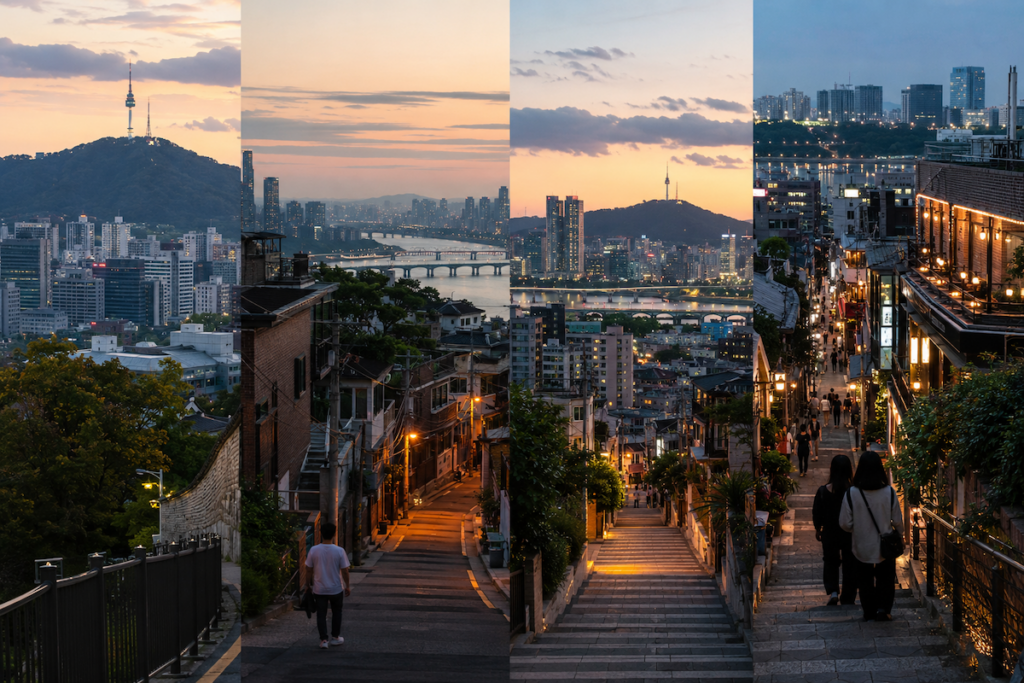
I started thinking about this while looking toward Namsan from different parts of Seoul. In many areas, you can see the mountain sitting in the middle of the city, with apartments, hotels, office buildings, and old neighborhoods climbing around it. Some buildings look tall simply because they are high-rise buildings. But in Seoul, many places also look high because the land itself is already rising.
You feel this clearly around Itaewon.
Itaewon has a bright, lifted feeling. The streets around the station can feel open, stylish, and slightly above the city. There are restaurants, bars, embassies, people dressed for the night, and a sense that Seoul is showing one of its more international faces. But if you decide to walk from Itaewon down toward the Han River for ramyeon, the route may look simple on a map while your legs tell a different story.
You keep going downhill.
At first, that can feel pleasant. The city opens up. The road pulls you toward lower ground. You may think, “This is not so bad.” But Seoul often teaches you that every easy downhill walk has a return trip. What felt casual on the way down can feel very different when you need to climb back up, find a subway station, or continue your day with tired feet.
That is the real point. Seoul is very walkable, but it is not flat.
For travelers, shoes are not just a fashion choice here. They are a geography choice.
Quick Answer: What Shoes Should You Wear in Seoul?
The best shoes to wear in Seoul are comfortable sneakers or walking shoes with good cushioning and reliable grip. Seoul is a very walkable city, but it has hills, subway stairs, long underground transfers, uneven sidewalks, rainy streets, and neighborhoods where a short route on the map can feel much harder in real life. Sandals, heels, dress shoes, or thin flat shoes may work for short café or dinner plans, but they are not ideal for a full day of sightseeing, shopping, subway rides, and hilly walks around places like Itaewon, Namsan, Bukchon, Haebangchon, or Samcheong-dong.
Seoul Is Walkable, But It Is Not Flat
One of the first things visitors notice about Seoul is how easy it is to move around without a car.
The subway system is extensive. Buses go almost everywhere. Many neighborhoods are full of cafés, convenience stores, restaurants, pharmacies, and shops within walking distance. Compared with car-dependent cities in North America or suburban areas in other countries, Seoul can feel wonderfully walkable.
But “walkable” does not always mean “easy on your feet.”
Seoul is built around mountains, rivers, old roads, tunnels, hills, and deep subway stations. The city does not move in a simple flat grid. A place that looks close on Naver Map, Kakao Map, or Google Maps may include a slope, a staircase, a pedestrian bridge, a long subway transfer, or a station exit that places you on the wrong side of a wide road.
This is why first-time visitors sometimes underestimate Seoul walking.
They see a distance of 700 meters and think it will be quick. But 700 meters in Myeongdong feels different from 700 meters in Itaewon. A short walk near the Han River feels different from a short walk around Namsan. A route through Gangnam’s wide roads feels different from a route through Bukchon’s slopes and stone paths.
The distance matters. But the shape of the city matters just as much.
Why Seoul Feels Different on Your Feet
Seoul walking is not difficult all the time. In fact, some areas are very comfortable.
Walking along the Han River can feel open and flat. Parts of Gangnam, Yeouido, Jamsil, and large shopping districts can feel smooth and modern. Underground malls like COEX, Express Bus Terminal, and parts of Gangnam Station can protect you from rain, heat, or cold.
But Seoul also has another walking pattern.
You go down into a subway station. You walk through a long passage. You climb stairs. You exit on the wrong side. You cross a major road. You walk uphill to a restaurant. Then after eating, you walk downhill to a café, then back up to a bus stop.
This combination is what makes shoes important.
It is not only one big mountain climb. It is the constant accumulation of small urban movements. Stairs, slopes, station corridors, crowds, curbs, uneven sidewalks, underground shopping areas, and long walking days all add up.
A normal travel day in Seoul can easily become 15,000 to 25,000 steps without feeling like a hiking day. You may visit a palace in the morning, walk through a neighborhood café street, take the subway across the city, shop in Myeongdong or Seongsu, eat dinner in Itaewon, and then walk again at night because the city still feels alive.
By the time you return to your hotel, your shoes may feel more important than your camera.
The Seoul Map Can Be Misleading
One common mistake is trusting the map too literally.
Maps are useful in Seoul, but they flatten the city emotionally and physically. They show distance, but they do not always show effort. They may show that Itaewon and the Han River are not terribly far apart. They may show that a café near Namsan is only a short walk from a station. They may show that a restaurant in Bukchon is close to a palace.
But the map does not fully show how your body will experience the route.
It does not always show that the road climbs. It does not tell you that the station exit has many stairs. It does not show that you will be walking with shopping bags. It does not show summer humidity, winter wind, rainy sidewalks, or the tired feeling after standing on a crowded subway.
This is one of the quiet lessons of Seoul travel. The city often looks simple from above, but it feels more complicated from the ground.
That is also why choosing the right subway exit matters. In a city with slopes and large roads, the wrong exit can turn a simple walk into an unnecessary detour. Sometimes the difference between Exit 1 and Exit 4 is not just direction. It can be a staircase, a hill, a crossing, or ten extra minutes of walking.
Korea vs Western Cities: Why Shoes Feel Different
| Situation | Seoul | Many Western cities |
|---|---|---|
| City layout | Dense, layered, and shaped by hills, rivers, and mountains | Often flatter or more car-oriented, depending on the city |
| Subway use | Many stairs, long transfers, and deep stations | Varies, but some cities rely more on street-level transport or cars |
| Daily travel | Walking, subway, stairs, buses, and hills often combine in one day | Walking may be separated from transit or replaced by driving |
| Tourist routes | Palaces, markets, cafés, stations, and neighborhoods can require long walking days | Major sights may be more spread out or reached by car/taxi |
| Fashion pressure | Seoul can feel stylish, especially in areas like Seongsu, Gangnam, and Itaewon | Comfort-first travel shoes may feel more normal in some cities |
| Rain and winter | Slippery sidewalks, subway stairs, humidity, snow, and icy patches can matter | Weather challenges vary by region |
This is why Seoul can surprise travelers. It is not a wilderness destination. You are not packing for hiking. But you are also not packing for a city where you only walk from a taxi to a restaurant.
Seoul asks you to move.
Neighborhoods Where Shoes Matter More Than You Expect
Some Seoul neighborhoods make the shoe question more obvious.
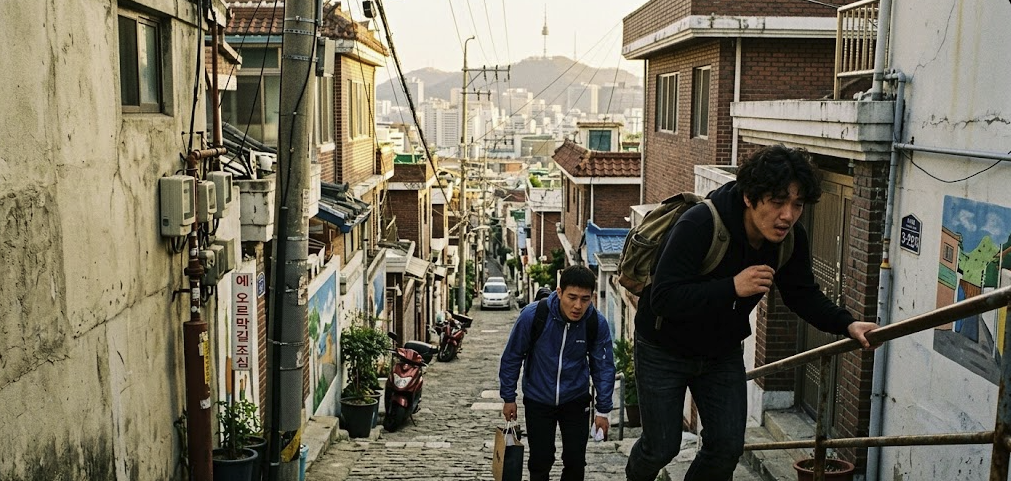
Itaewon is one of them. The central streets may feel lively and stylish, but the surrounding areas climb and fall quickly. If you walk toward Haebangchon, Noksapyeong, Hannam-dong, or down toward the river, you begin to feel the slope. Nightlife shoes may look good at the start of the evening, but they may not feel good by the end.
Namsan is another obvious example. Whether you are going toward N Seoul Tower, walking near Myeongdong, or exploring nearby hills, the mountain constantly shapes your route. Even when you are not climbing the mountain directly, you can feel its presence in the roads around it.
Bukchon and Samcheong-dong are beautiful, but they are not always gentle on your feet. The streets can slope, the paths can be uneven, and the area is best enjoyed slowly. This is not the place for painful new shoes.
Haebangchon and Gyeongnidan-gil have a similar issue. They are interesting, atmospheric, and full of small restaurants and bars, but the hills are real. A walk that sounds casual can become a workout.
Even Gangnam can be tiring in a different way. It may not feel as hilly as Itaewon or Namsan, but wide roads, huge blocks, underground passages, and long station transfers can create a different kind of fatigue.
COEX, Express Bus Terminal, Seoul Station, and large transfer stations also require serious walking. These are not mountain areas, but they can feel endless if you are wearing uncomfortable shoes or carrying luggage.
What Shoes Work Best for Seoul Travel?
For most visitors, the safest answer is simple: wear comfortable sneakers.
Not necessarily expensive running shoes. Not necessarily hiking shoes. Just shoes that you can wear for many hours without thinking about them.
Good Seoul travel shoes should have cushioning, stable soles, decent grip, and enough structure to handle stairs and long walking days. They should already be broken in before your trip. Seoul is not the place to test brand-new shoes on your first full day.
Light walking shoes also work well. If they are comfortable enough for a museum day, a subway transfer, a shopping street, and a night walk, they are probably good for Seoul.
Running shoes can be practical, especially if you care more about comfort than fashion. Seoul is stylish, but it is also practical. You will see many locals wearing sneakers with casual outfits, office looks, and weekend clothes. Sneakers do not look out of place here.
Water-resistant sneakers can be useful during rainy season, especially in summer. Seoul rain can be heavy, and wet socks can ruin a day faster than people expect.
In winter, choose shoes with warmth and grip. Seoul winters can be cold, and while heavy snow is not constant, icy patches and freezing ground can make slippery shoes a bad idea.
Shoes to Avoid for a Full Seoul Day
This does not mean you can never wear stylish shoes in Seoul.
You can. Many people do. Seoul is a fashion-conscious city, and in neighborhoods like Seongsu, Apgujeong, Hannam-dong, Gangnam, Hongdae, and Itaewon, you will see plenty of people wearing shoes chosen for style, not comfort.
But travel is different from local life.
Locals often know exactly where they are going, how far they will walk, when they will take a taxi, and which station exit is closest. Visitors often walk more by accident. They explore. They take wrong turns. They stand in lines. They wander through shops. They change plans.
For that reason, be careful with high heels, stiff dress shoes, thin sandals, cheap flat shoes, and brand-new sneakers. They may be fine for a short dinner or a café visit, but they are risky for a full day.
Summer sandals can be tempting because Korea gets hot and humid. But thin sandals with no support can become painful after hours of subway stairs and pavement. Flip-flops are especially weak for serious sightseeing.
Heavy boots can look good in photos, but in summer they can feel terrible. In winter, boots can work if they have grip and cushioning, but fashion boots with slippery soles can be dangerous on icy streets or wet station stairs.
The main rule is not “never wear stylish shoes.” The rule is: do not let your shoes control your day.
Seasonal Shoe Tips for Korea
Spring is one of the best walking seasons in Seoul. Comfortable sneakers are usually enough. The weather can change, and fine dust may make shoes dirty, but walking is generally pleasant.
Summer is more complicated. Heat, humidity, sudden rain, and long sightseeing days can make feet swell or sweat. Breathable sneakers or supportive sandals can work, but rainy days require grip. If you visit during monsoon season, avoid shoes that become slippery or take forever to dry.
Autumn is probably the easiest season for walking. The weather is cooler, the air often feels better, and many neighborhoods become more enjoyable on foot. This is the season when comfortable sneakers are almost perfect.
Winter needs more attention. Seoul can be dry and cold, with occasional snow or ice. You do not always need snow boots, but you do need shoes that keep your feet warm and stable. Thin canvas shoes may feel too cold, especially if you walk at night or spend time near the Han River.
What About Fashion?
This is a fair question because Seoul is stylish.
Some travelers worry that comfortable shoes will make them look too touristy. In reality, sneakers are very normal in Seoul. The important thing is choosing sneakers that feel clean, comfortable, and easy to match with your clothes.
Korean street style often mixes sneakers with wide pants, coats, skirts, denim, casual jackets, and even semi-formal outfits. You do not need to wear painful shoes just to fit in.
If you want a balance, bring one pair of comfortable walking sneakers and one pair of nicer shoes for dinners, bars, or special evenings. That is usually enough.
For Itaewon nightlife, Gangnam restaurants, hotel bars, or a nicer dinner in Hannam-dong, you may want something more polished. But even then, think about the route. If you need to walk uphill, stand in line, or take the subway home, comfort still matters.
A stylish shoe that makes you miserable after thirty minutes is not a good Seoul shoe.
Final Thoughts
Choosing what shoes to wear in Seoul is not just about style or packing space. It is about understanding the city.
Seoul is modern, efficient, and highly walkable, but it is also shaped by hills, mountains, deep subway stations, long transfers, uneven streets, and neighborhoods that rise and fall more than maps suggest. The city rewards walking, but it also tests your feet.
That is why the best Seoul travel shoes are not the most fashionable shoes in your suitcase. They are the shoes that let you keep saying yes.
Yes to one more café.
Yes to walking from Itaewon toward the Han River.
Yes to exploring Bukchon slowly.
Yes to taking the subway instead of giving up and going back to the hotel.
Yes to a night walk after dinner when Seoul suddenly feels too alive to leave.
For me, the shoe question became clearer while looking at Namsan and walking around Itaewon. Seoul often feels high, layered, and uneven because it is. The city is not flat, and once you understand that, many small travel choices make more sense.
Wear shoes that respect the city’s shape.
Your feet will understand Seoul before your map does.