Most travelers notice it somewhere around the third night.
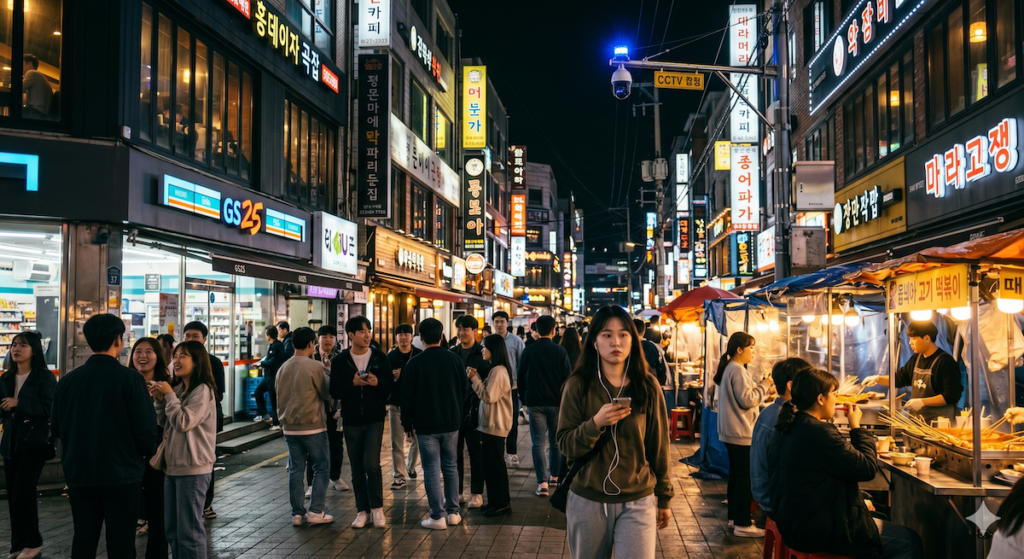
They are walking back from a restaurant in Hongdae at 1 AM. The streets are still full. Street food vendors are still open. Groups of people are laughing outside convenience stores. A woman is walking alone, earphones in, completely unbothered.
And the traveler realizes: they have not thought about safety once since arriving.
For people coming from cities where nighttime means locked doors and shorter routes, Seoul at night can feel almost disorienting in the opposite direction. Not dangerous. Just… unexpectedly alive. Unexpectedly calm.
Why Seoul feels so safe is a question many visitors ask — but few get a satisfying answer to. The usual responses are either too simple (“Korea has low crime!”) or too vague (“Koreans are just polite”).
Neither explanation is enough.
Because what actually makes Seoul feel safe at night is not one thing. It is a specific combination of infrastructure, culture, density, and collective behavior — working together in ways that most cities in the world do not replicate.
This guide breaks that combination down honestly. Including the parts that do not make it into tourism brochures.
Quick Answer: Why Does Seoul Feel So Safe at Night?
Seoul’s nighttime safety is the product of several overlapping factors: an exceptionally dense CCTV network, a 24-hour food and convenience culture that keeps streets populated through the night, high collective social awareness, well-lit public infrastructure, and a relatively low rate of violent street crime. However, “feels safe” and “is completely safe” are not the same thing. Seoul has its own risks — particularly around alcohol culture, targeted scams in tourist areas, and the specific vulnerabilities foreigners face that locals do not. Understanding both sides gives travelers a more accurate and more useful picture.
The First Thing You Notice: The Streets Never Empty
In many cities, there is a clear line between day and night.
Shops close. Streets empty. The social energy retreats indoors.
Seoul does not work this way.
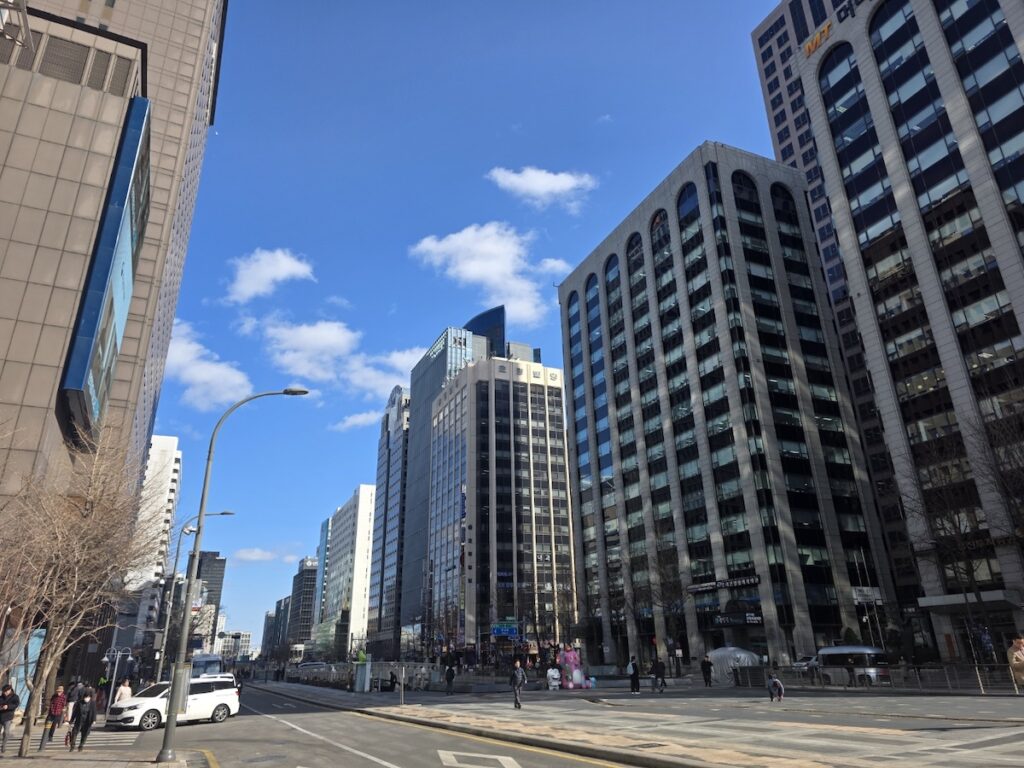
The city runs on a logic of continuous activity. Restaurants serve until 2 AM and sometimes beyond. Convenience stores — CU, GS25, 7-Eleven — are open around the clock on virtually every block, often with seating outside where people eat, drink, and talk at any hour. Street food carts in areas like Myeongdong, Hongdae, and Dongdaemun operate late into the night. The subway runs until around 1 AM, pushing a final wave of people through the streets before the night bus network takes over.
The result is a city where, even at midnight on a Tuesday, you are rarely the only person on the street.
This matters more than it sounds.
Urban safety research consistently shows that populated streets are safer streets. The presence of other people — what urban theorists call “eyes on the street” — creates informal surveillance. Potential bad actors are visible. Witnesses exist. The social cost of causing trouble in a crowded space is high.
Seoul’s 24-hour culture is not a safety policy. It is a commercial and cultural phenomenon. But its effect on nighttime safety is real and significant.
The CCTV Network: More Cameras Than Most Travelers Realize
Seoul has one of the densest CCTV networks of any city in the world.
As of 2026, the Seoul Metropolitan Government operates hundreds of thousands of cameras across the city — in subway stations, at major intersections, in residential alleyways, in parks, and along Han River paths. The number continues to grow annually. Many district offices run their own supplementary networks on top of the city-wide system.
For travelers, this creates a specific kind of psychological environment.
The cameras are visible. Not hidden. Many are mounted at eye level or slightly above, clearly marked, clearly present. Whether or not this consciously registers with people on the street, the density of visible surveillance infrastructure contributes to the sense that public space is monitored.
There is a legitimate debate about what this level of surveillance costs in terms of privacy. That debate is real and worth having. But from a pure street-safety perspective for travelers, the effect is measurable: Seoul’s public spaces are among the most comprehensively monitored in the world, and street crime rates reflect that.
Collective Awareness: The Cultural Component
This is the part that infrastructure alone cannot explain.
Seoul feels safe at night not just because of cameras and lighting. It feels safe because of how people behave in shared space.
Korean social culture places significant weight on collective awareness — the constant, low-level attention people pay to what is happening around them, and the instinct to not disrupt shared environments. This shows up in small ways: people move quickly through crowded areas, avoid blocking walkways, lower voices in quiet spaces, pay attention to who is nearby.
→ Related: Why Koreans Are So Quiet in Public — The social logic behind Korea’s collective awareness
This is connected to 눈치 (Nunchi) — the Korean concept of reading social atmosphere and adjusting behavior accordingly. A city where most people are quietly, constantly reading the room is a city where disruptions are noticed quickly and responded to.
It also means that genuinely threatening behavior in public space stands out sharply. Not because people will necessarily intervene directly — Korean culture tends to avoid public confrontation — but because it is noticed, documented, and reported. The combination of visible surveillance infrastructure and a socially aware population creates an environment where antisocial behavior has very little cover.
→ Related: Nunchi Culture in Seoul — The invisible social intelligence that shapes everything
The Convenience Store as Safety Infrastructure
This sounds like an overstatement. It is not.
The Korean convenience store — present on virtually every city block, staffed 24 hours, brightly lit, with seating inside and often outside — functions as a kind of informal community anchor point at night.
Think about what a convenience store provides in practice for a traveler in an unfamiliar city at 2 AM:
- A lit, staffed space to step into if something feels wrong
- A point of orientation (staff can help with directions, calls, basic communication)
- Other people — customers coming and going throughout the night
- Phone charging, food, water
- A reason to be on the street without looking out of place
In neighborhoods like Itaewon, Hongdae, Sinchon, and Insadong, convenience stores serve as informal gathering points where groups of people sit outside on low plastic stools for hours, talking and eating. These clusters of people, distributed across the neighborhood, mean that the streets around them feel inhabited rather than abandoned.
No city planner designed convenience stores to function as nighttime safety infrastructure. But in Seoul, that is partly what they do.
Late-Night Food Culture: Why the Streets Stay Full
Korea has a specific cultural relationship with late-night eating.
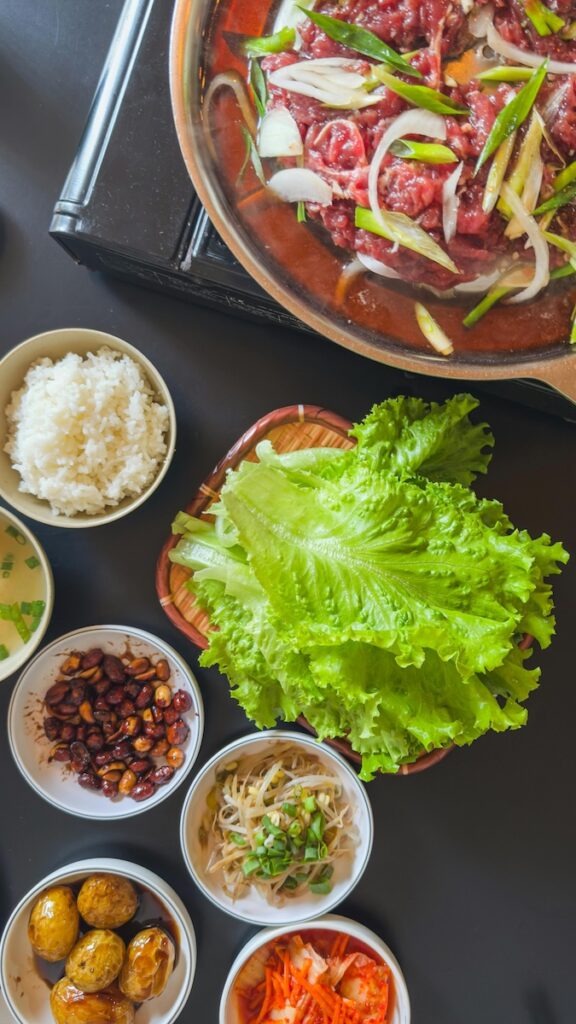
야식 (yasik) — late-night food — is not an afterthought in Korean culture. It is a category. Delivery apps list yasik as a filter. Certain foods (fried chicken, ramyeon, tteokbokki, jokbal) are culturally associated with being eaten late at night. After drinking, eating is expected. After working late, eating is expected.
The result: the streets in most Seoul neighborhoods do not empty when dinner service ends. They refill.
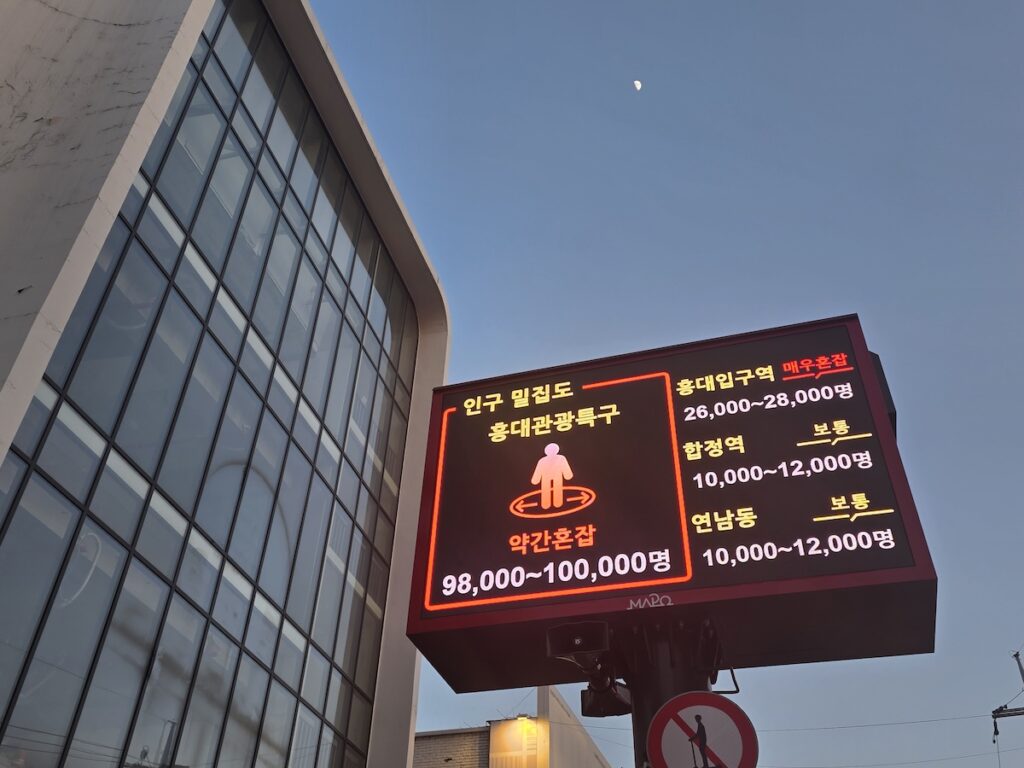
Between 10 PM and 1 AM on weekends, neighborhoods like Hongdae and Gangnam see continuous foot traffic — people moving between restaurants, convenience stores, pojangmacha (street food tents), and late-night cafés. The city’s rhythm does not have a curfew.
For travelers, this means that returning to accommodation late at night rarely means walking through empty streets. There are almost always other people around.
What the Numbers Actually Say
South Korea’s violent crime rate is among the lowest in the developed world.
Homicide rates consistently rank Korea near the bottom globally — comparable to Japan, Iceland, and Singapore, and significantly lower than most Western European countries. Street robbery is rare. Random violent attacks on tourists are genuinely uncommon.
This is not a tourism talking point. It is reflected in international crime indices, insurance risk assessments, and the experience reports of the millions of foreigners who visit or live in Seoul each year.
But numbers require context.
Low violent crime does not mean zero crime. And crime statistics tell you about averages — they do not tell you about the specific situations that create risk for specific types of travelers.
What Seoul Is Not: The Honest Part
Here is where most “Seoul is safe” content stops being useful.
Alcohol culture creates real situations.
Korea has a drinking culture that is genuinely intense by global standards. Soju is cheap, drinking is social, and late-night areas on weekends can become chaotic. The vast majority of this chaos is harmless. But alcohol-involved situations — arguments, accidents, disorientation — do happen, and travelers who are not used to navigating heavily intoxicated crowds in dense spaces can find it disorienting.
Tourist-area scams exist.
They are not aggressive or dangerous in the way travelers from some cities might expect. But overcharging in certain Itaewon bars, taxi drivers taking inefficient routes, and occasional targeting of visibly disoriented tourists does occur. The risk is financial rather than physical — but it is real.
Sexual harassment exists, particularly at night.
Korean society has made significant progress on this in recent years, and the legal and social consequences for harassment have increased. But female travelers — particularly those in heavy nightlife areas late at night — should be aware that this is not a zero-risk environment. The overall rate is lower than many comparable cities, but lower is not zero.
Foreigners face different risks than locals.
Locals know which areas to avoid, which situations to read, which social signals indicate trouble. Travelers do not have this contextual knowledge. This gap — not the crime rate itself — is the main source of risk for tourists in Seoul. Unfamiliarity is its own vulnerability.
The Han River requires attention.
Han River parks are popular at night — picnics, cycling, stargazing. They are also genuinely isolated in sections, poorly lit in areas away from the main facilities, and the site of a disproportionate number of accidents involving people who have been drinking. The river’s appearance of calm and safety can be misleading, particularly late at night.
The Neighborhood Difference
Seoul is not one environment. It is dozens.
The nighttime experience in Insadong (quiet, cultural, mostly closed by 11 PM) is completely different from Hongdae (loud, young, running until 5 AM on weekends) or Gangnam (polished, expensive, a different kind of late-night energy) or Itaewon (internationally mixed, historically more chaotic, in a period of significant change post-2022).
Travelers who read “Seoul is safe at night” and apply that uniformly to every neighborhood at every hour are working with an incomplete picture.
The general statement is true: Seoul is, by global standards, a remarkably safe city for nighttime travel. But within that general truth, specific neighborhoods at specific hours carry different risk profiles — and traveling with awareness of those differences is more useful than traveling with the blanket assumption that everywhere is the same.
Why Seoul Feels Safe vs. Why Seoul Is Safe: The Important Distinction
This is probably the most honest thing to say about this topic.
Feels safe and is safe overlap significantly in Seoul — more than in most cities. The infrastructure, the culture, the street activity, and the crime statistics all point in the same direction.
But “feels safe” is also partly a product of design.
Seoul is exceptionally well-lit. The streets are clean. The public transportation infrastructure communicates competence and order. The CCTV cameras are visible. Uniformed staff are present in subway stations around the clock. These design choices create a psychological environment that signals safety — and that signal is largely accurate.
Where travelers should pay attention is the gap between the signal and the reality. Seoul is not dangerous. But it is also not a consequence-free environment. The low base rate of serious crime can create a false sense that no caution is necessary.
The travelers who navigate Seoul most successfully at night are those who combine genuine relaxation — because the risk level genuinely is low — with the same basic awareness they would apply anywhere: knowing where they are, having a clear route home, not leaving drinks unattended, and trusting instincts when something feels off.
Practical Notes for Travelers
Getting home late: The subway closes around 1 AM. After that, night buses (marked with ‘N’) run on major routes. Kakao T is the most reliable app for taxis — always use metered, registered taxis and never unmarked vehicles.
Convenience stores as checkpoints: If something feels wrong, any convenience store is a legitimate place to step into, reorient, and figure out next steps. Staff are present, the space is lit, and other customers are usually around.
Han River at night: Go early in the evening rather than very late. The picnic culture is real and enjoyable. Just be aware of your surroundings in less-populated sections, especially if you’ve been drinking.
Nightlife neighborhoods: Hongdae and Itaewon are the most internationally familiar. Both are manageable with basic awareness. Avoid confrontations with heavily intoxicated people — not because violence is likely, but because unpredictability increases with intoxication.
Solo female travelers: Seoul is consistently ranked among the better cities globally for solo female travel. The risk is lower than most comparable urban environments. It is not zero. Late-night taxi rides are safer booked through apps (driver details recorded) than hailed randomly.
Final Thoughts
Why Seoul feels so safe at night comes down to something specific: it is a city that has invested heavily in the infrastructure of public safety, and it is inhabited by a culture that naturally produces behaviors — collective awareness, social consideration, quiet surveillance of shared space — that reinforce that infrastructure.
The cameras work because people also watch. The streets stay safe partly because they stay full. The low crime rate and the 24-hour food culture and the collective social awareness are not separate phenomena. They compound each other.
Seoul at night is genuinely one of the more remarkable urban experiences available to travelers right now. Walking home at 2 AM through lit streets, past open convenience stores, through neighborhoods that are still alive — it is a specific kind of freedom that many travelers have not experienced before, and it is real.
Just not unconditional.
The travelers who enjoy it most are the ones who experience it with accurate expectations: genuinely safe, thoughtfully designed, culturally fascinating — and still a real city, with real complexity, that rewards awareness over assumption.
Written by Marcus Park — Seoul local for over 10 years. Citygram Seoul provides deep-context guides for foreigners navigating Korean culture and daily life.