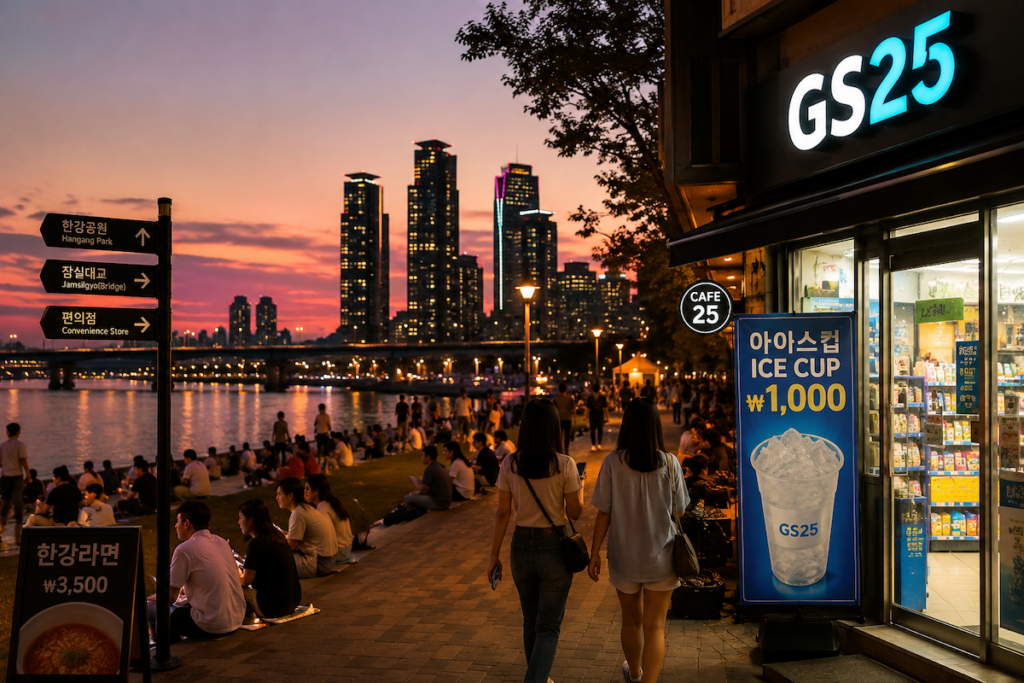
Best Korean souvenirs in Seoul — this is the search most foreigners make in a panic.
It happens to almost every foreigner on day four or five.
You are back at the hotel. Suitcase half-packed. Flight in 48 hours. And then — the realization.
I bought nothing.
Not for your parents. Not for the colleague who asked for “something Korean.” Not for your best friend who said “anything, I trust you.” You have been eating and walking and taking photos for a week and somehow the actual act of buying gifts completely slipped through.
So you think: Myeongdong. Safe. Fast. Done.
You walk in. You see the same Olive Young products available on your country’s online shopping sites. The same Innisfree. The same Sulwhasoo gift sets in the same white boxes. You buy three of them because you are tired and running out of time, and you spend twice what you needed to.
On the plane home, you already know.
These are not Korean gifts. These are global skincare brand gifts that happen to have been purchased in Korea.
There is a better option. Most foreigners walk past it on the way to Myeongdong without realizing what it is.

Quick Answer: Why Namdaemun Market for Souvenirs?
Namdaemun Market is Seoul’s oldest and largest traditional market, operating continuously for over 600 years. Unlike Myeongdong or Insadong, it functions primarily as a working market for Korean locals — which means the products inside reflect what Koreans actually buy, use, and give each other, rather than what a tourism board decided to package for foreign visitors. For souvenirs, this distinction matters enormously. The market carries high-quality Korean ginseng products, traditional teas, handcrafted goods, specialty foods, and items that carry genuine cultural weight — not because they were designed to look Korean, but because they are.
What Namdaemun Actually Is — And Why Most Foreigners Misread It
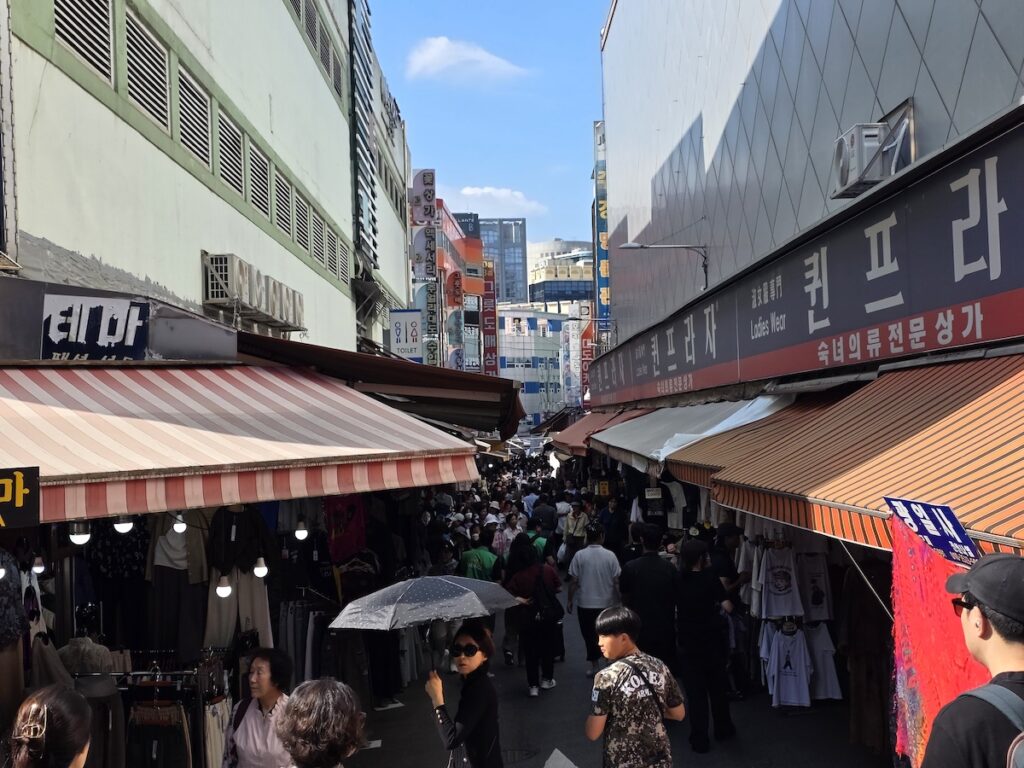
The first thing most foreigners experience when they enter Namdaemun Market is sensory overload followed by mild panic.
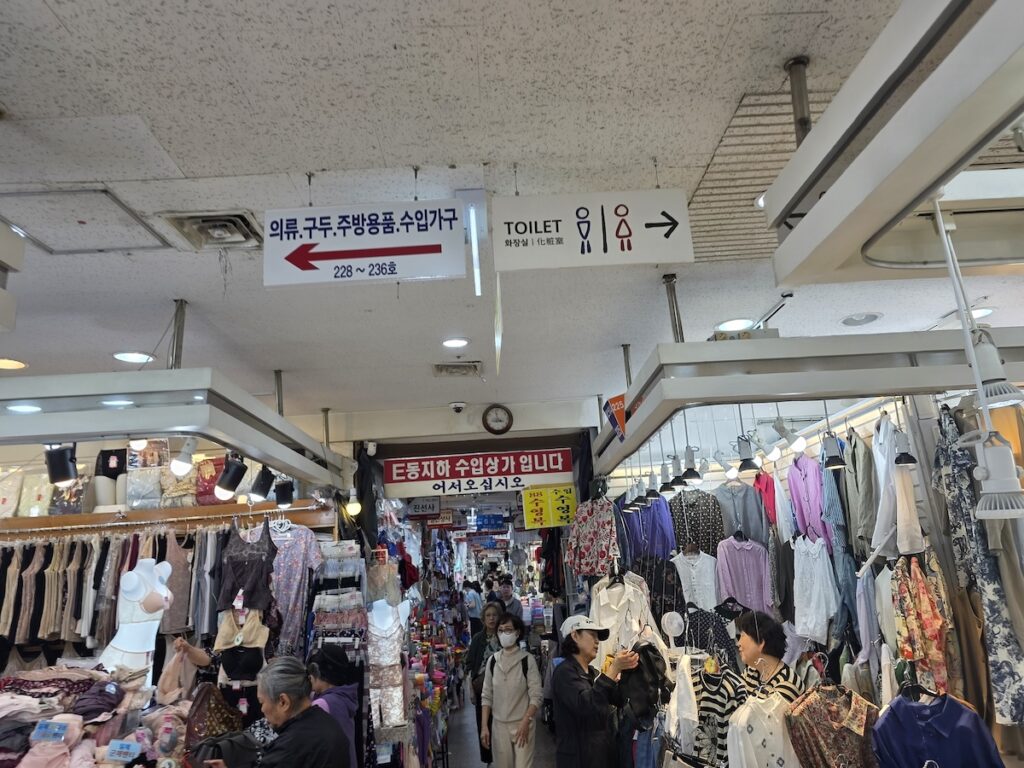
It does not look like a tourist destination. It looks like a city within a city — dense, loud, purposeful, operating on a logic that has nothing to do with making visitors comfortable. Vendors call out in Korean. Signs are in Korean. The alleyways branch in directions that seem to lead nowhere and then suddenly open into entirely new sections you did not know existed.
Most foreigners spend ten minutes, feel overwhelmed, and leave.
That is a mistake.
What looks like chaos is actually a highly organized ecosystem of specialized corridors. There is a section for clothing. A section for eyewear. A section for kitchen goods. A section for accessories. A section for traditional Korean products. And underneath everything — literally underneath, accessed by stairs that most visitors never notice — an entire underground shopping complex with its own economy and its own rules.
Namdaemun has two layers. Most tourists only see the top one.
The Underground Market — The Part Nobody Writes About
Take the stairs down.
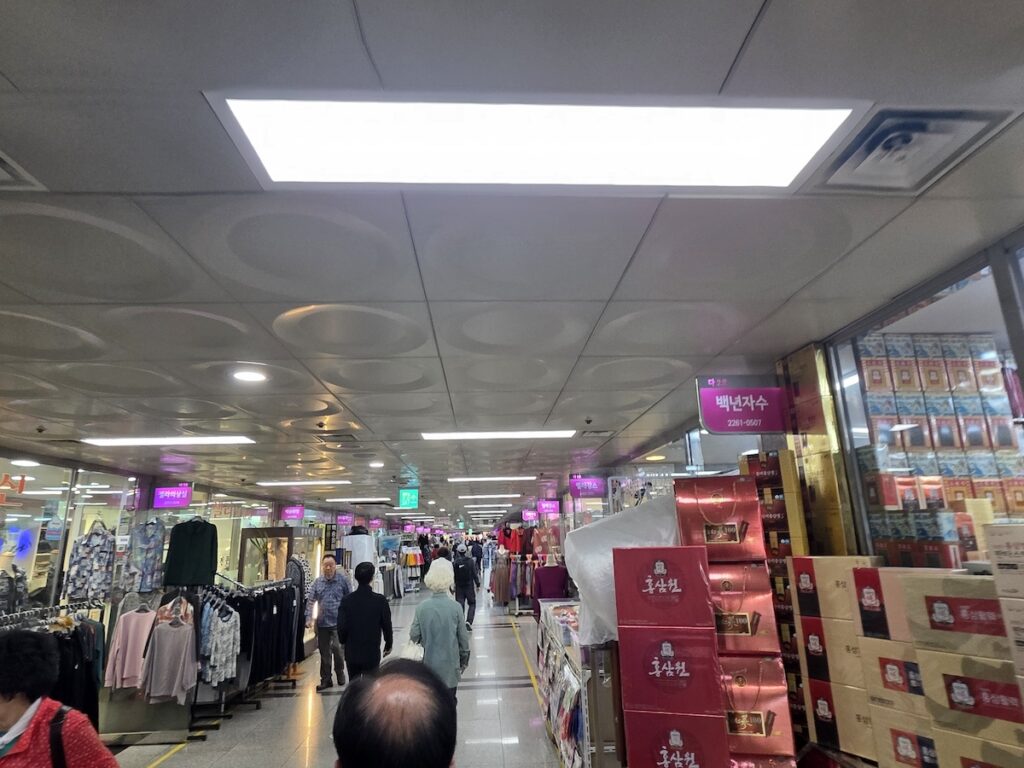
The underground shopping arcade beneath Namdaemun Market is a different environment entirely. Cooler. More organized. More permanent-feeling. The vendors here are not street stall operators — they are established shop owners who have run the same businesses in the same locations for years, in some cases decades.
The product mix shifts underground too. Less clothing chaos, more specialty goods. This is where you find concentrated sections of Korean traditional products — the kind of items that have actual cultural weight rather than just visual Korean-ness.
And then there is the sign.
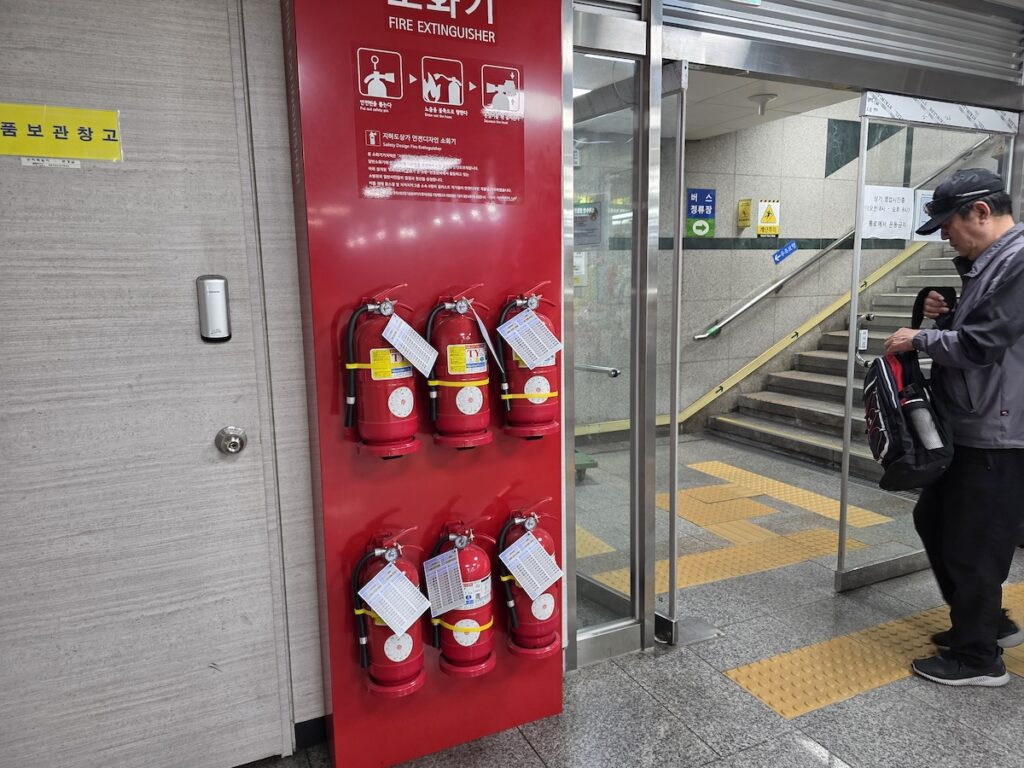
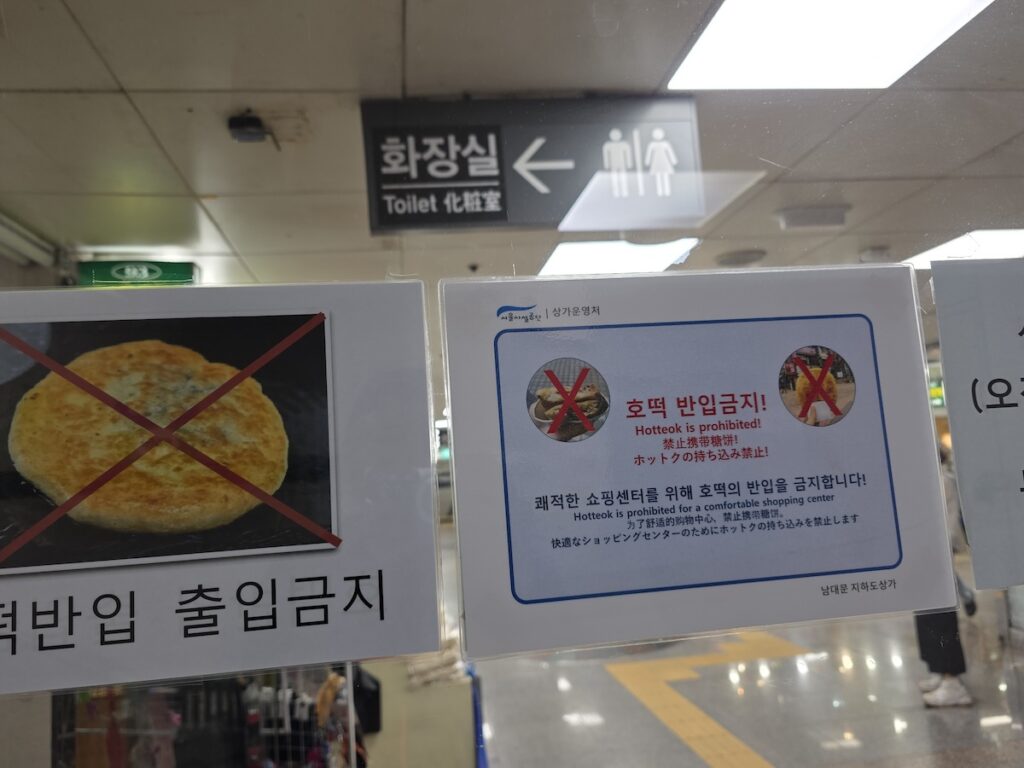
Posted at the entrance to the underground arcade, visible and unambiguous:
호떡 반입 금지 — No Hotteok Allowed.
The Hotteok Prohibition — And What It Actually Tells You
Above ground, Namdaemun’s hotteok is famous. The black sugar hotteok — a thick, chewy pancake filled with melted brown sugar syrup, pine nuts, and sesame — draws lines of visitors at the street stalls. Travel videos feature it. Instagram reels feature it. Every “things to eat in Seoul” list features it.
And then you go underground and there is a sign explicitly banning it.
The reason is practical and very Korean at the same time.
Hotteok contains melted brown sugar syrup that reaches extremely high temperatures inside the dough. When you bite into it, the syrup flows. When it flows onto a floor — especially a polished indoor floor — it creates a sticky, burning residue that is nearly impossible to clean completely. In an outdoor market environment, this is manageable. In an enclosed underground arcade where shop owners maintain their storefronts with the kind of care that comes from running a long-term business in a fixed location, it is a serious problem.
The sign is not about being unwelcoming.
It is about the fact that the underground market is a working space, not a performance of Korean culture for visitors. The vendors down there have businesses to run. The floors matter. The environment matters.
This is the most honest signal Namdaemun gives about what it is: a place where Koreans conduct real commerce, and where foreigners are welcome participants — not the primary audience.
Understanding that changes how you shop there.
The Bargaining Question — An Important Correction
Almost every foreigner arrives at Namdaemun expecting to bargain.
The reputation is decades old: Korean traditional markets, aggressive negotiation, prices starting high and coming down with enough persistence.
That version of Namdaemun largely no longer exists.
Korean traditional markets have shifted significantly toward fixed pricing over the past decade. The reasons are cultural as much as economic — many vendors find the bargaining dynamic uncomfortable, even disrespectful. The assumption that prices are inflated and designed to be negotiated implies that the vendor is not operating honestly. For shopkeepers who take genuine pride in their products and their pricing, that assumption stings.
At Namdaemun in 2026, most vendors operate on fixed prices. Attempting to bargain — especially in the way that some travel guides still recommend — will often produce visible discomfort rather than a discount.
What has not disappeared is something more interesting: 덤 (deom).
Deom is the Korean tradition of giving something extra — a small addition to a purchase, offered voluntarily by the vendor as a gesture of goodwill. You buy a box of ginseng tea and the vendor adds a small sample packet you did not ask for. You buy a bundle of dried seaweed and a few extra sheets appear on top of the wrapped package.
Deom is not bargaining. It cannot be requested or negotiated. It is offered — or it is not — based entirely on the vendor’s judgment and mood.
For foreigners, understanding this distinction matters practically. Do not try to bargain. Do accept deom graciously when it appears. The two behaviors communicate completely different things about how you see the transaction.
What to Actually Buy — The Real Souvenir List
This is the section most guides get wrong by being too generic. Here is what is actually worth buying at Namdaemun for gifts that will mean something.
Korean Ginseng Products
Namdaemun has a concentrated section of ginseng vendors — whole roots, extract products, red ginseng tea, ginseng candy, and processed health supplements. This is one of the few places in Seoul where you can find genuine, high-quality Korean ginseng products at reasonable prices without the markup of airport duty-free or the uncertainty of online purchases.
For gift purposes: red ginseng tea boxes are practical, well-packaged, and carry real cultural weight. They communicate that you paid attention to where you were, not just that you grabbed something from a checkout counter.
Dried Seaweed — The Underrated Gift
Korean dried seaweed (gim) is a genuinely excellent souvenir that almost nobody thinks of. It is lightweight, carries easily, has a long shelf life, and is a product that Korea does exceptionally well — the quality difference between Korean gim and the versions available in most countries is significant and immediately noticeable.
Namdaemun carries varieties that do not appear in supermarkets — sesame oil-roasted versions, traditionally processed versions, specialty regional styles.
Buy more than you think you need. It disappears faster than people expect once you get home.
Korean Traditional Teas
Barley tea, roasted corn tea, chrysanthemum tea, citron honey tea (yujacha) — the traditional Korean tea section at Namdaemun stocks varieties that are difficult to find outside of Korea and easy to appreciate without any special preparation. These make gifts that feel considered rather than impulse-bought.
The Sock Question
Yes, the Korean sock reputation is real. Namdaemun carries character socks, pattern socks, and novelty socks in quantities and variety that genuinely do not exist in most other markets. They are inexpensive, lightweight, and universally received well.
The key is buying them here rather than in Myeongdong, where the same socks cost significantly more because the retail environment is optimized for tourists rather than locals.
The Currency Exchange Advantage
One practical note that most Namdaemun guides omit entirely:
The area around Namdaemun Market has one of the highest concentrations of currency exchange offices in Seoul. Multiple licensed exchange booths operate in close proximity, which creates competitive rates — often meaningfully better than the rates available at Myeongdong or near major tourist hotels.
If you are going to Namdaemun anyway, this is worth factoring into your trip. Handle your remaining currency exchange here rather than at the airport or at the hotel desk, where rates are consistently worse.
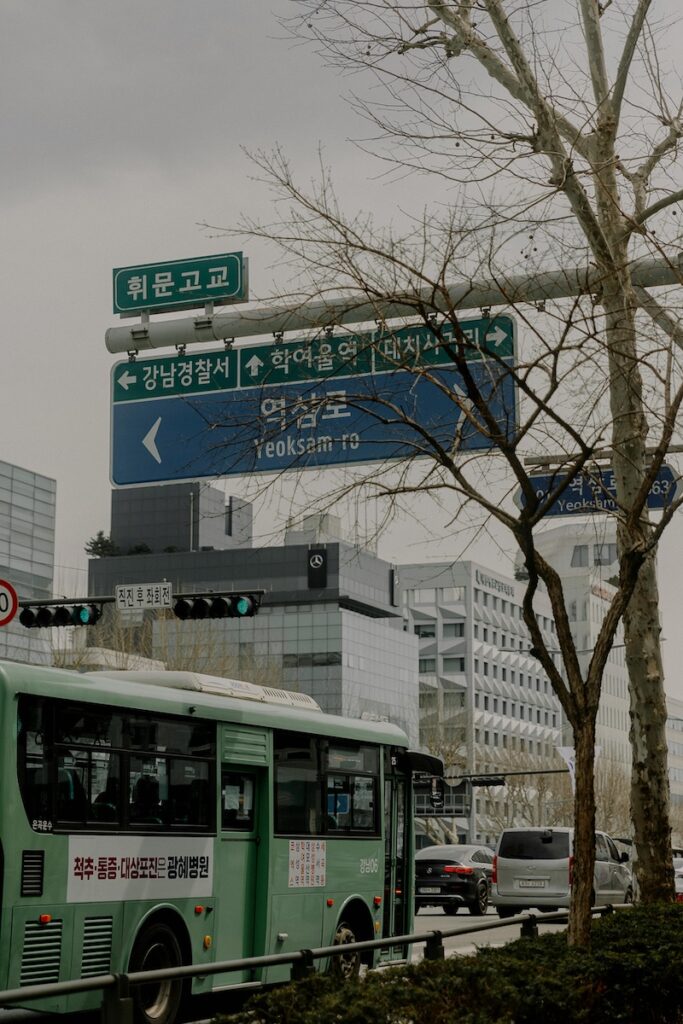
Getting to Namdaemun: Why You Probably Don’t Need the Subway
Most travel guides send everyone to Hoehyeon Station (회현역), Line 4, Exit 5.
That is correct. It works. And it is also slightly missing the point.
Namdaemun Market sits in the geographic center of Seoul’s most visited district. The stations around it form a tight circle — and more importantly, if you are already in Myeongdong, you are already close enough to walk. Which is exactly what we recommend.
The Walking Option — Better Than It Sounds
From Myeongdong: 8 to 10 minutes on foot. Walk toward Sungnyemun Gate (숭례문) — the large stone gate visible from the main Myeongdong shopping strip — and the market entrance appears just beyond it. This is the most natural approach and the one that gives you the best first impression of the market’s scale.
This matters for the framing of the whole visit. You walk out of Myeongdong having looked at the same global skincare brands available in your home country. You turn a corner. And Namdaemun is right there.
That contrast — felt physically, on foot — is part of the point.
If You Are Taking the Subway
Hoehyeon Station (회현역) — Line 4, Exit 5 The standard approach. Exit 5 puts you directly at the market entrance. Straightforward, no navigation required.
Seoul Station (서울역) — Lines 1 and 4, Exit 5 A ten-minute walk through the area around Sungnyemun Gate. Good option if you are coming from Itaewon, Yongsan, or the airport rail link.
City Hall Station (시청역) — Lines 1 and 2, Exit 4 Slightly longer walk — about 12 minutes — but useful if you are coming from Gwanghwamun, Gyeongbokgung, or the northern part of the city center.
Euljiro 1-ga Station — A Note for Foreign Visitors
This one requires a small explanation.
On Korean subway maps and signage, the station is listed as 을지로입구역 (Euljiro Ipgu, meaning “Euljiro Entrance”). In English, it appears on most apps and maps as Euljiro 1-ga — which is the name of the surrounding neighborhood, not a direct translation of the station name.
For foreign visitors navigating by English, this creates genuine confusion. If you search “Euljiro 1-ga Station” and “Euljiro Ipgu Station” you will get the same place — but the names look completely different, and it is not obvious that they refer to the same stop.
From this station, Namdaemun is approximately a 12-minute walk south. Not the closest option, but relevant if you are already in the Euljiro or Dongdaemun area.
The Recommended Approach — Honest Advice
If your itinerary already includes Myeongdong: walk. Skip the subway entirely. The distance does not justify a fare, and the walk along Sungnyemun gives you context for where Namdaemun sits in the city — right at the edge of where modern tourist Seoul ends and working local Seoul begins.
If you are coming specifically for Namdaemun: Hoehyeon Station Exit 5. Direct, fast, no decisions required.
| Starting Point | Best Option | Approx. Time |
|---|---|---|
| Myeongdong | Walk via Sungnyemun Gate | 8–10 min |
| Seoul Station | Walk Exit 5 | 10 min |
| City Hall Station | Walk Exit 4 | 12 min |
| Euljiro 1-ga Station | Walk south | 12 min |
| Hoehyeon Station | Exit 5, direct | 2 min |
The Honest Assessment
Namdaemun Market is not for everyone.
If you want air conditioning, English signage, and the ability to pay by card everywhere, Myeongdong or a department store will serve you better.
If you want the version of Seoul that existed before the tourism industry organized everything for maximum comfort — the version that is still operating as a living, working part of the city rather than a curated experience of one — Namdaemun is one of the last places in central Seoul where that version is still intact.
The souvenirs you bring home from here will not look like the ones from the airport duty-free. They will not come in matching gift boxes with English labels.
They will smell like Korea. They will require a sentence of explanation when you hand them over. And the person receiving them will remember that you went somewhere specific and brought something back that you could not have found anywhere else.
That is what a souvenir is supposed to be.
One Last Thing — A Story About a Hanbok and an Australian Friend
Years ago, before Namdaemun became a travel content topic, I bought a hanbok here for a friend in Australia.
Not an expensive one. Not the kind displayed in glass cases in Insadong boutiques with price tags that make you pause. A simple, affordable hanbok — the kind that a vendor in the market wraps in plastic without ceremony and hands over in a paper bag.
My friend loved it.
Not because it was luxurious. Because it was real. Because it smelled like the market. Because when she held it up and showed people, the story behind it was “my friend went to this enormous traditional market in Seoul and found this” — not “my friend bought this at a curated gift shop near the tourist district.”
That gap — between a gift that tells a story and a gift that tells you where the airport duty-free was — is the whole point of going to Namdaemun.
The best souvenirs are not the most expensive ones. They are the ones that require a sentence of explanation. The ginseng tea that your colleague has never seen before. The seaweed that tastes nothing like the version back home. The socks with a pattern that does not exist in your country. The hanbok that arrived in a paper bag from a vendor who threw in an extra item without being asked.
There is a specific pleasure in giving someone a gift from the largest, loudest, most chaotic local market in the center of a city — and watching them understand, immediately, that you went somewhere real.
Namdaemun is that place.
It has been for 600 years.
It will be long after the airport duty-free has been renovated and rebranded several more times.
Go before you fly home. Walk there from Myeongdong if you can. Go underground. Find the ginseng section. Accept the deom when it comes.
And bring a paper bag.