Introduction: Where the City Grows Silent
Seoul after dark is rarely quiet.
Neon lights hum across the skyline, billboards flicker, and delivery scooters slice through alleys like fireflies on caffeine.
It’s a city famous for its sleepless rhythm — for night markets, K-pop districts, and streets that never rest.
But the Han River, that long silver vein cutting through the heart of Seoul, moves to another rhythm entirely.
Especially when you start walking from Misa-dong in Hanam, just beyond Seoul’s official border, where the city begins to soften and breathe.
Here, there are no crowds.
No convenience stores selling late-night ramen, no picnic tents, no river cruises packed with music and neon light.
Only the soft orange glow of streetlights along the Han River path, stretching endlessly like a thread of calm.
The hum of Seoul fades behind you,
replaced by the steady whisper of the Olympic-daero highway,
its flow of headlights mirroring the current of the river beside it.
You begin to realize that this walk — this Han River night walk — isn’t about distance or direction.
It’s a quiet meditation between the city and yourself.
A slow, mindful journey through one of the safest cities in the world,
where even at midnight, you can walk freely beneath the open sky.
Each step draws you deeper into a Seoul few travelers ever see —
not the vibrant, crowded capital of K-dramas and street food,
but a quieter Seoul: a Seoul that listens, that exhales,
and that invites you to do the same.
It’s not a journey of distance, but of perspective.
A walk where Seoul stops performing — and simply breathes.
The Path Begins: Misa’s Open Sky
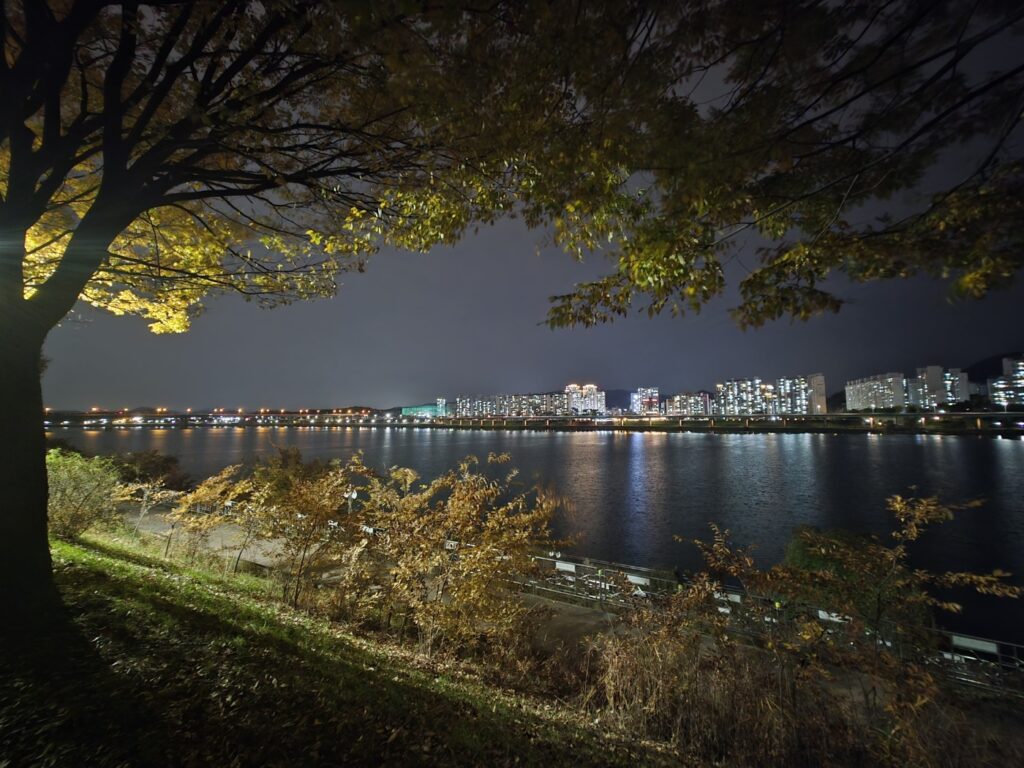
At Misa, the sky feels wider — like a canvas that the city forgot to paint.
The Han River flows quietly to your left, its surface rippling with reflections of faint streetlights that stretch into the distance.
There’s a softness in the air here, a sense that the city is close enough to feel, but far enough to forget.
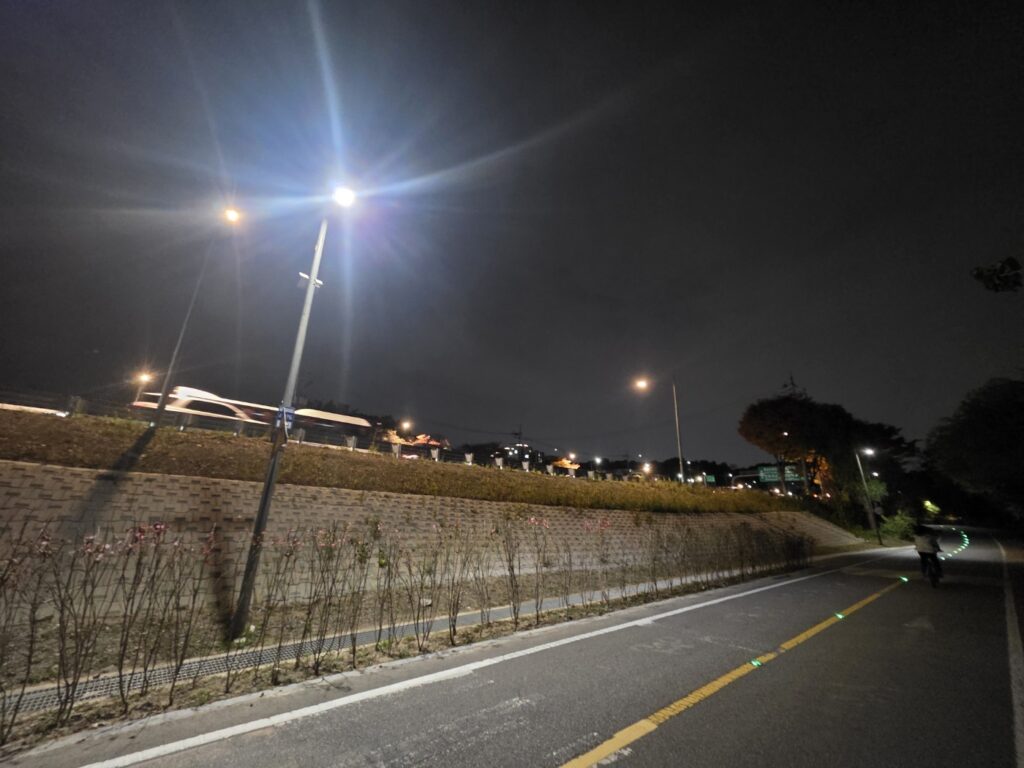
To your right, the hum of the Olympic-daero highway is constant but comforting —
a reminder that even as you step away from Seoul’s center, the pulse of the city moves beside you.
Each car’s headlights flicker briefly across the water before fading into the night,
like small comets tracing the rhythm of a living, breathing metropolis.
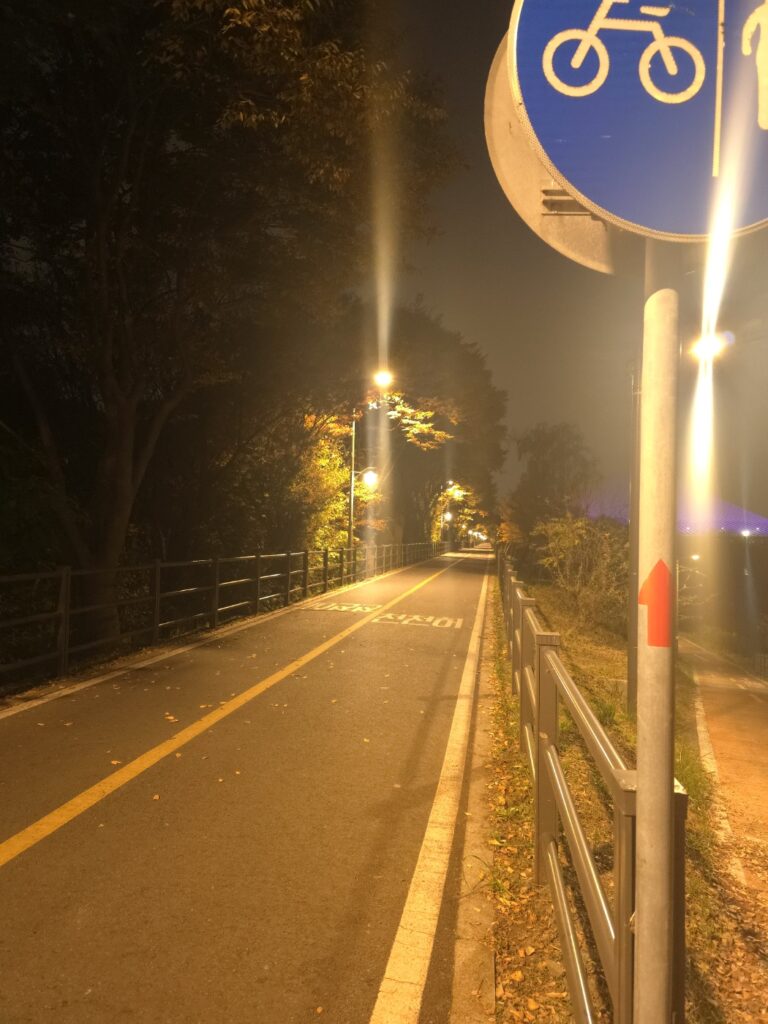
The walking path is smooth and clean, wide enough for cyclists, joggers, and late-night wanderers like yourself.
It’s well-lit, with tall lamps casting gentle amber halos on the asphalt.
Even when no one’s around, the light feels warm, almost watchful —
as if Seoul’s quiet efficiency extends even into its solitude.
A few people share this moment with you, though from a distance.
An elderly man walks ahead, his hands clasped neatly behind his back,
his pace slow and deliberate, like someone counting memories.
A woman jogs past, her earphones glowing faintly,
her ponytail swaying like a metronome keeping time with the soft thud of her sneakers.
Their presence doesn’t disturb the quiet; it deepens it.
It reminds you that solitude in Seoul isn’t about being alone —
it’s about feeling at peace among strangers.
Even at 10 p.m., the air feels safe and alive.
The path curves slightly, following the bend of the river.
You can hear the faint rustle of reeds swaying near the water,
the gentle hum of distant streetlights,
and the rhythmic splash of a night fisherman casting his line under a bridge.
In most cities, walking alone at night feels like a risk —
something cautious, something you plan around.
But here, it feels like a quiet kind of meditation.
The Han River night walk doesn’t ask for courage; it rewards curiosity.
Every step becomes a breath, every breath a reminder:
“You’re safe. You belong. Keep going.”
You notice how the air smells cleaner here, tinged with grass and cool metal from the river railings.
A breeze brushes past, carrying a faint echo of the city’s music —
not K-pop or traffic, but something more human:
the whisper of movement, the sigh of water, the steady heartbeat of Seoul after dark.
Somewhere ahead, the faint outline of a bridge shimmers through the haze.
It’s not a famous landmark — no crowds, no cameras —
but in this moment, it feels monumental.
Because here, under the open sky of Misa,
you realize that the quiet side of Seoul isn’t a hidden secret.
It’s been waiting all along — between the river and the road,
between stillness and sound.
And as you keep walking toward the city,
you’re no longer just observing Seoul —
you’re moving with it, step by step,
like two parallel rivers flowing toward something infinite.
The Light of the City, Seen from the Outside
As you move closer to Seoul, the city begins to reappear —
not suddenly, but gradually, like a constellation rebuilding itself one star at a time.
One building flickers on across the river, then another,
until the distant skyline of Gwangjin-gu glows faintly through the mist.
The reflection on the Han River shivers with motion,
each ripple carrying a piece of light, bending it, softening it.
To your right, the Olympic-daero highway keeps pace with you.
Its endless stream of headlights draws a glowing ribbon beside the river,
a bright river of its own — faster, louder, more human.
The contrast is mesmerizing: one river made of water,
the other made of motion,
and between them, you — a quiet traveler moving in neither,
but belonging to both.
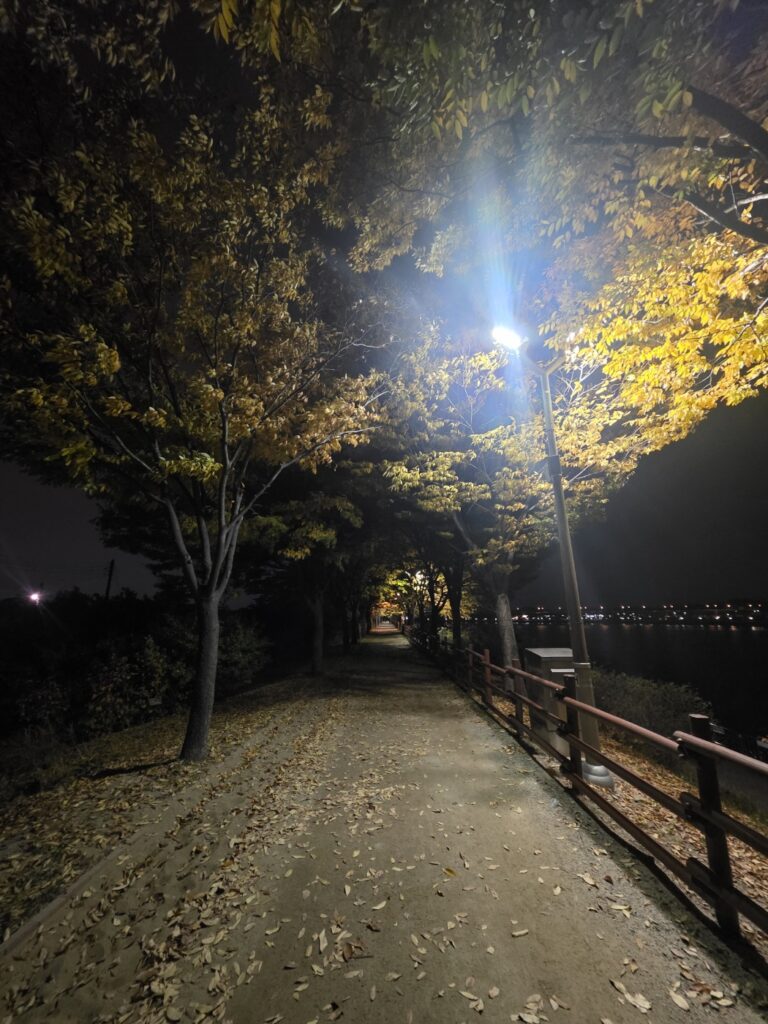
Streetlamps along the path cast long arcs of gold across the pavement.
Every few hundred meters, a blue emergency light blinks softly,
a quiet assurance of the safety and security that defines this city.
Even late at night, Seoul feels carefully lit —
not just illuminated, but watched over.
It’s the kind of detail you only notice when you walk,
when you let the rhythm of your steps sync with the steady hum of the infrastructure.
Above you, bridges rise like gateways —
iron giants stretching from darkness to light.
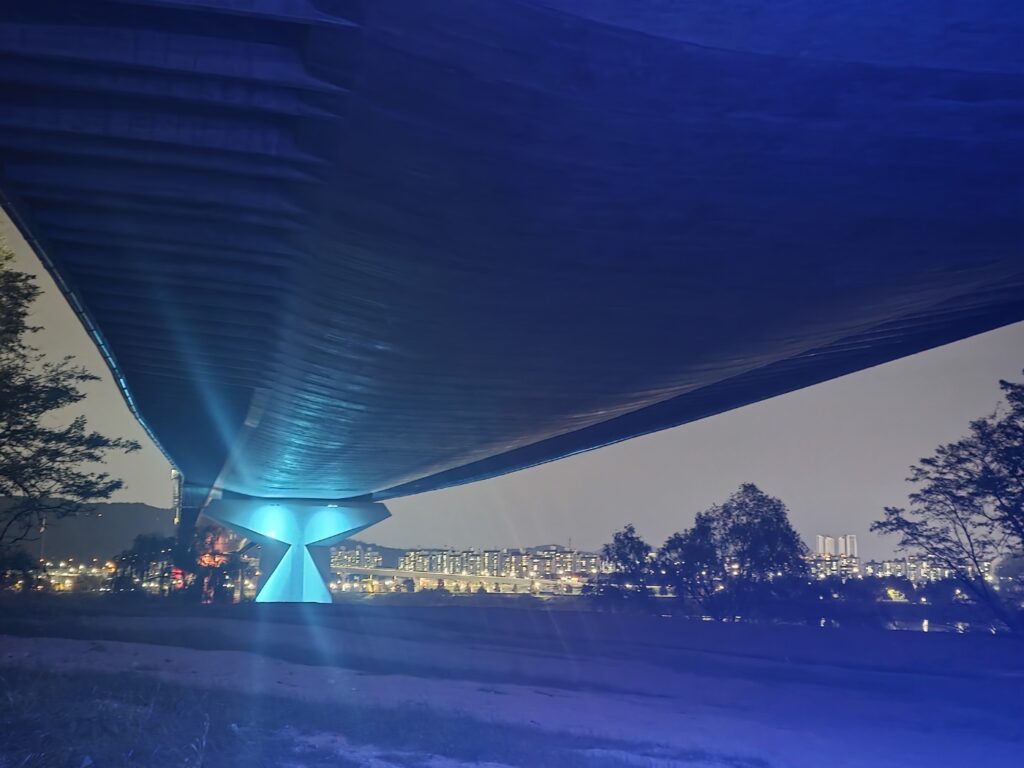
Cheonho Bridge, painted in faint steel blue,
spans the night like a promise kept between the riverbanks.
You stop beneath it, and for a moment the sound of rushing cars
blends with the quiet splash of water against concrete.
The pillars stand tall and patient, their reflections trembling in the dark surface below.
You lift your camera not for beauty,
but to remember this feeling —
the strange comfort of Seoul’s night lights reflected in black water.
There are no tourists here, no laughter, no picnic mats.
Only the whisper of the Han River breeze,
the rhythm of the city breathing through its veins of metal and asphalt.
Even here, beneath the highway,
the lighting is thoughtful — neither harsh nor dim.
It feels intentional, as if someone wanted even the forgotten corners of the city
to glow gently for whoever wandered this far.
Under the Bridges: The Architecture of Calm
There’s something deeply poetic about walking beneath a bridge at midnight —
especially along the Han River in Seoul, where every bridge feels like a character in the city’s story.
You hear your footsteps echo beneath the arches,
a steady reminder that even when Seoul sleeps, its architecture stays awake.
Each bridge has its own mood, its own pulse.
Cheonho Bridge glows in pale blue,
Gwangjin Bridge hums softly in amber,
and farther west, the Jamsil Railway Bridge vibrates faintly with the rhythm of passing trains.
Each carries its own kind of song —
urban lullabies for night walkers and insomniacs,
for those who find peace in the hum of the unseen.
The air here smells different — a mix of river mist and warm asphalt.
You pause under the bridge,
listening to the faint vibration of the road above you.
The sound isn’t noise; it’s presence.
It tells you that Seoul never truly stops — it simply slows its heartbeat at night.
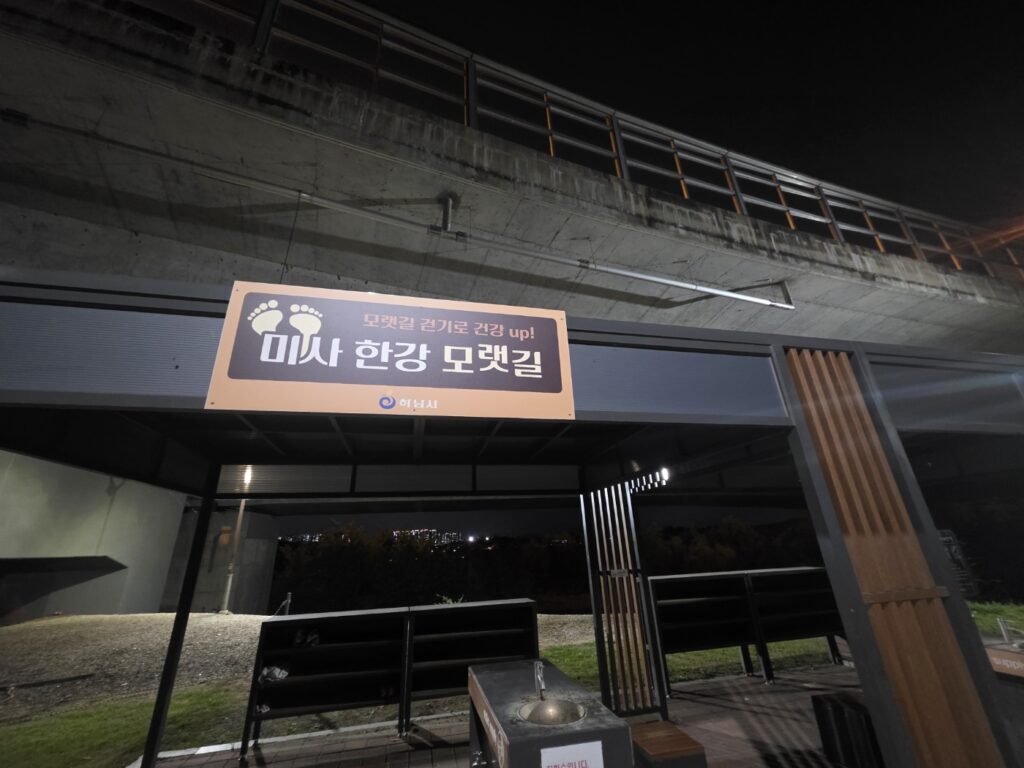
You look up, tracing the patterns of the beams illuminated by LED floodlights,
designed not just for visibility but for safety.
Every few steps, another light hums quietly to life,
revealing signs that read “Seoul Public Walkway – Han River Trail.”
It’s a simple but comforting reminder:
this is not a place you have to fear.
It’s a place designed for people — for everyone —
to walk, to think, and to feel safe, even after midnight.
You take a photo — not because it’s beautiful,
but because it feels like a secret you’ve stumbled upon.
A hidden perspective of Seoul’s architecture,
where utility meets poetry, and structure becomes serenity.
And as you keep walking,
the bridges fade behind you one by one —
each leaving a distinct echo in your memory:
the blue light of Cheonho, the soft orange of Gwangjin,
the rhythmic hum of traffic moving overhead like rain.
You realize that the Han River night walk isn’t only about nature or quiet.
It’s about learning to see the soul of a city through its silence.
Safety and Stillness: The Seoul You Didn’t Expect
This is perhaps the most surprising part for most foreigners.
It’s close to midnight, and yet the Han River Park feels quietly alive —
not busy, not loud, but human.
Old couples stroll side by side, their conversation soft and unhurried.
A group of cyclists passes by in a rhythmic flow,
their LED bike lights blinking like distant stars in motion.
A woman walks her dog alone,
her path illuminated by rows of evenly spaced street lamps that cast a warm, amber light.
She doesn’t look over her shoulder; she doesn’t need to.
The calm confidence in her pace tells the story of a safe city —
a Seoul that protects even its quietest corners.
There’s safety here — but not the kind you find in fences, patrol cars, or warnings.
It’s something subtler, something social —
a collective rhythm built on trust, design, and routine.
The Han River night path is never abandoned; it’s simply at rest.
Seoul’s night isn’t silent because it’s empty;
it’s silent because it’s safe enough to rest.
You notice small details that make this possible —
the steady glow of blue emergency posts every few hundred meters,
security cameras tucked into lampposts,
and call boxes marked in both Korean and English,
each one proof of how carefully this city tends to its people.
The walking trail feels designed for presence,
not surveillance — for peace, not paranoia.
A gentle wind brushes your cheek, carrying the scent of cool water mixed with steel and grass.
It’s the smell of a metropolis that cleans itself each night —
a quiet choreography of nature and technology.
Across the river, clusters of apartments twinkle,
their reflections rippling like living constellations on the Han River’s surface.
Each light holds a story — someone eating late, studying, watching a drama,
living their own version of Seoul’s night.
And you, walking here, are part of that constellation too —
a moving point of light in the larger calm.
The Wind Between City and River
The farther you walk, the cooler the air becomes.
The Han River breeze thickens with moisture,
its rhythm mingling with the hum of distant traffic from Olympic-daero.
You hear the faint whoosh of cars — constant, reassuring,
a heartbeat reminding you that life continues even when you slow down.
The streetlights create long golden lines on the pavement,
guiding your steps like a quiet compass.
You pass by resting benches, vending machines glowing faintly in the dark,
and the occasional jogger whose breath steams like smoke in the cold air.
Even here, miles from downtown, the path feels deliberate —
smooth, even, wide enough to share.
It’s Seoul’s way of saying: you belong here, even at midnight.
As you continue, the outline of Amsa Bridge begins to emerge in the distance.
Its white structure gleams softly against the night sky,
marking the eastern gateway of Seoul —
a threshold between the quiet outskirts and the pulse of the inner city.
For locals, Amsa might be just another bridge;
for you, it feels like a conclusion —
the symbolic point where reflection meets motion again.
The wind grows cooler now, brushing through reeds and metal railings,
carrying whispers of traffic, water, and time.
It’s the kind of wind that doesn’t rush you,
but invites you to stay a little longer,
to feel the stillness settle in your chest.
Arriving at Amsa: Expansion
When you finally reach Amsa,
you stop and turn back — not to check the distance,
but to see how far your thoughts have traveled.
The city you left behind in Misa now feels like another version of Seoul entirely.
This walk wasn’t about covering ground;
it was about expanding what “Seoul” means to you.
Most visitors know Seoul through its busiest hours —
through Namdaemun Market, Gangnam’s nightlife, and Myeongdong’s neon streets.
They see a Seoul that’s bright, efficient, unstoppable.
But this quiet walk between the Han River and Olympic-daero
reveals another truth:
that Seoul isn’t just alive — it’s aware.
Here, the city listens.
It watches gently without demanding attention.
It offers you space to breathe, to think,
to let the week dissolve in the soft wind of the river.
Every rustle of leaves, every distant car,
every ripple of light on the water feels like the city whispering:
You’ve done enough. Rest now.
You sit on a bench facing the river,
the glow of Amsa Bridge spreading across the surface like silk.
Somewhere behind you, the highway murmurs,
its sound steady, protective —
a reminder that Seoul is both near and far, fast and still.
In that moment, you understand something deeper:
that Seoul doesn’t only exist in movement.
It exists in pause.
It exists in the in-between, where the city meets the river,
where strangers share silence without fear.
And in that stillness,
you stop being a visitor.
You start becoming a part of Seoul —
not as a spectator,
but as someone who has walked its quiet edges,
felt its wind, trusted its night,
and claimed its calm as your own.
Conclusion: The Sound of a Quiet City
Seoul is often described as restless —
a city of neon, noise, and endless rhythm.
But perhaps that’s only because so few ever stop long enough
to listen to it breathe.
On this quiet walk along the Han River,
from Misa’s calm outskirts to Amsa’s soft city glow,
you begin to hear another side of Seoul —
a tempo that exists beneath the pulse,
like a gentle bassline under a fast song.
The night here has its own soundtrack.
It’s not loud or composed, but layered:
the low hum of distant cars on Olympic-daero,
the faint rustle of wind in the reeds,
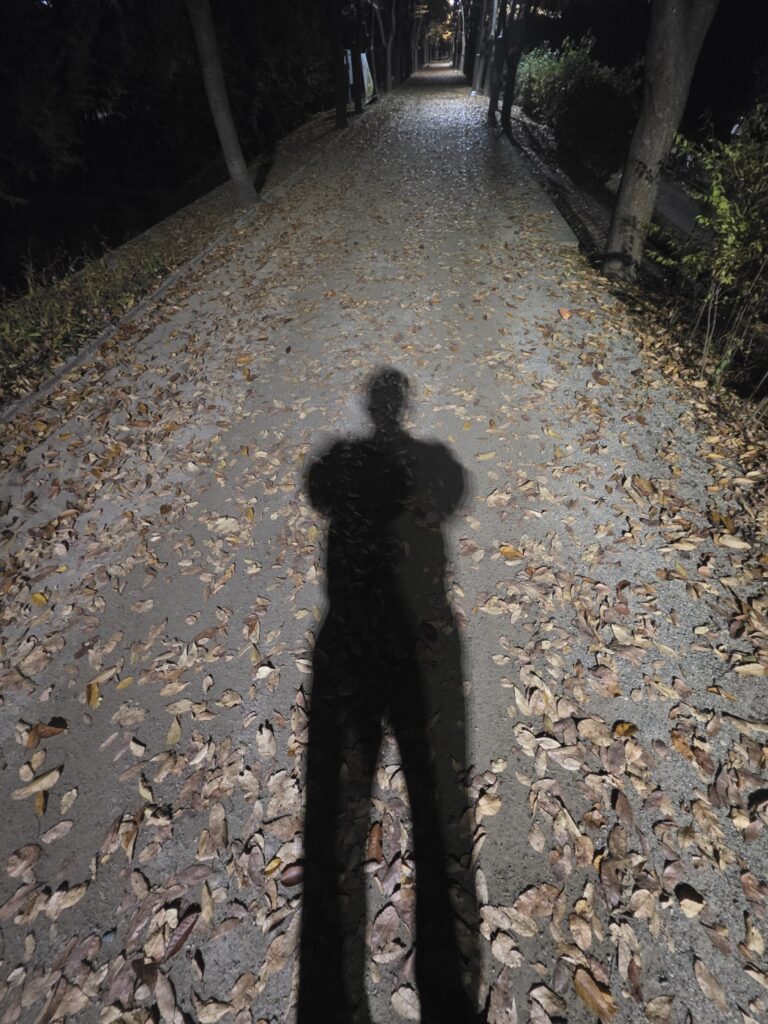
the soft shuffle of sneakers on clean pavement,
and the rhythmic blink of bicycle lights moving past like scattered notes.
If you were to choose music for this moment,
it wouldn’t be pop or club beats.
It might be Debussy’s “Clair de Lune”,
drifting across the river like mist,
or perhaps something Korean —
a quiet gayageum piece that feels like moonlight touching water.
There’s a harmony in this stillness,
a melody only the patient can hear.
The Han River at night is like a symphony stripped bare —
no chorus, no crescendo, only breath.
Each bridge hums a different tone:
Cheonho’s soft mechanical whir,
Gwangjin’s amber vibration,
Amsa’s gentle resonance as cars glide overhead.
Together, they form a subtle orchestra,
one that performs for no audience but you.
And if this walk had a painting,
it might look like something from Edward Hopper —
solitary figures, wide skies, light spilling softly over concrete.
Or maybe like Monet’s twilight over the Thames,
where city and water merge in reflection.
The Han River holds that same duality:
urban yet organic, distant yet intimate.
It’s a landscape of silence painted in light.
You don’t need a crowd, or ramen, or music to feel Seoul’s rhythm.
All you need are the streetlights,
the whisper of water against the embankment,
and the courage to walk alone in peace.
Because the city’s beauty doesn’t shout —
it hums quietly in the background,
like a memory you didn’t know you were keeping.
That’s the true beauty of Seoul after dark:
a metropolis confident enough to be silent,
a city that, even in its stillness,
sings.