To understand the heartbeat of Seoul, one must first decode the Pali-Pali culture in Korea, a high-speed lifestyle that turns a simple office lunch into a 10-minute logistics operation.
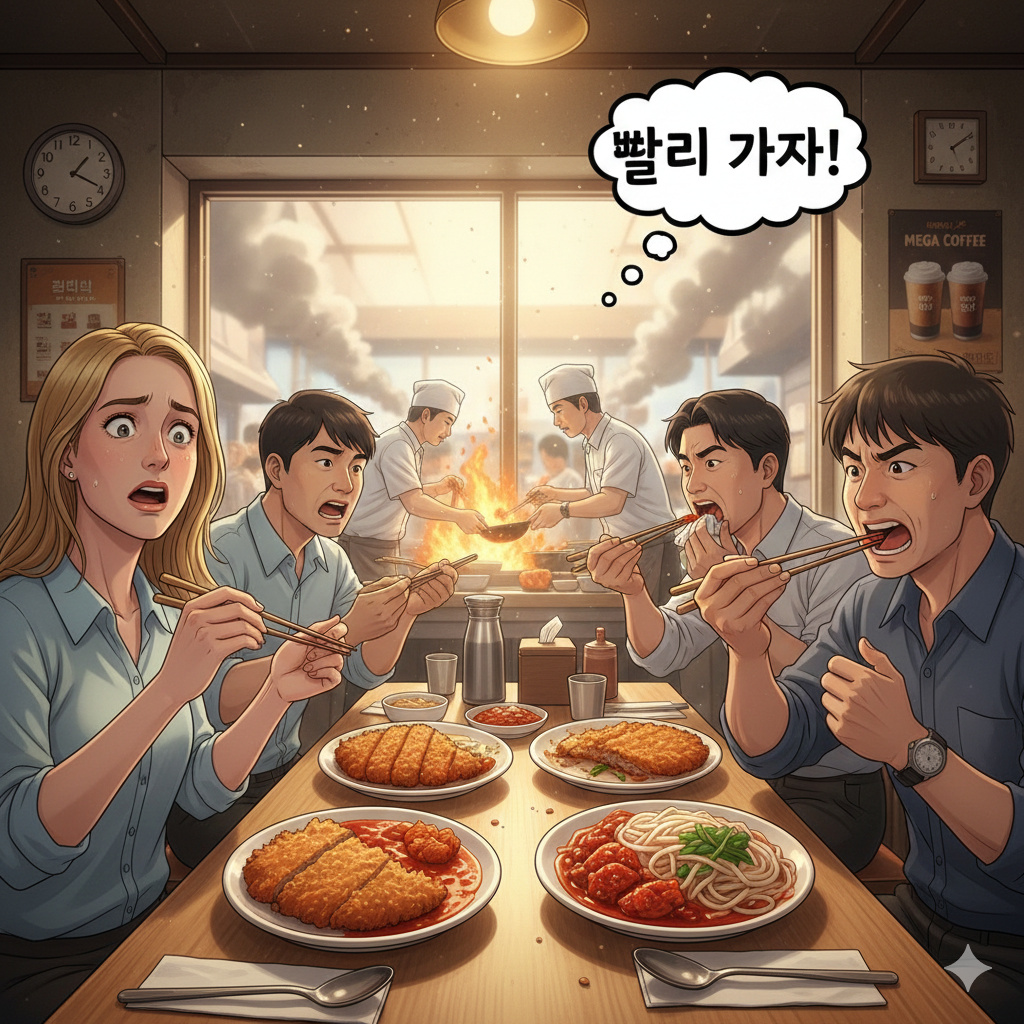
“The 10-minute lunch race in Seoul.”
1. Decoding the DNA of Pali-Pali Culture in Korea
“The Pali-Pali culture is the secret engine behind Korea’s rapid growth, and nowhere is this high-speed lifestyle more visible than during a 10-minute office lunch.”
In the heart of Seoul’s bustling business districts like Yeouido or Gangnam, a silent, invisible alarm triggers at exactly 11:30 AM. It’s the start of the “Pali-Pali” (hurry-hurry) lunch race—a phenomenon that defines the rhythm of modern Korean society. While the world recognizes Korea for its lightning-fast 5G internet and rapid economic miracles, the most visceral and everyday manifestation of this speed is found not in a tech lab, but at the office lunch table.
To understand the Korean lunch hour, one must first decode the profound cultural DNA of “Pali-Pali.” For Koreans, being “fast” is not merely about impatience; it is a deeply ingrained social responsibility. You can see this clearly even before you reach the restaurant. On an international flight landing at Incheon, most Korean passengers are already standing up and retrieving their overhead luggage the millisecond the plane’s tires touch the runway.
Why? Because in a collective society, there is an unspoken pressure not to be the “bottleneck.” Koreans have a psychological aversion to causing even the slightest delay or inconvenience to others due to their own perceived “laziness” or slow pace. This collective desire to keep the “flow” moving permeates every aspect of life, especially when dining in public.
Furthermore, the Korean relationship with time is one of intense optimization. There is a constant, almost subconscious pressure to utilize every minute of the day to its maximum potential. Yet, paradoxically, this drive for efficiency exists alongside a powerful cultural obsession with “three square meals a day.”
In Korea, the question “Have you eaten?” is a common greeting equivalent to “How are you?” This creates a unique tension during the lunch hour: the desire to fulfill the essential human need for a proper, hot meal, balanced against the urgent need to finish quickly to return to work or secure a few precious minutes of rest.
Consequently, the standard 60-minute lunch break is treated like a high-stakes logistics operation. Between 11:30 AM and 12:30 PM, the streets become a sea of ID lanyards as thousands of office workers move in synchronized haste. Within this golden hour, teams are expected to dine together to foster “Hwasik” (team dining) culture, but the social aspect is often secondary to the mission of refueling. For many expats and newcomers, this daily ritual can feel like a scene from a satirical sketch on SNL Korea, where the “salaryman’s loop” of fast eating is parodied as an unbreakable, almost robotic cycle.
However, beneath the comedy lies a serious work ethic—a nation built on the belief that if everyone moves just a little bit faster, the entire community thrives. In this environment, lunch is not a leisurely break; it is an efficient, high-speed pit stop fueled by the “Pali-Pali” spirit.
2. Deep Dive: The Philosophy of “Pali-Pali” in Korean Dining
To understand why Donkatsu and Jeyuk-Bokkeum dominate the menu, one must first understand the Pali-Pali culture. This isn’t just about being impatient; it’s a social DNA born from Korea’s rapid modernization.
- The Psychological Pressure: In a collective society, eating slowly is often perceived as being inconsiderate to the group or the restaurant owner waiting to turn over the table.
- The “Order Before Sitting” Skill: It is common to see a team leader shouting the order toward the kitchen before their coat has even touched the back of the chair.
- The Coffee Finish: The goal of the 10-minute meal is to secure the remaining 50 minutes for the “Second Round”—standing in a long line at a cafe to grab a 2,000 KRW “Mega Coffee” or “Paik’s Coffee.”
- The Social Satire: This speed is so extreme that popular YouTube channels and shows like SNL Korea often parody office workers who swallow their food whole just to be the first one to leave the restaurant. It’s a tragicomedy that every Korean office worker recognizes.
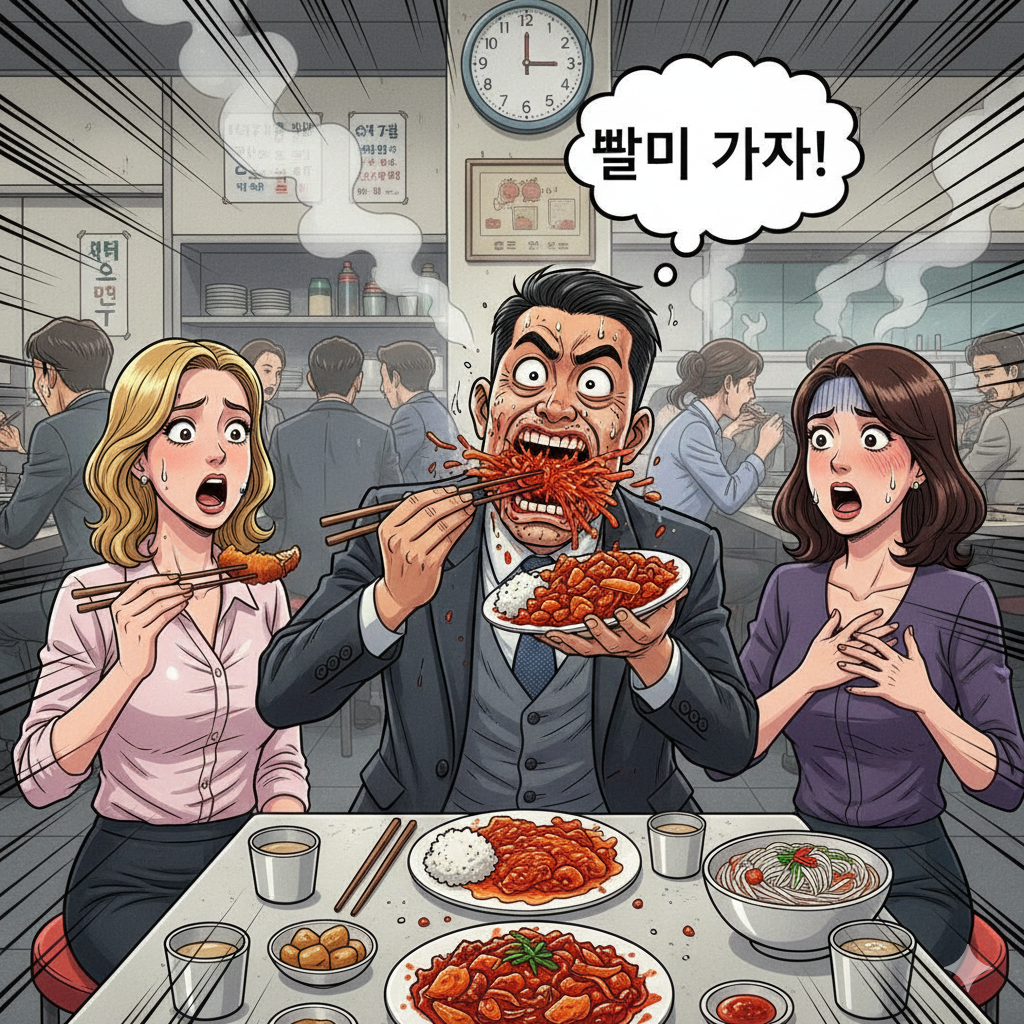
3. The “Formula 1” Foods: Donkatsu and Jeyuk-Bokkeum
If speed is the goal, your choice of fuel matters. You cannot eat a complex hot pot (Jeongol) or a multi-course meal in 10 minutes. This is why the Donkatsu-Jeyuk duopoly exists.
- Donkatsu (The Fried Velocity): Unlike the thick Japanese Tonkatsu that requires slow frying, the Korean-style Donkatsu is pounded thin to ensure it cooks in under 3 minutes. It’s the ultimate “fast-casual” meat dish.
- Jeyuk-Bokkeum (The Pre-Prepped Power): Most office-area restaurants have a massive pan of spicy pork marinade ready to go. The chef simply tosses a portion onto a high-flame wok for 120 seconds, and it’s on your table.
- Comparative Speed: For Westerners, think of this as the “Fast Food” version of a sit-down meal. It has the soul of a home-cooked meal but the delivery speed of a McDonald’s drive-thru.
| Menu | Why it’s Fast (Pali-Pali) | Preparation Time |
| Donkatsu | Pounded thin for instant frying | < 3 Minutes |
| Jeyuk | Pre-marinated, high-flame wok toss | < 2 Minutes |
4. The “Cultural Clash” at the Table
For many expats, the first time they dine with a group of Korean male colleagues is often a confusing experience.
- The Silence: You’ll notice very little conversation. Talk is for after-lunch coffee; lunch itself is for chewing.
- The Standing Exit: Don’t be surprised if your colleagues stand up the exact second their last chopstick hits the table.
- Survival Tip: If you are a slow eater, don’t try to match their pace—you’ll get indigestion. Simply acknowledge the “Pali-Pali” spirit and meet them at the coffee shop later.
Survival Guide: How to Navigate Pali-Pali Culture in Korea
- Tip 1: Order before your coat touches the chair.
- Tip 2: Conversation is for the “Second Round” (Coffee).
- Tip 3: Stand up the moment the last chopstick hits the bowl.
5. Conclusion: A Nation Built on 10-Minute Lunches
At Citygram Seoul, we see the Donkatsu and Jeyuk loop as more than just a lack of culinary variety. It is a symbol of the grit and efficiency that built modern Korea. While it might feel like a frantic race to the uninitiated, there is a certain beauty in the synchronized efficiency of a Korean lunch hour.
Next time you find yourself staring at a plate of spicy Jeyuk or a crispy Donkatsu, take a breath (if you can) and appreciate the “Pali-Pali” energy around you. It’s the heartbeat of Seoul, served on a plate with a side of rice.
“In Seoul, lunch is not a break; it’s a high-speed pit stop. We eat in 10 minutes to earn 50 minutes of freedom with an iced americano.”