K-pop positions explained simply means understanding the roles assigned to members in an idol group, such as leader, main vocal, lead dancer, main rapper, center, visual, maknae, and all-rounder. If you are a new K-pop fan, learning these positions helps you understand why certain members sing the high notes, stand in the center, lead interviews, or get highlighted during performances. In newer K-pop groups, positions are becoming more flexible, but these basic K-pop roles are still essential for understanding fan culture.
In newer K-pop groups, these positions are becoming more flexible. Groups like NewJeans, RIIZE, and BABYMONSTER often blur the lines between traditional roles, but the basic terms still matter. They help fans understand how K-pop groups are structured, how performances are designed, and why each member may be highlighted in a different way.
Quick Answer: What Are K-Pop Positions?
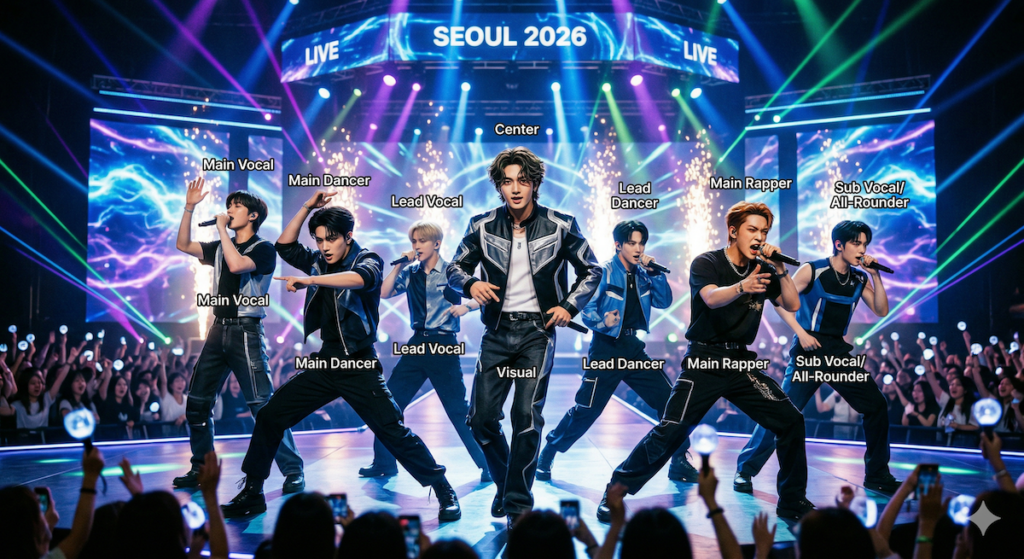
In simple terms, K-pop positions explain each member’s main role in the group. Some positions are musical, such as main vocal, lead vocal, main rapper, and main dancer. Others are more about team identity and fan culture, such as leader, center, visual, maknae, and all-rounder.
| Position | Primary Responsibility | 2026 Key Example |
| Leader | Team mediation & Public rep | RM (BTS), Soyeon ((G)I-DLE) |
| Main Vocal | High notes & Technical ad-libs | Lily (NMIXX), Ahyeon (BABYMONSTER) |
| Main Dancer | Dance breaks & Choreography | Lisa (BLACKPINK), Shotaro (RIIZE) |
| Main Rapper | High-intensity rap verses | Mark (NCT), Soyeon ((G)I-DLE) |
| Center / Visual | Group concept & Face of group | Wonyoung (IVE), Karina (aespa) |
| All-Rounder | Skilled in all positions | Haerin (NewJeans), Sungchan (RIIZE) |
Maknae: The youngest member of a K-pop group. The maknae often has a special image in fan culture because fans enjoy watching the youngest member grow, interact with older members, and sometimes become the group’s playful or emotional point.
K-Pop Positions List: The Main Roles Explained
The most common K-pop positions include leader, main vocal, lead vocal, sub vocal, main dancer, lead dancer, main rapper, lead rapper, center, visual, maknae, and all-rounder. Each position helps fans understand what a member usually contributes to the group’s music, performance, image, or team dynamic.
- Leader: The member who represents the group, supports communication, and often speaks during interviews or public moments.
- Main Vocal: The strongest vocalist in the group, usually responsible for high notes, difficult singing parts, and emotional climaxes.
- Lead Vocal: A strong singer who supports the main vocal and often carries verses, pre-choruses, or important melodic parts.
- Sub Vocal: A supporting vocalist who adds harmony, texture, and balance to the song.
- Main Dancer: The strongest dancer in the group, often highlighted during dance breaks or the most difficult choreography.
- Lead Dancer: A skilled dancer who supports the main dancer and helps maintain the group’s formation and performance quality.
- Main Rapper: The strongest rapper in the group, usually responsible for the most intense or technically difficult rap parts.
- Lead Rapper: A rapper who supports the main rapper and often handles shorter rap sections or transitions.
- Center: The member placed in the most visible position during key moments, such as the chorus, opening pose, ending pose, or killing part.
- Visual: The member often associated with the group’s public image, beauty standard, photoshoots, advertisements, and first impression.
- Maknae: The youngest member of the group. In fan culture, the maknae often has a special image because fans enjoy watching the youngest member grow and interact with older members.
- All-Rounder: A member who is strong in several areas, such as singing, dancing, rapping, stage presence, or performance.
Why K-Pop Groups Have Positions
In Western pop, a lead singer is usually the clear focal point. However, in K-pop, the industry operates on the principle of Efficiency and Perfectionism. Why do Koreans meticulously divide a 3-minute song into precise segments for each member? It is because the goal is a flawless, multifaceted performance where no talent is wasted.
By assigning a Main Vocal to handle the bridge and a Main Dancer to lead the breakdown, K-pop agencies ensure that every second of a stage is optimized for maximum impact. This specialized labor division is what allows K-pop groups to maintain high-quality live vocals while executing some of the most difficult choreography in the world.
What Does Leader Mean in K-Pop?
In Korea, the role of a Leader is deeply rooted in the social hierarchy and team-first mentality. While the oldest member was traditionally chosen, recent K-pop groups marks a shift toward Skill-Based Leadership. Groups now choose leaders who can produce music or speak multiple languages to navigate the global market. It is not about age anymore; it is about who can bridge the gap between the agency vision and the members well-being.
Vocals: Main vs Lead vs Sub
Understanding the vocal hierarchy is key to appreciating line distribution. The Main Vocalist handles the most technically difficult parts, often delivering the emotional climax of a track. Lead Vocalists support them, frequently opening the song to set the tone. Sub Vocalists provide the necessary texture and harmony, ensuring the song feels full and dynamic. The rise of groups like NMIXX has pushed the standard so high that even Sub Vocalists often possess Main Vocal skills.
Book Your One-Day K-Pop Recording Class with an Idol →
Main Dancer vs Lead Dancer in K-Pop
K-pop is a visual medium as much as a musical one. The Main Dancer is the engine of the group performance, often taking the spotlight during intense dance breaks. They are responsible for maintaining the groups synchronization and often work with choreographers to refine the stage movement. Lead Dancers flank them, ensuring the visual balance of the formation remains perfect during complex transitions.
Center vs Visual in K-Pop: What Is the Difference?
While every idol is undeniably attractive, the Visual position is a strategic marketing role. This member attracts commercial opportunities and high-end fashion ambassadorships, acting as the primary gateway for new fans. The Center, however, is the heartbeat of the choreography. They embody the groups overall concept and are usually the most recognizable face during the chorus. In 2026, stars like Jang Wonyoung and Karina have elevated these roles to a level of global influence that rivals traditional Hollywood icons.
Center vs Visual in K-Pop: What Is the Difference?
The center and the visual are often confused, but they are not exactly the same position.
The center is the member who stands in the most noticeable position during key parts of the choreography, especially the chorus, opening pose, ending pose, or killing part. The center helps define how the performance feels on stage.
The visual is usually the member associated with the group’s public image, beauty standard, photoshoots, advertisements, and first impression. A visual may also be a strong performer, but the role is more connected to branding and public appeal.
In some groups, the same member can be both center and visual. In others, these roles are separated.
Main vs Lead vs Sub Positions in K-Pop
In K-pop, the words main, lead, and sub usually describe the level of responsibility within a role.
- Main usually means the strongest or most technically important member in that area.
- Lead means a strong supporting member who often receives important parts.
- Sub means a supporting role that adds balance, harmony, or extra energy.
For example, the main vocal usually handles the most difficult singing parts, while lead vocals support the song’s structure. The same logic can apply to dancers and rappers, although each company may use the terms differently.
What It Feels Like: The Thrill of the Killing Part
For a dedicated fan, the beauty of these positions comes alive during the Killing Part—that specific moment in a song where a member’s unique position shines brightest. Whether it is a rappers intense flow or a dancers fluid solo, these roles create a narrative within the performance. It makes every fan feel like they are watching a specialized team of superheroes, each with a unique power that contributes to a greater whole.
Why New K-Pop Groups Use More All-Rounders
The biggest shift in this what is k-pop positions explained guide is the emergence of the All-Rounder. 5th Gen groups like NewJeans and RIIZE often avoid fixed positions altogether. In these groups, every member is expected to sing, dance, and rap at an elite level. This versatility allows for more experimental music and prevents the group from being pigeonholed into a single style. It is the ultimate evolution of the K-pop training system.
Book Your K-Pop Idol Experience in Seoul →
Final Summary: K-Pop Positions Are a Map for Understanding the Group
K-pop positions are not just simple labels. They help fans understand how each member contributes to the group’s music, choreography, image, and teamwork. The main vocal may carry the emotional peak of a song, the main dancer may shape the performance, the center may define the stage image, and the leader may support the group behind the scenes.
In newer K-pop groups, these roles are becoming more flexible, and many idols are expected to be all-rounders. Still, learning the basic positions — leader, main vocal, main dancer, main rapper, center, visual, maknae, and all-rounder — makes it much easier to understand K-pop performances and fan culture.
Explore More K-Pop Journeys in Korea
After mastering the secrets of idol roles with this what is k-pop positions explained guide, it is time to step into the actual locations where your favorite stars shine. Whether you are seeking the cinematic night views of a luxury music video or the sun-drenched filming spots of a summer comeback, these curated guides will help you live out your K-pop fantasy in 2026.