Leaving the city for a long-distance drive? Driving on Korean Highways for Foreigners is a journey through one of the most technologically advanced road networks in the world. However, beneath the smooth asphalt of the Gyeongbu Expressway lies a complex system of tolls, strict lane laws, and heavy financial penalties that can catch any expat off guard. In 2026, navigating these roads is not just about steering; it’s about managing your financial and legal risks.
1 | The Financial Strategy of Tolls: Hi-Pass & Smart Payment
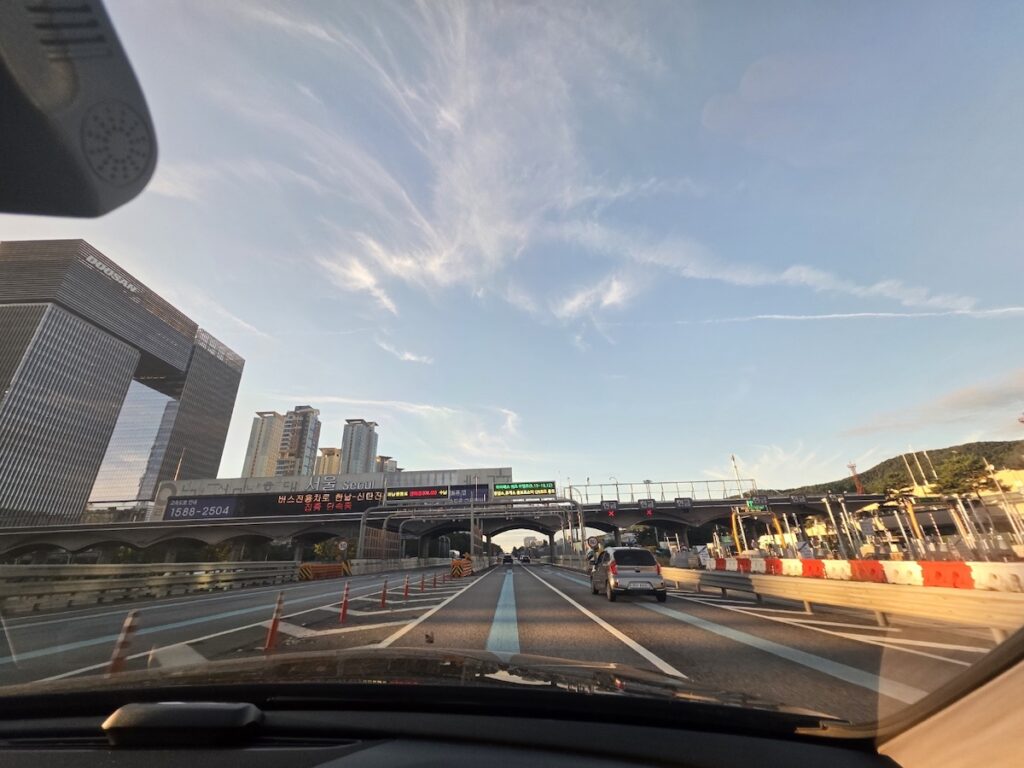
When you enter the Gyeongbu Expressway (Route 1) heading towards Busan, you will immediately encounter the Hi-Pass system.
- The Blue Line Mechanism: The blue lane is for vehicles with a Hi-Pass OBU (On-Board Unit). In 2026, many toll gates are moving toward “Multi-lane Free-flow,” meaning you don’t even need to slow down.
- Financial Tip – The Multi-Currency Challenge: If you are using a Seoul car rental, the Hi-Pass card provided is often a postpaid version. However, if you are a long-term resident with your own car, you must manage a Hi-Pass card linked to a Korean bank account.
- The “Unpaid Toll” Risk: If you pass without a card, don’t panic. You can pay the unpaid toll (미납 통행료) at the destination toll office or through a dedicated mobile app using your Passport or Alien Registration Card (ARC). Failure to pay within the deadline results in a 10x surcharge, which is a high-cost mistake many foreigners make.
- Investment View: For those planning frequent trips, look into Credit Cards with Hi-Pass Benefits. These cards often offer 5–10% cashback on toll fees, turning a mandatory expense into a small saving.
2 | Lane Etiquette & The “1st Lane” Penalty (300% Expanded)
The most strictly enforced rule on Korean expressways, such as the Yeongdong Expressway, is the “Passing Lane” law.
- The Designated Lane System (지정차로제): On a 4-lane highway, the 1st lane (leftmost) is exclusively for overtaking. You are legally forbidden from “cruising” in this lane, even if you are at the speed limit.
- Bus Lane Exceptions: On the Gyeongbu Expressway between Seoul and Hannam, the 1st lane is often a Blue-lined Bus Lane during specific hours (usually 7 AM – 9 PM). Driving a regular passenger car in this lane will result in a heavy fine of 60,000 KRW and 30 penalty points—two such violations can lead to an immediate license suspension.
- Financial Protection Strategy: High-speed lane violations often lead to high-impact accidents. Standard Seoul car rental insurance might have high deductibles for highway collisions.
- The “Short-term Driver Special Clause”: If you are sharing the wheel with a friend on a long trip, you must purchase a “One-day Driver’s Insurance” through your smartphone. It costs less than 10,000 KRW but provides millions in coverage for legal expenses and bodily injury, which is essential when Driving on Korean Highways for Foreigners.
3 | Speed Enforcement: The “Section Control” Trap
On long stretches like the Seohaean Expressway, you will encounter “Section Speed Enforcement” (구간단속).
- The Logic: This system calculates your average speed between two points, often 10km apart. It eliminates the habit of “braking in front of the camera”.
- The Cost of Speeding: Fines are steep, and for expats, accumulating penalty points can affect your visa status.
- Financial Protection: This is why premium Driver’s Insurance (운전자보험) is a top-selling financial product in Korea. It covers the cost of hiring a lawyer if a speeding incident leads to a serious accident, and it can even reimburse you for the fines paid.
4 | The “Cashless” Rest Area Economics
Korean Rest Areas (휴게소) are more than pit stops; they are massive commercial hubs.
- The Payment Barrier: In 2026, 99% of kiosks at these areas are Cashless. Many do not recognize international “Swipe-only” cards.
- Financial Tip: Always carry a WowPass or a T-money card as a backup. These cards are accepted at all highway rest areas and can be easily topped up at any convenience store.
5 | Prohibited Actions: Littering and Shoulder Lane Misuse
To maintain order on high-speed roads, Korean law is extremely strict regarding road environment and emergency lanes.
- Littering (오물 투기): Throwing anything (including cigarette butts or tissues) out of a moving vehicle is monitored by other drivers’ dashboard cameras (Black Boxes). Citizens can report you via the “Safety Report” app, leading to a fine of 50,000 KRW.
- Shoulder Lane (갓길) Usage: The shoulder is strictly for emergency stops only. During heavy traffic on the Seoul-Yangyang Expressway, you may see a green arrow on the shoulder—this is a “Variable Lane” that opens only during congestion. Driving on the shoulder when the arrow is red is a serious offense, often resulting in immediate police intervention.
- Emergency Financial Tip: If your car breaks down, use the “Free Towing Service” provided by the Korea Expressway Corporation (EX) to move your car to the nearest safe rest area. This prevents you from paying exorbitant private towing fees, which can exceed 300,000 KRW.