“In a crisis, every second counts. When you dial the emergency numbers, the dispatcher’s first question will always be: ‘Where are you?’ Knowing how to report to 112 and 119 is only half the battle; the real challenge is providing a pinpoint Emergency Location in Korea when you are in an unfamiliar area. Whether you are USFK personnel or an expat in Seoul, this guide provides the exact localized codes and scripts you need to ensure responders find you with absolute precision.”
1. Master the Blue Road Signs to Report Your Emergency Location in Korea at Intersections
When you are on the street, the most reliable way to report to 112 and 119 is by identifying the major road intersection. Korea’s urban planning uses a systematic naming convention for its “Daero” (Major Road) and “Ro” (Street).
- Understanding the Signs: Look for the large blue overhead signs at every major crossing. These are not just for drivers; they are for your survival. As shown in our reference photo of Songpa-daero, the sign provides the exact name of the artery you are on.
- The Power of “Intersection” Names: Most intersections have a specific name (e.g., Garak Market Intersection). Providing this name allows the 112 dispatcher to narrow down your location to a 50-meter radius instantly.
- Legal Perspective: Under the Framework Act on the Management of Disasters and Safety, the government is obligated to provide these signs for public safety. By utilizing them, you are engaging with the highest level of the national safety network.
2. Using Subway Exit Numbers and Elevators for Precise Reporting to 112 and 119
South Korea’s subway system is one of the densest in the world, making it a perfect landmark for an Emergency Location in Korea.
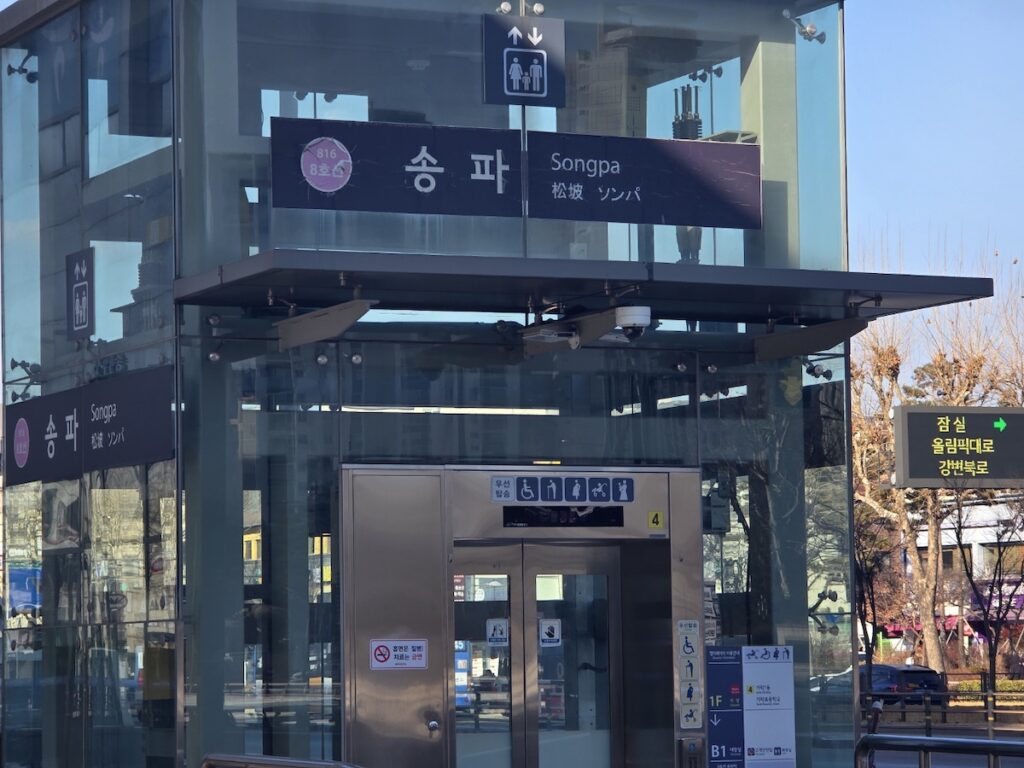
- The Specificity of Exit Numbers: Every subway station has multiple exits, each uniquely numbered. As seen in the photo of Songpa Station Exit 4, these numbers are clearly visible on the glass structures above ground.
- The Elevator Landmark: If you are near an elevator (like the one in our image), mention it. Elevators often have their own unique GPS markers in the emergency database.
- Line Identification: Don’t just say “I’m at the station.” Mention the line color or number (e.g., Line 8, the Pink Line). This is crucial in massive transfer hubs like Jamsil or Seoul Station where multiple lines meet.
3. How to Use the Green State Grid Number for Rescue in Parks and Mountains
What happens if you are hiking on Bukhansan or walking through a vast riverside park where there are no buildings or subway exits? This is where most foreigners feel truly lost.
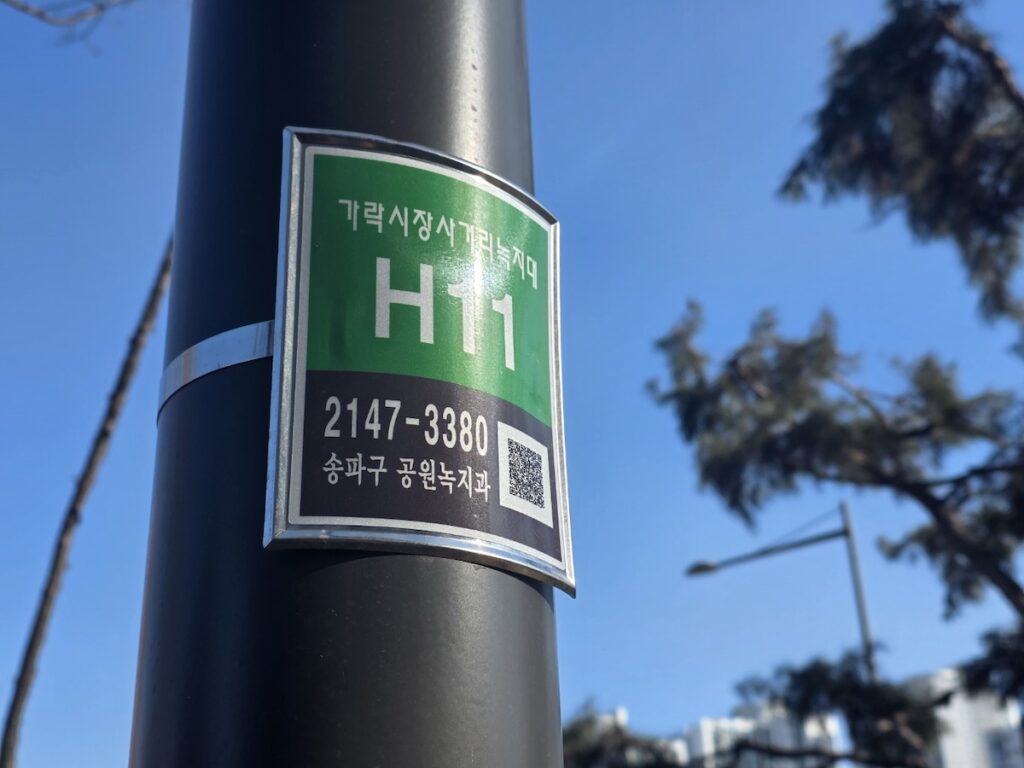
- The 10-Character Code: Look for small green metal signs attached to utility poles, trees, or trail markers. These display the State Grid Number (e.g., H11 2147-3380).
- How the System Works: This system divides the entire Korean peninsula into 10m x 10m squares. When you provide this code to 119, they don’t need a street name; they have your exact coordinates.
- Visibility: These signs are specifically designed to be reflective and visible at night. If you are lost in the mountains, finding one of these is your fastest ticket home.
4. Step-by-Step Script: Exactly What to Say When You Report to 112 and 119 in English
In a crisis, your English might be fast, and the dispatcher’s English might be limited. Using a structured script is the best way to report to 112 and 119. Use these templates:
- Scenario A: Urban Street (Intersection)
- You: “Emergency! Help needed. I am at an intersection.”
- Dispatcher: “Where is your location?”
- You: “I am on [Street Name, e.g., Songpa-daero] at the [Intersection Name, e.g., Garak Market Intersection]. I am standing near the large blue sign.”
- Scenario B: Subway Station
- You: “Police needed! I am at [Station Name, e.g., Songpa Station].”
- Dispatcher: “Which exit?”
- You: “I am at Exit number [4], right next to the [Subway Elevator]. I am wearing a red jacket.”
- Scenario C: Mountain or Park (The Grid)
- You: “I am lost/injured. 119 needed.”
- Dispatcher: “Can you see a green sign?”
- You: “Yes. The State Grid Number is [H-1-1] [2-1-4-7] [3-3-8-0]. Please send help to these coordinates.”