Korea Interest Income Tax Rate 15.4% is something many foreigners only notice after opening their first Korean savings account. The bank advertisement shows one number, but the actual interest deposited later feels slightly smaller than expected.
For many expats, students, and foreign workers in Korea, this becomes one of those small “wait… what?” moments that happen while learning how Korean systems work.
At first, the process feels simple. A Korean bank promotes a deposit account with attractive interest rates, especially compared to countries where savings accounts barely pay anything. But after the interest payment arrives, some foreigners realize a portion has already disappeared automatically.
That missing amount is usually connected to Korea’s interest income tax system.
What surprises people is not necessarily the tax itself. Many countries tax savings interest. The confusing part is how automatically and invisibly the deduction happens in Korea.
Quick Answer: Why Does Korea Deduct 15.4% From Savings Interest?
Korea Interest Income Tax Rate 15.4% generally applies to bank interest earned from savings accounts, fixed deposits, and similar financial products. The standard deduction usually combines national income tax and local resident tax. In many cases, Korean banks automatically withhold the tax before interest reaches the account holder. This means foreigners often see lower actual payouts than the advertised interest rate suggests. Tax treatment may vary depending on residency status, account type, or special tax-saving products, so checking directly with the bank is always important.
The First Time Foreigners Notice the Difference
Many foreigners living in Korea first encounter this while opening:
- savings accounts
- time deposits
- installment savings plans
- high-interest promotional accounts
The process often feels very efficient. Korean banking apps display projected earnings clearly, and staff may explain annual rates during account setup.
But later, when the actual interest payment arrives, the final amount looks slightly lower.
For example:
| Advertised Interest | Expected Earnings | Actual Deposit After Tax |
|---|---|---|
| 4.0% annual interest | ₩100,000 | About ₩84,600 |
| 3.5% annual interest | ₩70,000 | About ₩59,220 |
| 5.0% annual interest | ₩200,000 | About ₩169,200 |
This happens because the tax is generally withheld automatically before the money reaches the account.
For foreigners unfamiliar with Korean banking, it can feel confusing at first because the deduction happens quietly in the background.
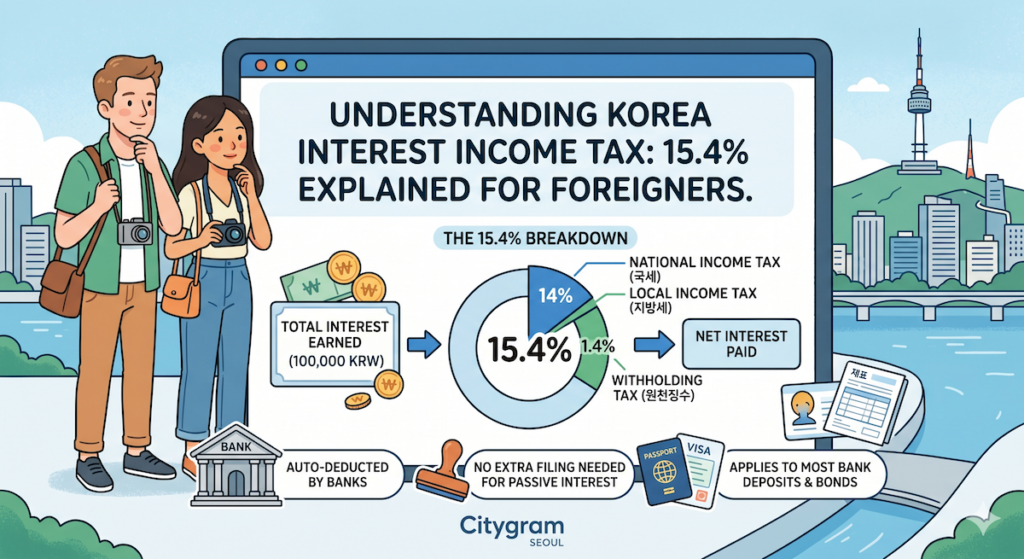
Why the Number Is Exactly 15.4%
The number itself looks oddly specific to many foreigners.
In Korea, the standard interest income tax structure usually combines:
- 14% national income tax
- 1.4% local resident tax
Together, this creates the commonly seen 15.4% deduction rate.
Many Korean banking apps and websites already assume locals understand this automatically, so advertisements sometimes focus more heavily on pre-tax interest rates.
Foreign residents often expect the displayed rate and final payout to match more closely, especially if their home countries present savings earnings differently.
Korean Savings Accounts Can Look More Attractive Than They Actually Feel
This becomes especially noticeable when foreigners compare Korean interest rates internationally.
In some countries, standard savings accounts pay extremely low interest. Korea occasionally offers promotional rates that initially look very attractive by comparison.
But once taxes are deducted, the emotional feeling changes slightly.
The account may still perform well overall, but foreigners often realize:
“The advertised rate is not the exact amount I personally receive.”
This is one reason many expats in Korea begin paying closer attention to:
- after-tax returns
- banking conditions
- minimum deposit periods
- withdrawal penalties
- tax-free products
instead of only looking at headline interest rates.
Korea Still Has a Strong Savings Culture
One thing many foreigners notice after living in Korea for a while is how seriously people treat savings accounts and financial planning.
In some countries, ordinary savings accounts feel almost irrelevant because interest rates remain extremely low. But in Korea, people still actively compare deposit rates, installment savings plans, and limited-time banking promotions.
Coworkers sometimes discuss bank interest rates the same way people discuss phone plans or coffee subscriptions. Banking apps regularly advertise new savings products, and even younger Koreans often use structured monthly savings systems instead of leaving money untouched in checking accounts.
Foreign residents are often surprised by how normal it feels for people to track:
- fixed deposit maturity dates
- monthly savings targets
- special interest promotions
- banking app events
- government-supported savings products
Part of this comes from Korea’s fast-moving financial culture, where small percentage differences in interest rates receive significant attention online and in the news.
For foreigners, the overall atmosphere can feel much more savings-focused than expected.
Small Korean Banking Details Foreigners Often Miss
Even after understanding the 15.4% interest income tax, many foreigners still get confused by smaller parts of Korean banking systems.
One common surprise involves automatic renewal settings. Some Korean savings accounts automatically renew at maturity unless customers manually stop the process inside the banking app.
Another confusing detail is early withdrawal penalties. Foreigners sometimes expect partial interest earnings even after ending a deposit early, but Korean fixed-term products may reduce interest sharply if the agreement is canceled before maturity.
Bank maintenance hours also surprise many expats. Certain online banking services temporarily stop late at night during scheduled system maintenance, which can feel unusual for visitors used to 24-hour banking access.
| Korean Banking Detail | Why Foreigners Get Confused |
|---|---|
| Automatic renewal | Deposits may restart automatically |
| Early withdrawal penalties | Interest earnings can drop significantly |
| Banking maintenance hours | Some services pause overnight |
| Multiple verification steps | Apps often require extra security checks |
| Korean-language banking terms | Financial vocabulary can feel difficult even in English mode |
These details are usually not major problems, but together they create the feeling that Korean banking follows its own rhythm and logic.
For many foreigners, understanding these small systems becomes part of adjusting to everyday life in Korea.
Fixed Deposits and Installment Savings Are Popular in Korea
Foreigners living in Korea long-term often notice how common structured savings products are.
Korean banks heavily promote:
- fixed-term deposits
- monthly installment savings
- youth savings programs
- salary-linked accounts
- promotional mobile banking products
Some accounts offer surprisingly high temporary rates to attract new customers.
This can feel unfamiliar to visitors from countries where ordinary savings culture is less aggressive or less visible.
Inside Korean subway stations and banking apps, advertisements for savings products appear constantly, especially during periods of higher interest rates.
For foreigners, Korea’s banking environment can feel much more actively savings-focused than expected.
The Tax Is Usually Automatic
One reason foreigners become confused is that they often never personally pay the tax themselves.
The bank usually handles the deduction automatically before depositing interest.
| Step | What Usually Happens |
|---|---|
| Interest generated | Bank calculates earnings |
| Tax applied | 15.4% withheld automatically |
| Final payment | Remaining interest deposited |
| Customer action | Usually none required |
This system feels convenient for many locals because it removes extra paperwork in ordinary situations.
But foreigners sometimes miss the deduction entirely until they compare projected earnings with the final deposited amount.
Residency Status Can Matter
An important detail is that taxation rules may vary depending on:
- visa type
- tax residency status
- financial product
- international tax treaties
- account structure
For example, long-term foreign residents may experience different tax situations compared to short-term travelers or temporary workers.
Some countries also maintain tax agreements with Korea that affect certain financial reporting obligations.
Because of this, foreigners should avoid assuming every situation follows exactly the same rules.
Korean banking staff sometimes explain only the basic standard deduction unless customers ask more detailed questions.
Why Korean Banking Feels Extremely Systemized
For many foreigners, Korean banking culture itself becomes part of the experience.
The system often feels:
- fast
- app-driven
- document-heavy
- security-focused
- highly automated
Opening a bank account in Korea can involve:
- ARC verification
- phone authentication
- banking certificates
- mobile apps
- security passwords
- identity checks
At first, this may feel complicated. But once accounts are active, much of the financial system operates automatically, including tax withholding.
That efficiency is one reason many daily financial processes in Korea feel surprisingly smooth after the initial setup phase.
Some Foreigners Search for Tax-Free Savings Options
After learning about the standard 15.4% deduction, some foreigners start researching special Korean financial products that advertise tax advantages.
These may include:
- youth savings programs
- government-supported accounts
- long-term investment products
- special residency-linked programs
However, eligibility rules can become complicated quickly, especially for non-Korean citizens.
Some products only apply to:
- Korean nationals
- specific age groups
- income ranges
- long-term residents
That is why foreigners often discover that basic savings accounts remain the simplest option despite the tax deduction.
Why This Feels Like a “Korea System” Experience
In many ways, this situation represents a very typical foreigner experience in Korea.
Nothing dramatic happens. Nobody gets into trouble. The bank account works normally.
But small system details appear that locals already understand automatically while foreigners slowly learn them one by one.
The 15.4% interest income tax becomes one of those moments where visitors realize Korea’s financial systems operate with their own internal logic and expectations.
And because the deduction is automatic, efficient, and mostly invisible, it perfectly matches how many Korean administrative systems work overall.
Conclusion
Korea Interest Income Tax Rate 15.4% surprises many foreigners because the deduction usually happens automatically before savings interest reaches their account.
For expats, students, and foreign workers opening Korean bank accounts for the first time, this can create confusion when advertised interest rates look higher than actual payouts.
Still, the system itself is relatively straightforward once understood. Korean banks generally combine national and local taxes into automatic withholding, making the process efficient even if it initially feels unfamiliar.
For foreigners adjusting to daily financial life in Korea, understanding this small detail makes Korean banking feel much less confusing.
And like many parts of life in Seoul, the system often starts making sense only after experiencing it directly once.