Seoul subway child fare protocols are often the first invisible wall foreign parents hit when navigating the city’s hyper-efficient transit grid. It was a humid Sunday afternoon at Jamsil Station—a sprawling subterranean labyrinth where the Lotte World crowds collide with weary commuters. Standing near the ticket kiosks, I watched a foreign family, maps unfolded and brows furrowed, feeding bills into the machine. They were purchasing a single-journey ticket for a child who, by my estimation, couldn’t have been more than five.
I hesitated. In the “Midnight Run” philosophy of urban observation, you learn that intervention is a double-edged sword. To ask a stranger the age of their child is to intrude upon their private travel sanctuary; yet, to watch them waste currency on a “free” system felt like witnessing a minor tactical failure. For expats and travelers, the fear of a red-light error at the turnstile—the sharp beep of a fare violation—outweighs the desire to save a few thousand Won. They pay for peace of mind, unaware that the city has already granted them a free pass.
The Under-6 Protocol: Seoul’s Invisible Gift
The technical reality of the Seoul subway child fare is straightforward but poorly advertised to those who don’t speak the local digital language. In Seoul, children under the age of 6 ride for free. This isn’t a suggestion; it is a legal provision of the Seoul Metropolitan Strategy. A single guardian can accompany up to three infants (under 6) without spending a single Won.
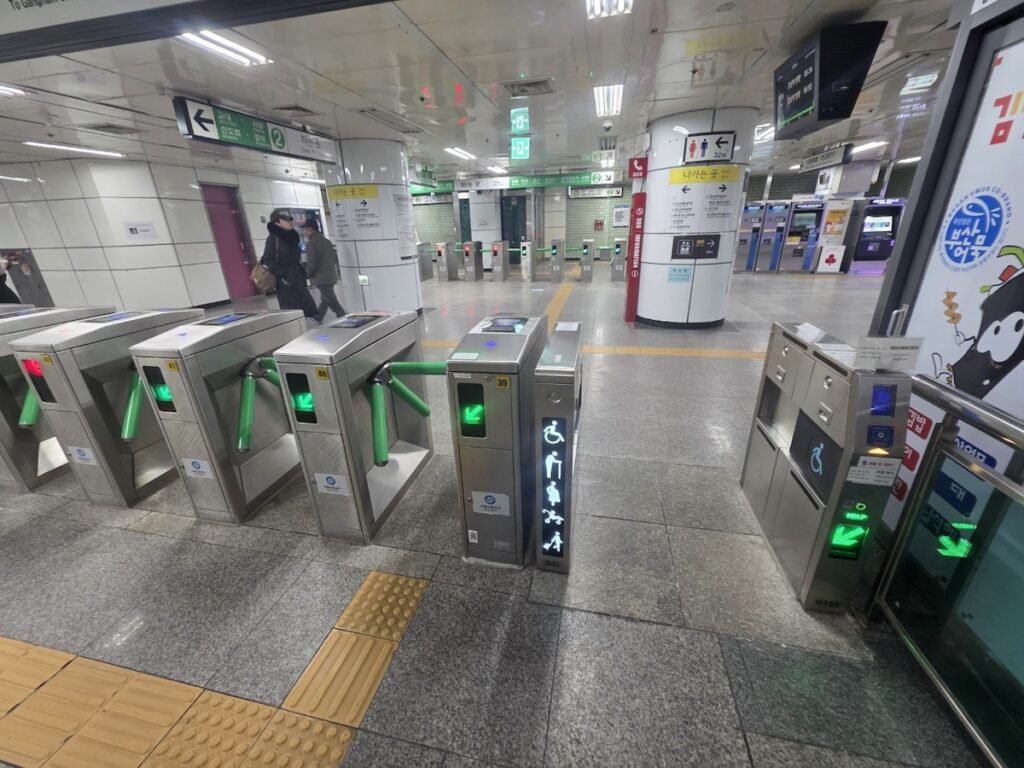
The friction arises at the gate. Foreign parents, conditioned by stricter systems in London, NYC, or Tokyo, look for a slot to insert a toddler’s ticket. In Seoul, the “Tactical Move” is simpler: you use the wide “Priority Lane” gate. You tap your card, and as the transparent shields retract, you and your child pass through together. No interrogation, no age verification paperwork, just the silent efficiency of a city that values family mobility.
The 72-Month Rule: Decoding the “Korean Age” Confusion
Seoul recently synchronized its legal age system with the international standard, but the cultural ghost of “Korean Age” still haunts the subway gates. For a foreign parent, the question “How old is your child?” can be a tactical trap. In the eyes of the Seoul Metro, your child’s age is not a social construct—it is a strict 72-month countdown.
Unlike the traditional Korean counting system (where a baby is “one” at birth), the subway system operates strictly on International Age (Man-nai).
- The Global Comparison: While an American or European parent might consider their child “six” the moment the calendar hits their birth year, Seoul’s turnstiles are more precise. If your child is 5 years and 364 days old, they are a ghost in the system—free to pass. The second they hit their 6th birthday, the free ride protocol expires.
- The Passport Strategy: We don’t use school grades or physical height to determine fares. The only “source of truth” is the birth date on the passport. If the math says 71 months, you walk through for free.
The Age 6-12 Transition: The Registration Trap
Once a child hits the age of 6 (or 72 months), the “free ride” ends, and the “Child Fare” (어린이 요금) begins. This is where most travelers make a costly mistake. If you buy a standard T-money card at a convenience store and fail to register it, the system defaults to the Adult Fare.
To secure the discounted rate—roughly 50% of the adult price—you must present the child’s passport to the convenience store clerk at the time of purchase. They will input the birth date into the system, locking the card into “Child Mode.” Without this 30-second ritual, you are essentially donating money to the city treasury with every tap.
Silver Mobility: The 65+ Free Access System
The generosity of the Seoul grid extends to the other end of the age spectrum, though the mechanics are different for locals and visitors. In Korea, citizens aged 65 and older enjoy 100% free access to the subway system. You will see seniors tapping a specific “G-Pass” or a dedicated silver-colored plastic card.
Tactical Note for Foreign Seniors: Unlike the “Under 6” rule, the 65+ free transit benefit is strictly reserved for Korean residents and specific visa holders (like the F-5 or F-6). If you are a tourist over 65, you are still required to pay the adult fare. It is a point of frequent confusion, but the “Senior Free Pass” is a benefit tied to the national social security and residency system.
The Penalty of the Red Light: Fare Evasion Risks
Why do parents overpay? Because the penalty for “unintentional” fare evasion in Korea is steep. If a child over 6 is caught using a free pass, or if an adult uses a child’s card, the fine is 30 times the base fare plus the original fare. In a culture that values “Chemyeon” (saving face), the psychological cost of being stopped by a station agent is far higher than the 1,500 Won ticket price.
Related Guides
- Seoul Subway Kiosk Guide: Mastering the Digital Interface to Save Your Money and Time
- Seoul Subway Rules and Fines: A 2026 Tactical Guide to Prohibited Acts and Penalties
- Seoul Subway Line 2 Travel Guide: The Green Loop—Best Stops, Local Tips, and Must-See Attractions
Action Plan
- Count the Months: Confirm your child is under 72 months old based on their passport birth date.
- Ignore the Kiosk: If they are under 6, do not buy them a ticket. Simply walk through the Priority Gate with them after you tap your card.
- The Convenience Store Ritual: For children aged 6–12, head to a GS25 or CU, present their passport, and ask for “Eorini-hal-in” (Child Discount) registration.
- Carry Digital Proof: Keep a photo of your child’s passport on your phone as your ultimate defense against any station agent’s inquiry.