The $1,000 Sneaker Anxiety: Your First Encounter with the Korean Floor
You have traveled across the globe to taste legendary Hanwoo beef in a hidden Jongno alley, but before you can take a bite, you must learn how to survive korean floor seating without losing your dignity or your expensive footwear. In 2026, while Seoul leads the world in high-tech robotics, the floor remains the final, traditional frontier of authentic hospitality. For a traveler unaccustomed to folding a 6-foot frame onto a thin silk cushion, this is not just a dinner invitation; it is a high-stakes physical endurance test.
Your limited-edition sneakers are sitting in a public rack, and your joints are about to face a grueling 60-minute interrogation. Understanding the physical boundary of the shoe-free zone is the first psychological hurdle every modern traveler must overcome to truly experience the depth of Korean dining culture.
The Bal-naemsae Taboo: Why Even Locals Avoid the Floor
It is a common myth that all Koreans prefer the floor. In reality, a significant portion of the local population—especially those in physically demanding jobs or manual labor—deliberately search for restaurants with standard tables. The reason is rarely about the knees; it is about Bal-naemsae (Foot Odor). After a long day of physical work or walking the humid streets of Gangnam, the social anxiety of releasing a day’s worth of human scent in a heated, confined floor environment is a genuine psychological burden.
If you see a group of locals rejecting a beautiful traditional room, they are not rejecting culture; they are protecting their social dignity from an olfactory mishap. This practical avoidance by locals highlights that floor seating is as much about social etiquette as it is about physical flexibility.
CCTV and Your $500 Sneakers: The Shoe Security Paradox
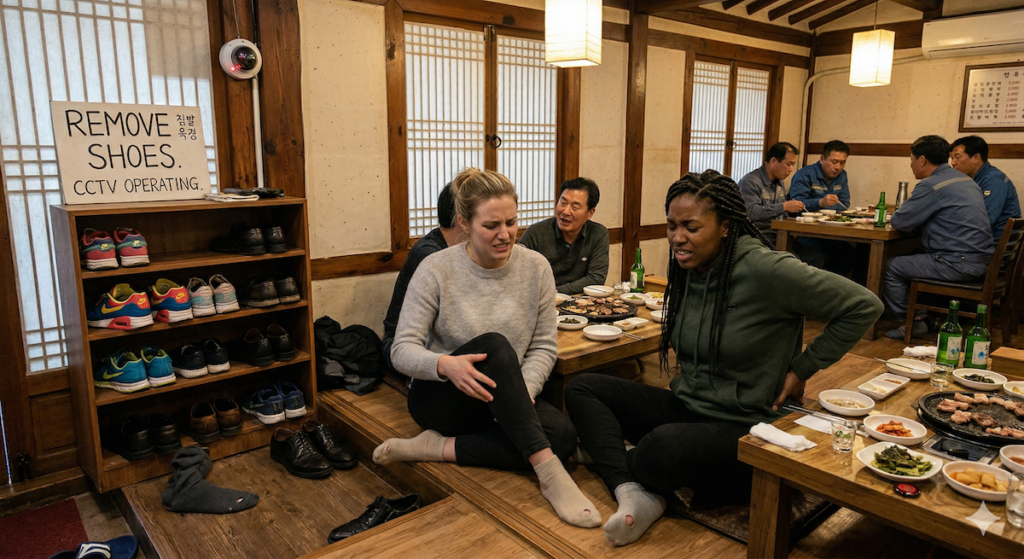
Korea is incredibly safe, yet every traditional restaurant entrance is lined with CCTV cameras. While intentional theft is extremely rare, accidental swaps are surprisingly common, especially after a few rounds of Soju. Many Koreans wear similar-looking black dress shoes or popular brand sneakers, creating a high risk of mistaken identity.
To secure your footwear, always utilize the lockers with physical keys if available. If not, placing your shoes on a higher shelf or inside a provided plastic bag is the only way to ensure your limited-edition sneakers do not walk away on someone else’s feet. The presence of CCTV is a silent testament to the chaotic reality of the shoe rack, serving as the ultimate tool for post-dinner identification when a footwear mix-up occurs.
Tactical Survival: Mastering the Art of Grounded Hospitality
To survive a long dinner with your dignity and joints intact, you need a tactical approach that goes beyond simple endurance. The most effective move is the Wall-Lean Strategy; when entering a room, move immediately to a seat against the wall to reduce spinal fatigue by 50%. Furthermore, discreetly folding your Bangseok (cushion) in half allows you to sit on a slight incline, aligning your spine and taking immediate pressure off your lower back.
You can also utilize the long tablecloth to perform a Stealth Stretch, extending one leg toward the center of the table where it remains visually hidden. By mastering these physical adjustments and navigating the unspoken anxieties of shoes and scents, you transform a potentially painful ordeal into a sophisticated cultural masterclass.
The Hidden Risks: Oily Socks and Social Exposure
When you enter a traditional Korean BBQ house with floor seating, you are stepping into a minefield of invisible residues. The most immediate “side effect” of this experience is the Oily Sock Syndrome. As thousands of tables of Samgyeopsal (pork belly) are grilled, a fine mist of aerosolized fat settles onto the floor. By the time you finish your meal, this microscopic layer of grease has likely bonded with your socks. When you finally slide your feet back into your expensive leather loafers or suede sneakers, that sticky, damp sensation is not just unpleasant—it can ruin the interior of your footwear.
Furthermore, the act of removing your shoes acts as an involuntary Social Sock Inspection. In Korean culture, the transition from the foyer to the dining floor is a moment where your personal hygiene and attention to detail are on full display. It is not uncommon for locals to jokingly check each other’s socks for the dreaded Gumeong (hole).
Discovering a hole in your sock at the entrance of a high-end restaurant is a unique form of social exposure that can derail your confidence for the rest of the evening. For this reason, savvy travelers in Seoul always carry a spare pair of high-quality, dark-colored socks, ensuring that their “floor-level dignity” remains intact even in the face of greasy floors and unexpected inspections.
Conclusion: Mastering the Art of Grounded Dignity
In the end, surviving the Korean floor-seating ritual is about far more than just physical flexibility; it is a sophisticated navigation of unspoken social anxieties, footwear security, and personal hygiene. Whether you are shielding your $1,000 sneakers under the watchful eye of a high-definition CCTV or strategically managing the “Bal-naemsae” factor after a long day of urban exploration, your approach to the floor defines your level of cultural mastery in Seoul.
By anticipating the “Oily Sock Syndrome” at BBQ houses and ensuring your socks are free of “Gumeong” (holes) before the involuntary social inspection at the door, you transform a potentially agonizing ordeal into a seamless display of international grace. Remember, the floor is not your enemy—it is a sacred, heated stage where some of Korea’s most intimate bonds are forged. Approach it with the right tactical mindset, a spare pair of high-quality socks, and a seat against the wall, and you will find that the most authentic flavors of Korea are always found closest to the ground.