Introduction: Why Understanding Korean Gas Stations Matters
Gas stations in Korea can feel surprisingly stressful the first time you pull up in a rental car, because the most important words at the pump are written in Korean: 휘발유 for gasoline and 경유 for diesel.
If you choose the wrong fuel, it can damage the car, so this is one of those small travel details that matters more than it seems. The good news is that Korean gas stations are usually clean, efficient, and easy to use once you understand the basic labels, payment flow, and self-service screens.
This guide explains what foreign drivers should know before refueling in Korea, including fuel types, self-service pumps, payment methods, price differences, highway gas stations, and practical mistakes to avoid when driving a rental car.
Quick Answer: What Foreign Drivers Should Know First
If you are using gas stations in Korea for the first time, remember three words: 휘발유 means gasoline, 경유 means diesel, and 셀프 means self-service.
Most rental cars in Korea use gasoline, but you should always check your rental agreement, fuel cap, or car manual before filling the tank. Choosing the wrong fuel can create serious damage and extra charges.
Here is the quick version.
| Topic | What to Know |
|---|---|
| Gasoline | 휘발유, used by many passenger cars |
| Diesel | 경유, common for some SUVs, vans, and trucks |
| Premium gasoline | 고급 휘발유, used by some imported or performance cars |
| Self-service | 셀프 주유소, usually cheaper but may feel confusing at first |
| Payment | Credit cards are widely used, but some foreign cards may fail |
| Safety | Use the anti-static pad or gloves before touching the nozzle |
| Highway stations | Convenient but often more expensive than city stations |
If you are not sure which fuel to choose, do not guess. Ask staff, check the rental documents, or use a translation app to confirm the fuel type before pumping.
1. Fuel Types in Korea: Learn the Korean Words First
The first thing foreigners should understand at gas stations in Korea is the fuel label. Pump screens and signs often use Korean words, and choosing the wrong fuel can damage the car.
This matters especially if you are driving a rental car. Before you fill up, check your rental agreement, the fuel cap, or the car manual to confirm whether the vehicle uses gasoline, diesel, or premium gasoline.
휘발유: Gasoline
휘발유 means gasoline or petrol. This is the standard fuel type for many regular passenger cars in Korea.
At the pump, you will usually see it written clearly as:
휘발유
If your rental car is a normal compact car or sedan, there is a good chance it uses gasoline, but you should still confirm before pumping.
경유: Diesel
경유 means diesel fuel.
At the pump, it is usually written as:
경유
Diesel is often used for SUVs, vans, trucks, and some larger vehicles. This is where foreign drivers need to be careful. The Korean words for gasoline and diesel do not look similar in English, but if you are tired, rushed, or using a self-service machine, it is still easy to make a mistake.
If you are not completely sure, do not guess.
고급 휘발유: Premium Gasoline
고급 휘발유 means premium gasoline, or high-grade gasoline.
At the pump, it may be written as:
고급 휘발유
Some imported cars, luxury cars, or performance vehicles may require premium gasoline. If you are renting a higher-end car, check the fuel requirement before you leave the rental office.
Do not choose premium gasoline just because it sounds better. Use the fuel type required by the car.
Quick Fuel Label Table
| Korean Label | Meaning in English | Common Use |
|---|---|---|
| 휘발유 | Gasoline / Petrol | Many passenger cars |
| 경유 | Diesel | SUVs, vans, trucks, some diesel cars |
| 고급 휘발유 | Premium gasoline | Some imported, luxury, or performance cars |
The safest habit is simple: check the correct fuel type before driving, then match it with the Korean label at the pump.
2. Fuel Prices in Korea: Why They Change by Location
Fuel prices in Korea are not the same everywhere. They can vary depending on the neighborhood, brand, station type, and daily market conditions.
This means the price you see in central Seoul may be different from the price in a smaller city, suburb, or highway rest area.
City, Suburb, and Highway Prices
In general, fuel prices can be higher in expensive or busy areas of Seoul, especially places where land costs and demand are high. A gas station in Gangnam or central Seoul may not have the same price as a station in a suburban area.
Outside Seoul, prices may sometimes be lower, but this is not always guaranteed. Fuel prices change frequently, so it is better to treat any price range as a rough guide rather than a fixed rule.
Highway gas stations are convenient when you are driving between cities, but they may not always be the cheapest option. You are paying partly for convenience: when you are already on the expressway, you have fewer choices.
Rough Fuel Price Range
Fuel prices move up and down, so the numbers below should only be used as a general example.
| Fuel Type | Korean Label | Rough Price Range |
|---|---|---|
| Gasoline | 휘발유 | Around ₩1,600–₩1,800 per liter |
| Diesel | 경유 | Around ₩1,500–₩1,700 per liter |
| Premium gasoline | 고급 휘발유 | Around ₩1,800–₩2,000 per liter |
Before a long drive, it is better to check current prices rather than rely on old information. Korea has official and private fuel price services that show station-by-station prices.
How to Check Fuel Prices
For current fuel prices, you can use OPINET, Korea’s official fuel price information service. Some Korean map and navigation apps may also show nearby gas station prices.
If you are renting a car for a short trip, you do not need to obsess over small price differences. But if you are driving long distances, checking prices before entering the expressway can help you avoid paying more than necessary.
The practical rule is this: fill up before a long highway drive if you find a reasonably priced station near your starting point. Then use highway gas stations for convenience, not necessarily for the lowest price.
3. Self-Service vs Full-Service Gas Stations in Korea
At gas stations in Korea, you will usually find two types of service: full-service stations and self-service stations. Both are common, but the experience can feel quite different for foreign drivers.
Full-service stations are easier if you are nervous about Korean pump screens. Self-service stations can be cheaper, but you need to choose the correct fuel type and follow the payment steps yourself.
Full-Service Gas Stations
At a full-service gas station, an attendant refuels the car for you. You usually stay in the car, open the fuel door, and tell the staff what fuel you want and how much you want to pay.
This can be convenient for foreigners because you do not need to use the pump screen yourself. The main challenge is communication.
You may hear or use simple phrases like:
| Korean Phrase | Meaning |
|---|---|
| 가득 넣어주세요 | Fill it up, please |
| 휘발유 가득이요 | Gasoline, full tank, please |
| 경유 가득이요 | Diesel, full tank, please |
| 만 원어치 넣어주세요 | Please put in ₩10,000 worth |
| 카드로 결제할게요 | I’ll pay by card |
If you are not confident in Korean, the easiest option is to show the fuel type on your rental document or use a translation app. You can also say the Korean fuel word slowly: 휘발유 for gasoline or 경유 for diesel.
Self-Service Gas Stations
Self-service stations are also common in Korea, especially in cities and along major roads. They are usually marked with the word:
셀프
At a self-service station, you choose the fuel type, payment method, amount, and pump the fuel yourself. These stations may be slightly cheaper than full-service stations, though the price difference depends on the location and station.
For many foreign drivers, self-service may feel familiar. But in Korea, the Korean-language screen can still be stressful if you are not used to the fuel labels.
The most important words to recognize are:
| Korean Word | Meaning |
|---|---|
| 셀프 | Self-service |
| 주유 시작 | Start fueling |
| 결제 | Payment |
| 취소 | Cancel |
| 영수증 | Receipt |
| 가득 | Full tank |
Some self-service machines offer English or other language options, but not always. If the screen is only in Korean, slow down and check the fuel label carefully before pressing anything.
Which One Is Better for Foreign Drivers?
If it is your first time refueling a rental car in Korea, a full-service station may feel easier. You can ask for help, show your rental document, and avoid navigating the screen alone.
If you already know your fuel type and feel comfortable using the machine, self-service can be simple and sometimes cheaper.
| Type | Best For | What to Watch Out For |
|---|---|---|
| Full-service | First-time drivers, nervous drivers, language support | You still need to say or show the correct fuel type |
| Self-service | Drivers who know their fuel type and want convenience | Korean screen, payment steps, wrong fuel selection |
The safest choice is not always the cheapest one. If you are unsure whether your car uses gasoline or diesel, choose a staffed station or ask for help before fueling.
4. Useful Features at Gas Stations in Korea
Some details at gas stations in Korea may feel unfamiliar if you are driving here for the first time. Most of them are small conveniences, but they can make refueling cleaner, safer, and easier.
Anti-Static Pads and Plastic Gloves
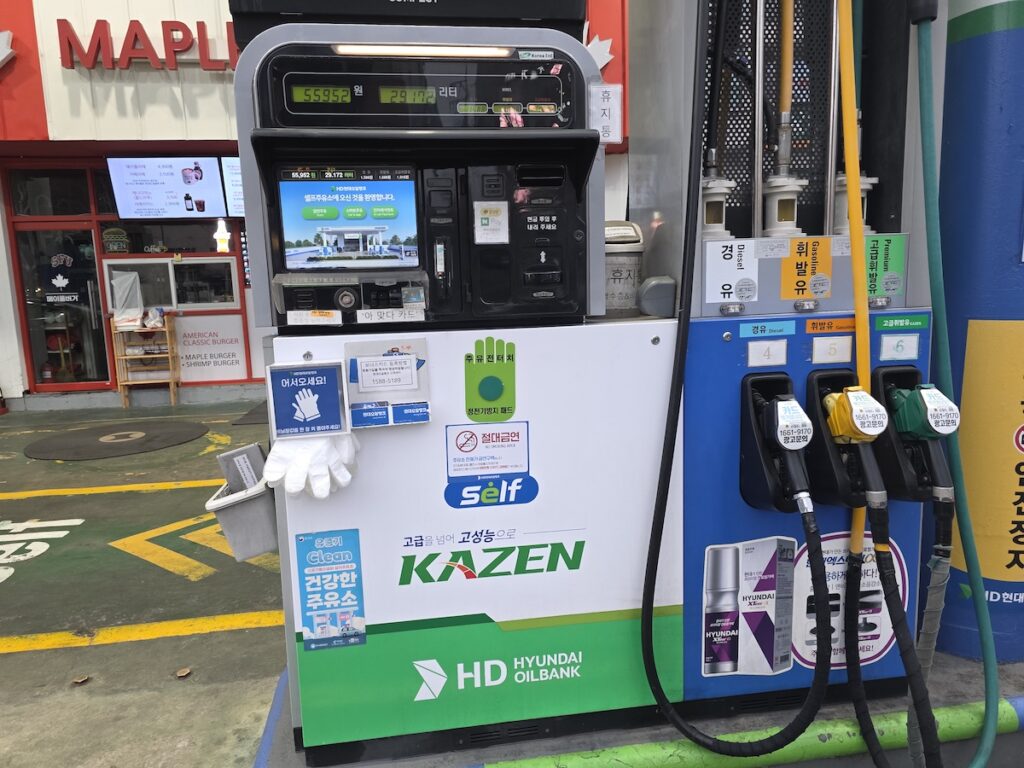
At many self-service gas stations, you may see an anti-static touch pad near the pump or screen. If the machine asks you to touch it before fueling, follow the instruction before handling the nozzle.
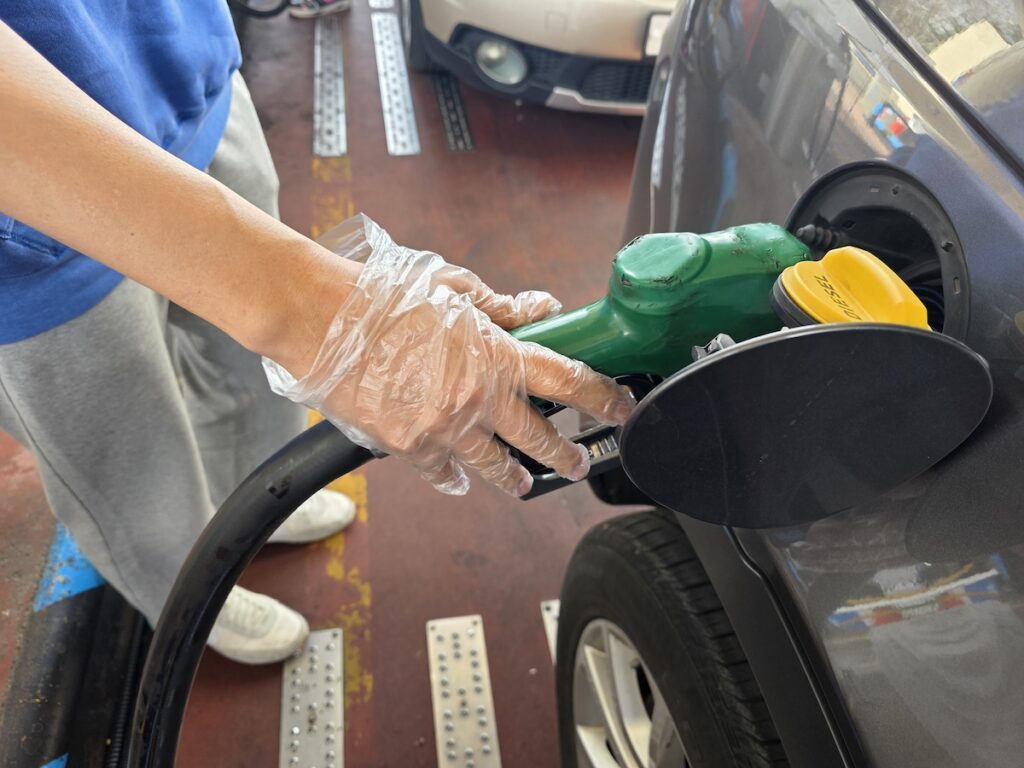
You may also see plastic gloves near the pump. These are usually provided to keep your hands clean while fueling. They can feel unusual if you are from a country where drivers normally pump fuel with bare hands, but in Korea they are a common part of the self-service station setup.
The basic rule is simple: follow the pump instructions, touch the anti-static pad if shown, and use the gloves if you want to keep your hands clean.
Paper Towels and Cleaning Supplies
Many Korean gas stations provide paper towels, tissues, or small cleaning supplies near the pump. Drivers may use them to wipe their hands, clean small spills, or handle the fuel nozzle more comfortably.
Not every station provides the same items, but the overall experience is usually clean and organized compared with gas stations in many countries.
Payment Options
Credit and debit cards are widely accepted at gas stations in Korea. Cash is also possible at many stations, but card payment is usually more convenient.
Some stations may accept Korean mobile payment options such as Samsung Pay, Naver Pay, or Kakao Pay. However, tourists should not rely only on mobile payments, especially if their payment app or card was issued outside Korea.
If you are using a foreign credit card, keep a backup card or some cash just in case. Most major stations handle card payments smoothly, but some self-service machines may reject certain foreign cards.
If You Live in Korea Long Term
If you are an expat or long-term resident, a Korean bank card can make daily payments easier, including fuel, parking, tolls, and convenience store purchases.
For short-term travelers, this is not necessary. A major international credit card is usually enough. But if you drive often in Korea, having a local payment method can reduce small payment problems at self-service pumps or parking machines.
5. Major Gas Station Brands in Korea
Korea has several major gas station brands. For most foreign drivers, the brand matters less than the fuel type, price, location, and whether the station is self-service or full-service.
Still, recognizing the main names can make driving feel easier.
GS Caltex
GS Caltex is one of the largest fuel brands in Korea. You will see its stations in cities, suburbs, and along major roads. The branding often uses green and blue colors.
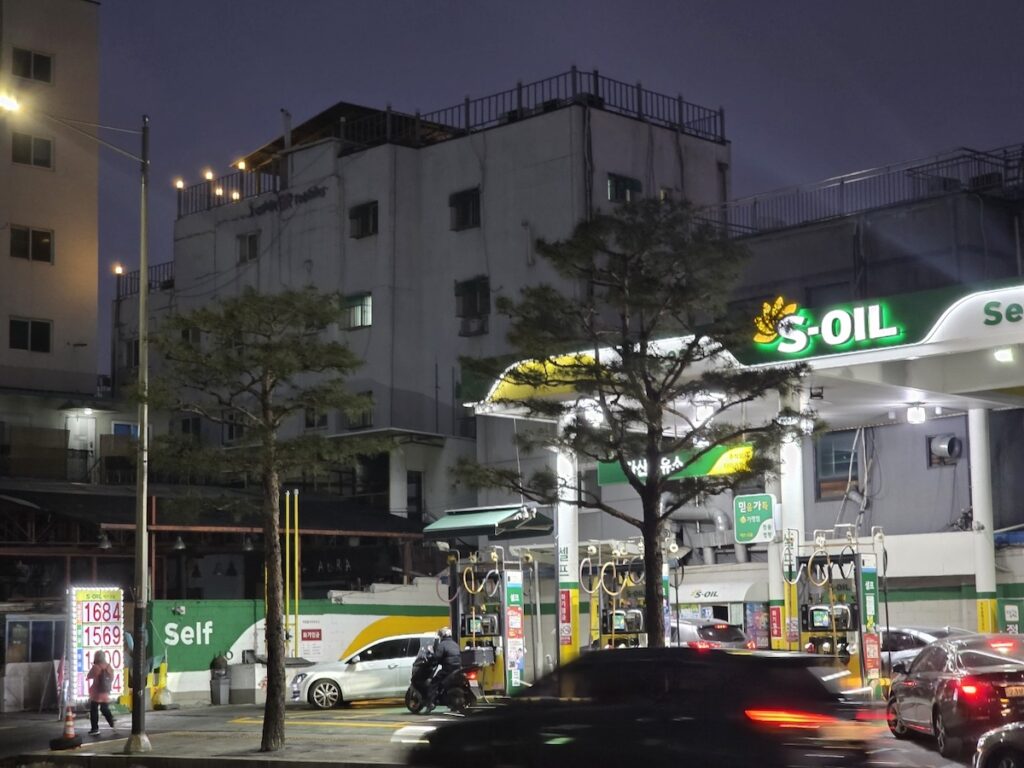
S-OIL
S-OIL is another common brand in Korea, often recognized by its yellow and red color scheme. It is widely available and easy to spot while driving.
SK Energy
SK Energy is one of Korea’s major fuel companies and has a strong presence across the country. You may see SK stations in both urban and rural areas.
Hyundai Oilbank
Hyundai Oilbank stations are also widely available. They are usually recognizable by blue and white branding.
Does the Brand Matter?
For a short-term visitor or rental car driver, you do not need to worry too much about choosing a specific brand. The more important questions are:
- Does the station have the correct fuel for your car?
- Is it full-service or self-service?
- Is the price reasonable?
- Can you pay with your card?
- Is it easy to enter and exit safely?
If you are low on fuel, choose a safe and convenient station rather than searching too long for a specific brand.
6. Gas Stations on Korean Highways
Gas stations on Korean highways are often connected to large expressway rest areas, known as hyugeso. These places are more than simple fuel stops. They usually have restrooms, food courts, convenience stores, snack stands, coffee, and sometimes regional specialty foods.
For foreign visitors, highway rest areas can be one of the more enjoyable parts of a Korean road trip.
Why Highway Gas Stations Are Convenient
Highway gas stations are useful because you can refuel, eat, use the restroom, and take a break in one stop. If you are driving from Seoul to Busan, Sokcho, Jeonju, Gangneung, or another city, these rest areas can make the trip much easier.
They are especially helpful if you are not familiar with local roads outside the expressway.
Are Highway Gas Stations More Expensive?
Highway gas stations may be more expensive than some city or suburban stations, but this is not always fixed. Prices change by location, brand, and market conditions.
The main reason drivers still use them is convenience. When you are already on the expressway, leaving the highway just to find cheaper fuel may not be worth the time, tolls, or stress.
If you want to save money, check fuel prices before a long drive and fill up near your starting point if you find a good price.
Ex-Oil and Highway Fuel Prices
Some highway rest areas have Ex-Oil stations, which are associated with Korea Expressway Corporation and are often known for competitive pricing on expressways.
If you see Ex-Oil while driving, it can be worth checking the price board. However, do not rely on one brand name alone. The best habit is to compare the displayed price before entering the pump area if it is safe to do so.
Rest Areas Are Part of the Trip
One thing foreign drivers may enjoy is how seriously Korea treats expressway rest areas. Many are clean, busy, and full of food options. Some travelers stop not only for fuel, but also for hot snacks, noodles, coffee, or local specialties.
This is one reason driving in Korea can feel different from driving in some Western countries. The gas station is not always just a gas station. On highways, it can feel like a small travel hub.
7. Practical Tips for Foreign Drivers
Using gas stations in Korea becomes much easier once you remember a few basic rules. Most problems happen when drivers rush, choose the wrong fuel, or assume every payment machine will work the same way as back home.
Check Your Fuel Type Before You Drive
Before leaving the rental office, confirm the fuel type of your car.
Remember these words:
| Korean | English |
|---|---|
| 휘발유 | Gasoline / petrol |
| 경유 | Diesel |
| 고급 휘발유 | Premium gasoline |
If you are not sure, check your rental agreement, fuel cap, or ask the rental staff before you start driving.
Do Not Guess at the Pump
If you arrive at a self-service station and feel unsure, stop and ask for help. Choosing the wrong fuel can create a much bigger problem than waiting a few extra minutes.
You can show the Korean fuel word on your phone or rental document and ask:
이거 맞아요?
Igeo majayo?
“Is this correct?”
Even a simple translation app can help you avoid a costly mistake.
Keep a Backup Payment Method
Most gas stations accept cards, but some self-service machines may not work smoothly with every foreign card. Keep a second card or some cash available, especially if you are driving outside Seoul or late at night.
If you live in Korea long term, a Korean bank card or local payment app can make refueling easier.
Check Prices Before a Long Drive
Fuel prices change often. If you are planning a long trip, check prices before you enter the expressway. OPINET or Korean map apps can help you compare nearby stations.
You do not need to chase the cheapest station every time. But filling up before a long highway drive can help you avoid relying only on expressway rest area prices.
Use Highway Rest Areas Strategically
Highway gas stations are convenient, especially during long-distance trips. Even if the price is not the lowest, they save time because you can refuel, eat, use the restroom, and take a break in one place.
For foreign travelers, Korean highway rest areas can also be part of the experience. They are often cleaner, larger, and more food-focused than visitors expect.
Take Your Time at Self-Service Stations
Self-service pumps can feel stressful if the screen is in Korean, but you do not need to rush. Look for the fuel label, select the payment method, check the amount, and follow the steps slowly.
If the station provides an anti-static touch pad or gloves, follow the instructions before fueling.
Final Thoughts: Gas Stations in Korea Are Easier Once You Know the Basics
Gas stations in Korea can feel confusing at first, especially when the pump screen is in Korean and you are trying to avoid choosing the wrong fuel. But once you know the main fuel words, the system becomes much easier to understand.
The most important things are simple: 휘발유 means gasoline, 경유 means diesel, and 셀프 means self-service. Check your rental car’s fuel type before driving, keep a backup payment method, and do not hesitate to ask for help if you are unsure.
For most foreign drivers, refueling in Korea is not difficult. It just requires a little preparation. And if you are driving on an expressway, a gas station may be more than a place to fill your tank. It can also be a rest stop, a food break, and a small glimpse into everyday Korean road trip culture.