1. A Tapestry of Faith: The Spiritual Hybrid of Korean Funerals
Korean Funeral Etiquette for Foreigners is a complex tapestry of ancient traditions and modern convenience that every international visitor should master in 2026. The first thing a foreigner must understand is that a Korean funeral is rarely a single-faith event. While the historical foundation is a mix of Confucianism (ancestral respect) and Buddhism (reincarnation), the specific ritual format often follows the family’s current religion—be it Protestantism, Catholicism, or Buddhism. Even for families with no religious affiliation, the ceremony remains a deeply cultural pillar where you might see a Christian choir singing hymns in front of a portrait framed by Buddhist-inspired white chrysanthemums.
2. The Logistics: Why You Are Heading to a Hospital
In many Western cultures, funerals take place at a dedicated funeral home or a church. However, in cities like Seoul, the vast majority of funerals are held in Funeral Halls attached to major hospitals. While standalone funeral homes exist primarily in rural provinces, the urban standard in 2026 is the hospital-annexed facility. This ensures convenience for medical procedures and provides a centralized location for the hundreds of guests who will arrive over the three-day period.
3. The Digital Summon: Receiving a KakaoTalk “Obituary”
In 2026, the tradition of hand-delivered letters is long gone. You will likely receive the news of a passing via KakaoTalk or a text message. This digital notice contains critical information that you must read carefully:
- The Location: The specific hospital and room number.
- The “Bal-in” (발인): This is a crucial concept to master. Bal-in refers to the funeral procession or the time the coffin leaves the funeral hall for the burial or cremation site.
- The Schedule: Usually, the standard is a 3-day funeral. However, during cold “change-of-season” periods, when mortality rates rise, cremation facilities can become fully booked. This may result in a 4-day funeral instead. Always check the Bal-in date to ensure you visit before the family departs.
4. The Dress Code: Modern Flexibility over Rigid Tradition
While a black suit, black tie, and black leather shoes remain the formal principle, the modern Korean funeral has become significantly more flexible.
- If you don’t own a suit: Do not panic. The act of showing up is far more important than the brand of your clothes.
- The Safe Zone: Any dark-colored, modest attire (navy, charcoal, or dark brown) is perfectly acceptable. No one will judge a foreigner for not having a full tuxedo, as long as the intention of respect is clear.
5. “Bu-ui-geum”: Navigating the Financial Etiquette
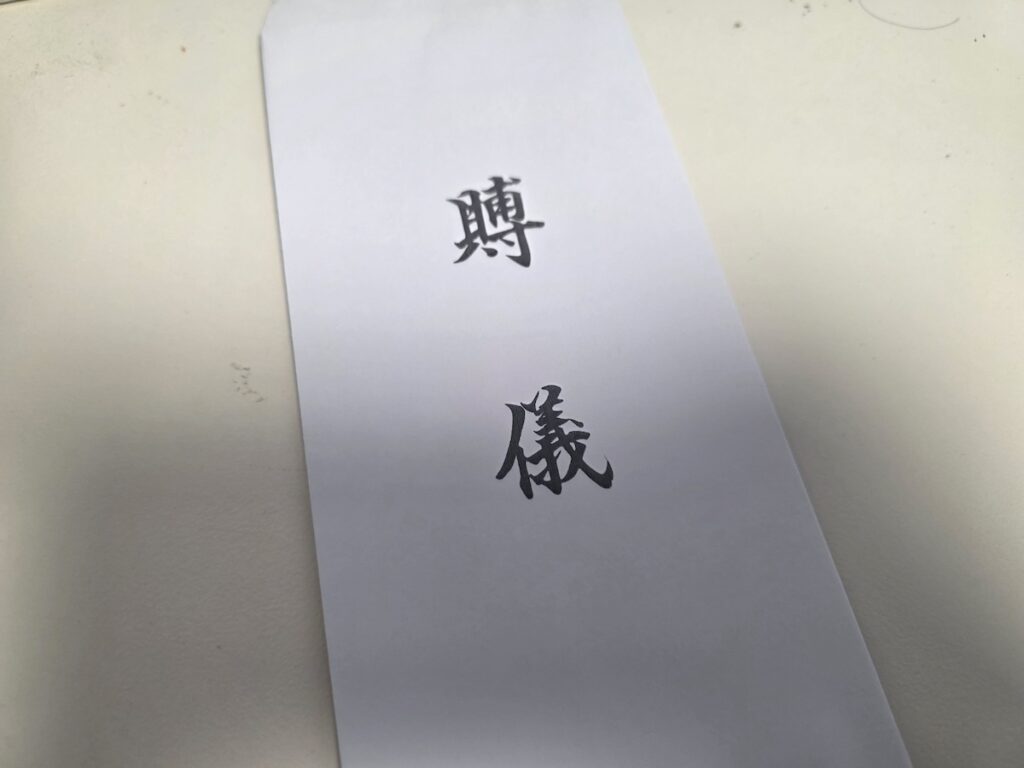
The most practical aspect of your visit is the “Bu-ui-geum” (Condolence Money). This is not just a gift; it is a communal contribution to help the family cover the significant costs of the three-day ritual.
- Standard Rates: In 2026, 50,000 KRW is the common standard for acquaintances, while 100,000 KRW is expected for closer colleagues or friends.
- Close Bonds: If you share a deep personal or business bond, you may choose to provide more, but always ensure the amount starts with an odd number (3, 5, 7) or is a “full” number like 10 (100,000).
6. Navigating the Hall: The Digital Guide and the Ritual of Entrance
When you enter the hospital’s funeral floor, you will likely be greeted by an array of digital monitors. These screens are your primary navigation tool, displaying the portrait of the deceased and the name of the Sang-ju (Chief Mourner) who invited you.
- The Power of Timing: While you can technically visit anytime, the most respectful window is between 6:00 PM and 9:00 PM. In Korean culture, being part of the “bustling crowd” during these peak hours provides the family with immense emotional support, ensuring they don’t feel alone in their grief.
- Preparing Your Envelope: I highly recommend preparing your Bu-ui-geum (condolence money) at the stations near these monitors. You will find stacks of white envelopes provided for guests.
- The “Poom-assi” Philosophy: Understand that this money is more than a gift; it is a manifestation of Poom-assi, a traditional communal culture of mutual aid. It is a practical way to support the family economically during a costly time.
- Identification Matters: On the back of the envelope, write your name vertically. To ensure the family recognizes you amidst hundreds of guests, it is wise to write your company name or affiliation next to your name.
- The Reception Desk: Locate the room number from the monitor and head to the reception desk at the entrance. Sign the Bui-rok (guest book) and place your prepared envelope in the collection box. If you are unsure, the attendants at the desk are there to assist you with a simple nod.
7. The Final Farewell: The Silent Respect of Bowing
As you step onto the elevated floor of the inner memorial room, you are entering the most sacred space of the ritual.
- The Direction of Your Shoes: Here is a “Marcus-tier” tip: When you remove your shoes, turn them so the fronts are facing the exit. This tiny act of mindfulness shows a level of cultural fluency that will deeply move the Korean family.
- The Traditional Bow (Jeol): If you choose to bow to the deceased, the standard is two and a half bows. You perform two full, deep bows to the floor and one slight half-bow while standing.
- The Logic: In Korean tradition, one bow is for the living, but two are reserved for the souls of the deceased.
- The Modern Alternative: If you are uncomfortable with bowing for religious or personal reasons, a silent prayer or a deep standing bow is perfectly acceptable and fully respected by the family.
- Greeting the Sang-ju: After acknowledging the deceased, turn to the Sang-ju and bow once. A short, sincere “I am sorry for your loss” is all that is needed.
8. The Commemorative Meal: Sharing the Gift of the Deceased
In Korea, the funeral meal is not just food; it is considered a final gift from the deceased to those who came to honor their memory.
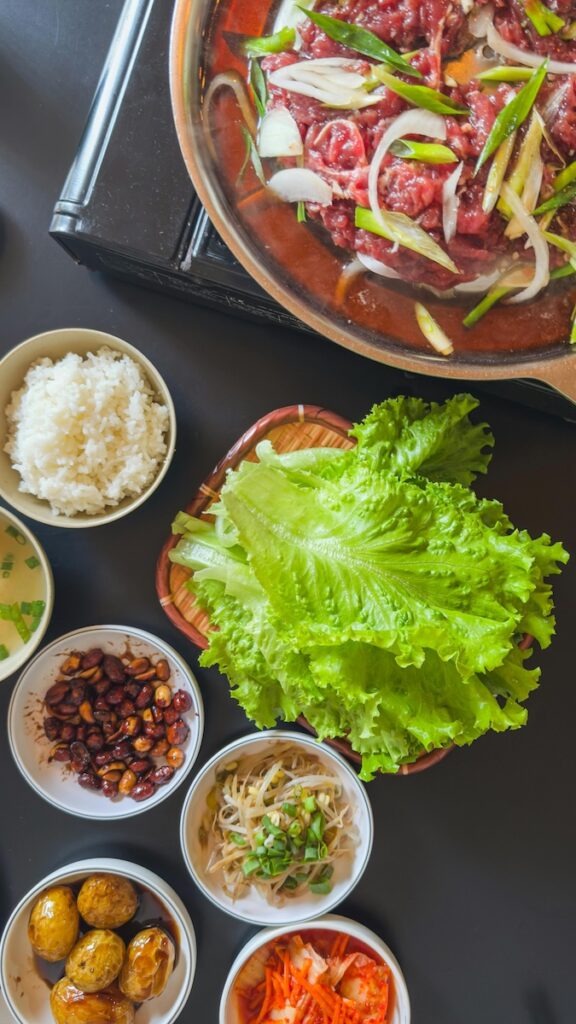
- The Signature Dish (Yukgaejang): You will almost certainly be served Yukgaejang, a hearty, spicy beef soup. Historically, its deep red color was believed to ward off evil spirits and protect the guests staying late into the night.
- The “No Clinking” Rule: While Soju or beer may be served, never clink your glasses or say “Cheers” (Geon-bae). In a house of mourning, “clinking” is seen as celebratory. Simply lift your glass slightly and drink in quiet reflection as you reminisce about the life of the person who has passed.
Related Guides: Decoding the Secrets of Korean Daily Life
To fully master the nuances of living in Korea in 2026, explore our deeper dives into the hidden hygiene and beauty rituals of the peninsula.
- 7 Amazing Secrets of Korean Bathroom Culture: Why You Don’t Need Shower Curtains
- Ever wondered why Korean bathrooms are designed as “wet rooms”? Discover the ingenious logic behind the open shower layout and why the absence of a curtain is actually a pinnacle of modern hygiene and efficiency.
- Korean Exfoliating Mitt: The Amazing Secret to Celebrity “Glass Skin”
- The glowing “Glass Skin” seen on K-Drama stars isn’t just about expensive creams. It’s about the humble exfoliating mitt found in every Korean household. Learn the professional technique to achieve ultimate skin radiance at home.
- The Unspoken Hygiene Standard: A Deep Dive into Korea’s Wet Wipe Culture
- In Seoul, a wet wipe is more than just a cleaning tool—it’s a social etiquette. From restaurants to public spaces, explore how this meticulous standard of cleanliness has shaped the daily behavior of millions.
9. Conclusion: The Heart Beyond the Ritual
Navigating a Korean Funeral for the first time can feel like walking through a complex, unfamiliar labyrinth of codes and customs. You may feel awkward, and you might worry about making a mistake with the bows or the envelope. However, there is one profound truth you must remember: In the heart of Korean grief, your presence is far more important than your performance.
Koreans are people who deeply value etiquette and tradition, yet they are also a people of immense gratitude for those who share in their sorrow. Even if your bows are slightly off, or your dress code isn’t perfectly formal, the family will not judge you. Instead, they will be moved by the sight of a “foreigner”—someone from a different world and appearance—stepping into their pain to offer a piece of their time.
By following these meticulous steps, from the direction of your shoes to the spicy bowl of Yukgaejang, you are sending a powerful message that transcends language: “I respect your culture, and I am here for you in your darkest hour”. In a society that values “Jeong” (deep communal bonding), your sincere participation transforms you from a mere visitor or business partner into a person they will never forget.
Don’t let the fear of doing it “wrong” stop you from going. Step into that funeral hall with a heavy heart and a respectful mind. You will find that by honoring their loss, you have gained a level of respect and connection that no business contract could ever provide.