Tipping culture in Korea is one of the first things foreigners get wrong — not because they don’t know the rule, but because they don’t understand what’s underneath it.
You finish a meal in Seoul.
The food was exceptional. The server refilled your water three times without being asked. Someone at the table next to you got a complimentary banchan you didn’t even order.
You reach for your wallet.
Then you freeze.
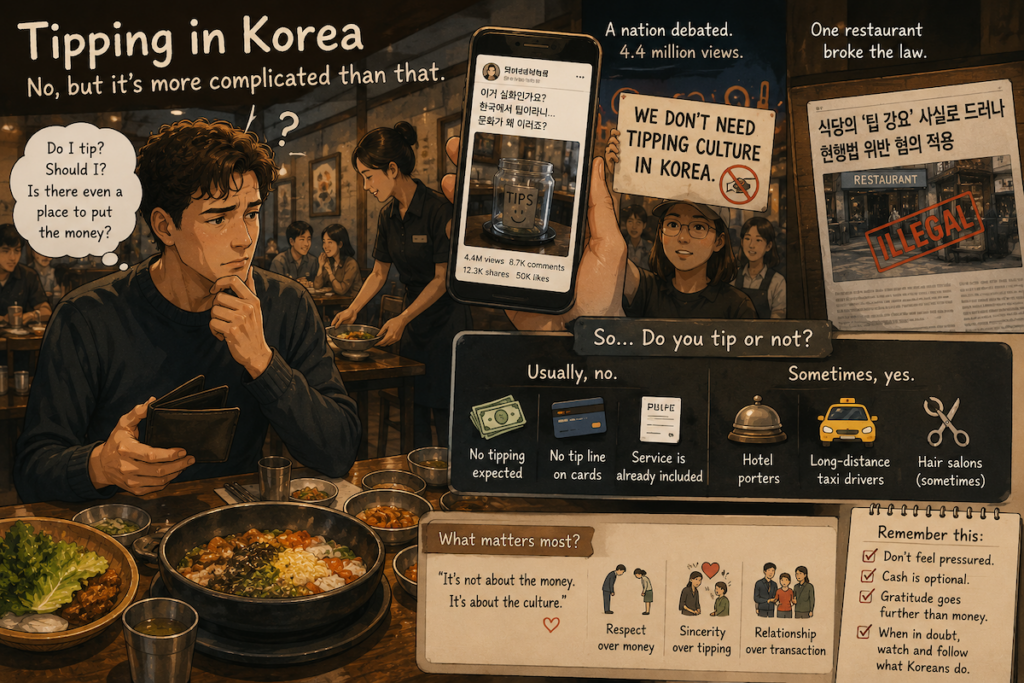
Do I tip? Should I? Is there even a place to put the money?
This moment — the tipping hesitation — happens to almost every foreigner in Korea at some point. Usually more than once.
The short answer is: no, you don’t tip. But the short answer misses everything interesting about why tipping in Korea feels the way it does — awkward, loaded, and more culturally complex than most travel guides acknowledge.
Because here’s what those guides don’t tell you: Korea has had a genuine national debate about tipping. A single photo of a tip jar went viral with 4.4 million views. Cafes have faced public backlash. A restaurant was found to be technically breaking the law. And at the same time, in certain very specific dining situations, tipping quietly happens — and nobody finds it strange at all.
Understanding all of this gives you something more useful than a yes or no answer. It gives you a real read on how Korean society thinks about service, money, and the relationship between the two.
→ Related: Tipping in South Korea — The 2026 Practical Guide
Quick Answer: Why Is Tipping Awkward in Korea?
Tipping is awkward in Korea because it sits outside the social and legal framework Korean service culture is built on. By law, menu prices must include all taxes and service charges — meaning the price you see is the complete price, and the staff’s compensation is already built in. Offering a tip can unintentionally signal that you think the system is broken, or worse, that you see the staff as someone who needs charity rather than a professional doing their job. However, tipping is not universally absent — in specific high-end dining contexts, informal gratuity does happen and is quietly appreciated.
The Legal Foundation Nobody Talks About
Most conversations about tipping in Korea start with culture. They should start with law.
Under South Korea’s Food Sanitation Act, the price displayed on a menu must include both value-added tax and any service charges. This is not a suggestion. It is a legal requirement.
What this means in practice: when you sit down at a Korean restaurant and see ₩15,000 next to a dish, that number already contains everything. Tax. Service. The complete cost of the meal. There is no hidden layer waiting to be added at the end.
This is structurally different from the American system, where menu prices are pre-tax and service staff are often paid below minimum wage on the legal assumption that tips will make up the difference. In Korea, servers are regular salaried employees. Their income does not depend on customer gratuity. The system was designed this way deliberately.
This legal foundation matters because it changes the entire meaning of a tip.
In the US, tipping is moral obligation — you are completing the server’s wage. In Australia, tipping is appreciation — a top-up for exceptional service. In Korea, tipping is a category error — the transaction is already complete.
Handing someone money after a complete transaction, in Korean social logic, can feel less like a compliment and more like an implication that something was missing.
The Tip Jar Incident — And Why It Became a National Story
In July 2023, a single photo changed the conversation.
Someone posted a picture of a glass jar labeled “Tip Box” sitting on the counter of a Seoul cafe. The jar was filled with Korean won. The caption: “A type of culture we don’t want to have in Korea: tipping.”
The post received 4.4 million views. Within days, it had sparked a national debate.
The reaction was swift and almost uniformly negative. Online comments included:
“If you’re going to implement tip culture, go to the States.”
“Why did they start tip culture here? Please explain this.”
“Requesting an amount not specified in advance is clearly illegal.”
The cafe in question — the popular London Bagel Museum in Seoul — responded by claiming the tip jar had been placed as a decorative prop, not an actual solicitation. It was removed shortly after.
But the controversy did not end there.
In the months and years that followed, similar incidents surfaced. A noodle restaurant in Nowon District added a 300-won “staff dinner contribution” as an optional item at its self-service kiosk. A pizzeria was found requiring a mandatory 2,000-won tip before customers could even place an order. A grilled eel restaurant requested a 5,000-won tip per table for “kind service.” Kakao Mobility piloted a tipping feature for taxi drivers — and pulled it after significant public resistance.
Each incident produced its own backlash. Each backlash revealed something consistent about how Korean consumers feel.
The reaction was not simply “we don’t tip here.”
It was something closer to: “this system tries to shift a cost that should belong to the business onto the customer, and we find that deeply unfair.”
One restaurant owner captured the business-side anxiety perfectly, telling media: “If you order a lot of food, you end up paying more tips” — expressing concern that tipping could actually reduce sales by making the total cost feel unpredictable and inflated.
Even Americans reading the coverage reacted with something close to envy. Comments from US readers included sentiments like: “I hope this doesn’t spread there. Korea is already expensive enough.”
What the Backlash Is Really About
To understand why Koreans reacted so strongly, you have to understand something about Korean service culture.
In Korea, high-quality service is not considered exceptional. It is considered standard.
The expectation — deeply embedded across restaurants, cafes, hotels, and retail — is that staff will be attentive, efficient, and professional as a baseline. Not because they might receive extra money. Because that is the job.
This connects to something broader in Korean social culture: the idea that service is a form of professional pride, not a performance calibrated to a tip. A server who refills your water quickly is not doing you a special favor. They are doing their job well. Offering money on top of a complete transaction can subtly imply that you didn’t expect them to do it well — which lands, in Korean social logic, closer to an insult than a compliment.
→ Related: Why Korean Social Culture Operates on Different Assumptions
There is also a class dimension. The viral Twitter reaction included references to American tipping culture as a mechanism that allows businesses to underpay workers. Koreans saw the tip jar not as generosity but as the beginning of a structural shift — one that would make customers responsible for compensating labor that employers should be paying for directly.
The resistance, in other words, was not just about money. It was about what kind of service economy Korea wants to be.
The Exception: Where Tipping Actually Happens in Korea
Here is where the story gets more nuanced — and more useful for foreigners.
Despite the backlash against formal tip culture, there are specific dining contexts in Korea where informal gratuity quietly happens. Not as a rule. Not as an expectation. But as a natural expression of genuine appreciation in situations where someone has provided something beyond the transactional.
High-end Korean BBQ — especially the premium cuts
At restaurants serving premium beef — wagyu-grade hanwoo, the best cuts of galbi and chadolbaegi — some establishments provide a staff member whose entire role is to manage the grill at your table. They control the heat, turn the meat at exactly the right moment, cut portions, and time the meal so everything arrives perfectly.
This is not standard table service. It is skilled, attentive, hands-on work for the duration of your meal. In these settings, particularly among Korean diners who understand and value what they are watching, it is not unusual for a folded bill to be quietly left at the end.
No announcement. No tip line on the receipt. Just a discreet gesture that says: I noticed what you did, and I appreciated it.
Grilled eel restaurants
Jangeo — Korean grilled eel — is a dish that requires real technique. The fish is prepared tableside in many establishments, and the person managing the grill often has years of experience reading texture, timing, and heat. In premium eel restaurants, the same informal gratuity culture can appear.
This was actually part of the tip jar controversy — one of the restaurants that attempted to formalize tipping was a grilled eel restaurant, which suggests that informal tipping was already happening there and the owner attempted to institutionalize it. The backlash was not against the appreciation itself, but against making it mandatory and visible.
Premium raw fish and tuna restaurants
At high-end hoe (Korean raw fish) restaurants and dedicated tuna specialty restaurants — where a skilled chef is breaking down a whole tuna at the table, selecting cuts, explaining each piece — a similar dynamic sometimes appears. The experience crosses from restaurant service into something closer to a performance or craft demonstration. In those situations, quiet appreciation sometimes takes the form of a small gesture.
What these situations have in common
In each case, the tipping happens around a specific person doing a specific skilled thing — not as a blanket gratuity for “the restaurant” or “the staff.” It is personal. Targeted. And almost always done quietly, without making it a transaction.
This distinction matters enormously in Korean social culture. A tip left discreetly for the person who grilled your meat for two hours feels different from a tip jar demanding gratuity from everyone who orders a coffee.
One is recognition. The other feels like obligation.
What Foreigners Should Actually Do
In standard restaurants and cafes: nothing.
The meal is complete when you pay the bill. No tip line exists on Korean card machines — this is not an oversight, it is by design. Walking out after paying the exact amount on the receipt is not rude. It is correct.
If you genuinely want to express appreciation:
The most culturally natural options:
Verbal acknowledgment — “Jal meogeot-seumnida” (잘 먹었습니다) — “I ate well” — said sincerely on the way out carries real meaning in Korean dining culture. It is heard. It is appreciated.
Return — Coming back to the same restaurant is the highest compliment in Korean food culture. It tells the owner and staff that you valued the experience enough to choose them again.
If you absolutely want to give something — small gifts (a nice drink, a box of snacks from a quality convenience store) land more naturally than cash in most contexts. Cash can feel transactional. A gift feels personal.
In high-end BBQ, eel, or tuna restaurants where someone worked your table personally:
If you felt the service was genuinely exceptional and the person who provided it was skilled and attentive, a quietly folded bill left at the end is not inappropriate. Keep it small and discreet — ₩5,000 to ₩10,000. Do not make it a moment. The gesture matters; the performance of the gesture does not.
In luxury hotels:
A bellperson who handles significant luggage or a concierge who goes meaningfully beyond their role — ₩5,000 to ₩10,000 is acceptable. This is the one context in Korea where international tipping norms are most understood and most expected, particularly in properties that cater heavily to foreign guests.
The Bigger Picture: What This Tells You About Korea
The tipping debate in Korea is not really about money.
It is about two different philosophies of what service means.
One philosophy — the American model — treats service as a variable performance where staff compete for tips by exceeding expectations. The customer becomes the judge. The tip is the score.
The other philosophy — the Korean model — treats service as a professional standard. Excellence is the baseline, not the ceiling. The customer pays the agreed price. The transaction is complete. Dignity is distributed equally across the interaction.
Neither model is perfect. The American system can create genuinely motivated, personalized service — and also exploitative wage structures. The Korean system can produce consistently excellent professional service — and also occasional rigidity, where there is no mechanism to express genuine appreciation beyond words.
What the backlash against tip jars revealed is that Koreans, when confronted with the choice directly, overwhelmingly prefer their own model.
Not because they are resistant to change. But because they understand what replacing it would cost.
For foreigners, this is worth sitting with.
The service you receive in Korea — the attentiveness, the refills, the efficiency, the care — is not a performance hoping for a reward. It is a standard. Understanding that changes how the experience feels.
And maybe, after enough time in Korea, you start to wonder why it ever needed to be anything else.
Written by Marcus Park — Seoul local for over 10 years. Citygram Seoul provides deep-context guides for foreigners who want to understand Korea beyond the surface.
→ Related: Tipping in South Korea — The 2026 Practical Guide
→ Related: Why Korean Social Culture Operates on Different Assumptions — Complete Guide