You are watching a K-drama.
Ten episodes of tension. Slow glances. Almost-moments. A hand that brushes another hand and then pulls away. The music builds. They are finally face to face.
And then it happens.
He leans in. She freezes. Their lips touch — and then nothing. Eyes open. Bodies completely still. Two people standing with their mouths pressed together like they forgot what comes next.
You pause the screen.
Is that it?
Why do K-drama kisses look so awkward is one of the most searched questions foreigners ask after their first few weeks of watching Korean content. It shows up on Reddit. It floods Quora. It generates comment sections that run for hundreds of replies.
And the answers people find are almost always the same: “It’s the broadcasting regulations.” “Korean actors are just shy.” “It’s a cultural thing.”
All of those answers are partially correct. None of them go deep enough.
Because the real answer — the one that actually explains what you are seeing — starts with a word distinction that does not exist in English.
Quick Answer: Why Do K-Drama Kisses Look Awkward?
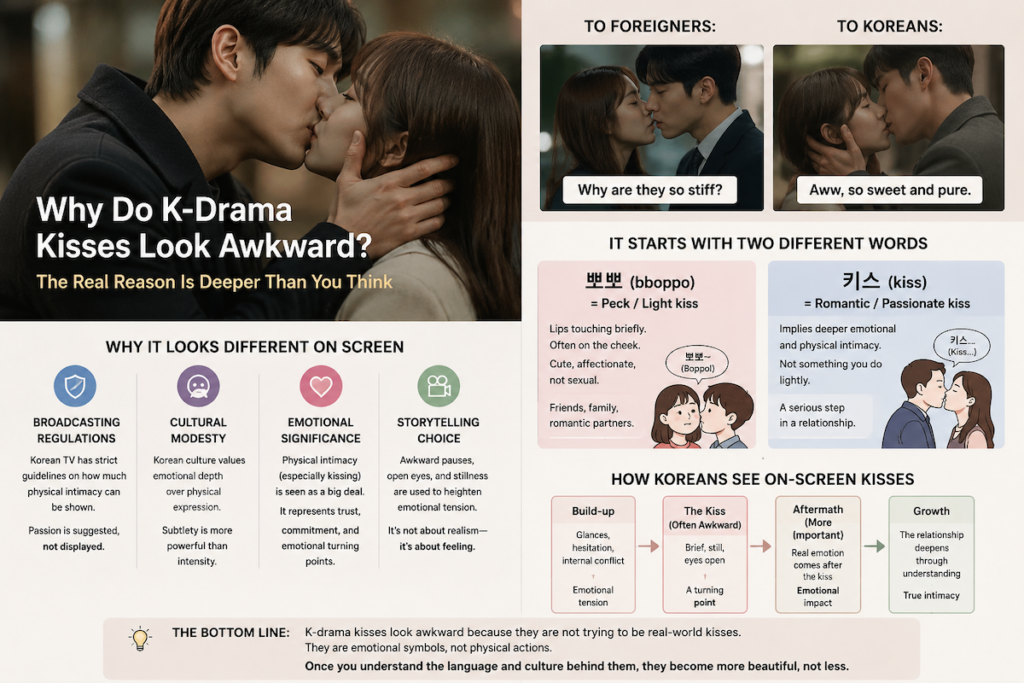
K-drama kisses look awkward to foreign viewers because Korean on-screen intimacy follows a different logic entirely. What appears stiff or unfinished is often intentional — a reflection of how Korean culture treats physical intimacy as emotionally significant rather than physically expressive. But there is a deeper layer: in Korean, the words 뽀뽀 (bboppo) and 키스 (kiss) describe genuinely different acts — and even among Koreans themselves, the line between them is blurry, contested, and surprisingly personal. Understanding this distinction changes everything about how K-drama romance reads on screen.
There Are Two Different Words — And They Mean Very Different Things
English has one word for it: kiss.
Korean has two.
뽀뽀 (bboppo) — lips touching lips, briefly, with minimal pressure. Closed mouth. No movement. The kind of thing a parent gives a child. The kind of thing that might happen at the end of a first date. Tender. Safe. Emotionally loaded in a specific, restrained way.
키스 (kiss) — the borrowed English word, used in Korean for something more. Open mouth. Longer. More physically present. When Koreans say 키스, they mean something meaningfully different from 뽀뽀.
In English, you would use “kiss” for both. In Korean, these are genuinely separate categories — with separate emotional weights, separate social implications, and separate expectations attached to them.
This distinction matters because what you are watching in most K-dramas is 뽀뽀.
Not because the director forgot to film a real kiss. Because 뽀뽀 is, within Korean romantic culture, a complete and significant act. It does not need to become something more to count. It is not the beginning of something. It is the thing itself.
The First Kiss Problem — And Why It Is Not What You Think
In Korean, the phrase is 첫키스 — first kiss.
Every Korean speaker knows this phrase. It carries weight. First kisses are remembered. Discussed. Sometimes mythologized.
But here is what nobody explains to foreign viewers:
When most Koreans imagine their 첫키스, what they picture is not what English speakers imagine when they hear “first kiss.”
They picture 뽀뽀.
The word says 키스. The mental image is 뽀뽀. And for many Koreans — particularly older generations, or anyone who grew up in a more conservative household — this is not a contradiction. It is simply how the categories work.
This creates a very specific kind of cultural confusion that plays out in real conversations.
The Scene That Happens at Every Korean Drinking Table
Imagine a group of Korean friends at a 회식 — a group dinner, slightly drunk, comfortable enough to say things they wouldn’t sober.
Someone asks the friend who has never been in a relationship:
“야, 너 키스는 해봤냐?” “Hey — have you ever kissed someone?”
The friend thinks. Then: “어… 고등학교 때 뽀뽀는 해봤는데.” “I mean… I did bboppo in high school.”
Immediately, someone at the table: “그건 키스가 아니지!!” “That doesn’t count!!”
This scene — or some version of it — happens in Korean social life with enough regularity that most Korean adults have either witnessed it or been part of it.
And it reveals something that travel guides and K-drama explainers consistently miss:
Even among Koreans, the line between 뽀뽀 and 키스 is not agreed upon.
One person counts high school 뽀뽀 as a first kiss. Another insists it does not qualify. There is no official answer. The ambiguity is built into the culture itself — into the fact that two separate words exist for acts that exist on a spectrum rather than in discrete categories.
The French Complication — And What It Reveals
When I studied French at university, I encountered 비쥬 — the French greeting kiss.
La bise. Two people meeting, tilting toward each other, making a sound near the cheek. Sometimes lips touch cheek. Sometimes lips touch air. Sometimes it is one side, sometimes two, sometimes three depending on the region.
My first question: Is this a kiss?
The answer is genuinely unclear. It is called a kiss. It involves lips and proximity. But it is also a greeting performed between strangers, between colleagues, between people who have never met before. By any Korean standard — 뽀뽀 or 키스 — it does not fit either category.
Which raises the real point:
Every culture draws the line somewhere different. What counts as intimate contact, what counts as casual contact, what requires emotional context and what does not — these are not universal human categories. They are cultural agreements, negotiated over generations, embedded in language.
Korean has 뽀뽀 and 키스 because Korean culture needed two words for two genuinely different experiences.
English collapsed them into one because English-speaking cultures drew the line differently.
French 비쥬 exists in a category that Korean has no word for — because Korean culture never needed one.
None of these systems is more or less sophisticated. They are just different maps of the same terrain.
So Why Does It Look Awkward on Screen?
Here is the honest answer — in three parts.
Part 1: Broadcasting Regulations Are Real
Korean terrestrial television (KBS, MBC, SBC) operates under content guidelines that have historically restricted on-screen physical intimacy. This is real, documented, and has shaped K-drama kiss scenes for decades.
But regulations alone do not explain everything. Cable channels and streaming platforms operate under different — often much more relaxed — rules. And even on those platforms, the restrained lip press appears regularly. Which means something beyond regulation is at work.
Part 2: The Act Being Performed Is 뽀뽀, Not 키스
What reads as an “unfinished” kiss to foreign viewers is often, within the logic of the scene, a complete act. The characters are exchanging 뽀뽀 — which is emotionally significant in Korean romantic culture without needing to escalate into something more.
The awkwardness foreign viewers perceive is partly the experience of watching a culturally complete gesture through a lens calibrated for a different system.
Part 3: Physical Stillness Communicates Differently in Korean Romance
In Western romantic visual culture, physical movement during a kiss signals genuine passion. Someone who kisses back is attracted. Someone who stands still is shocked, or conflicted, or not ready.
Korean romantic visual culture — both on screen and off — often operates on a different register. Stillness during physical intimacy can communicate being overwhelmed rather than being unmoved. The frozen quality that foreign viewers read as awkward is sometimes specifically intended to convey intensity — the character so affected by the moment that movement becomes impossible.
This is not a rationalization. It is a genuinely different aesthetic grammar.
How K-Drama Kiss Culture Has Changed — And What It Reveals
Watch a K-drama from 2005. Then watch one from 2025.
The difference is significant.
2005: A kiss is an event. It happens once, maybe twice in sixteen episodes. The camera cuts away or zooms into eyes. The music swells. The scene ends.
2025: Kisses happen earlier. More frequently. With more physical presence. Cable dramas and streaming originals — Netflix, Disney+, Wavve — operate under fundamentally different content guidelines than terrestrial broadcasters, and it shows on screen.
This is not a coincidence. It reflects something real happening in Korean society — a generational shift in how physical intimacy is understood, expressed, and considered appropriate for public viewing.
The Generational Divide Is Real
Korean attitudes toward physical intimacy between generations are not just different. They are sometimes operating in completely separate frameworks.
The parent generation — roughly anyone over fifty:
Physical affection between couples was largely a private matter. Public displays of affection — hand holding, embracing, kissing — carried social risk. Not legal risk. Social risk. The awareness that someone might see, might judge, might whisper.
For this generation, 뽀뽀 as a complete romantic act is not a diminished version of something more. It is simply what intimacy looked like — tender, brief, private.
The current twenty and thirty-something generation:
Seoul’s streets tell a different story. Couples hold hands openly. Couples embrace at subway exits. In Hongdae, in Sinchon, in the parks along the Han River on weekend evenings, young Korean couples display affection in ways that would have been genuinely unusual twenty years ago.
The vocabulary has shifted too. Younger Koreans use 뽀뽀 and 키스 with clearer distinctions — and are more likely to mean something closer to the Western understanding of “kiss” when they say 키스.
The frozen lip press that dominated K-drama screens for decades is increasingly a period aesthetic — accurate to a specific generation’s experience, but no longer the universal Korean romantic register.
What Korean Couples Actually Do in Public
This is the question foreign viewers eventually get around to asking.
The K-drama answer and the real Seoul answer are not the same — and the gap between them has narrowed significantly in the past decade.
What you will see in Seoul in 2026:
In areas with younger demographics — Hongdae, Sinchon, Itaewon, the Han River parks on weekend evenings — couples hold hands as a baseline. Embracing while waiting for food, leaning against each other on park benches, brief kisses at subway station exits — these are present and unremarkable among younger Koreans.
What you will not see:
Extended physical displays. Prolonged kissing in crowded public spaces. The kind of casual physical familiarity that reads as completely normal in parts of Western Europe or Latin America.
The line still exists. It has simply moved.
Korea in 2026 is not the Korea of the 2005 K-drama. It is also not Paris. It sits somewhere between — a society in genuine transition, where the older framework and the newer one coexist, sometimes within the same family, sometimes within the same couple depending on who might be watching.
Why Streaming Changed Everything
The introduction of Netflix original Korean content — and the subsequent explosion of Korean streaming platforms — did something that decades of cable television had been doing gradually: it decoupled Korean drama production from terrestrial broadcasting standards.
The results were immediate and visible.
Squid Game (2021). The Glory (2022). Mask Girl (2023). These are not shows operating under the aesthetic grammar of the frozen lip press. They contain violence, sexuality, and moral complexity that terrestrial Korean broadcast had historically avoided.
And in the romance space: streaming Korean dramas began featuring kisses that foreign viewers immediately recognized as “real” — longer, more physically present, more mutual.
The interesting thing is what this revealed.
When Korean actors and directors were freed from the constraints of terrestrial broadcast guidelines, they did not immediately produce content that looked like American romantic television. The aesthetic sensibility — the emphasis on emotional weight over physical expression, the tendency to let a single moment carry enormous significance — remained recognizably Korean.
What changed was degree. What stayed was the underlying grammar.
The Honest Answer About Awkwardness
Let’s return to the original question.
Why do K-drama kisses look awkward?
The complete answer, assembled from everything above:
They look awkward because you are reading them in the wrong language.
Not literally. But aesthetically.
When you watch a K-drama kiss through a visual grammar calibrated for Western romantic content, you are applying a set of expectations — about movement, reciprocity, duration, physical presence — that the scene was not designed to meet.
The frozen quality reads as inexperience or discomfort because in Western romantic visual culture, stillness during a kiss means something is wrong. In Korean romantic visual culture — particularly the version that dominated screens from the 1990s through the 2010s — stillness meant being overwhelmed. Undone. So affected by the moment that the body simply stops.
The eyes-open quality reads as staged because in Western romantic content, closed eyes signal genuine surrender to the moment. In Korean romantic content, open eyes can signal the opposite of detachment — hyper-presence. I am watching this happen. I cannot look away from it. This is real.
These are not rationalizations. They are genuinely different aesthetic systems that evolved from genuinely different cultural contexts.
What Actually Makes a Kiss Mean Something
Here is what K-dramas get right — and what foreign viewers eventually understand after enough episodes.
The meaning of a kiss in Korean romantic storytelling is almost never in the physical act itself. It is in everything surrounding it.
The episodes of buildup. The almost-moments that did not happen. The specific circumstances that finally made it possible. The expressions immediately after. The silence. What is said or not said in the scene that follows.
A 뽀뽀 at the end of episode twelve, after twelve episodes of a specific emotional journey, carries more weight in Korean romantic storytelling than a full kiss at the end of episode two would.
This is not a consolation prize version of romance. It is a different theory of where romantic meaning lives.
Western romantic content tends to locate meaning in the physical act — the intensity of the kiss itself signals the intensity of the feeling.
Korean romantic content tends to locate meaning in the accumulated emotional context — the kiss is the punctuation mark on a sentence that has been building for a very long time.
Neither system is wrong. They are different answers to the same question: how do you show, on screen, that two people are in love?
The Bboppo You Remember
There is one more thing worth saying.
In Korean, there is a specific cultural belief — more sentiment than superstition, but held with genuine warmth — that your 첫키스 is something you remember forever.
The word says 키스. But what most people are actually remembering, when they reach back for that moment, is something quieter.
A moment that probably looked, from the outside, like two people pressing their lips together and standing completely still.
Which is to say: it looked exactly like every K-drama kiss that foreign viewers find awkward.
And yet — for the person who experienced it — it was the whole world.
That is not awkwardness. That is a different scale of measurement.
A Note on Where Korea Is Going
The frozen lip press is not disappearing. But it is becoming one register among several — a specific aesthetic choice rather than the default.
Younger Korean directors, working primarily for streaming, are making different choices. Younger Korean audiences are watching both the traditional register and the newer one, and seem comfortable with both. The 뽀뽀/키스 distinction remains linguistically alive — the drinking table argument still happens, younger Koreans still navigate the ambiguity — but the cultural gap between what the words describe and what happens on screen is narrowing.
Korea is not becoming Western. It is becoming more itself — more varied, more internally diverse, more willing to let different registers exist simultaneously.
Which means that in ten years, the question “why do K-drama kisses look so awkward?” may be harder to answer — not because the culture has abandoned its aesthetic grammar, but because that grammar will have expanded to contain more.
Final Thought
The next time you pause a K-drama on the frozen lip press and feel the urge to ask why it looks so awkward — ask a different question instead.
What would it mean if this moment were the most significant thing that has happened to either of these characters in years?
Watch it again with that question.
It will look completely different.