The most crowded places in Seoul on weekends are not a secret. They show up on every tourist map, every travel blog, every “things to do in Seoul” list.
But here is what those lists do not tell you:
Most Koreans who live in Seoul actively avoid these places on weekends.
Not because the places are bad. But because 10 million people live in this city, and the locals have learned — through painful experience — exactly which streets turn into human compression zones between Saturday noon and Sunday midnight.
This guide gives you both sides.
The five places where the crowds peak — with real data behind why — and what Koreans actually do instead. Whether you came to Seoul to experience the density or to escape it, knowing both options makes the weekend dramatically more navigable.
Quick Answer: Where Are Seoul’s Most Crowded Weekend Spots?
Based on Seoul Metropolitan Government’s real-time city data (서울 실시간 도시데이터) — which aggregates telecom signal data, card transaction volumes, and public transit usage across 120 locations citywide — the five consistently highest-density weekend zones in Seoul are Hongdae, Gangnam Station area, Myeongdong, Jamsil, and Seongsu-dong. Peak congestion across all five occurs between Saturday 6 PM and 10 PM. Each zone draws a different type of crowd for different reasons — and each has a local alternative that most tourists never find.
→ Check real-time crowd levels: Seoul Real-Time City Data
1. Hongdae (홍대) — The One That Never Empties
Peak hours: Friday 9 PM – Saturday 2 AM / Saturday 6 PM – Sunday midnight
Why it gets this crowded:
Hongdae is not one neighborhood. It is four or five neighborhoods that have merged into a single mega-district — Hongdae proper, Hapjeong, Sangsu, Yeonnam-dong, and the area around Sinchon — all feeding into the same pedestrian corridor. On weekend evenings, these streams of people converge simultaneously.
Add: three subway lines intersecting at Hongik University Station, the Airport Railroad bringing international visitors directly from Incheon, and the R1/R2 Red Road busking zone drawing street performance crowds — and you have the conditions for Seoul’s most consistently packed weekend environment.
The Seoul real-time city data marks Hongdae as “매우 붐빔” (extremely crowded) on Saturday evenings with more regularity than any other district in the city.
What the crowd looks like:
Younger demographic — university students, international visitors, K-pop fans. The energy is genuine and the street performance culture is real. But Saturday after 8 PM, the main corridor between Exit 8 and the R4 zone becomes genuinely difficult to move through.
The local alternative:
Koreans who want the Hongdae atmosphere without the compression go to Mangwon-dong — one subway stop away on the Gyeongui-Jungang Line. Same young energy, independent cafes, good food. Essentially zero tourist density. The Han River park at Mangwon is where Seoul locals actually spend Saturday afternoons.
→ Related: Hongdae R2 Busking Zone in 2026 — What’s Actually Happening
2. Gangnam Station Area (강남역) — The Concrete That Never Breathes
Peak hours: Saturday 2 PM – 9 PM (consistent year-round)
Why it gets this crowded:
Gangnam Station is the most heavily used subway station in Seoul — consistently ranking at or near the top for daily passenger volume. On weekends, this base traffic combines with: the major commercial strip along Gangnam-daero, the concentrated cluster of large cram schools (학원) whose students flow in and out throughout the day, department stores, and the fact that “강남역” has become the default meeting point for the entire southern half of Seoul.
“Let’s meet at Gangnam Station Exit 11” is the Korean equivalent of “let’s meet at Times Square” — said with the same mixture of convenience and resignation.
What the crowd looks like:
Unlike Hongdae’s younger demographic, Gangnam draws a broader age range. Office workers, families, couples, students. The density is less chaotic than Hongdae but more relentless — it does not have an off switch.
The local alternative:
Koreans who need to be in the Gangnam area but want to actually move freely go to Garosu-gil — a tree-lined street about 15 minutes walk from Gangnam Station toward Sinsa-dong. Independent boutiques, good cafes, walkable. The density is a fraction of the main Gangnam strip and the atmosphere is significantly more pleasant.
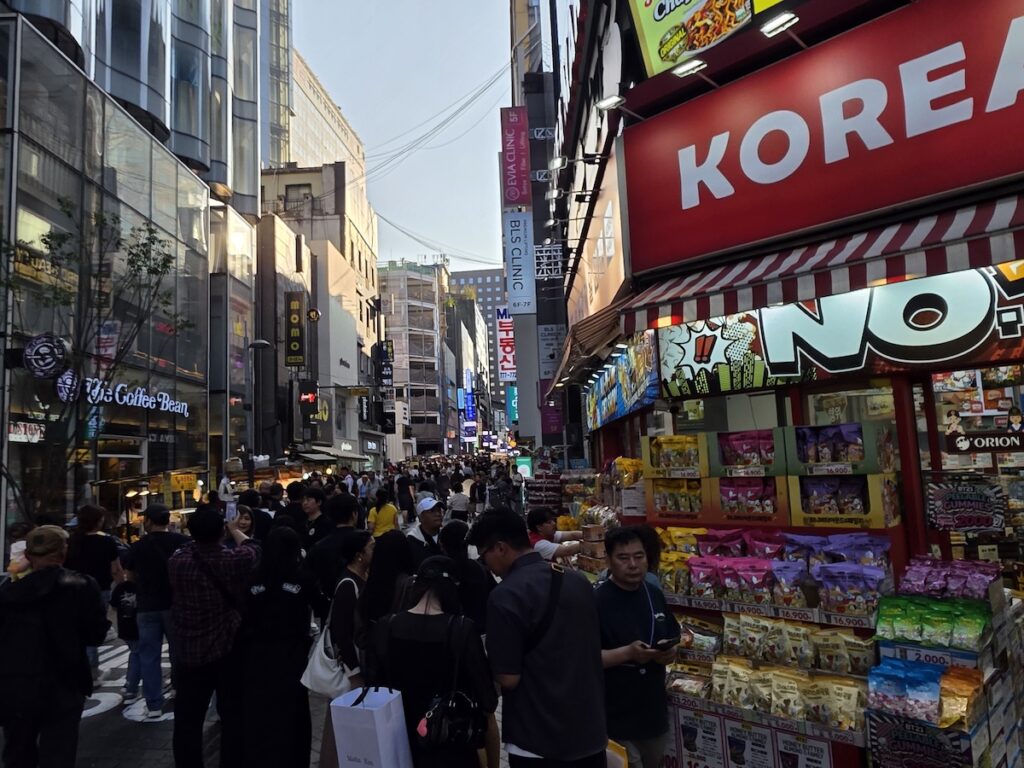
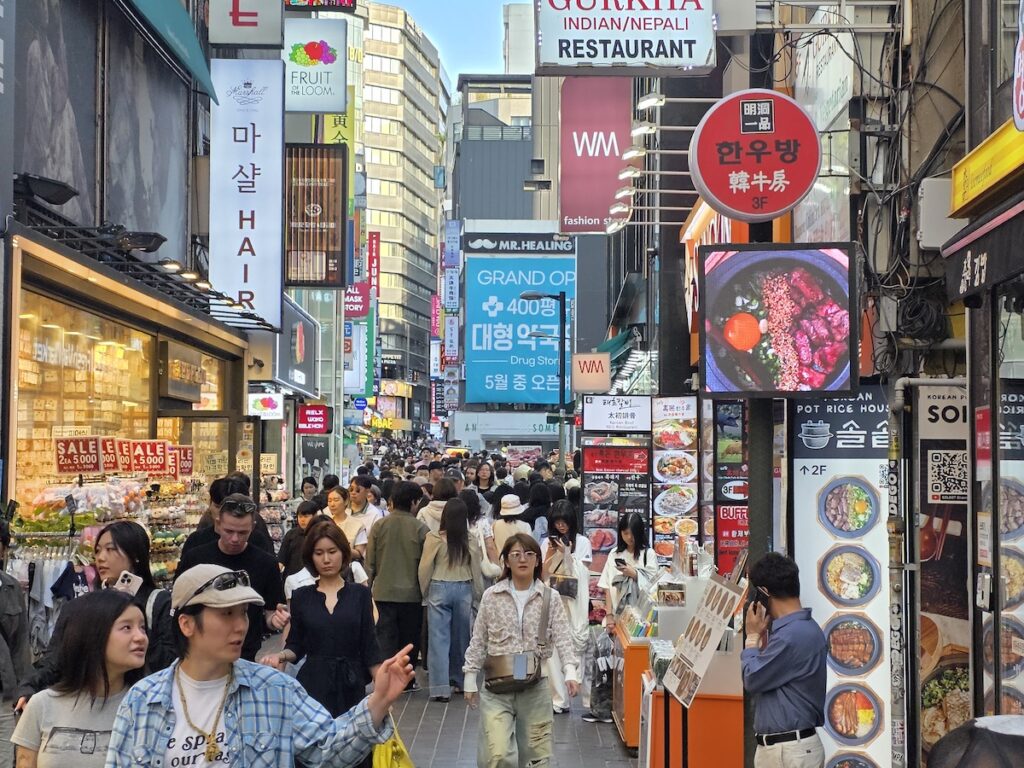
3. Myeongdong (명동) — Peak Density, Peak Tourism
Peak hours: Saturday 5 PM – 8 PM
Why it gets this crowded:
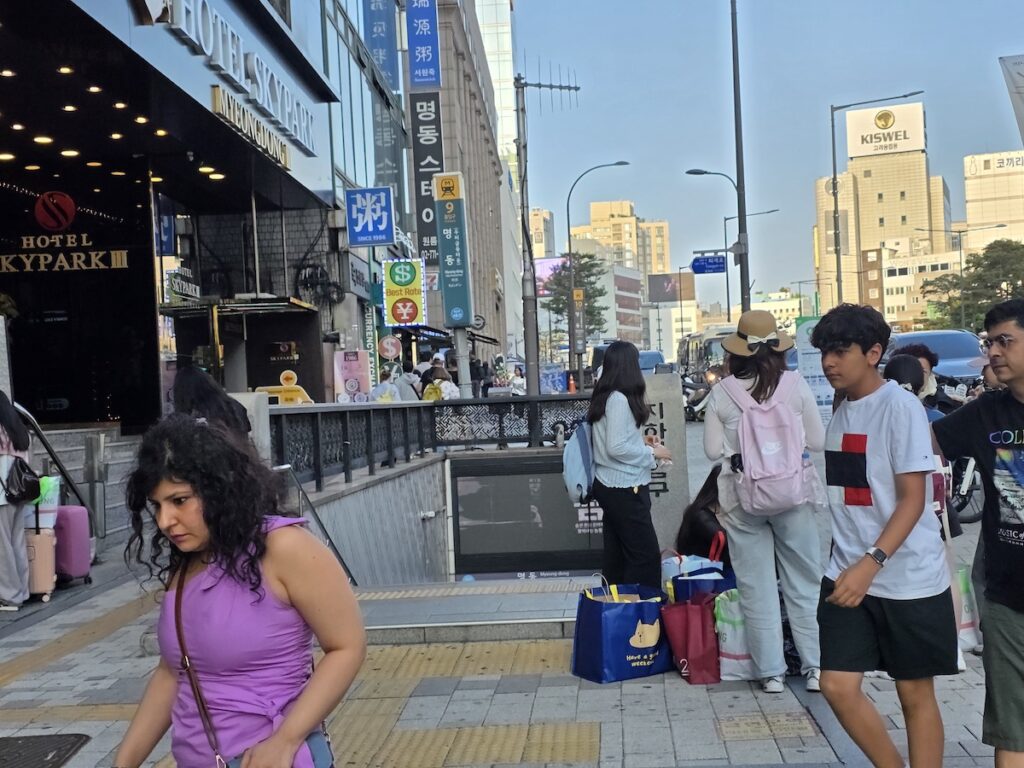
Myeongdong’s weekend crowd is almost entirely tourist-driven — which makes it unique among Seoul’s five peak zones. The combination of K-beauty flagship stores, street food vendors operating at maximum capacity, and the area’s central location (accessible from virtually anywhere in Seoul within 30 minutes) creates a specific kind of density: everyone is a visitor, nobody knows where they are going, and the narrow pedestrian streets cannot absorb the volume.
Seoul’s real-time data shows Myeongdong’s congestion index spiking sharply between 5 and 8 PM on Saturdays — the window when the street food market reaches full operation and day-trippers overlap with evening visitors.
What the crowd looks like:
Predominantly international tourists, particularly visitors from East and Southeast Asia. Koreans who live in Seoul rarely go to Myeongdong on weekends unless they are accompanying foreign guests.
The local alternative:
For street food without the compression: Namdaemun Market — ten minutes walk from Myeongdong, operating on a completely different social logic. Local vendors, working market energy, products that actually smell like Korea rather than products designed to look Korean for tourists.
For K-beauty shopping without the chaos: same products, significantly lower prices, zero crowds — at any Olive Young or local pharmacy in a residential neighborhood like Mapo or Yeonnam-dong.
→ Related: Skip Myeongdong — Where to Buy Real Korean Souvenirs in Seoul
4. Jamsil (잠실) — The Family Compression Zone
Peak hours: Saturday 1 PM – 7 PM / Sunday 12 PM – 6 PM
Why it gets this crowded:
Jamsil is where multiple high-density magnets exist in close physical proximity. Lotte World — one of the world’s largest indoor theme parks — draws family groups year-round. Lotte World Mall, one of Seoul’s largest shopping complexes, sits adjacent. Seokchon Lake provides weekend picnic grounds. And during baseball season (April through October), Jamsil Baseball Stadium adds 25,000+ people to the area on game days.
The result: Jamsil on a Saturday afternoon during baseball season is among the highest-density environments in the city. The subway exits during post-game dispersal have to be experienced to be understood.
What the crowd looks like:
Families, couples, groups of friends. The demographic skews slightly older than Hongdae — more 30s and 40s with children, more deliberate day-trip energy.
The local alternative:
Koreans who want lakeside atmosphere without Lotte World density go to Seokchon Lake’s east side — the section furthest from the main mall entrance — or bypass Jamsil entirely for Ttukseom Han River Park, which offers comparable green space and riverside access with a fraction of the crowd.
5. Seongsu-dong (성수동) — Seoul’s Newest Compression Problem
Peak hours: Saturday 11 AM – 5 PM
Why it gets this crowded:
Seongsu-dong’s transformation from industrial district to Seoul’s premier “cool neighborhood” happened faster than anyone anticipated — and the infrastructure has not caught up. The streets that were designed for factory logistics now handle weekend foot traffic from across the city and increasingly from international visitors.
The specific compression problem in Seongsu is geographic: the cafes and pop-up stores that drive weekend traffic are concentrated in a small number of alleys — particularly Yeonmujang-gil and the surrounding streets. When pop-up events from major fashion or cosmetic brands operate simultaneously, these narrow alleys reach crowd densities that make forward movement genuinely difficult.
Seoul’s real-time data shows Seongsu’s card transaction velocity — the speed at which spending is occurring — as among the fastest-accelerating in the city on weekends. This reflects what locals already know: people are waiting in lines, buying quickly, and cycling through at high turnover.
What the crowd looks like:
Predominantly Korean — this is one of the few peak zones where domestic visitors outnumber international tourists. Demographic skews heavily toward 20s and early 30s. The pop-up culture means the specific crowd composition changes weekly based on which brands are operating.
The local alternative:
Koreans who want the Seongsu aesthetic without the compression go on weekday afternoons — the neighborhood transforms completely. Or they go to 성수동 서쪽 (west Seongsu) — the blocks further from the main cafe strip, where the industrial conversion atmosphere remains without the queues.
The Exact Hours to Avoid — Weekend Timing Guide
Most crowd guides tell you where to go. Almost none tell you when.
Seoul’s five peak zones do not run at the same density all day. Each has a specific window when compression reaches its worst — and a window when the same street is genuinely manageable.
| Location | Peak Hours (Worst) | More Manageable |
|---|---|---|
| Hongdae | Saturday 8PM – 2AM | Sunday before 11AM |
| Gangnam Station | Saturday 2PM – 9PM | Sunday morning / Weekdays |
| Myeongdong | Saturday 5PM – 8PM | Weekday before 10AM |
| Jamsil | Saturday 1PM – 7PM (worse during baseball season) | Sunday morning, no game days |
| Seongsu-dong | Saturday 11AM – 5PM | Weekday afternoon or Sunday evening |
The practical rule:
If you want to experience any of these areas without feeling like you are being slowly compressed — arrive at least 90 minutes before the peak window opens, or wait until it closes. The difference between Myeongdong at 4 PM and Myeongdong at 6 PM on a Saturday is not gradual. It is a step change.
Sunday mornings — particularly before noon — are the best-kept secret for visiting any of Seoul’s peak zones. The streets are the same. The shops are (mostly) open. The crowds have gone home to sleep.
The Pattern Behind All Five
Looking at these five zones together, a pattern emerges.
Each one became crowded for a legitimate reason — genuine culture, genuine commerce, genuine experience. And then the crowd itself became the product. At a certain density threshold, the reason to be there shifts from “experiencing the place” to “experiencing the experience of being in the crowded place.”
For tourists, this threshold is often invisible until they are already inside it.
For Seoul locals, the threshold is well-known — and crossing it voluntarily on a weekend is something most try to avoid.
What About Itaewon?
Every foreigner asks about Itaewon eventually.
It deserves its own answer — because Itaewon in 2026 is genuinely different from the Itaewon that most travel guides still describe.
The October 2022 crowd crush that killed 159 people in Itaewon’s Hamilton Hotel alley changed the neighborhood in ways that are still unfolding. The immediate aftermath brought sharp drops in foot traffic. Many international-facing bars and restaurants closed permanently. The specific alley where the crush occurred remains a site of ongoing memorial and civic discussion.
What exists now is a neighborhood in slow reconstruction — some of the original energy returning in certain pockets, new businesses opening in spaces left by closures, and a crowd management infrastructure that is significantly more visible than before.
In practical terms for 2026 visitors:
Itaewon on a weekend evening is no longer one of Seoul’s five most compressed zones — which is itself a meaningful change from its pre-2022 status. The crowds are present but manageable. The international atmosphere — the multilingual restaurants, the diversity of food options, the English-language friendliness — remains more pronounced here than almost anywhere else in Seoul.
The neighborhood has not disappeared. It has not fully recovered either. It is somewhere between those two states, and visiting it with that awareness is more respectful — and more honest — than either pretending nothing happened or treating it as permanently diminished.
For foreigners: Itaewon remains one of the most navigable neighborhoods in Seoul for first-time visitors — the language barrier is lower, the food diversity is higher, and the crowd density is currently more manageable than it was at its peak.
For those who want to understand what happened: The alley at Hamilton Hotel is marked and accessible. Many Koreans visit quietly. It is worth a moment of awareness.
The Honest Advice
If you want to see what peak Seoul crowd density actually feels like — go to Hongdae on a Saturday at 8 PM. Walk from Exit 8 toward R4. Let yourself be part of it for an hour. It is genuinely remarkable. Ten million people have learned to coexist in a remarkably small space, and the organized chaos of a Seoul weekend crowd is worth experiencing at least once.
If you want to move freely, eat well, and feel like you are somewhere that did not specifically design itself for your presence — go one or two stops past any of these five zones. The local version of Seoul is always adjacent to the tourist version. It is quieter, cheaper, and significantly more interesting.
The city that locals actually live in is right there.
You just have to be willing to walk past the crowd to find it.
→ Related: Why Seoul Feels So Safe at Night
→ Related: Korean Social Culture for Foreigners — Complete Guide