Is Hongdae too crowded? You start asking somewhere around the third time a stranger’s shoulder brushes yours.
It is a Sunday night. The street has no cars. Just people, shoulder to shoulder, moving in two slow rivers. You look up, past the busking crew and the neon, and a screen is glowing in the dusk.
It is counting you.
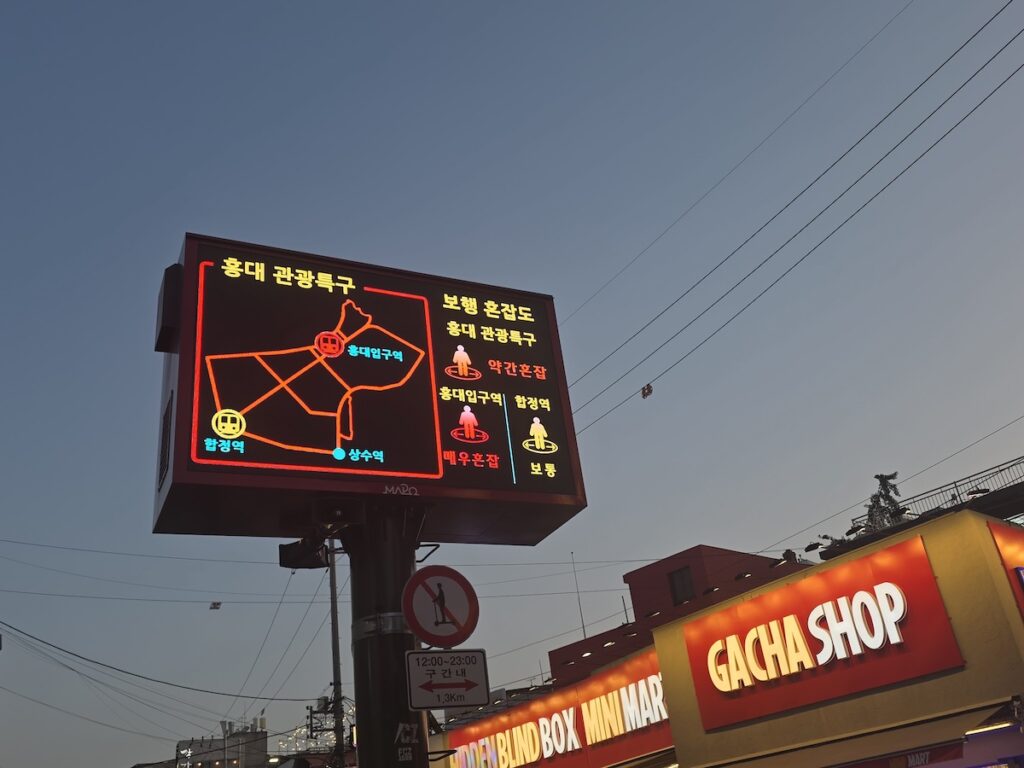
Not a metaphor. An actual number, updated in real time. The night I last stood there, it read 98,000 to 100,000. And it called that “slightly crowded.”
Quick Answer: Yes, Hongdae is crowded — but rarely dangerously so, and not at every hour. On a weekend night the main tourist zone holds close to 100,000 people, which the city’s own sign still rates as only “slightly crowded.” It gets tight from 7 PM to midnight on Fridays and Saturdays. Come around 6 PM, on a weekday, or drift toward Hapjeong or Yeonnam-dong, and the crush eases fast.
The screen that counts the crowd
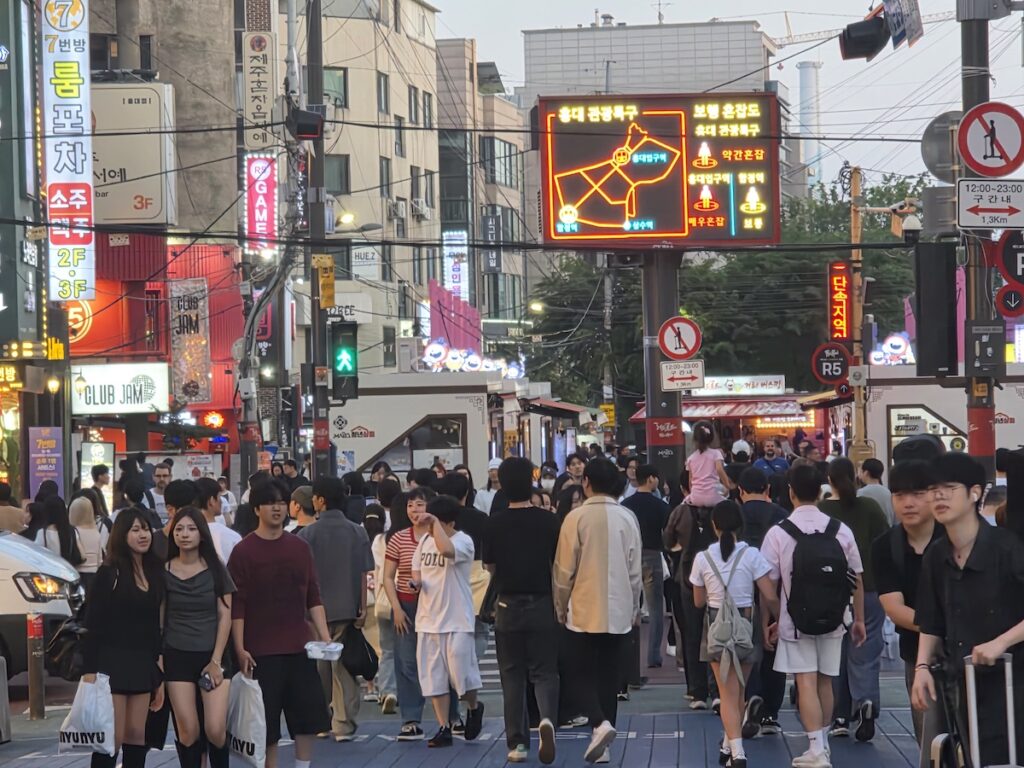
Most visitors walk under it without noticing. A large electronic board, mounted high near Hongik University Station, run by the Mapo district office.
Look closer and it is doing two separate jobs.
One side shows population density — how many people are inside the Hongdae Special Tourism Zone right now. That night: 98,000 to 100,000, rated “slightly crowded.” Break it down by spot and it shifts. Hongik University Station: 26,000 to 28,000, rated “very crowded.” Hapjeong Station: 10,000 to 12,000, “normal.” Yeonnam-dong: the same, “normal.”
The other side shows pedestrian congestion — not how many people, but how hard it is to actually walk. The two are not the same. A wide street can hold a lot of bodies and still flow. A narrow exit can choke with a fraction of that number.
That gap is the whole story of a Hongdae night. The district can read “slightly crowded” while you, standing at the wrong exit, cannot move your feet.
So, is Hongdae too crowded?
It depends on where you stand, and when.
Here is what the sign’s three readings mean in practice.
| What the sign says | English | Roughly how many | What it feels like |
|---|---|---|---|
| 보통 | Normal | ~10,000–12,000 in a zone | You walk at your own pace |
| 약간혼잡 | Slightly crowded | ~98,000–100,000 across the district | Steady flow, the odd shoulder |
| 매우혼잡 | Very crowded | ~26,000–28,000 at one hotspot | Stop-start shuffling, you move with the mass |
Notice the strange math. A hundred thousand people across the whole zone counts as merely “slightly crowded,” while twenty-seven thousand packed around a single station exit counts as “very crowded.”
That is because the rating measures density, not headcount. People per square meter. A crowd spread thin reads calm. A crowd funneled into one mouth of the subway reads alarming. So the real answer to “is Hongdae too crowded” is: the average is fine, the pinch points are not. Avoid the pinch points and you avoid the problem.
When Hongdae is busiest, and when it is not
The pattern is reliable after enough weekends here.
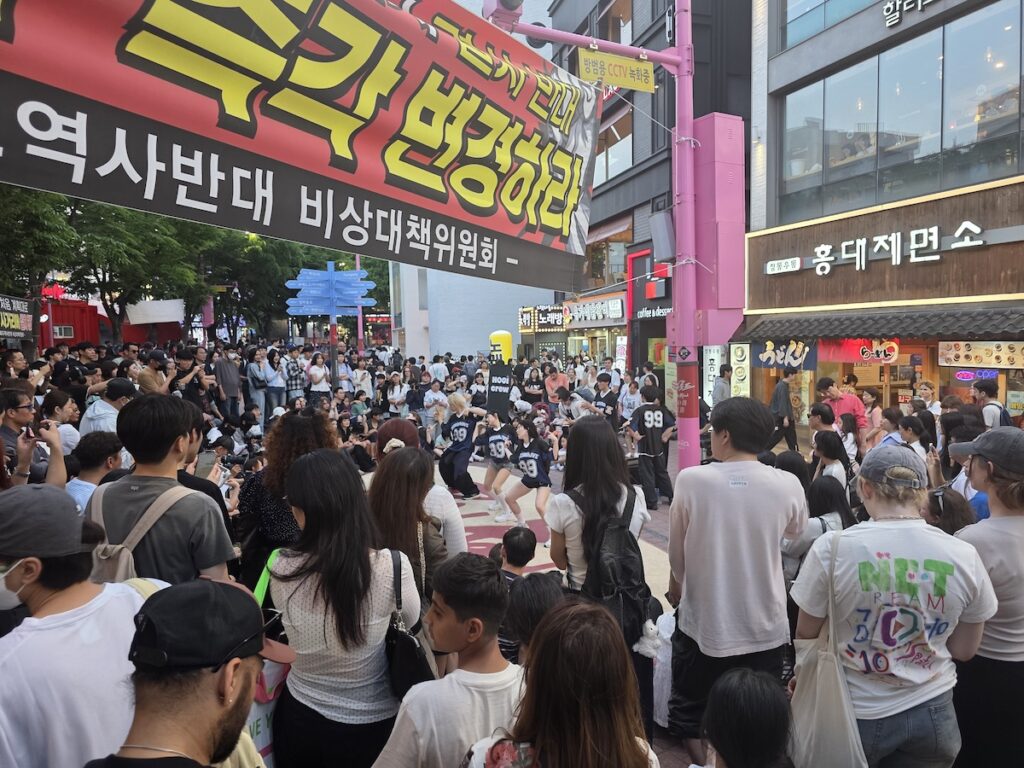
Friday and Saturday, 7 PM to midnight, the main pedestrian strip is full. Not unsafe, but full enough that you stop choosing your direction and start drifting with everyone else.
Early evening, around 6 PM, is the balance point. The buskers are setting up, the energy is rising, and you can still walk a straight line. Weekday afternoons and early mornings are quiet enough to see the neighborhood instead of the back of someone’s head.
By season, late May and early October are the sweet spots — mild weather, lighter crowds. The first week of April is the opposite: cherry-blossom overflow from nearby Yeouido spills into Hongdae, and it gets heavy.
Why a Seoul street counts its crowd
This is the part the guidebooks skip.
The board did not appear because Seoul likes data. It appeared after a loss. In 2022, a crowd surge in nearby Itaewon during Halloween killed nearly 160 people, most of them in their twenties, in an alley not much wider than a hallway.
The city’s response was, in part, technological. Mapo district installed crowd-density analysis across Hongdae: cameras feed a control center and these street-side boards, which escalate through caution, alert, and serious stages, with audio warnings at the top end.
The effect is visible on the worst nights. On Halloween, the crowds came back — around 110,000 in Hongdae, with much of it the “balloon effect” of people who once went to Itaewon. The boards turned red. The city held.
It is a quiet, complicated kind of safety. Not the warm “Seoul feels safe at night” you read about — that holds too. This is something colder and more deliberate: a city that learned to count, because once it did not.
The crowd in Hongdae is everyone
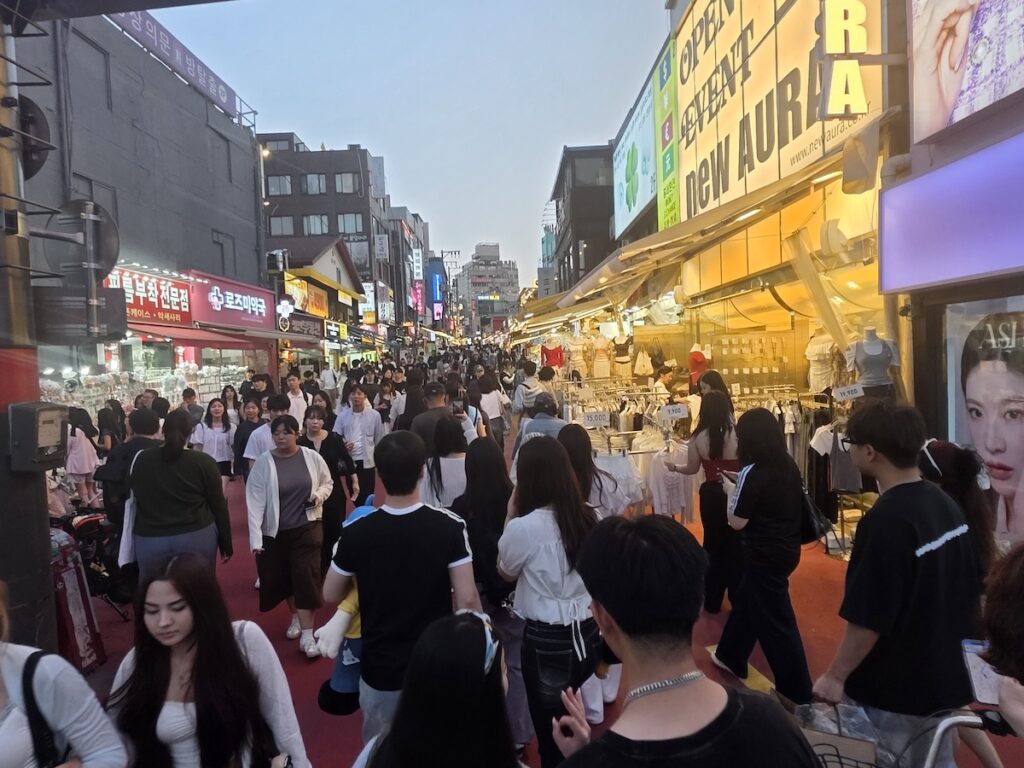
Here is what I notice that the numbers cannot show.
Most Seoul neighborhoods have a default age. Konkuk University area skews teens and twenties. Gangnam pulls thirties and forties with money. Jamsil draws families, so all ages mix. You can almost guess a district by the faces in it.
Hongdae breaks the rule.
On a single Sunday night I watched a tour group of Asian travelers in their sixties and seventies file out of a samgyetang restaurant on the district’s edge, dozens of them at once. A French man in his fifties filmed a dance crew on his phone, alone and delighted. (I spent two years in a French class in this city; I still catch myself eavesdropping.) An English-speaking family grilled pork belly at a street-side table, the kids more interested in the buskers than the meat.
That mix is the answer to a question most people do not think to ask. Why count this crowd so carefully?
Because the crowd is not one kind of person. A street of only young clubbers is a logistics problem. A street holding grandparents, children, first-time tourists, and people who do not read the language is something else. When the crowd is everyone, density stops being a number and becomes a duty.
That is what the glowing sign really means. It is not watching clubbers. It is keeping an eye on everyone’s grandmother.
How to enjoy Hongdae when it is crowded
You do not need to avoid the crowd. You need to read it.
Glance at the board when you arrive. If your station shows “very crowded,” walk one or two streets in before you stop. The main strip is the densest point by design; the side alleys hold the same energy at half the pressure.
When the center feels like too much, walk west into Hapjeong or north into Yeonnam-dong. The board reads them “normal” most nights for a reason. Same neighborhood, gentler pulse, better cafes.
And if you came for the performances — the dance crews, the indie bands, the magicians — the busking zones are where the crush is thickest and most worth it.
So: is Hongdae too crowded? On a Saturday at 10 PM, at the wrong exit, yes. Most other times, no.
The crowd was never really the problem. It is the proof. A street this full, this mixed, this alive is a rare thing — a place that pulls in the whole world and the whole age range at once. The screen overhead is not there to scare you off it.
It is there so that everyone in the count gets to go home.